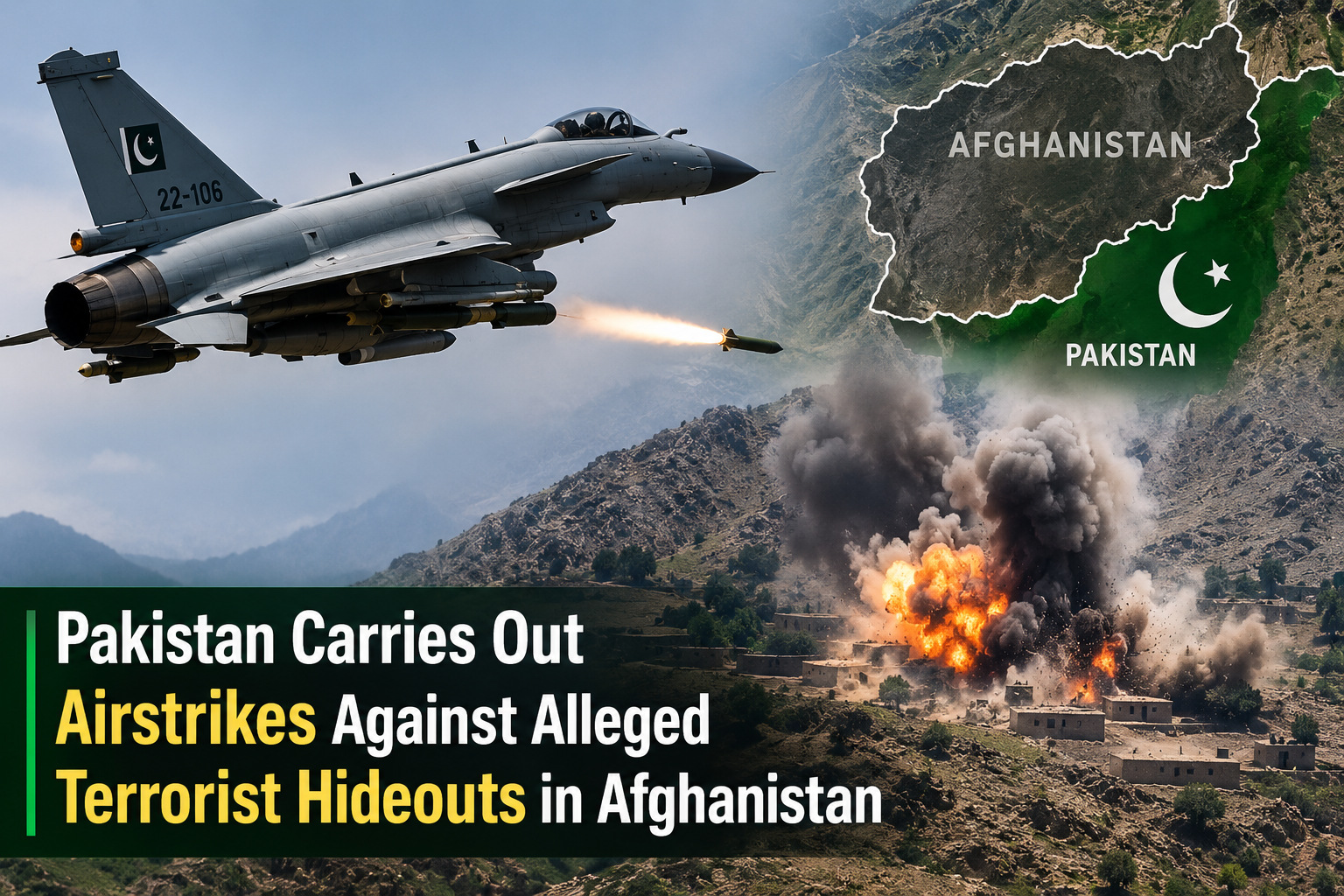
Pakistan carried out airstrikes against what its government described as terrorist hideouts in Afghanistan on October 1, 2026, marking another significant development in the already tense relationship between the two neighboring countries. Pakistan's Information Ministry said the strikes were conducted at two locations and were based on what it described as credible intelligence about militant camps and safe havens. According to Pakistan's initial assessment, 22 militants were killed and weapons and ammunition were destroyed.
The Afghan side gave a different account. Afghan authorities said Pakistani aircraft struck houses in Kunar and Helmand provinces, reporting that nine people, including women and children, were killed and 11 civilians were injured. The United Nations Assistance Mission in Afghanistan (UNAMA) separately confirmed at least 10 civilian deaths, most of them children, and nine injuries.
The conflicting accounts show that the situation remains developing and that casualty figures and details of the targets have not been independently established in full. Pakistan says the operation focused on militant infrastructure, while Afghan authorities have emphasized civilian casualties.
Pakistan Announces the Airstrikes
Pakistan's Information Ministry announced the operation on October 1. It described the strikes as “well-planned and calibrated” and said they were carried out as part of the country's continuing counterterrorism campaign.
The ministry said the operation was conducted in continuation of Operation Ghazab lil Haq and reflected Pakistan's stated determination to target terrorist organizations, their networks and supporters. It said selective targeting was carried out at two locations in Afghanistan after intelligence assessments identified alleged terrorist camps and hideouts.
According to Pakistan's official account, the targets were associated with organizations that Pakistani authorities refer to as Fitna al Khawarij and Fitna al Hindustan, along with affiliated groups. Pakistan uses the term Fitna al Khawarij for the banned Tehreek-i-Taliban Pakistan, or TTP.
The ministry stated that the strikes were conducted with precision and accuracy. It also said the operation resulted in the deaths of multiple militants, while later reporting from Dawn said initial reports indicated 22 terrorists had been killed.
What Pakistan Says Was Targeted
Pakistan has for years expressed concerns about militant organizations operating from or using territory in Afghanistan.
The Pakistani government says some militant groups responsible for attacks inside Pakistan maintain networks across the border. Islamabad has repeatedly urged the Afghan authorities to prevent militant organizations from using Afghan territory for attacks against Pakistan.
The October 1 operation was presented by Pakistani authorities within this broader security context.
According to the Information Ministry, the latest strikes were not described as a general attack on Afghanistan but as selective action against specific alleged militant locations. The government emphasized that the targets were selected on the basis of intelligence.
This distinction is important because Pakistan has attempted to frame its cross-border operations as counterterrorism actions directed at specific organizations rather than military action against the Afghan population.
Afghanistan Reports Civilian Deaths
Afghan authorities have disputed Pakistan's description of the targets and reported civilian casualties.
According to Reuters, the Taliban government said Pakistani aircraft struck three houses in Kunar and Helmand provinces. Afghan officials reported that nine people, including women and children, were killed and another 11 civilians were injured.
UNAMA also reported civilian casualties. The United Nations mission said it had confirmed at least 10 civilians killed, most of them children, and nine people injured in the airstrikes.
These reports have created a major difference between the accounts given by Pakistan and Afghanistan.
Pakistan says its forces targeted militant camps and hideouts. Afghan authorities have focused on damage to residential locations and civilian deaths. The difference illustrates why independent verification is important when reporting military operations.
Why Pakistan and Afghanistan Remain Tense
Relations between Pakistan and Afghanistan have become increasingly difficult because of disagreements over militant activity, border security and responsibility for attacks.
Pakistan has repeatedly accused militant groups based in Afghanistan of being involved in attacks inside Pakistan. Islamabad has urged Kabul to take action against such organizations.
Afghanistan has rejected Pakistan's accusations and has disputed claims that it allows militant groups to use its territory against Pakistan.
Reuters reported in September that the relationship between Pakistan and Afghanistan had deteriorated considerably, with Pakistan accusing the Taliban-led Afghan government of providing space to militant groups while Afghan authorities denied the allegations.
The two countries therefore have different interpretations of the security problem.
Pakistan emphasizes attacks originating from or linked to Afghan territory. Afghanistan argues that Pakistan should address its internal security problems without conducting military operations inside Afghanistan.
The TTP Factor
The Tehreek-i-Taliban Pakistan, commonly known as the TTP, remains a central issue in Pakistan-Afghanistan security relations.
Pakistan considers the TTP a major militant threat and has repeatedly linked the group to attacks inside Pakistan.
Pakistani authorities use the term Fitna al Khawarij for the TTP and related militants. The Information Ministry used that terminology when announcing the October 1 strikes.
The Afghan Taliban and TTP are separate organizations, although analysts and governments have discussed historical and ideological links between elements of the two movements.
Pakistan wants Afghan authorities to prevent TTP members from using Afghan territory to plan or support attacks against Pakistan.
The Taliban government, however, has rejected Islamabad's accusations and has maintained that Pakistan's internal security problems should not automatically be attributed to Afghanistan.
This disagreement remains one of the most difficult issues between the two governments.
Cross-Border Security Concerns
The Pakistan-Afghanistan border is long and difficult to manage. It passes through mountainous and remote areas, making security operations challenging.
Communities on both sides of the border have longstanding social, cultural and economic connections. At the same time, the region has experienced decades of conflict and militant activity.
Pakistan has invested heavily in border management and security infrastructure. Its security forces also conduct operations against militants in areas close to the Afghan border.
For Islamabad, preventing militants from crossing into Pakistan is a major security priority.
For Kabul, maintaining control over Afghan territory and protecting its sovereignty are also major concerns.
These competing priorities make border security particularly sensitive.
The Importance of Intelligence
Pakistan's official explanation emphasizes the role of intelligence in the October 1 operation.
The Information Ministry said credible intelligence was used to identify terrorist camps and hideouts before the strikes were carried out.
Intelligence-based operations generally depend on information collected through multiple security and intelligence sources. Authorities use such information to identify suspected militant locations, movements or networks.
Pakistan says this approach allows security forces to focus on specific targets instead of conducting broader operations.
However, information surrounding military strikes is often difficult for outside observers to verify immediately, particularly when operations take place in remote areas or across an international border.
That is why official statements from different sides may differ considerably during the early stages of an incident.
Humanitarian Concerns
The reports of civilian deaths have also placed a humanitarian dimension on the latest development.
Whenever military operations take place near homes or populated areas, there is a risk to civilians. The reports from Afghan authorities and UNAMA have therefore attracted attention beyond the security aspect of the incident.
According to UNAMA, at least 10 civilians were killed and nine injured. Most of those killed were reportedly children.
These figures differ from Pakistan's reported militant casualty figures because the two sides are describing different aspects of the operation.
Pakistan's statement focuses on alleged militant targets and the number of militants it says were killed. Afghan and UN reporting has focused on civilian casualties.
More independent information may be required before the full picture becomes clear.
Impact on Afghan Families
Reports of civilian casualties can have a significant impact on families living in affected areas.
People living near conflict zones can face displacement, property damage and interruptions to normal daily life. Children and other vulnerable groups can be particularly affected when fighting occurs near residential communities.
The United Nations' reporting of civilian deaths makes the humanitarian dimension an important part of the discussion surrounding the latest strikes.
At the same time, Pakistan maintains that its operations are intended to protect its own citizens from militant violence and that the strikes were directed at terrorist infrastructure.
This creates a difficult situation in which security objectives and civilian protection concerns exist simultaneously.
Pakistan's Security Situation
Pakistan has faced a number of security challenges in its western regions.
Khyber Pakhtunkhwa and parts of Balochistan have experienced militant attacks, including attacks targeting security personnel and civilians.
A recent Reuters report noted that an attack on a Pakistani police facility had killed 24 people the previous month, contributing to renewed tensions between Pakistan and Afghanistan.
Pakistan has linked some of these security problems to militant groups operating from Afghan territory.
The Pakistani government therefore views action against militant networks as an important part of its national security strategy.
The October 1 strikes were presented within this wider context.
Previous Periods of Tension
The latest airstrikes did not occur in isolation.
Pakistan and Afghanistan have experienced repeated periods of tension over the past year. These have included cross-border military actions, accusations of militant support and disputes over border security.
Reuters reported that the October 1 strikes followed around three months of relative calm between the two countries.
Earlier in September, Pakistan also reported airstrikes in Afghanistan and said militants had been targeted. Afghan authorities again reported civilian casualties.
These developments indicate that the underlying disagreements have remained unresolved despite periods of reduced violence.
Diplomatic Challenges
Military operations between neighboring countries can make diplomacy more difficult.
Pakistan and Afghanistan share important economic and social links. Trade routes connect the two countries, while millions of people have family or historical connections across the border.
Both countries therefore have interests in maintaining functional communication even when security relations are tense.
Diplomatic discussions can potentially address issues such as militant activity, border crossings, trade and the movement of people.
However, the disagreement over militant groups remains a major obstacle.
Pakistan wants stronger action against groups it says threaten its citizens. Afghanistan has resisted what it sees as pressure to accept Pakistan's interpretation of its security situation.
Effect on Border Trade
The Pakistan-Afghanistan border is important for regional trade.
Traders transport food, consumer goods, construction materials and other products through major crossing points.
When security conditions deteriorate, border crossings can face delays or temporary restrictions. Such disruptions can affect businesses and communities on both sides.
Transporters may also face uncertainty when security conditions change rapidly.
For this reason, prolonged tensions between Pakistan and Afghanistan can have economic consequences in addition to security and humanitarian effects.
Stable border conditions are important for traders, transport companies, farmers, businesses and ordinary families who depend on cross-border movement.
Regional Security Implications
The relationship between Pakistan and Afghanistan is also important for the wider South Asian region.
Pakistan is one of Afghanistan's most important neighboring countries because of geography, trade and historical links.
Developments along the border can also attract attention from other regional countries, particularly those interested in regional security, trade routes and counterterrorism.
The latest strikes therefore have significance beyond the immediate locations where the reported attacks occurred.
Regional stability depends partly on preventing militant violence from spreading across borders.
At the same time, military escalation between neighboring states can create additional security challenges.
International Attention
International organizations have closely followed the security situation between Pakistan and Afghanistan.
UNAMA's confirmation of civilian casualties adds an independent international perspective to the competing statements from Islamabad and Kabul.
The international community has generally emphasized the importance of civilian protection and peaceful mechanisms for addressing disputes.
The latest incident demonstrates why reliable information is important when military operations occur.
Early reports can change as officials receive more information, investigators reach affected locations and hospitals update casualty figures.
Conflicting Casualty Figures
One of the most important aspects of the October 1 incident is the difference between casualty reports.
Pakistan reported that its strikes killed 22 militants, according to initial reports cited by Dawn.
Afghan authorities reported that nine civilians were killed and 11 injured.
UNAMA later confirmed at least 10 civilian deaths and nine injuries.
These numbers should not automatically be treated as directly competing measurements of exactly the same group of people because the reports refer to different categories of casualties.
The figures also remain subject to further verification.
Why Independent Verification Matters
Independent verification is particularly important during military operations.
Governments involved in conflict naturally provide information based on their own military and political perspectives. Their statements can therefore emphasize different aspects of the same event.
Pakistan's statement emphasizes terrorism, intelligence and the destruction of militant targets.
Afghan statements emphasize sovereignty and civilian casualties.
UNAMA's reporting provides another perspective, focusing specifically on civilian harm.
A complete understanding of the incident requires comparing these accounts while recognizing that some details may remain uncertain.
Possible Effects on Future Relations
The latest strikes could further complicate relations between Islamabad and Kabul.
If both sides continue exchanging accusations, the possibility of additional tension along the border may remain.
Pakistan is likely to continue emphasizing its security concerns and its demand that militant groups not use Afghan territory against Pakistan.
Afghanistan is likely to continue emphasizing its sovereignty and opposing Pakistani military operations inside Afghanistan.
The continuation of these opposing positions makes diplomatic communication particularly important.
Importance of Dialogue
Dialogue can provide a channel for discussing security concerns without relying entirely on military measures.
Pakistan and Afghanistan have previously used diplomatic contacts to discuss border issues and militant activity.
The countries also have shared economic interests.
Regular communication between officials can help clarify incidents, reduce misunderstandings and create mechanisms for dealing with future security problems.
However, successful dialogue would require both sides to address their competing concerns.
Security and Civilian Protection
The October 1 incident demonstrates the difficult balance between national security and civilian protection.
Pakistan argues that militant threats require action and that terrorist organizations should not be allowed to operate from locations where they can plan attacks against Pakistan.
Afghan authorities and UN officials have highlighted civilian deaths associated with the strikes.
Both issues are important when assessing the wider consequences of the incident.
Protecting citizens from terrorism and protecting civilians during military operations are separate but connected responsibilities.
What the Situation Means for Pakistan
For Pakistan, the latest strikes underline the government's continuing focus on militant threats along its western border.
The Information Ministry's statement makes clear that Islamabad intends to continue operations against organizations it considers responsible for terrorism and instability.
The government has framed the operation as selective and intelligence-based.
At the same time, reports of civilian casualties demonstrate the diplomatic and humanitarian risks associated with conducting military operations across an international border.
Pakistan therefore faces both security and diplomatic dimensions in managing the situation.
What the Situation Means for Afghanistan
For Afghanistan, the strikes raise questions about border security, sovereignty and civilian protection.
Afghan authorities have rejected Pakistan's claims about militant safe havens and have objected to military action inside Afghan territory.
Afghanistan also faces the challenge of maintaining security within its territory while managing relations with neighboring Pakistan.
The Broader Picture
The October 1 airstrikes are part of a broader pattern of difficult relations between Pakistan and Afghanistan.
The two countries have deep historical, cultural and economic links, but security disputes have repeatedly placed pressure on their relationship.
Militant activity, border management, refugee issues, trade and sovereignty all influence bilateral relations.
The latest strikes therefore cannot be understood only as a single military event. They are also connected to a much larger debate about regional security and the future relationship between Islamabad and Kabul.
Developments to Watch
Several developments will be important following the October 1 strikes.
First, additional information may emerge about the locations that were targeted and the identities of those killed.
Second, the final civilian casualty figures may change as Afghan authorities, hospitals and international organizations collect more information.
Third, Pakistan and Afghanistan may issue further statements explaining their positions.
Fourth, diplomatic contacts could determine whether tensions decrease or continue.
Finally, developments along the border will remain important for both countries' security.
Conclusion
Pakistan's airstrikes in Afghanistan on October 1, 2026, represent another significant development in the complicated security relationship between the two neighboring countries. Pakistan says its forces conducted selective, intelligence-based strikes against alleged terrorist camps and hideouts at two locations and reported that 22 militants were killed.
Afghan authorities have presented a different account, reporting that Pakistani aircraft struck houses in Kunar and Helmand and killed nine people, including women and children. UNAMA subsequently confirmed at least 10 civilian deaths, most of them children, along with nine injuries.
The conflicting accounts demonstrate that the situation remains developing and that some details require further independent verification.
The incident also highlights the larger challenges facing Pakistan and Afghanistan. Pakistan is concerned about militant attacks and wants stronger action against groups it says operate from Afghan territory. Afghanistan rejects those accusations and emphasizes its territorial sovereignty and opposition to foreign military operations.
The two countries also share important economic, social and geographic connections. Continued instability could affect border communities, trade and regional security.
As both sides respond to the latest strikes, reliable information, civilian protection and diplomatic communication will remain important issues. The future course of Pakistan-Afghanistan relations will depend on how the two governments address militant activity, border security and their wider political disagreements.
FAQs
1. Why did Pakistan carry out airstrikes in Afghanistan?
Pakistan said the strikes targeted alleged terrorist camps and hideouts based on credible intelligence about militant activity.
2. How many militants did Pakistan report killed?
Pakistan reported that initial information indicated 22 militants were killed during the operation.
3. What did Afghanistan report about the strikes?
Afghan authorities reported that nine people, including women and children, were killed and 11 civilians were injured.
4. What did the United Nations report?
UNAMA confirmed at least 10 civilian deaths, most of them children, and nine injuries.
5. What is the main issue between Pakistan and Afghanistan?
A major point of disagreement is Pakistan's accusation that militant groups operate from Afghan territory, while Afghan authorities reject the accusation and oppose Pakistani military operations inside Afghanistan.