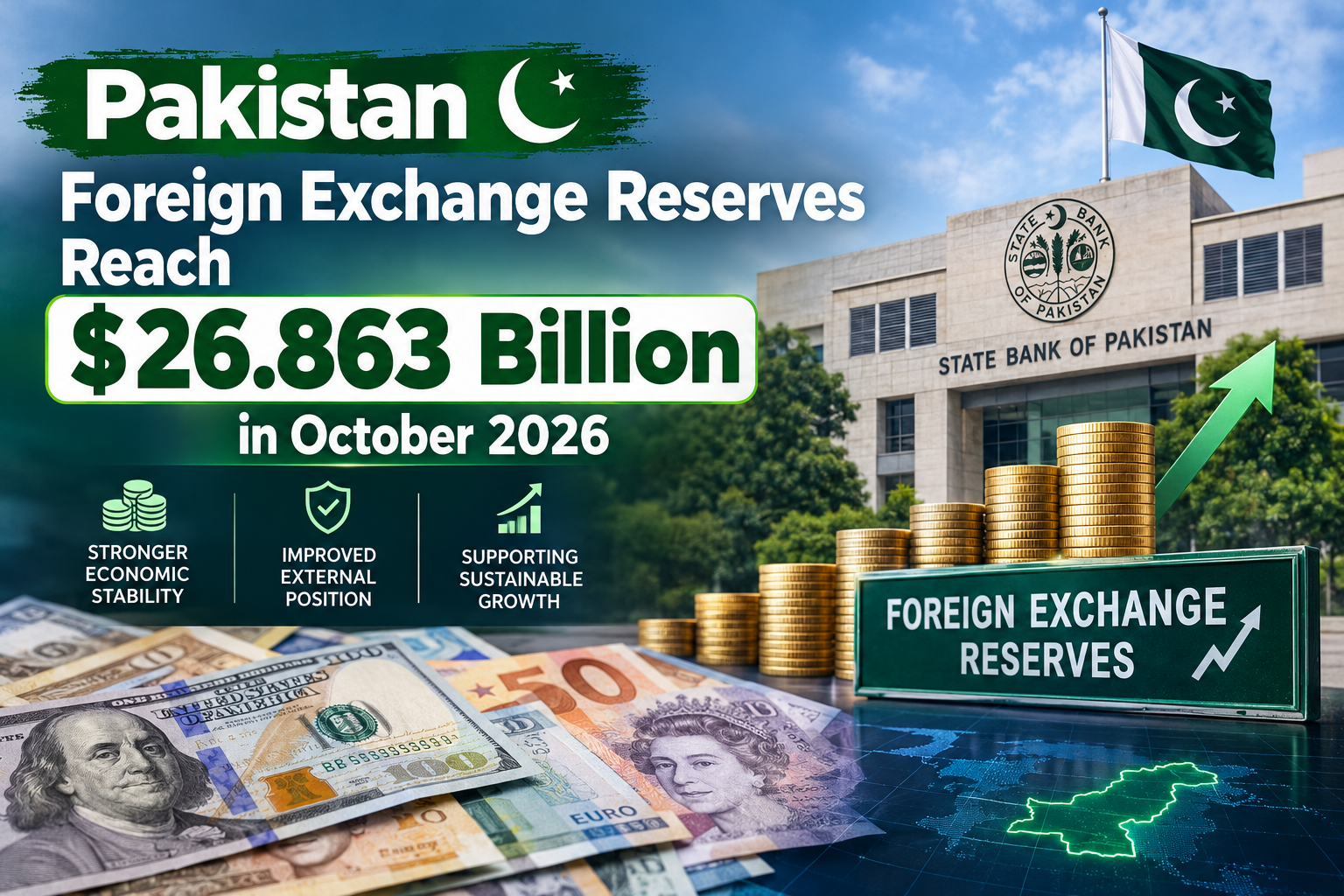
Pakistan’s foreign exchange reserves remain an important indicator of the country’s economic position, its ability to meet external payment obligations and its overall financial stability. The reported figure of $26.863 billion has drawn attention to the country’s reserve position and the role of foreign currency holdings in supporting trade, imports and confidence in the economy.
Foreign exchange reserves are particularly important for Pakistan because the country relies on international trade, overseas remittances, external financing and foreign currency to pay for essential imports. A stable reserve position can help the country manage temporary financial pressures, while a sustained decline can increase concerns about external payments and currency stability.
For businesses, investors and ordinary citizens, reserve figures provide useful information about the broader economy. However, reserves should not be viewed in isolation. Their significance depends on which institutions hold them, how they change over time, the country's external debt obligations and the amount of foreign currency needed to pay for imports.
Latest Foreign Exchange Reserve Figures
According to figures reported on Friday, October 16, Pakistan’s total liquid foreign exchange reserves reached $26.863 billion during the week ended October 9, 2026. The State Bank of Pakistan (SBP) held approximately $21.469 billion, while commercial banks held around $5.394 billions.
The figures indicate a modest weekly increase in the country’s overall foreign currency reserves.
Pakistan's foreign exchange reserves
$26.863 billion
State Bank of Pakistan
$21.469bn
Commercial banks
$5.394bn
Reporting period: Week ended October 9, 2026. Figures rounded.
The distinction between central bank reserves and commercial bank reserves is important. The SBP’s holdings represent the foreign currency reserves directly held by the country's central bank. Commercial bank holdings are maintained by banks and form part of the broader national total.
The two figures are combined to calculate total liquid foreign exchange reserves. They should not be confused with government revenue, foreign investment or money that the government can freely spend on domestic development projects.
The latest figures provide a snapshot of Pakistan’s external financial position. To understand whether the country’s position is improving, however, it is necessary to examine changes over several weeks and consider the country’s import requirements, debt payments and sources of foreign currency.
Why Foreign Exchange Reserves Matter
Foreign exchange reserves play an important role in the management of a country's economy. They consist of foreign currency assets and other eligible reserve assets held by monetary authorities to meet international payment needs and support financial stability.
For Pakistan, these reserves are particularly important because the country imports a range of essential goods and services. These include petroleum products, machinery, industrial equipment, medicines, chemicals and materials required by local businesses.
Many international transactions are conducted in foreign currencies, especially the US dollar. Pakistan therefore needs a reliable supply of foreign currency to pay for imports, meet external obligations and maintain confidence in its ability to conduct international trade.
When reserves are sufficient relative to the country's needs, authorities have more room to manage temporary external financial pressures. When reserves become inadequate, concerns can increase about the country's ability to meet payments without additional borrowing or financial assistance.
Foreign exchange reserves can also influence market expectations. Investors, businesses and international lenders monitor reserve levels when assessing a country's external financial position.
However, higher reserves do not automatically mean that every part of the economy is improving. Inflation, unemployment, government debt, industrial production and household purchasing power remain important indicators of economic performance.
For this reason, Pakistan’s latest reserve increase should be viewed as one positive development in the broader economic picture rather than proof that all financial challenges have been resolved.
What Caused the Latest Increase?
The latest data showed that the State Bank of Pakistan’s reserves increased by approximately $15.8 million during the week ended October 9, while commercial banks’ reserves rose by around $50.1 million.
Together, these changes lifted total liquid foreign exchange reserves by approximately $65.9 million compared with the previous week.
The increase was relatively small compared with the overall size of the reserve holdings. Nevertheless, weekly changes are useful for monitoring the direction of the country's external financial position.
Reserve movements can result from several factors, including foreign currency inflows, international payments, external debt servicing, government borrowing, export receipts and transactions conducted by the central bank.
Foreign investment and financial assistance can also affect reserves, depending on how the funds enter the country and how they are subsequently used.
Pakistan has recently received attention for its international financing arrangements and efforts to strengthen its financial position. However, individual reserve movements should not be attributed to a particular source unless the available data confirms that connection.
The latest weekly increase is therefore best understood as a change in the country's reported reserve balance. Future updates will help establish whether the improvement continues.
The Role of the State Bank of Pakistan
The State Bank of Pakistan is the country's central bank and plays a central role in monetary policy, financial stability and the management of official foreign exchange reserves.
Its responsibilities include supporting monetary and financial stability, overseeing the banking system and managing relevant foreign currency operations within its legal mandate.
Reserve management requires careful decisions about liquidity, safety and the availability of assets when international payments must be made. The central bank needs to maintain sufficient access to foreign currency while managing risks associated with its reserve portfolio.
The SBP also publishes economic information that helps the public, analysts and financial institutions monitor developments in Pakistan’s external sector.
Weekly reserve statistics are particularly useful because they offer a relatively frequent view of changes in the country's foreign currency position. They allow observers to compare the latest figures with previous reporting periods and identify whether reserves are increasing or decreasing.
Nevertheless, the central bank's reserve balance is only one component of monetary and economic policy. Interest rates, inflation, currency movements and financial market conditions can all influence the wider economic environment.
For Pakistan, effective reserve management must operate alongside policies that encourage exports, support sustainable investment and improve the country's ability to earn foreign currency.
How Reserves Support Pakistan’s Import Requirements
Imports are an essential part of Pakistan's economy. Local households and businesses depend on products that are either unavailable domestically or cannot be supplied in sufficient quantities by local producers.
Petroleum products are particularly important because they support transportation, electricity generation, agriculture and industrial activity. Pakistan also imports machinery and components used by factories, construction companies and technology businesses.
Foreign currency reserves help support the country's ability to meet international payment obligations. They can provide a financial buffer when external receipts fluctuate or unexpected payment needs arise.
A country with stronger reserves relative to its import bill may have greater flexibility when managing temporary disruptions in foreign currency inflows.
However, reserves do not eliminate the need to earn foreign currency through exports and other sustainable sources. If a country repeatedly spends more foreign currency than it earns, it may face pressure to borrow, attract investment or reduce the gap between its external receipts and payments.
Pakistan therefore needs a balanced approach that combines appropriate reserve management with stronger export performance, stable remittance inflows and responsible external borrowing.
The long-term objective is not simply to increase the headline reserve figure. It is to maintain a sustainable external position that supports trade, investment and economic activity without creating excessive future financial obligations.
What Do Higher Reserves Mean for the Pakistani Rupee?
Foreign exchange reserves can influence confidence in a country's currency, but their relationship with the exchange rate is not automatic.
When reserves improve, market participants may become more confident that the country can meet its foreign currency obligations. This can contribute to more stable expectations, particularly when the increase reflects sustainable inflows and an improving external balance.
However, the value of the Pakistani rupee is influenced by several other factors. These include demand for imported goods, export receipts, overseas remittances, foreign investment, interest rate differences and global movements in the US dollar.
The balance between the supply and demand for foreign currency also matters.
If importers require large amounts of dollars while foreign currency inflows remain limited, pressure on the rupee can persist even when reserves are relatively high.
Conversely, stronger export receipts and remittance inflows can support the foreign currency supply and help ease external pressure.
The latest reserve figures alone cannot establish whether the rupee will strengthen or weaken in the coming weeks. They should be considered alongside current exchange rates and other economic indicators.
For households and businesses, it is therefore important to avoid assuming that a rise in reserves will immediately reduce the cost of imported goods or lower everyday expenses.
Impact on Inflation and Household Budgets
Foreign exchange reserves can influence the broader economic conditions that affect household budgets, although the connection is indirect.
Pakistan imports many products and raw materials that are used in manufacturing, transportation, agriculture and energy production. Changes in the exchange rate can influence the local cost of these imports.
If the rupee depreciates significantly, imported products may become more expensive in local currency. Businesses that depend on foreign materials can face higher costs, which may eventually affect the prices charged to consumers.
A more stable external financial position can help reduce some uncertainty surrounding international payments and foreign currency availability.
However, reserve growth does not automatically lower inflation. Domestic food supplies, energy prices, transportation expenses, taxation, monetary conditions and other factors also influence the cost of living.
Families may therefore continue to experience financial pressure even when the country's reserves increase.
For example, an improvement in the national reserve balance does not directly guarantee lower prices for flour, vegetables, electricity, petrol or school supplies.
The broader economic benefit depends on whether greater financial stability contributes to sustainable growth, improved business conditions and stronger purchasing power.
Policymakers must therefore consider household welfare alongside reserve accumulation and other financial indicators.
The Importance of Overseas Remittances
Overseas Pakistanis play an important role in the country's external economy through remittances sent to families and other recipients in Pakistan.
These transfers provide financial support to households and contribute to the flow of foreign currency into the country. Remittances can help families pay for education, healthcare, housing, food and other daily needs.
They also contribute to foreign currency availability and can help support the balance of payments.
For many households, remittances are an important source of income. Their economic impact extends beyond individual families because recipients often spend money on local goods and services.
This spending can support shops, transport providers, schools and other businesses.
However, remittances should be distinguished from foreign exchange reserves themselves. Money sent by overseas Pakistanis does not automatically become a permanent addition to the SBP's reserves. The ultimate effect depends on how the foreign currency enters the financial system and how it is used or retained.
Pakistan benefits when remittance flows remain reliable and are supported by convenient, transparent and affordable formal transfer channels.
Alongside exports and investment, remittances can help the country meet its external payment needs and reduce pressure on its financial position.
Exports and the Need for Sustainable Foreign Currency Earnings
One of the most important long-term challenges for Pakistan is strengthening its ability to earn foreign currency.
Exports provide a source of foreign exchange that does not necessarily require the country to take on additional debt. When businesses sell goods and services internationally, they generate revenue that can support imports, investment and economic activity.
Pakistan's export sectors include textiles, clothing, rice, sports goods, surgical instruments, agricultural products and a growing range of services.
Information technology and digital services also offer opportunities for businesses to reach international customers. Software development, business services and other technology-related exports can help diversify the country's foreign currency earnings.
However, stronger exports require competitive production costs, reliable energy, skilled workers, efficient transport and access to international markets.
Businesses also need predictable regulations and access to financing so they can expand production and meet international standards.
If export earnings grow sustainably, Pakistan may become less dependent on repeated external borrowing to meet its international payment obligations.
This does not mean borrowing or foreign investment has no role in economic development. Both can be useful when managed responsibly. The key is to ensure that the country develops a stronger capacity to generate the foreign currency needed to meet its obligations.
Reserve accumulation is more sustainable when supported by a healthy external economy rather than relying mainly on temporary financial inflows.
External Debt and Financial Obligations
Pakistan's external financial obligations are another important factor when evaluating its foreign exchange reserves.
External debt payments require foreign currency, and large repayment requirements can place pressure on the country's available resources.
A reserve figure may appear substantial in isolation, but its adequacy depends partly on the scale and timing of international payments that must be made.
Governments therefore monitor debt maturities, interest payments, expected foreign currency receipts and financing arrangements when assessing external liquidity.
Refinancing or obtaining new financing may help meet immediate obligations, but it can also create future repayment commitments. Responsible debt management requires careful consideration of the cost, timing and purpose of borrowing.
Pakistan has relied on international financial institutions, bilateral partners and capital markets for various forms of external financing. These arrangements can support financial stability, but their terms and repayment requirements remain important.
The country's longer-term objective is to strengthen economic growth and government finances while maintaining a manageable external debt position.
Higher reserves can improve the ability to manage short-term pressures, but they should be evaluated alongside debt levels and future payment schedules.
Pakistan’s International Financial Relationships
Pakistan's external financial position is connected to its relationships with international lenders, trading partners and investors.
International financial institutions can provide financing and policy support, while bilateral partners may offer loans, deposits or other forms of assistance. Foreign investors can contribute capital to businesses, infrastructure and other economic activities.
These sources of financing can help meet immediate financial needs and support investment. However, they differ in their economic effects and long-term implications.
Loans must generally be repaid, while equity investment involves ownership and potential returns. Foreign currency deposits may also have specific conditions and repayment arrangements.
For this reason, not every increase in reserves has the same significance.
An increase supported by strong exports, sustainable remittances and productive investment may indicate a different kind of improvement from an increase driven mainly by short-term borrowing.
The composition and durability of foreign currency inflows matter when assessing whether the country's financial position is becoming more resilient.
Pakistan's reserve figures should therefore be considered alongside its broader economic strategy, including measures to strengthen exports, improve public finances and encourage investment.
Could the Reserve Increase Improve Investor Confidence?
Investor confidence depends on a range of economic, political and financial considerations.
Foreign exchange reserves can be an important part of that assessment because they provide information about a country's ability to meet external payment needs.
A stable or improving reserve position may help reassure investors that immediate foreign currency pressures are being managed.
However, investors also consider inflation, interest rates, taxation, energy costs, political stability, regulatory predictability and the prospects for economic growth.
Businesses evaluating Pakistan as an investment destination need to understand not only the current financial position but also the likely conditions over the coming years.
For example, a company considering a manufacturing project may examine access to imported machinery, the cost of electricity, the availability of skilled workers and the ability to repatriate lawful returns.
Reserve growth can contribute to a more favourable financial environment, but it cannot compensate for every structural challenge.
Sustained improvements in economic policy, infrastructure and productivity are important for turning greater financial stability into long-term investment and employment opportunities.
Challenges That Pakistan Still Needs to Address
Despite the latest increase, Pakistan continues to face economic questions that cannot be answered by reserve statistics alone.
The country needs to maintain sufficient foreign currency to meet imports and external obligations while avoiding excessive reliance on borrowing.
It also needs to strengthen domestic production, improve export competitiveness and create conditions in which businesses can invest and employ more workers.
Several areas deserve continued attention.
1. Expanding exports: Greater productivity, improved quality and access to new markets can help businesses generate more foreign currency.
2. Maintaining remittance inflows: Reliable formal transfer channels can help overseas Pakistanis send money securely and efficiently.
3. Managing external debt: Careful planning of repayment schedules and borrowing costs can reduce financial pressure.
4. Improving energy efficiency: Reliable and reasonably priced energy can help domestic industries become more competitive.
5. Encouraging productive investment: Investment that expands production and creates employment can strengthen long-term economic capacity.
6. Supporting economic stability: Predictable policies and effective institutions can help businesses plan and investors assess risks.
These objectives require consistent implementation rather than short-term measures alone. A stronger reserve position can provide useful support, but lasting improvement depends on the overall performance of the economy.
What Should Citizens Watch in the Coming Weeks?
The next reserve updates will help show whether Pakistan's foreign currency position continues to improve.
Citizens, businesses and economic observers can pay attention to several indicators when reviewing future reports.
First, changes in SBP-held reserves will show whether the central bank's own foreign currency holdings are rising or falling.
Second, total liquid reserves will indicate how the combined holdings of the central bank and commercial banks have changed.
Third, the exchange rate can provide information about conditions in the foreign currency market, although it is influenced by factors beyond reserves.
Fourth, import and export data can help explain changes in the country's external balance.
Fifth, remittance figures can show whether overseas transfers continue to provide a stable source of foreign currency.
Finally, information about external debt payments and new financing arrangements can help explain major changes in reserves.
Looking at these indicators together provides a more complete picture than focusing on a single weekly number.
A modest increase is encouraging in the context of external financial management, but the trend over several months is more informative than one reporting period.
Conclusion
Pakistan’s total liquid foreign exchange reserves reached $26.863 billion in the week ended October 9, 2026, according to figures reported on October 16. The total included approximately $21.469 billion held by the State Bank of Pakistan and $5.394 billion held by commercial banks. The weekly increase was around $65.9 millions
The latest figures provide an update on Pakistan’s external financial position and its capacity to manage international payment requirements. Foreign exchange reserves are important for imports, external debt servicing and confidence in the economy.
However, the headline figure is not a complete measure of economic health. Pakistan must also consider inflation, household purchasing power, export growth, remittances, external debt and the sustainability of foreign currency inflows.
Continued reserve growth, supported by stronger economic fundamentals, could help improve financial resilience. The long-term challenge is to ensure that the country can maintain an adequate reserve position while creating employment, encouraging investment and supporting sustainable economic growth.
The coming weeks will provide further information about whether the improvement continues and how Pakistan’s wider economic conditions develop.
Frequently Asked Questions (FAQs)
1. What are Pakistan’s latest foreign exchange reserves?
Pakistan’s total liquid foreign exchange reserves reached $26.863 billion in the week ended October 9, 2026.
2. How much foreign currency does the State Bank of Pakistan hold?
The SBP held approximately $21.469 billion in foreign exchange reserves during the reporting period.
3. Why are foreign exchange reserves important for Pakistan?
They help support international payments, including imports and external obligations, and provide a financial buffer against external pressures.
4. Will higher foreign exchange reserves automatically strengthen the Pakistani rupee?
No. The exchange rate also depends on foreign currency demand, exports, remittances, imports, interest rates and global market conditions.
5. Does an increase in reserves mean Pakistan’s economic problems are solved?
No. Reserve growth is one indicator of financial conditions. Inflation, employment, debt, exports and household purchasing power must also be considered.




