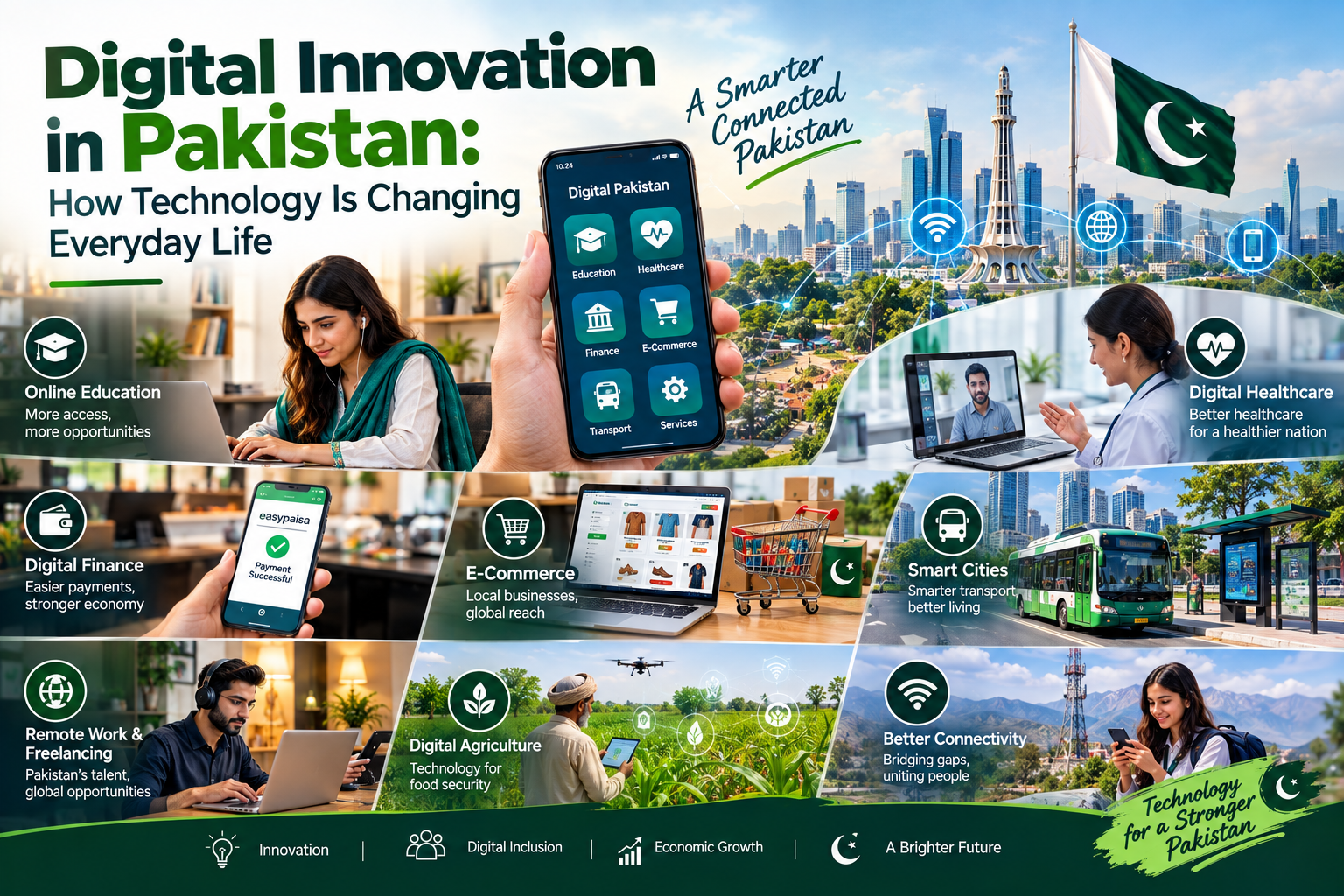
Digital innovation is changing everyday life in Pakistan in many important ways. The increasing use of smartphones, internet services, digital payments, online shopping, social media, cloud platforms, artificial intelligence, and mobile applications has created new ways for people to communicate, study, work, shop, access services, and manage businesses.
Pakistan has a large and increasingly connected population, which provides significant opportunities for digital services. From students attending online classes to businesses accepting digital payments, technology has become part of many daily activities.
Digital innovation does not simply mean using computers or smartphones. It means using digital technology to improve existing processes, create new services, solve problems, and make activities more convenient.
For Pakistan, digital innovation can support economic development, entrepreneurship, education, healthcare, financial inclusion, agriculture, and public services. At the same time, issues such as digital access, cybersecurity, privacy, and digital literacy need attention.
What Is Digital Innovation?
Digital innovation means using digital technologies to develop new products, services, processes, or ways of working.
A traditional business moving from paper-based records to digital management is adopting digital innovation. A shop accepting QR-based payments is another example. An educational institution providing online learning resources is also using digital innovation.
Digital innovation can be simple or highly advanced.
It may involve:
Mobile applications
Websites
Cloud computing
Artificial intelligence
Digital payments
Online marketplaces
Data analytics
Social media
Automation
Digital communication systems
The purpose is generally to improve efficiency, accessibility, convenience, or customer experience.
Digital Transformation in Pakistan
Pakistan has experienced a gradual shift from traditional systems toward digital services.
Many people now use smartphones as their primary digital devices. Smartphones provide access to communication, entertainment, banking, shopping, education, news, and professional services.
Businesses are also becoming more digital.
A small business can create a social media page, communicate with customers through messaging applications, accept electronic payments, advertise products online, and arrange deliveries.
This has reduced some of the barriers that previously limited small businesses to local markets.
Smartphones and Everyday Life
Smartphones have become one of the most important tools supporting digital innovation.
People use smartphones to communicate with family members, attend online classes, search for information, manage accounts, order products, use maps, watch educational content, and access digital services.
For businesses, smartphones provide an easy way to communicate with customers and manage operations.
Mobile applications have also created new service models.
Instead of visiting a physical office, customers can sometimes complete tasks through an application.
This convenience is one of the major effects of digital innovation.
Internet Connectivity and Digital Opportunities
Internet access is fundamental to digital innovation.
Reliable internet allows users to participate in online education, remote work, e-commerce, digital banking, entertainment, and professional services.
For businesses, internet connectivity provides access to customers, suppliers, employees, and international markets.
It also enables Pakistani freelancers and technology professionals to work with clients from different countries.
However, digital opportunities are not equally available to everyone. Differences in connectivity, devices, affordability, and digital skills can create a digital divide.
Reducing this divide is important for inclusive digital development.
Digital Payments in Pakistan
Digital payments are changing the way people and businesses conduct transactions.
Mobile wallets, online banking, electronic transfers, and QR-based payment systems provide alternatives to cash.
For customers, digital payments can be convenient because transactions can be completed using mobile devices.
For businesses, digital payments can provide electronic transaction records and additional payment options.
Small businesses can benefit from accepting digital payments because customers may prefer not to carry cash.
The growth of digital payments is also connected to the wider development of financial technology in Pakistan.
E-Commerce and Digital Shopping
Online shopping has become an important part of Pakistan's digital economy.
Customers can browse products, compare prices, place orders, make payments, and receive deliveries without visiting a traditional store.
Social media has also become an important sales channel for small businesses.
Entrepreneurs can promote clothing, food, accessories, home products, handmade items, and other goods through digital platforms.
E-commerce innovation has created opportunities for businesses that may not have enough resources to establish physical stores in multiple locations.
Digital Innovation in Education
Education is one of the sectors where digital innovation can create significant opportunities.
Students can access online lectures, educational videos, digital books, practice material, and learning platforms.
Teachers can use digital presentations, online assignments, video lessons, and educational applications.
Digital learning can supplement classroom education by allowing students to review material outside school or college hours.
Students living in areas with limited access to specialized teachers can also use online resources to learn additional subjects and skills.
However, effective digital education requires suitable devices, reliable connectivity, good learning content, and guidance.
Online Skill Development
Digital platforms have also changed the way people learn professional skills.
People can learn programming, graphic design, digital marketing, video editing, content writing, data analysis, artificial intelligence, and other skills through online courses.
This can be useful for students and professionals who want to develop skills beyond traditional education.
Online learning also allows people to update their knowledge as technology changes.
Continuous skill development is increasingly important because many digital professions evolve rapidly.
Freelancing and Remote Work
Digital innovation has created opportunities for remote work and freelancing.
A professional with a laptop and internet connection can provide services to clients in different cities or countries.
Freelancers may work in:
Software development
Graphic design
Writing
Search engine optimization
Digital marketing
Video editing
Web development
Virtual assistance
Data analysis
Remote work can also allow companies to hire employees who live in different locations.
This creates more flexible working arrangements and expands the potential talent pool.
Digital Innovation in Healthcare
Healthcare services are also being influenced by digital technology.
Telemedicine allows patients to communicate with healthcare professionals remotely.
Digital appointment systems can simplify scheduling.
Healthcare organizations can use digital records and management systems to organize information.
Mobile applications can also provide health-related reminders and general information.
Digital healthcare can be especially useful for people who have difficulty traveling long distances for certain consultations.
However, healthcare technology must protect sensitive personal information and should operate under appropriate professional standards.
Digital Agriculture
Agriculture can benefit from digital tools that provide farmers with information and management support.
Mobile platforms can provide information about weather, farming techniques, crop management, and markets.
Digital systems can also help connect farmers with suppliers and buyers.
Modern agricultural technologies can combine sensors, satellite data, weather information, and software to support better decision-making.
For a country where agriculture is economically important, digital agricultural innovation can contribute to productivity and resource management.
Digital Banking
Digital banking has changed how customers interact with financial institutions.
Many banking activities can now be performed through mobile applications or online banking platforms.
Customers may be able to check account information, transfer money, pay bills, and manage certain services without visiting a physical branch.
Digital banking can save time and provide greater convenience.
Banks also use technology to improve internal operations, customer service, security, and data management.
Artificial Intelligence and Everyday Life
Artificial intelligence is increasingly becoming part of digital services.
AI can help businesses automate repetitive tasks, analyze information, provide customer support, and create personalized services.
Students may use AI-powered learning tools to understand concepts or practice skills.
Businesses can use AI for data analysis and customer communication.
AI can also support software development and creative workflows.
However, AI-generated information should be checked carefully because automated systems can sometimes produce inaccurate or incomplete results.
Responsible use is essential.
Social Media as a Digital Business Tool
Social media has become much more than a communication platform.
Pakistani businesses use social media to promote products, communicate with customers, build brands, and receive feedback.
Small businesses can create digital content without needing large advertising budgets.
Video content, product demonstrations, educational posts, customer reviews, and other forms of communication can help businesses reach potential customers.
Social media has therefore become an important part of digital entrepreneurship.
Digital Marketing
Digital marketing allows businesses to promote products and services through online channels.
Search engines, social media, websites, email, video platforms, and online advertisements can all be part of a digital marketing strategy.
Digital marketing provides businesses with tools to understand customer behavior and measure campaign performance.
Small businesses can experiment with different types of content and identify what attracts their target audience.
This has made marketing more accessible to many new businesses.
Digital Government Services
Government services can also benefit from digital innovation.
Online systems can allow citizens to submit applications, access information, make payments, and track certain processes without visiting an office.
Digital records can help organizations manage information more efficiently.
Online public services can potentially reduce paperwork and save time.
However, digital government systems need strong security, reliable infrastructure, accessible interfaces, and proper support for people who are less familiar with technology.
Digital Innovation in Transportation
Technology is also changing transportation.
Digital maps and navigation applications help people find routes and estimate travel times.
Ride-hailing and delivery platforms connect customers with drivers through digital systems.
Businesses can use tracking technologies to monitor shipments.
Public transportation can also benefit from digital ticketing, route information, and traffic-management systems.
These technologies can make transportation more connected and data-driven.
Digital Innovation in Small Businesses
Small businesses are among the major beneficiaries of digital technology.
A local shop can use digital accounting software to track sales and expenses.
A restaurant can use online ordering and delivery platforms.
A clothing business can display products through social media.
A freelancer can market services through professional platforms.
Digital tools can therefore help businesses operate more efficiently without requiring extremely large investments.
Cybersecurity and Digital Safety
As digital activity increases, cybersecurity becomes increasingly important.
Individuals and businesses need to protect accounts, devices, networks, and personal information.
Basic security practices include:
Using strong passwords
Enabling multi-factor authentication
Keeping software updated
Avoiding suspicious links
Checking website addresses
Using secure networks
Backing up important data
Being careful with personal information
Phishing is another important risk. Fraudulent messages may attempt to convince users to reveal passwords, financial information, or account details.
Digital literacy can help users recognize such threats.
Privacy in the Digital Age
Digital services often involve the collection and processing of information.
Users may provide names, contact details, payment information, location information, or other personal data.
Businesses and organizations therefore need responsible approaches to data management.
Users should also understand what information they share online and review privacy settings where appropriate.
Protecting privacy is an important part of responsible digital innovation.
Challenges of Digital Innovation in Pakistan
Digital innovation provides opportunities, but several challenges remain.
One challenge is unequal access to technology.
Some communities have better internet connectivity and access to devices than others.
Digital literacy is another challenge. People need basic knowledge to use digital services safely and effectively.
Cybersecurity threats can also reduce trust in digital systems.
Businesses may face costs associated with technology adoption.
Some organizations may also struggle to train employees and integrate new digital systems with older processes.
Addressing these challenges requires investment in infrastructure, education, cybersecurity, and digital skills.
Digital Skills and the Future Workforce
The future workforce will require a combination of technical and soft skills.
Digital skills can include:
Computer literacy
Software use
Data analysis
Programming
Digital marketing
Cybersecurity awareness
Online communication
Soft skills such as teamwork, communication, creativity, critical thinking, and problem-solving are equally valuable.
Schools, colleges, universities, and professional training institutions can help prepare students for changing digital workplaces.
Women and Digital Opportunities
Digital technology can provide new opportunities for women in Pakistan.
Women can operate online stores, provide freelance services, teach online, create digital content, work remotely, and develop technology-based businesses.
Digital platforms can allow women to reach customers beyond their local communities.
Online education can also provide access to professional skills.
However, equal access to devices, internet connectivity, training, and safe digital environments remains important.
Youth and Digital Innovation
Young Pakistanis are among the most active users of digital technology.
Many young people are learning programming, graphic design, video editing, artificial intelligence, digital marketing, and other online skills.
Some are building startups, while others are working as freelancers or creating online businesses.
Youth-focused technology programs, coding clubs, innovation competitions, and entrepreneurship initiatives can help turn digital interest into practical skills.
The Role of Educational Institutions
Schools and universities can play an important role in digital development.
Students should have opportunities to learn how technology works and how it can be applied to real problems.
Computer education should ideally include practical activities rather than only theoretical concepts.
Universities can also encourage research, innovation, entrepreneurship, and technology projects.
Partnerships between educational institutions and technology companies can provide students with exposure to real-world applications.
The Future of Digital Innovation in Pakistan
Digital innovation in Pakistan is likely to continue expanding.
Artificial intelligence, fintech, e-commerce, cloud computing, digital healthcare, online education, cybersecurity, smart agriculture, and digital government services are likely to remain important areas.
The increasing availability of smartphones and online platforms can further expand access to digital services.
At the same time, future development should focus on accessibility and responsible use.
Digital innovation should benefit not only large technology companies but also students, small businesses, farmers, professionals, and communities across the country.
Conclusion
Digital innovation is changing everyday life in Pakistan by transforming communication, education, finance, healthcare, shopping, transportation, employment, and business.
Smartphones and internet connectivity have made digital services more accessible, while online platforms have created new opportunities for entrepreneurship and remote work.
Digital payments and e-commerce are changing commercial activities, while artificial intelligence and cloud computing are creating new possibilities for businesses and professionals.
However, digital progress also requires attention to cybersecurity, privacy, digital literacy, infrastructure, and equal access.
Pakistan's young population provides significant potential for digital innovation. By investing in skills, infrastructure, education, entrepreneurship, and responsible technology use, the country can continue building a stronger digital economy.
Digital innovation is not simply about adopting the newest technology. Its real value comes from using technology thoughtfully to solve problems, improve services, create opportunities, and make everyday life more efficient.
FAQs
1. What is digital innovation in Pakistan?
Digital innovation means using digital technologies to improve services, business processes, communication, education, finance, healthcare, and everyday activities in Pakistan.
2. How is technology changing everyday life in Pakistan?
Technology is changing how people communicate, shop, study, work, make payments, access healthcare, and manage businesses.
3. What are examples of digital innovation in Pakistan?
Examples include mobile banking, digital payments, e-commerce, online education, telemedicine, freelancing platforms, mobile applications, and digital government services.
4. What challenges does digital innovation face in Pakistan?
Major challenges include unequal internet access, limited digital skills, cybersecurity threats, privacy concerns, device affordability, and infrastructure limitations.
5. What is the future of digital innovation in Pakistan?
The future is likely to include greater use of artificial intelligence, fintech, e-commerce, cloud computing, digital healthcare, online education, smart agriculture, and cybersecurity.