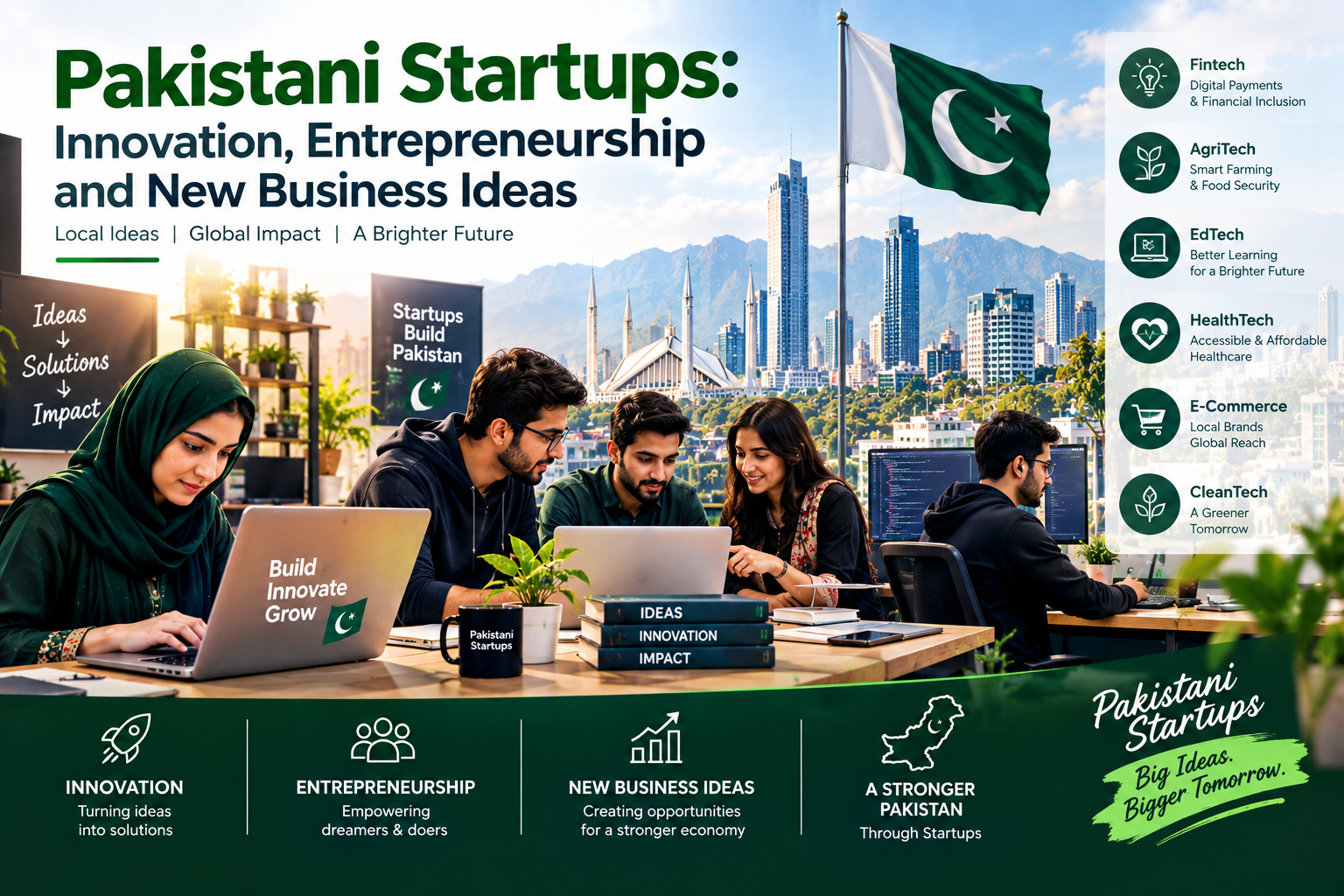
Pakistan has a growing culture of entrepreneurship, with young people, professionals, and business-minded individuals increasingly exploring new ideas and building startups. A startup is generally a new business created to solve a problem, introduce a product or service, or develop a new way of serving customers.
In Pakistan, startups are working across many sectors, including financial technology, e-commerce, healthcare, education, agriculture, transportation, logistics, software, artificial intelligence, and digital services. These businesses are contributing to a changing entrepreneurial environment and creating opportunities for innovation.
The rise of smartphones, internet connectivity, digital payments, social media, and online marketplaces has made it easier for entrepreneurs to test business ideas and reach customers. At the same time, Pakistan's large population provides a broad potential market for businesses that can solve local problems effectively.
Startup development is not always easy. Entrepreneurs face challenges related to funding, skills, infrastructure, regulations, competition, and market conditions. However, the growing interest in technology and entrepreneurship continues to create new possibilities.
What Is a Startup?
A startup is a newly established business that aims to develop and offer a product or service. Startups often begin with a specific problem that the founders want to solve.
Unlike a traditional small business, a technology startup may focus on developing a solution that can eventually serve a large number of users.
For example, an entrepreneur may create an online platform that connects customers with service providers. Another founder may develop a mobile application for digital payments or an educational platform for students.
Not every startup becomes a large company, but the process of experimenting with ideas can encourage innovation and entrepreneurship.
Why Startups Matter in Pakistan
Startups can contribute to Pakistan's economy in several ways.
One important contribution is job creation. Growing businesses need developers, designers, sales professionals, marketers, accountants, customer-support teams, managers, and other workers.
Startups can also introduce competition into markets. New businesses may encourage existing companies to improve their products and services.
Another benefit is problem-solving. Entrepreneurs often identify problems that customers experience and attempt to create practical solutions.
Startups can also attract investment and encourage the development of supporting industries such as software development, digital marketing, logistics, financial services, and professional consulting.
The Growth of Entrepreneurship
Entrepreneurship has become increasingly popular among Pakistani youth.
Instead of relying only on traditional employment, some young people are exploring freelancing, online businesses, software development, content creation, e-commerce, and technology startups.
Universities and private organizations also increasingly promote entrepreneurship through workshops, competitions, incubation programs, and business training.
Social media has made entrepreneurship more visible. Young people can learn about business models, marketing strategies, product development, and customer engagement through online resources.
This does not mean every business idea will succeed. Entrepreneurship involves experimentation, learning, and adapting to customer needs.
Technology and Pakistani Startups
Technology has become a major part of the Pakistani startup ecosystem.
A business can use websites, mobile applications, cloud services, digital payments, social media, and online advertising to operate and reach customers.
Technology can also reduce certain costs. A startup may use cloud-based software rather than building all of its own computer infrastructure.
Digital communication allows teams to collaborate from different cities.
These technologies have made it possible for entrepreneurs to build businesses that serve customers across Pakistan and, in some cases, international markets.
Fintech Startups
Financial technology, or fintech, is an important startup category.
Fintech businesses develop digital solutions for payments, banking, financial management, and other financial services.
Mobile wallets and digital payment platforms can make transactions more convenient for consumers and businesses.
Small businesses can use digital payment tools to accept electronic payments and maintain transaction records.
Other fintech ideas may focus on financial education, business accounting, digital savings, insurance technology, or payment infrastructure.
The development of fintech can contribute to a more digitally connected financial environment.
E-Commerce Startups
E-commerce startups are changing how people buy and sell products.
An online business can display products through a website or digital marketplace, receive orders electronically, and arrange delivery to customers.
Pakistani entrepreneurs have created online businesses in areas such as fashion, beauty products, electronics, home items, food, handmade products, and other consumer categories.
E-commerce also supports small sellers who may not have the resources to establish large physical stores.
However, successful online businesses need reliable delivery, customer service, secure payments, accurate product information, and effective digital marketing.
Healthtech Startups
Healthcare technology, often called healthtech, is another area of startup innovation.
Healthtech companies may develop digital appointment systems, telemedicine services, health information platforms, pharmacy-related solutions, or medical management software.
Telemedicine can help connect patients with healthcare professionals through digital communication.
Digital appointment systems can simplify scheduling.
Technology can also help healthcare organizations manage information more efficiently.
Healthcare startups need to operate responsibly because medical information and healthcare decisions require strong privacy, safety, and professional standards.
Edtech Startups
Education technology, or edtech, has created new possibilities for learning.
Edtech startups can provide online courses, educational videos, practice tests, digital classrooms, learning management systems, and other educational resources.
Students can use digital platforms to supplement their traditional education.
Teachers can also use online tools to share assignments, conduct assessments, and communicate with students.
Pakistan's large student population creates opportunities for educational technology businesses that offer useful, affordable, and accessible learning solutions.
Agritech Startups
Agriculture technology, known as agritech, focuses on using technology to improve farming and agricultural business.
Agritech startups may provide digital farming information, market connections, weather data, crop-management tools, irrigation solutions, or agricultural supply-chain services.
Farmers can benefit from better access to information about crops, weather, markets, and farming practices.
Technology can also help improve communication between farmers, suppliers, buyers, and agricultural service providers.
Agritech is particularly relevant to Pakistan because agriculture remains an important part of the country's economy.
Logistics and Delivery Startups
The growth of e-commerce has increased demand for efficient logistics and delivery services.
Logistics startups can use technology to manage orders, track shipments, optimize routes, and communicate with customers.
Businesses can use digital systems to monitor deliveries and provide customers with updates.
Improved logistics can benefit both online businesses and traditional companies.
Transportation technology can also help optimize the movement of goods between cities and regions.
Artificial Intelligence Startups
Artificial intelligence is opening new opportunities for Pakistani entrepreneurs.
AI startups can develop solutions for customer service, data analysis, education, agriculture, healthcare, cybersecurity, marketing, and software development.
Some businesses may create AI-powered tools that automate repetitive tasks.
Others may provide specialized data analysis or machine-learning services.
The growth of AI also creates demand for professionals with skills in programming, mathematics, data science, machine learning, and software engineering.
Software Startups
Software development remains one of the most important areas for Pakistani technology entrepreneurs.
Software startups can create websites, mobile applications, business-management systems, accounting tools, educational platforms, communication systems, and other digital products.
Software has an advantage in that digital products can potentially serve customers in multiple countries.
Pakistani developers can therefore build products for local users while also targeting international markets.
Women Entrepreneurs and Startups
Women are increasingly participating in entrepreneurship and digital business.
Women entrepreneurs in Pakistan operate businesses in areas such as fashion, food, education, online retail, digital services, handicrafts, technology, and professional consulting.
Digital platforms can make it easier for women to market products and communicate with customers.
Online work can also provide flexible opportunities for women who prefer home-based or remote business models.
Access to financing, mentorship, training, networking, and technology can help more women develop sustainable businesses.
Youth Entrepreneurship
Young people are an important part of Pakistan's startup environment.
Students and recent graduates can bring fresh ideas and familiarity with modern technologies.
Universities can encourage entrepreneurship by offering business courses, innovation labs, startup competitions, coding clubs, and mentorship programs.
Young entrepreneurs can also learn from experienced founders and industry professionals.
However, starting a business requires more than enthusiasm. Entrepreneurs need to understand customers, competition, costs, marketing, operations, and financial management.
The Role of Universities
Universities can support startups by creating environments where students can experiment with ideas.
Incubation centers can provide workspace, mentoring, training, networking opportunities, and access to business resources.
Students can use university projects to identify real-world problems and develop possible solutions.
Research institutions can also contribute by developing technologies that entrepreneurs can eventually commercialize.
Stronger connections between universities and industries can help transform academic research into practical products.
Startup Funding in Pakistan
Funding is an important issue for startups.
Entrepreneurs may need money to develop products, hire employees, purchase equipment, market their services, and expand operations.
Different types of funding can include personal savings, support from family and friends, angel investment, venture capital, business loans, grants, and other financing arrangements.
The appropriate funding method depends on the nature and stage of the business.
Financial planning is essential because rapid spending without a sustainable business model can create problems for a startup.
Importance of Business Planning
A strong business idea needs a practical plan.
Entrepreneurs should understand:
What problem they are solving
Who their customers are
What product or service they will offer
How the business will earn revenue
What competitors already exist
What the initial costs will be
How the business can grow
What risks may affect operations
A business plan can help entrepreneurs organize these questions and make informed decisions.
Digital Marketing for Startups
Digital marketing has become an important tool for new businesses.
Social media platforms can help startups introduce products, communicate with customers, share educational content, and build brand awareness.
Search engine optimization can help businesses become easier to find online.
Email marketing, video content, online advertising, and influencer collaborations are other possible marketing methods.
Startups should focus on understanding their target audience rather than simply trying to reach the largest possible number of people.
Customer Feedback and Product Development
Customer feedback is one of the most useful resources for a startup.
Entrepreneurs can learn what customers like, what they dislike, and what problems they continue to experience.
A startup can then improve its product or service based on this information.
This process is often called iteration.
Instead of assuming that the original idea is perfect, entrepreneurs test their assumptions and make changes.
This approach can reduce the risk of developing a product that customers do not actually need.
Challenges Faced by Pakistani Startups
Pakistani startups face several challenges.
Funding can be difficult, particularly for early-stage businesses without an established revenue history.
Access to skilled workers can also be challenging in specialized fields.
Infrastructure, internet reliability, regulatory processes, and market uncertainty may affect operations.
Competition can be another challenge. Entrepreneurs may need to compete with established local businesses as well as international platforms.
Customer trust is particularly important for online businesses.
Cybersecurity is also essential because startups often handle customer information and financial transactions.
Importance of Innovation
Innovation is the foundation of many successful startups.
A startup does not necessarily need to invent completely new technology. It may innovate by combining existing technologies in a new way.
For example, a business could combine mobile applications, digital payments, location services, and delivery systems to create a new customer experience.
Innovation can also involve business models.
A company may find a new way to charge customers, distribute products, or connect buyers and sellers.
The most important question is whether the innovation solves a real problem.
Startups and Job Creation
Startups can create both direct and indirect employment.
Direct employees may work in technology, marketing, sales, customer support, management, and administration.
Indirect employment can develop through suppliers, delivery companies, freelancers, consultants, manufacturers, and other service providers.
As startups grow, their economic impact can extend beyond the original company.
This makes entrepreneurship an important part of broader economic development.
Global Opportunities for Pakistani Startups
Digital technology allows Pakistani startups to target international markets.
Software products and online services can be delivered across borders without requiring a physical office in every country.
Pakistani entrepreneurs can also provide technology services to international companies.
Global markets can provide opportunities, but international expansion requires understanding foreign customers, regulations, competition, payments, and cultural differences.
Strong product quality and professional customer service are essential.
The Future of Pakistani Startups
The future of Pakistani startups is likely to involve greater use of artificial intelligence, fintech, e-commerce, cloud computing, healthtech, edtech, agritech, cybersecurity, renewable energy, and digital services.
Young entrepreneurs will continue to experiment with new business ideas.
Technology will make it easier for startups to communicate with customers and operate across geographic boundaries.
At the same time, sustainable growth will remain important. Startups need practical business models, responsible financial management, skilled teams, and products that customers genuinely value.
The most successful startup ecosystems are generally built through cooperation among entrepreneurs, investors, universities, businesses, government institutions, and technology communities.
How Pakistan Can Support Entrepreneurship
Pakistan can strengthen its startup ecosystem by improving access to education, digital infrastructure, funding, mentorship, research facilities, and business support.
Entrepreneurship education can help students understand how businesses are created and managed.
Technology training can help young people develop practical skills.
Startup incubators and accelerators can provide mentorship and networking.
Simplified business processes can also help entrepreneurs establish and operate companies more efficiently.
Research partnerships can encourage the development of innovative products.
Conclusion
Pakistani startups are becoming an important part of the country's innovation and entrepreneurship landscape. Entrepreneurs are developing businesses in fintech, e-commerce, healthcare, education, agriculture, logistics, artificial intelligence, software, and many other areas.
Technology has made it easier for startups to reach customers, manage operations, accept digital payments, and connect with international markets.
Young people and women are also contributing to the growing entrepreneurial environment through digital businesses, freelancing, online services, and technology-based ventures.
However, startups face challenges involving funding, skills, infrastructure, regulations, cybersecurity, and competition. Addressing these challenges can help create a stronger environment for innovation.
The future of Pakistani startups will depend on practical ideas, skilled people, responsible investment, customer-focused products, and collaboration between different parts of society.
Pakistan has a large pool of young and ambitious people. With the right education, technology, support, and opportunities, entrepreneurship can continue to contribute to innovation, employment, and economic development.
FAQs
1. What is a startup in Pakistan?
A startup is a newly established business that develops a product, service, or solution to address a specific market need or problem.
2. Which startup sectors are growing in Pakistan?
Important areas include fintech, e-commerce, healthtech, edtech, agritech, logistics, artificial intelligence, software, and digital services.
3. How do startups contribute to Pakistan's economy?
Startups can create employment, introduce innovative products and services, encourage competition, attract investment, and develop new business opportunities.
4. What challenges do Pakistani startups face?
Common challenges include access to funding, skilled workers, infrastructure, regulations, cybersecurity, competition, and building customer trust.
5. How can young people start a business in Pakistan?
Young entrepreneurs can begin by identifying a real problem, researching their target customers, developing a practical solution, testing the idea, planning finances, and gradually building the business.




