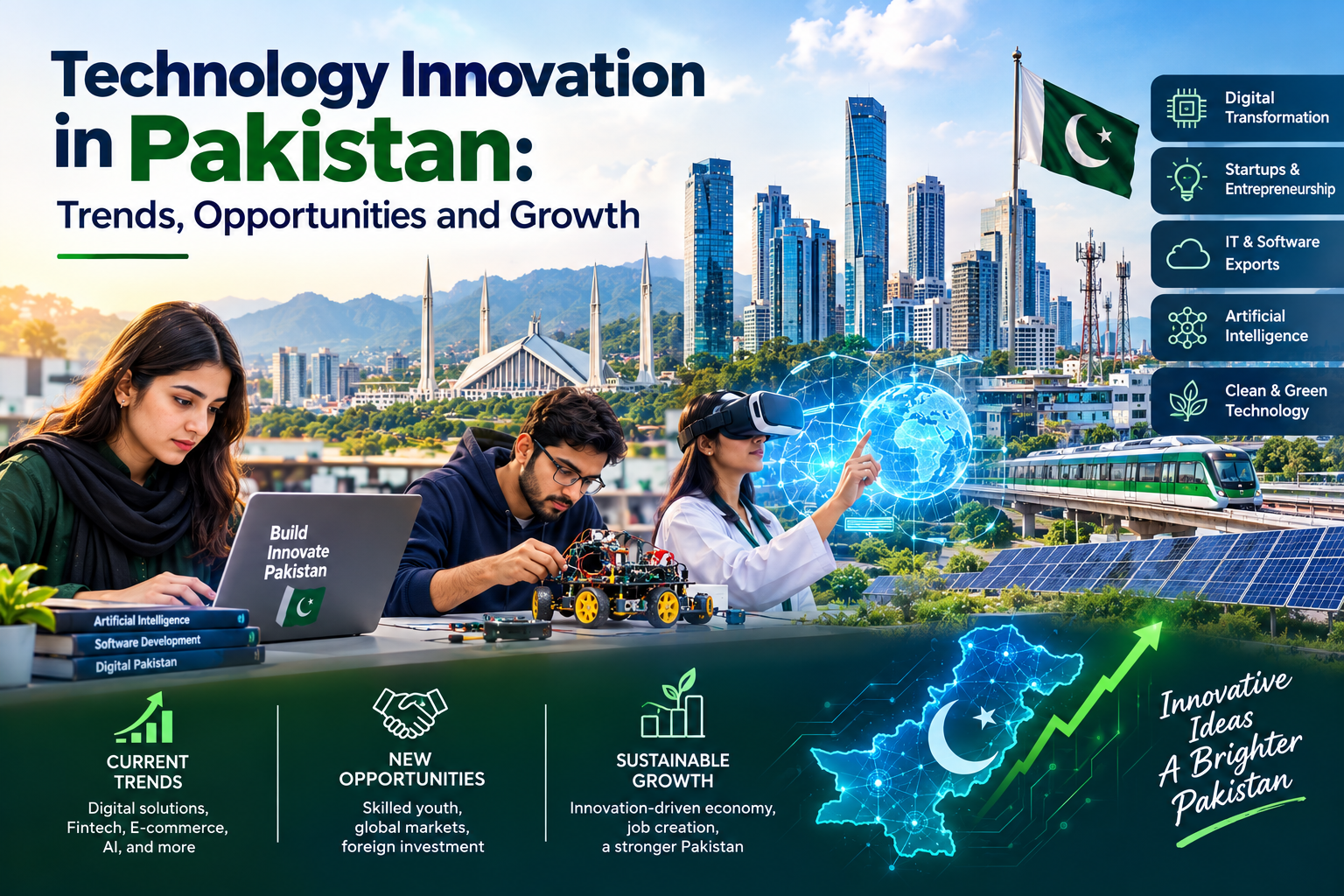
Technology innovation is becoming an increasingly important part of Pakistan's economic and social development. From smartphones and digital payments to artificial intelligence, cloud computing, e-commerce, and modern agricultural technologies, new digital solutions are changing how people live, study, work, communicate, and conduct business.
Pakistan has a large young population with growing interest in technology and entrepreneurship. As internet connectivity expands and digital services become more common, individuals and businesses are finding new ways to use technology to solve problems and create opportunities.
Technology innovation does not only mean developing advanced software or machines. It also includes using existing technologies in new and more effective ways. A small business using an online payment system, a teacher providing lessons through digital platforms, or a farmer using technology to monitor crops can all be examples of technological innovation.
For Pakistan, technology can provide opportunities to improve productivity, create jobs, support businesses, increase access to services, and connect local talent with international markets.
What Is Technology Innovation?
Technology innovation refers to the development or application of technology to create new products, services, processes, or solutions.
It can involve software, hardware, artificial intelligence, telecommunications, robotics, cloud computing, mobile applications, digital platforms, and many other technologies.
For example, mobile banking is a technological innovation that allows customers to perform financial activities using digital devices. Online education platforms provide another example by allowing students to access educational material through the internet.
Innovation can be gradual rather than revolutionary. A company may improve an existing application, make a service faster, simplify a process, or reduce its cost.
The main purpose is to create useful value.
Why Technology Innovation Matters in Pakistan
Technology innovation is important because Pakistan faces many challenges that can potentially be addressed through better systems and digital solutions.
A growing population requires efficient services in education, healthcare, transportation, finance, energy, agriculture, and communication.
Technology can help organizations process information faster and manage resources more effectively.
It can also reduce geographical barriers. Someone living in a smaller Pakistani city can potentially provide digital services to customers in Lahore, Karachi, Islamabad, or even other countries.
This creates new opportunities for employment and entrepreneurship.
Technology innovation can also support economic diversification. Instead of depending only on traditional industries, Pakistan can expand sectors such as software, IT services, digital commerce, fintech, artificial intelligence, and technology-enabled manufacturing.
Growth of the Pakistani Technology Sector
Pakistan's technology sector has developed significantly over the years.
Software houses, IT companies, startups, freelancers, digital agencies, and technology-focused entrepreneurs operate in different parts of the country.
Major urban centers such as Lahore, Karachi, and Islamabad have developed technology and startup communities, while digital work has also created opportunities for people in smaller cities.
The availability of internet services and digital platforms allows professionals to work remotely.
This is particularly important for software developers, designers, writers, digital marketers, data analysts, and other professionals whose work can be delivered online.
Startups and Technology Innovation
Technology startups are an important source of innovation.
A startup usually begins by identifying a problem and developing a product or service to address it. Many technology startups use mobile applications, websites, cloud platforms, artificial intelligence, or other digital tools.
Pakistan's startup ecosystem includes businesses working in fintech, e-commerce, logistics, education, healthcare, agriculture, transportation, and software.
Technology makes it possible for some startups to test their ideas with relatively small teams before expanding.
Entrepreneurs can collect customer feedback, improve their products, and reach wider audiences through digital channels.
Startup culture is also encouraging young people to consider entrepreneurship as a possible career path.
Artificial Intelligence in Pakistan
Artificial intelligence is one of the most important areas of modern technology innovation.
AI systems can analyze large amounts of information, recognize patterns, generate content, automate certain tasks, and support decision-making.
In Pakistan, AI has potential applications in education, agriculture, healthcare, banking, customer service, cybersecurity, software development, and business operations.
For example, AI-based systems can help organizations analyze customer inquiries or organize large datasets.
In agriculture, AI and data analysis can potentially support crop monitoring and agricultural planning.
In education, AI-powered tools can provide personalized learning assistance and help students practice concepts.
However, AI also creates challenges related to privacy, accuracy, cybersecurity, employment, and responsible use. Developing appropriate skills and ethical practices is therefore important.
Digital Payments and Financial Technology
Financial technology, commonly called fintech, is another major area of technology innovation.
Digital wallets, mobile banking, online transfers, QR payments, and electronic financial services are changing how people and businesses handle transactions.
Digital payments can provide convenience to customers and help businesses maintain electronic records of transactions.
Small businesses can also benefit because digital payment methods provide alternatives to cash.
Fintech companies are exploring solutions for payments, savings, financial management, insurance, and other services.
As digital financial literacy improves, technology can help more people participate in formal financial systems.
E-Commerce and Online Businesses
E-commerce has changed the way products are marketed and sold.
Pakistani businesses can use websites, social media, online marketplaces, and messaging platforms to communicate with customers.
A small business does not necessarily need a large physical store to reach customers. Digital platforms can allow sellers to display products and receive orders from different locations.
Technology also supports the wider e-commerce system.
Inventory management software helps businesses track products. Digital payment systems process transactions. Logistics platforms help manage deliveries. Customer relationship tools help businesses communicate with buyers.
This combination of technologies creates a modern digital commerce ecosystem.
Freelancing and Remote Work
Freelancing is one of the most visible examples of technology creating new work opportunities in Pakistan.
Professionals can provide services to clients in different countries through online platforms and direct business relationships.
Common freelance skills include:
Software development
Graphic design
Content writing
Video editing
Digital marketing
Search engine optimization
Virtual assistance
Data-related services
Web development
Remote work has also expanded opportunities for employees who can perform their jobs digitally.
This means technology is not only creating new companies but also changing traditional employment patterns.
Technology in Education
Technology is transforming education in Pakistan.
Students can access online lectures, educational videos, digital books, learning platforms, practice tests, and other resources.
Teachers can use digital presentations, interactive activities, online assignments, and educational applications.
Technology can also help students learn at their own pace. A student who does not understand a particular topic can revisit digital lessons and practice additional questions.
Online learning is particularly useful when students cannot easily access specialized educational resources in their local area.
However, digital education works best when students have reliable internet, suitable devices, and proper guidance.
Healthcare Technology
Healthcare technology is another growing area of innovation.
Digital appointment systems can make it easier for patients to communicate with healthcare facilities.
Telemedicine can connect patients with healthcare professionals through digital communication.
Electronic health records can help organize medical information and improve access to patient data within appropriate systems.
Medical equipment is also becoming increasingly sophisticated, supporting diagnosis and treatment.
Technology can be particularly valuable for communities where specialized healthcare services are geographically distant.
Agricultural Technology
Agriculture can benefit significantly from technology innovation.
Modern farming technologies can help farmers monitor soil, weather, water usage, and crop conditions.
Digital agricultural platforms can provide information about farming practices and market conditions.
Modern irrigation systems can improve water management.
Satellite imagery, sensors, drones, and data analysis can potentially help identify crop problems and improve farm planning.
Pakistan's agricultural sector is large, so even small improvements in productivity or resource efficiency can have wider economic effects.
Renewable Energy Technology
Pakistan has strong potential for renewable energy technologies, particularly solar power.
Solar panels are increasingly used by households, businesses, farms, and institutions.
Technology improvements have also contributed to better batteries, inverters, energy management systems, and solar equipment.
Renewable energy innovation can help diversify electricity sources and support energy efficiency.
Smart energy systems may also allow users to monitor consumption and identify ways to reduce unnecessary energy use.
Internet and Telecommunications
Telecommunications infrastructure is fundamental to technology innovation.
Fast and reliable internet allows people to use cloud services, video communication, digital payments, online education, e-commerce, and remote work.
Mobile connectivity is particularly important because smartphones are among the main tools through which people access digital services.
Improving connectivity can therefore support innovation across many sectors rather than only the telecommunications industry.
Cloud Computing in Pakistan
Cloud computing allows businesses and organizations to access computing resources through internet-based services.
Instead of maintaining all infrastructure themselves, companies can use cloud services for data storage, software applications, computing power, and collaboration.
Cloud technology can be useful for startups because businesses can scale digital resources according to their needs.
Employees can also collaborate remotely using cloud-based documents and applications.
As Pakistani companies become more digitally connected, cloud computing can play an increasingly important role in business operations.
Cybersecurity and Digital Safety
As technology use increases, cybersecurity becomes increasingly important.
Businesses, schools, government organizations, and individuals store and exchange large amounts of digital information.
Cybersecurity practices can help protect accounts, systems, networks, and sensitive information.
Common security measures include strong passwords, multi-factor authentication, software updates, secure networks, data backups, and employee awareness.
Digital literacy is also important. People should understand common online risks such as phishing, fake websites, suspicious links, and fraudulent messages.
Technology innovation should therefore be accompanied by responsible digital security practices.
Smart Cities and Urban Technology
Technology can also contribute to smarter urban services.
Smart city technologies can involve digital traffic management, public transportation systems, environmental monitoring, smart energy systems, digital government services, and data-based urban planning.
Large Pakistani cities face challenges related to traffic, waste management, water supply, energy, and public services.
Technology can potentially help authorities collect information and manage these systems more efficiently.
Smart urban development requires careful planning because technology alone cannot solve every urban problem.
Robotics and Automation
Robotics and automation are becoming increasingly important around the world.
Manufacturing industries can use automated systems for repetitive tasks, quality control, packaging, and production.
Automation can increase consistency and reduce the time required for certain processes.
Pakistan's manufacturing sectors, including textiles and other industries, can explore appropriate automation technologies to improve productivity.
At the same time, automation changes the skills required by workers. Training and education therefore need to evolve alongside technological development.
Technology in the Textile Industry
Pakistan's textile sector can benefit from modern technology in design, production, quality control, logistics, and marketing.
Computer-based design systems can help designers create and modify patterns.
Modern machinery can improve production efficiency.
Digital inventory systems can help businesses manage materials and finished products.
E-commerce and digital marketing can also allow textile and fashion businesses to reach customers beyond traditional markets.
Combining manufacturing experience with digital technology can help Pakistani businesses compete in changing global markets.
Women in Technology Innovation
Women can play an important role in Pakistan's technology sector.
Digital work can create opportunities in software development, design, online education, e-commerce, digital marketing, content creation, and entrepreneurship.
Remote work can also provide flexible professional opportunities for people who prefer working from home.
Access to technology education and professional training can help more women develop digital skills.
Women entrepreneurs can also create technology-enabled businesses that address specific consumer and community needs.
Youth and Technology
Pakistan's young population provides significant potential for technological innovation.
Young people are often quick to adopt new digital tools and can develop skills in programming, design, artificial intelligence, cybersecurity, gaming, and digital entrepreneurship.
Schools and universities can support this potential through computer education, coding programs, research projects, technology clubs, and entrepreneurship activities.
Practical learning is especially valuable because technology changes quickly.
Students who learn how to solve problems and adapt to new tools can be better prepared for changing career requirements.
Challenges to Technology Innovation
Pakistan's technology sector also faces challenges.
One major issue is the digital divide. Not everyone has equal access to high-speed internet, modern devices, or digital education.
Another challenge is the availability of advanced technical skills.
Businesses may also face difficulties accessing funding, research facilities, and specialized technology.
Cybersecurity threats are another concern.
Regulatory uncertainty and complicated processes can also affect technology businesses.
Addressing these issues requires cooperation among government institutions, educational organizations, private companies, investors, and technology professionals.
The Role of Education and Skills
Technology innovation cannot grow without skilled people.
Pakistan can strengthen its technology sector by improving education in computer science, engineering, mathematics, data science, artificial intelligence, and other technical fields.
Soft skills are also important. Communication, teamwork, creativity, problem-solving, and project management help professionals work effectively.
Continuous learning is particularly important in technology because new tools and methods appear regularly.
Online courses and professional training can help people update their skills throughout their careers.
Investment in Technology
Investment is another important factor in technology innovation.
Startups need funding to develop products, hire employees, market services, and expand.
Research institutions need resources for laboratories, equipment, and scientific projects.
Technology companies need investment to build infrastructure and develop new products.
A healthy investment environment can therefore support innovation at multiple levels.
The Future of Technology Innovation in Pakistan
The future of technology innovation in Pakistan is likely to involve greater use of artificial intelligence, cloud computing, digital finance, automation, e-commerce, renewable energy, smart agriculture, and digital education.
The country's young population and expanding digital economy provide a strong foundation for further development.
Pakistani technology professionals can also participate in international markets by providing software, digital services, creative work, and technology solutions.
Local innovation will remain important as well. Technologies designed specifically for Pakistani conditions can address problems related to agriculture, education, transportation, energy, healthcare, and financial inclusion.
The most useful technological progress will be technology that solves real problems and creates sustainable value.
Conclusion
Technology innovation in Pakistan is transforming many aspects of modern life. From digital payments and online education to artificial intelligence, e-commerce, agriculture technology, healthcare solutions, and renewable energy, technology is creating new possibilities.
Young people are playing a particularly important role by learning digital skills, launching startups, freelancing, and developing new ideas.
However, continued technological progress requires investment in education, infrastructure, cybersecurity, research, and entrepreneurship. Access to technology must also expand so that innovation benefits people across different communities and regions.
Pakistan has the opportunity to develop a stronger digital economy by combining its human talent with modern technology. With responsible planning, education, investment, and collaboration, technology innovation can support businesses, create employment opportunities, improve services, and contribute to the country's long-term development.
FAQs
1. What is technology innovation in Pakistan?
Technology innovation in Pakistan involves developing or using modern technologies to create better products, services, processes, and solutions.
2. Which technologies are growing in Pakistan?
Important areas include artificial intelligence, fintech, e-commerce, cloud computing, software development, renewable energy, cybersecurity, and digital education.
3. How does technology create opportunities in Pakistan?
Technology creates opportunities through startups, freelancing, remote work, e-commerce, software development, digital services, and technology-based businesses.
4. Why is artificial intelligence important for Pakistan?
Artificial intelligence can support areas such as education, agriculture, healthcare, business automation, software development, data analysis, and customer services.
5. What challenges affect technology innovation in Pakistan?
Major challenges include unequal digital access, limited advanced skills, funding difficulties, cybersecurity risks, infrastructure limitations, and the need for stronger research and development.




