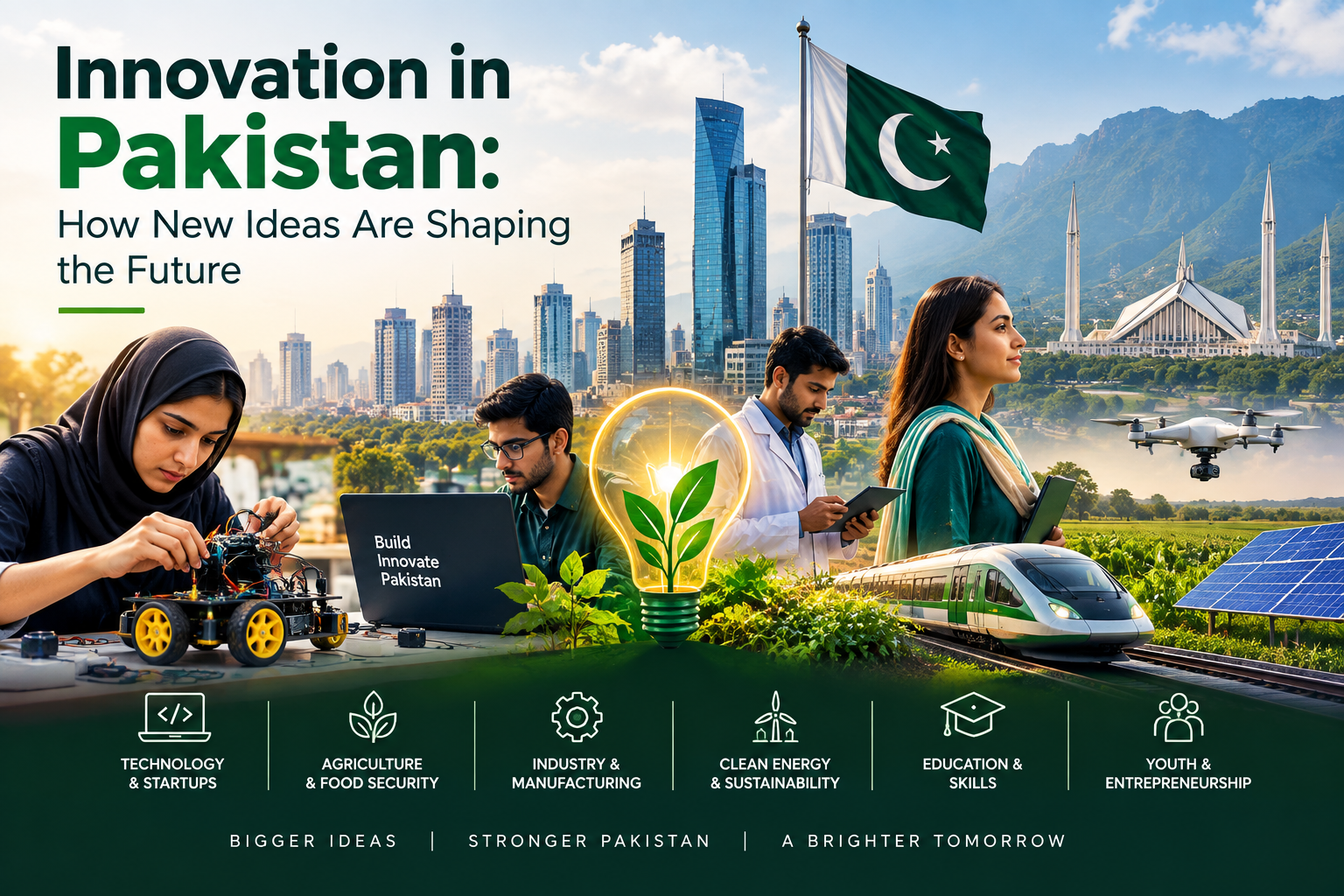
Pakistan is a country with a large and talented young population, a growing technology sector, and a strong tradition of entrepreneurship. Across cities and smaller communities, people are developing new ideas to solve everyday problems, create businesses, improve services, and support economic growth. From digital payments and online education to modern agriculture and renewable energy, innovation in Pakistan is becoming an important part of the country's future.
Innovation does not always mean creating a completely new invention. It can also mean finding a better, faster, cheaper, or more sustainable way to solve an existing problem. In Pakistan, many innovative ideas are emerging because people face challenges related to education, healthcare, transportation, agriculture, energy, employment, and access to financial services.
The country's expanding internet access and increasing use of smartphones have also created new opportunities. Young entrepreneurs can now develop digital businesses, sell products online, provide services remotely, and connect with customers around the world. This changing environment is helping Pakistan develop a growing culture of innovation.
What Is Innovation?
Innovation means introducing a new idea, product, service, process, or method that creates useful value. It can involve technology, business models, social services, manufacturing, agriculture, education, or everyday activities.
For example, a farmer using modern irrigation technology to reduce water consumption is using innovation. A student learning through online educational platforms is benefiting from educational innovation. A business accepting digital payments instead of relying only on cash is adopting financial innovation.
Innovation is therefore much broader than advanced technology. It is fundamentally about solving problems in better ways.
Why Innovation Matters in Pakistan
Innovation is particularly important for Pakistan because the country has a large population and a wide range of economic and social needs. New solutions can help businesses become more productive while making important services more accessible.
One major benefit of innovation is job creation. Startups and technology companies can create employment opportunities for developers, designers, marketers, engineers, researchers, and many other professionals.
Innovation can also help small businesses. Digital tools allow small companies to advertise their products, communicate with customers, manage accounts, and sell products through online platforms.
Another important benefit is productivity. Modern technology can help organizations complete tasks more efficiently and reduce unnecessary costs.
Innovation can also support sustainable development. Renewable energy, efficient transportation, water-saving agriculture, and environmentally friendly manufacturing can help address environmental challenges.
Technology and Digital Innovation
Technology is one of the most visible areas of innovation in Pakistan. Smartphones, cloud computing, artificial intelligence, digital platforms, and online services are changing the way people communicate and conduct business.
Many Pakistani businesses now use websites and social media to reach customers. Online marketplaces have also created opportunities for sellers who may not have traditional physical stores.
Digital innovation is particularly useful for young entrepreneurs. A person with a computer, internet connection, and a useful skill can potentially provide services to customers both inside and outside Pakistan.
Freelancing is another important part of Pakistan's digital economy. Pakistani professionals work in areas such as software development, graphic design, content writing, digital marketing, video editing, and virtual assistance.
This has created opportunities for people to participate in the global digital economy without necessarily moving abroad.
Innovation in Pakistani Startups
Startups are an important part of the innovation ecosystem. A startup usually begins with an idea designed to solve a particular problem or serve a particular market.
Pakistan has seen the emergence of startups working in areas such as financial technology, education, healthcare, transportation, e-commerce, logistics, agriculture, and software.
The startup model encourages experimentation. Entrepreneurs identify a problem, develop a solution, test it with users, receive feedback, and improve the product.
Some startups focus on large national problems, while others serve specific groups of customers.
The growth of startup culture has also encouraged young Pakistanis to consider entrepreneurship as an alternative career path. Universities, incubators, accelerators, technology communities, and entrepreneurship programs can help young people develop business and technical skills.
Agricultural Innovation in Pakistan
Agriculture remains an important part of Pakistan's economy and provides livelihoods for millions of people. Innovation can help farmers increase productivity while using resources more efficiently.
Modern agricultural technologies include improved irrigation systems, weather information, soil monitoring, farm-management software, improved machinery, and data-based farming techniques.
Water management is particularly important. Efficient irrigation technologies can help farmers use water more carefully.
Technology can also improve access to agricultural information. Farmers can use digital platforms to learn about weather conditions, crop management, market information, and modern farming techniques.
Agricultural innovation can therefore contribute not only to food production but also to rural development.
Innovation in Healthcare
Healthcare is another area where innovation can make a meaningful difference.
Telemedicine allows patients to communicate with healthcare professionals through digital platforms. This can be particularly useful for people living in areas where specialized healthcare services are limited.
Digital health records and electronic systems can also improve the organization of medical information.
Mobile applications can provide health-related information, appointment systems, reminders, and other services.
Medical technology is also developing in areas such as diagnostic equipment, laboratory systems, medical imaging, and remote healthcare.
For Pakistan, healthcare innovation has the potential to improve access, efficiency, and communication between patients and healthcare providers.
Educational Innovation
Education is changing rapidly because of digital technology.
Students can now access lectures, tutorials, digital books, educational videos, online courses, and practice resources through the internet.
This can provide additional learning opportunities for students who may not have access to specialized teachers or educational institutions nearby.
Online learning also allows students to study at flexible times. Digital tools can support traditional classroom education rather than completely replacing it.
Teachers can use presentations, educational software, online quizzes, digital assignments, and interactive resources to make lessons more engaging.
Pakistan's young population makes educational innovation especially important. Better access to digital learning can help students develop both academic and practical skills.
Financial Innovation and Fintech
Financial technology, commonly known as fintech, is transforming financial services in Pakistan.
Digital wallets, mobile banking, online transfers, QR payments, and other digital services can make financial transactions faster and more convenient.
Fintech can also help people who have limited access to traditional banking services.
Small businesses can benefit from digital payment systems because they provide additional ways for customers to pay.
The increasing use of digital financial services also creates opportunities for new businesses that develop solutions for payments, lending, savings, insurance, and business management.
As digital connectivity expands, financial innovation is likely to remain an important part of Pakistan's economic development.
Renewable Energy Innovation
Pakistan faces significant energy challenges, making renewable energy innovation particularly relevant.
Solar energy has become increasingly visible in homes, businesses, farms, and other locations. Solar systems can provide an alternative source of electricity and can be particularly useful in areas with strong sunlight.
Other renewable energy sources include wind, hydropower, and biomass.
Innovation in energy storage is also important because renewable energy generation can vary depending on weather and time of day.
Energy-efficient appliances, smart systems, improved batteries, and better power-management technologies can contribute to more efficient energy use.
Artificial Intelligence in Pakistan
Artificial intelligence is becoming one of the most important technology trends worldwide, and Pakistan is also exploring its applications.
AI can be used in areas such as customer service, education, agriculture, healthcare, software development, data analysis, and business automation.
For example, businesses can use AI-based tools to analyze information, automate repetitive tasks, and communicate with customers.
Students and professionals are also learning AI-related skills, including machine learning, data science, and AI-assisted software development.
However, AI innovation requires responsible use. Issues such as privacy, accuracy, cybersecurity, employment changes, and ethical decision-making need careful attention.
Innovation in E-Commerce
Online shopping has created new opportunities for Pakistani businesses.
E-commerce allows sellers to reach customers beyond their immediate neighborhoods. Small businesses can promote products through websites, social media, and online marketplaces.
Digital marketing has become an important part of this process. Businesses can use videos, images, social media posts, and targeted advertising to introduce products to potential customers.
E-commerce also encourages innovation in logistics, delivery systems, payment methods, inventory management, and customer service.
The growth of online commerce can help entrepreneurs enter markets with lower initial costs than traditional retail in some cases.
Innovation in the Textile Industry
Pakistan has a major textile and garment sector, and innovation can help this industry remain competitive.
Modern machinery can improve manufacturing efficiency and product quality. Digital design tools can support fashion and textile designers.
Sustainable production is another important area. Businesses can explore ways to reduce waste, improve energy efficiency, reuse materials, and manage water consumption.
Innovation can also help Pakistani textile companies reach international customers through digital marketing and e-commerce.
Combining Pakistan's existing manufacturing capabilities with modern technology can create opportunities for higher-value products.
Women and Innovation
Women can play an important role in Pakistan's innovation ecosystem.
Digital platforms have created opportunities for women to work in areas such as online education, freelancing, fashion, e-commerce, digital marketing, design, and entrepreneurship.
A woman with specialized skills can potentially provide services to customers from different cities or countries using online platforms.
Women-led businesses can also introduce products and services designed around specific community needs.
Greater access to education, technology, financing, mentorship, and professional networks can help more women participate in innovation and entrepreneurship.
Youth and Innovation
Pakistan has a large young population, making young people central to the country's innovation potential.
Young Pakistanis are increasingly interested in software development, artificial intelligence, content creation, digital marketing, gaming, e-commerce, and entrepreneurship.
Schools and universities can support this potential by encouraging problem-solving, creativity, research, teamwork, and practical projects.
Instead of focusing only on memorization, education can also encourage students to develop solutions to real-world problems.
Innovation competitions, coding clubs, entrepreneurship societies, technology events, and research programs can give young people opportunities to experiment with ideas.
Local Innovation and Everyday Problem-Solving
Innovation does not have to come from large companies or research laboratories.
People across Pakistan develop simple solutions to everyday challenges. Small businesses may create new ways to package products, deliver goods, communicate with customers, or manage their operations.
Local craftsmen and manufacturers also develop practical techniques based on experience.
This type of grassroots innovation is valuable because it often responds directly to local needs.
A simple idea that saves time, reduces waste, lowers costs, or improves convenience can have a meaningful impact.
Challenges Facing Innovation in Pakistan
Despite growing opportunities, innovation in Pakistan faces several challenges.
One challenge is access to funding. Entrepreneurs often need financial support to develop products, hire employees, purchase equipment, and expand their businesses.
Another challenge is access to advanced technology and research facilities.
Education and skills are also important. Innovation requires people with technical knowledge, creative thinking, business skills, and the ability to work collaboratively.
Infrastructure can also affect innovation. Reliable electricity, high-quality internet access, transportation, and digital services are important for modern businesses.
Regulatory processes can influence how quickly new businesses and technologies develop.
Cybersecurity and data protection are additional concerns as more activities move online.
Addressing these challenges requires cooperation between government institutions, educational organizations, businesses, investors, researchers, and communities.
The Role of Universities in Innovation
Universities can become important centers of innovation.
Research departments can investigate new technologies and develop solutions to national challenges.
Universities can also encourage students to create prototypes, conduct research, launch startups, and participate in innovation competitions.
Collaboration between universities and industries can help connect academic research with practical applications.
Students can gain valuable experience when they work on real-world projects rather than studying concepts only from textbooks.
Government and Innovation
Government policies can influence the innovation environment by supporting research, digital infrastructure, entrepreneurship, education, and technology development.
Programs that encourage startups, technology training, research, digital payments, and broadband access can help expand opportunities.
Clear regulations are also important because entrepreneurs and investors need predictable systems in which to operate.
Public-sector innovation can also improve government services through digital systems, online applications, electronic records, and data-based decision-making.
The Importance of Research and Development
Research and development, often called R&D, is a key part of long-term innovation.
Research can help identify new technologies and understand local problems. Development can then turn useful research into products, services, or processes.
Pakistan can benefit from greater collaboration between researchers, universities, technology companies, manufacturers, and entrepreneurs.
Investment in scientific research can also help develop expertise in areas such as biotechnology, artificial intelligence, renewable energy, engineering, agriculture, and healthcare.
The Future of Innovation in Pakistan
The future of innovation in Pakistan will likely be influenced by technology, education, entrepreneurship, and changing consumer needs.
Artificial intelligence, automation, digital finance, renewable energy, e-commerce, smart agriculture, and online education are among the areas with significant potential.
The country's young population can become a major source of ideas if young people receive access to quality education, technology, mentorship, and opportunities.
Pakistan also has an opportunity to develop solutions specifically suited to local conditions. Instead of simply copying technologies from other countries, innovators can adapt ideas to Pakistan's economic, cultural, environmental, and social needs.
Innovation can therefore become both a tool for solving domestic problems and a way to create products and services for international markets.
Conclusion
Innovation in Pakistan is developing across technology, agriculture, healthcare, education, finance, energy, e-commerce, manufacturing, and entrepreneurship. New ideas are helping individuals and organizations find better ways to solve problems and create opportunities.
Young people are playing an increasingly important role in this transformation. With digital skills, education, entrepreneurship, and access to technology, they can contribute to Pakistan's future economy.
At the same time, innovation requires more than ideas. Successful innovation depends on research, investment, infrastructure, skills, responsible policies, and collaboration.
Pakistan has many challenges, but those challenges can also create opportunities for creative solutions. By supporting education, research, entrepreneurship, digital infrastructure, and responsible technology use, the country can build an environment where useful ideas can grow.
The future of innovation in Pakistan will ultimately depend on the ability of individuals, businesses, educational institutions, researchers, and public organizations to work together. New ideas are already emerging across the country, and continued support for innovation can help turn those ideas into practical solutions and sustainable opportunities.
FAQs
1. What is innovation in Pakistan?
Innovation in Pakistan means developing or adopting new ideas, technologies, products, services, and methods to solve problems and create useful opportunities.
2. Which sectors are experiencing innovation in Pakistan?
Important areas include technology, agriculture, healthcare, education, fintech, renewable energy, e-commerce, textiles, transportation, and artificial intelligence.
3. How are young people contributing to innovation in Pakistan?
Young Pakistanis are contributing through startups, freelancing, software development, artificial intelligence, e-commerce, digital marketing, research, and other technology-related activities.
4. Why is technology important for innovation in Pakistan?
Technology can help businesses improve productivity, expand their markets, provide digital services, reduce costs, and develop new solutions to everyday problems.
5. What is the future of innovation in Pakistan?
The future can include continued development in artificial intelligence, digital finance, renewable energy, smart agriculture, e-commerce, healthcare technology, education technology, and entrepreneurship.