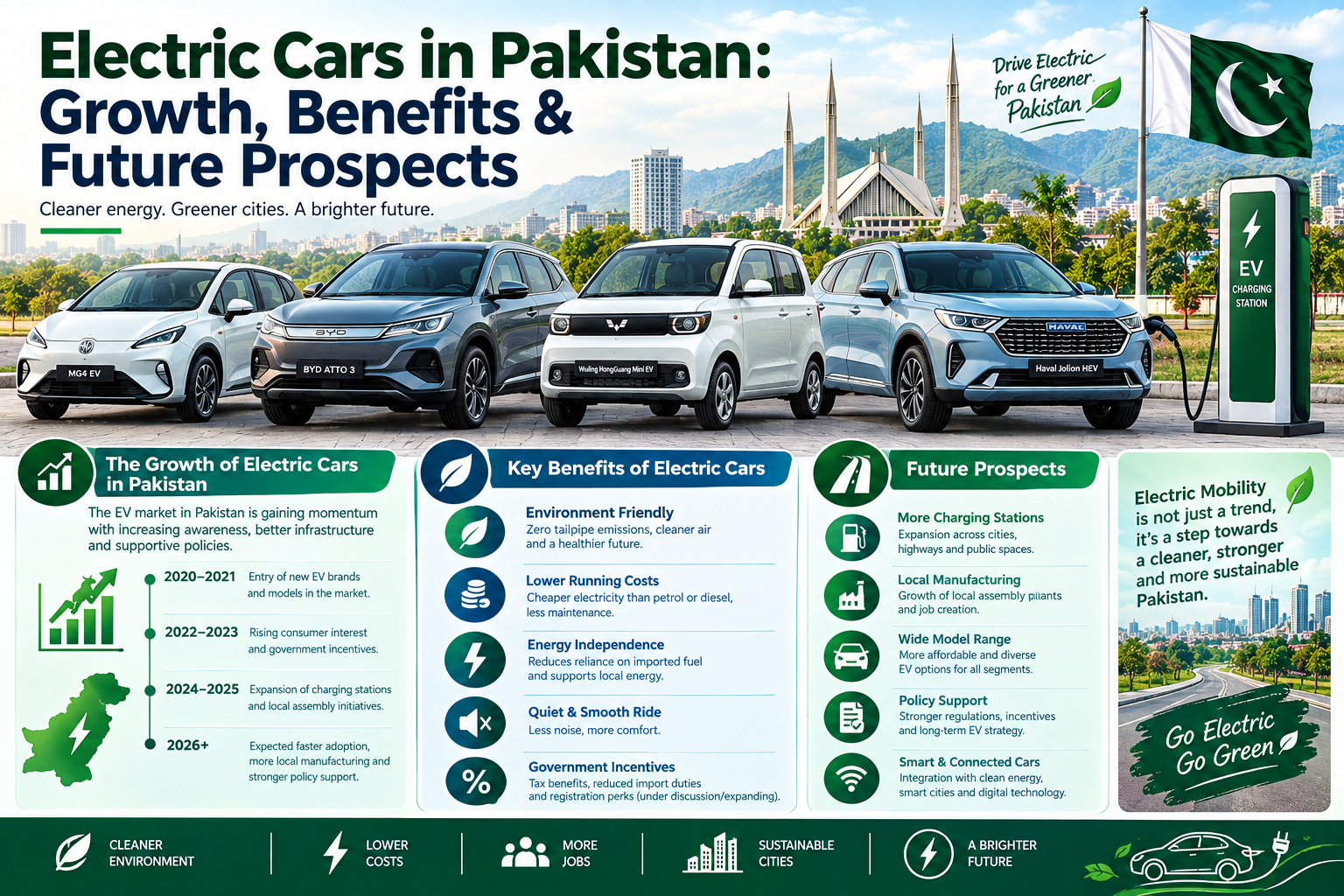
Electric cars are becoming an increasingly important topic in Pakistan’s automobile sector. As technology develops and people become more interested in fuel-efficient and environmentally conscious transportation, electric vehicles are attracting attention from consumers, businesses, manufacturers, and policymakers.
Unlike conventional cars that use petrol or diesel engines, electric cars use electric motors powered by rechargeable batteries. This difference changes how the vehicles operate, how they are maintained, and how they are charged.
Pakistan’s electric-car market is still developing. Several factors will influence its future, including vehicle prices, charging infrastructure, electricity availability, battery technology, government policies, consumer awareness, and local manufacturing.
Electric cars may provide several advantages, but they also present challenges. Understanding both sides can help Pakistani consumers better understand this developing technology.
What Is an Electric Car?
An electric car is a vehicle powered primarily by electricity stored in a rechargeable battery.
Instead of using a conventional internal-combustion engine as its main source of propulsion, an electric vehicle uses an electric motor.
The battery stores electrical energy, which is supplied to the motor when the vehicle is driven.
Electric cars generally include several major components, such as:
Battery pack
Electric motor
Power electronics
Charging system
Regenerative braking system
Vehicle control systems
The exact technology varies between different electric-vehicle models.
How Electric Cars Work
When an electric car is connected to a charging source, electrical energy is transferred to its battery.
The stored energy can later be used to power the electric motor.
When the driver accelerates, the vehicle's control system sends electricity from the battery to the motor. The motor converts electrical energy into mechanical movement, turning the wheels.
Many electric cars also use regenerative braking. During deceleration, some of the vehicle's kinetic energy can be converted back into electrical energy and stored in the battery.
Electric Cars in Pakistan
Pakistan's electric-vehicle market is developing gradually.
Electric mobility is attracting attention because of concerns related to fuel costs, urban air quality, energy use, and transportation technology.
Electric vehicles can be found in different forms, including cars, motorcycles, scooters, and other types of transportation.
The electric-car segment remains smaller than the conventional petrol- and diesel-car market, but interest in electric mobility continues to develop.
Why Electric Cars Are Getting Attention
Several factors have contributed to interest in electric vehicles.
Fuel Costs
Fuel expenses are an important part of car ownership.
Electric vehicles use electricity instead of petrol or diesel, so their operating costs are calculated differently.
The actual cost depends on electricity prices, charging efficiency, driving distance, battery capacity, and driving conditions.
Environmental Concerns
Electric vehicles do not produce exhaust emissions while being driven.
This can be particularly relevant in urban areas where air pollution is a concern.
However, the overall environmental impact of an electric vehicle also depends on battery production, manufacturing, electricity generation, and the vehicle's complete life cycle.
New Technology
Electric vehicles introduce modern automotive technologies.
Many EVs include digital displays, smartphone connectivity, regenerative braking, advanced energy-management systems, and other technology features.
Benefits of Electric Cars
Electric vehicles can offer several advantages.
Lower Routine Mechanical Maintenance
Electric motors have fewer moving mechanical components than conventional internal-combustion engines.
As a result, EVs generally do not require some conventional engine-related maintenance tasks such as regular engine-oil changes.
However, electric cars still require maintenance of tires, brakes, suspension, cooling systems, electrical components, and other vehicle systems.
Quiet Operation
Electric motors generally operate more quietly than conventional engines.
This can provide a quieter driving experience, particularly at lower speeds.
Instant Motor Response
Electric motors can deliver strong torque from low speeds.
This can provide responsive acceleration depending on the vehicle's design.
Regenerative Braking
Regenerative braking allows some kinetic energy to be converted into electrical energy during deceleration.
This energy can be returned to the battery.
Challenges of Electric Cars in Pakistan
Despite their potential advantages, electric cars face several challenges in Pakistan.
Charging Infrastructure
One of the biggest considerations is charging availability.
Petrol stations are widely distributed across the country, while electric-vehicle charging infrastructure is still developing.
People who do not have convenient home charging may need to rely on public charging stations.
Purchase Price
Some electric vehicles can have higher upfront prices than comparable conventional cars.
Battery technology contributes significantly to the cost of many EVs.
As production increases and technology develops, pricing may change.
Battery Concerns
The battery is one of the most important components of an electric car.
Battery performance can change over time due to factors such as age, usage, temperature, charging patterns, and technology.
Potential buyers should understand the battery warranty and replacement arrangements before purchasing an EV.
Service Availability
Electric vehicles require technicians who understand high-voltage electrical systems and EV-specific components.
The availability of trained technicians and specialized service centers can influence the ownership experience.
Home Charging
Home charging can be a major advantage for EV owners who have suitable parking and electrical access.
A home charger can allow an owner to recharge the vehicle overnight or during periods when the car is not being used.
Before installing charging equipment, homeowners should make sure their electrical system is suitable and use qualified professionals for installation.
Public Charging Stations
Public charging infrastructure can make electric vehicles more practical for people who travel longer distances.
Charging stations may be located at shopping centers, commercial areas, parking facilities, service areas, or other locations.
The development of a reliable nationwide charging network would make intercity electric travel more convenient.
Charging Time
Charging time depends on several factors.
These include:
Battery capacity
Charger power
Vehicle charging technology
Current battery level
Temperature
Charging infrastructure
Fast chargers can charge vehicles more quickly than standard charging systems, but availability varies by location.
Consumers should understand the charging specifications of the exact EV they are considering.
Electric Cars and Pakistan's Cities
Electric cars can be particularly relevant to urban transportation.
Large Pakistani cities experience traffic congestion and air-quality challenges.
Because electric vehicles produce no tailpipe exhaust emissions while operating, they can be part of broader efforts to reduce vehicle-related local air pollution.
However, electric cars alone cannot solve urban transportation problems. Public transportation, traffic management, urban planning, and other measures also influence mobility and air quality.
Electric Vehicles and Electricity Supply
The growth of electric vehicles is connected to the electricity system.
If EV ownership increases significantly, additional electricity demand may develop.
Charging infrastructure needs to be planned carefully to ensure reliable electricity supply.
Charging at different times of the day can also influence the impact on the electricity network.
Electric Cars and Renewable Energy
Electric vehicles can be charged using electricity produced from different sources.
When electricity comes from renewable sources such as solar or wind, EV charging can be associated with lower operational carbon emissions than charging from more carbon-intensive electricity sources.
Pakistan has significant solar-energy potential, making solar-powered EV charging an area of interest.
Homeowners and businesses with suitable solar systems may explore ways to combine solar generation with EV charging.
Electric Cars and Solar Power
Solar power and electric vehicles can complement each other.
A household with solar panels can potentially use generated electricity for vehicle charging, depending on the system configuration and electricity arrangements.
This approach may help reduce dependence on grid electricity for charging during suitable periods.
However, solar installation costs, battery storage, charging requirements, and household electricity consumption should all be considered.
Electric Cars and Long-Distance Travel
Long-distance travel requires additional planning for EV owners.
Drivers need to know where charging stations are located along their route.
They should also consider the vehicle's practical driving range, weather, traffic, road conditions, passenger load, and air-conditioning use.
Range can vary significantly depending on driving conditions.
Electric Car Range
Driving range refers to the distance an electric vehicle can travel before requiring another charge.
Manufacturers usually provide official range figures, but real-world range can vary.
Factors affecting range include:
Driving speed
Temperature
Air conditioning
Road conditions
Traffic
Vehicle load
Tire pressure
Driving style
Therefore, buyers should consider real-world usage rather than relying only on the official range figure.
Battery Life
Battery life is an important concern for EV owners.
Modern batteries are designed to operate for many years, but battery capacity can gradually decrease with use and age.
Battery degradation depends on several factors, including battery chemistry, temperature, charging behavior, usage, and vehicle design.
Consumers should carefully review the battery warranty and manufacturer's recommendations.
Electric Car Maintenance
Electric vehicles still require regular maintenance.
Important areas include:
Tires
Brakes
Suspension
Steering
Cooling systems
Electrical systems
Charging equipment
Battery management system
Although some conventional engine maintenance is eliminated, EV ownership is not completely maintenance-free.
Safety of Electric Cars
Electric vehicles are designed with safety systems like other modern vehicles.
Depending on the model, features may include airbags, anti-lock braking, electronic stability control, parking sensors, cameras, and driver-assistance systems.
Because EV batteries contain significant amounts of stored electrical energy, vehicles include specialized safety systems to manage the battery.
Consumers should always check the safety specifications of the specific model and variant.
Electric Cars and Government Policies
Government policies can have an important influence on the development of electric mobility in Pakistan.
Policies may address areas such as:
Vehicle imports
Local manufacturing
Taxes
Charging infrastructure
Energy use
Environmental standards
Investment
Electric mobility targets
Policy changes can influence both manufacturers and consumers.
Local Manufacturing of Electric Vehicles
Local manufacturing can play an important role in making electric vehicles more accessible.
Producing or assembling vehicles domestically may support employment, technology development, supply chains, and technical expertise.
The development of local battery-related and component industries could also support the wider EV ecosystem.
Electric Cars and Employment
The transition toward electric mobility can change the types of skills needed in the automotive sector.
Traditional mechanics may increasingly need training in:
Electrical systems
Battery technology
Electronic diagnostics
Electric motors
Charging systems
High-voltage safety
New jobs may also develop in charging infrastructure, battery services, software, energy management, and EV maintenance.
Consumer Awareness
Consumer education is important for the growth of electric vehicles.
Potential buyers should understand how charging works, how much range they actually need, battery warranties, service requirements, and the availability of charging facilities.
Clear information can help consumers compare electric vehicles with conventional and hybrid alternatives.
Electric Cars vs Petrol Cars
Electric and petrol vehicles have different characteristics.
Electric cars generally have fewer moving drivetrain components and do not produce tailpipe emissions while operating.
Petrol cars can be refueled quickly through an extensive network of fuel stations.
EVs require charging, while petrol vehicles require fuel.
The better option for an individual depends on factors such as driving distance, charging access, budget, vehicle availability, and personal requirements.
Electric Cars vs Hybrid Cars
Hybrid vehicles combine an internal-combustion engine with electric technology.
They can use petrol while benefiting from electric assistance.
Fully electric vehicles rely primarily on stored electrical energy and do not use a conventional petrol engine for propulsion.
For Pakistani consumers, charging access can be an important factor when comparing EVs and hybrids.
Future of Electric Cars in Pakistan
The future of electric cars in Pakistan will depend on several connected developments.
Charging infrastructure will need to expand. Vehicle prices and battery technology will also influence consumer demand.
Local manufacturing could make EVs more accessible, while technical training could improve service availability.
Government policies and energy-sector developments will also influence the pace of electric mobility adoption.
Tips for Buying an Electric Car in Pakistan
Potential EV buyers can consider the following points:
Check the vehicle's real-world range.
Understand the battery warranty.
Check charging options near home and work.
Research public charging stations along regular routes.
Compare charging times.
Check service-center availability.
Ask about battery replacement costs.
Compare insurance and maintenance requirements.
Take a test drive.
Calculate the total ownership cost.
Conclusion
Electric cars represent an emerging part of Pakistan's automobile sector. They offer a different approach to transportation through electric motors, rechargeable batteries, and modern energy-management systems.
Their potential benefits include reduced tailpipe emissions, quiet operation, responsive performance, and fewer conventional engine-maintenance requirements. At the same time, challenges such as charging infrastructure, purchase prices, battery concerns, technical support, and electricity requirements need to be considered.
For Pakistani consumers, the decision to purchase an electric car should depend on practical needs. Home charging access, daily driving distance, long-distance travel requirements, budget, service availability, and battery warranty are all important factors.
As technology develops and infrastructure expands, electric vehicles may become an increasingly visible part of Pakistan's transportation system. Their future will depend on cooperation between manufacturers, consumers, energy providers, policymakers, and the wider automotive industry.
FAQs
1. Are electric cars available in Pakistan?
Yes. Electric cars are available in Pakistan, although the market is still developing compared with conventional petrol and diesel vehicles.
2. How are electric cars charged?
Electric cars are charged by connecting them to suitable charging equipment. Charging can take place at home or at public charging stations, depending on availability.
3. Are electric cars cheaper to maintain?
Electric cars can require less routine mechanical maintenance because they do not have conventional engines requiring engine-oil changes. However, they still require maintenance of tires, brakes, suspension, electrical systems, and other components.
4. What is the biggest challenge for electric cars in Pakistan?
Charging infrastructure is an important challenge, particularly for people who travel long distances or do not have convenient access to home charging.
5. Can solar power be used to charge electric cars?
Yes, a suitable solar-energy system can potentially provide electricity for EV charging. The exact setup depends on the home's electrical system and solar installation.