Introduction
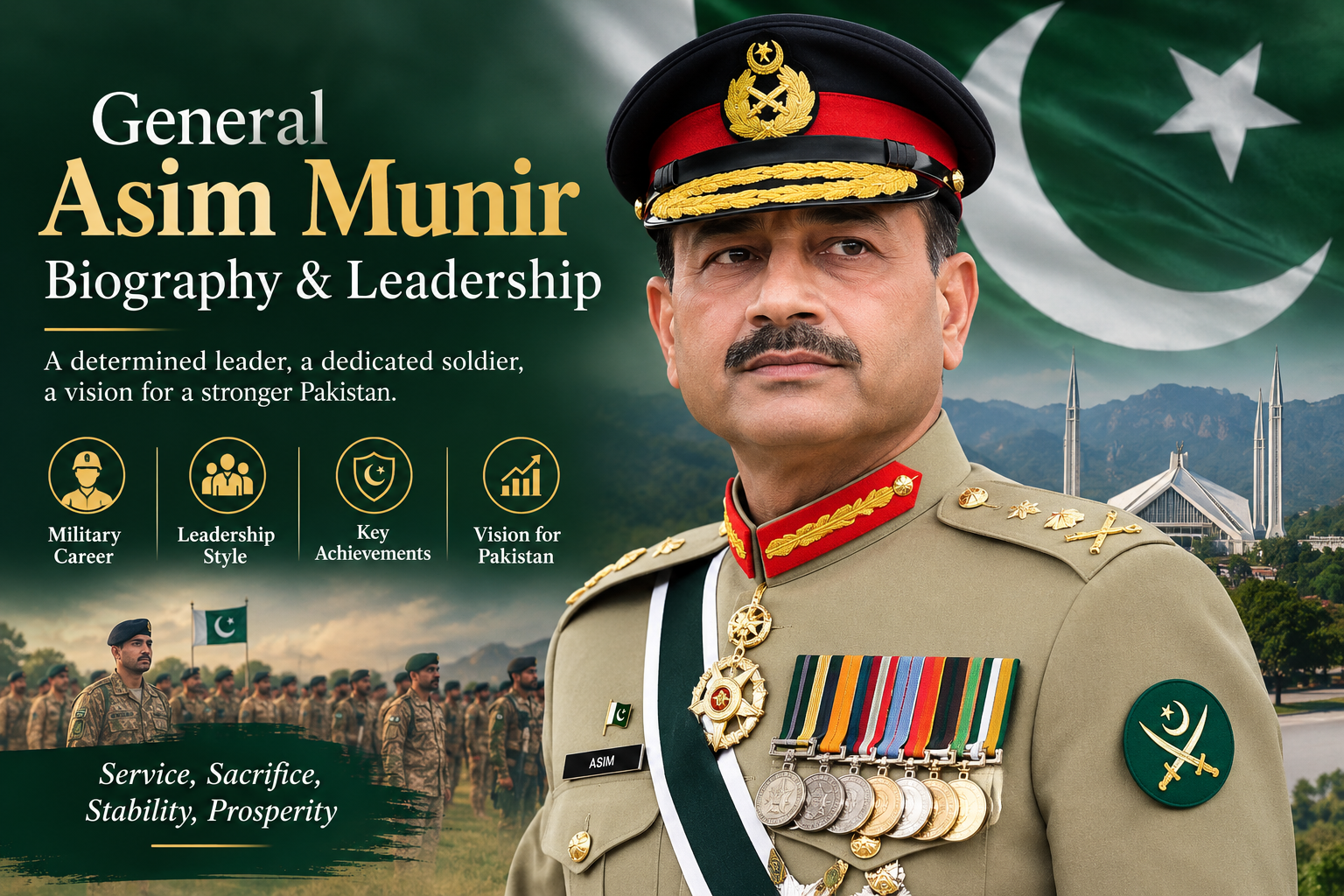
Field Marshal Syed Asim Munir is one of the most prominent military leaders in Pakistan. He currently serves as Pakistan's Chief of Army Staff (COAS) and, concurrently, as Chief of Defence Forces (CDF). In December 2025, the President of Pakistan approved his appointment as Chief of Defence Forces alongside his continuation as Chief of Army Staff for a five-year period.
His career represents a long journey of military service, professional responsibility, leadership, and national duty. As the head of Pakistan's armed forces, his responsibilities extend beyond military administration to matters involving national security, regional stability, strategic cooperation, and international defence relations.
General Asim Munir's leadership has also attracted attention because of his involvement in high-level national and international engagements. In 2026, he participated alongside Pakistan's political leadership in meetings concerning regional peace, diplomacy, economic cooperation, and international relations.
Military Career
General Asim Munir has spent much of his professional life serving Pakistan through the armed forces.
A military career requires discipline, training, responsibility, teamwork, and the ability to make decisions under difficult circumstances. Officers gradually gain experience through different assignments and responsibilities.
His rise to the country's highest military leadership position reflects a long professional journey within Pakistan's armed forces.
Leadership Responsibilities
As Chief of Army Staff, General Asim Munir is responsible for leading the Pakistan Army.
The position involves strategic planning, military preparedness, institutional leadership, and coordination on matters related to national security.
The appointment as Chief of Defence Forces further expanded his responsibilities within Pakistan's defence structure. The federal government announced that he would serve concurrently as COAS and CDF for five years.
This places significant responsibility on his leadership.
National Security
National security is an important responsibility for any country's leadership.
Pakistan faces a complex regional environment involving developments in South Asia, the Middle East, Central Asia, and beyond.
The country's security institutions therefore need to remain prepared while also supporting efforts toward peace and stability.
Official government statements in 2026 have highlighted General Asim Munir's participation in discussions concerning regional security and peace efforts.
Regional Peace
Security and peace are closely connected.
Pakistan has repeatedly expressed support for peaceful solutions to regional disputes and dialogue between countries.
In April 2026, General Asim Munir participated in high-level discussions regarding Pakistan's mediatory efforts for sustainable regional peace. The Pakistani leadership emphasized de-escalation and peaceful negotiations.
Such engagements demonstrate the importance of diplomacy alongside defence preparedness.
Role in Defence Diplomacy
Modern military leadership is not limited to domestic defence matters.
Military leaders also engage with international partners on security cooperation, defence relations, and regional developments.
General Asim Munir has participated in meetings with leaders from countries including Qatar, Saudi Arabia, China, and Iran as part of Pakistan's broader diplomatic and strategic engagements.
These interactions reflect the importance of maintaining communication with international partners.
Pakistan-China Relations
China is an important strategic partner of Pakistan.
In May 2026, General Asim Munir accompanied Prime Minister Shehbaz Sharif during high-level engagements in Beijing. The meetings emphasized the long-standing Pakistan-China strategic partnership and cooperation in several areas.
Such engagements highlight the connection between national security, diplomacy, economic development, and international cooperation.
Relations with Gulf Countries
Pakistan has longstanding relations with Gulf countries.
Saudi Arabia and Qatar, among others, have important economic, cultural, and strategic relationships with Pakistan.
General Asim Munir's participation in high-level meetings with Gulf leadership reflects the importance of maintaining strong institutional relations with these countries.
Defence and Economic Stability
In the modern world, national security and economic stability are increasingly connected.
A stable security environment can support investment, trade, tourism, and economic activity.
Pakistan's leadership has emphasized economic development alongside security and diplomatic priorities.
General Asim Munir has participated in high-level engagements where economic cooperation, investment, energy, trade, and regional stability were discussed.
Role in the Special Investment Facilitation Council
General Asim Munir's responsibilities also intersect with Pakistan's economic initiatives.
The Special Investment Facilitation Council (SIFC) is designed to help facilitate investment and economic activity in Pakistan.
In September 2026, the Government of Pakistan described the SIFC as being chaired by the Prime Minister and Chief of Army Staff and Chief of Defence Forces, Field Marshal Syed Asim Munir, with participation from provincial chief executives.
This reflects the government's emphasis on coordination between different institutions to support economic development.
Technology and National Development
Technology has become an important part of national development.
Pakistan is working to expand its digital economy, improve connectivity, and attract investment in technology.
Government initiatives in 2026 connected the country's digital transformation agenda with the broader economic development framework supported by the SIFC.
This demonstrates that national development today involves more than traditional sectors.
Importance of Professionalism
Professionalism is a fundamental quality in military leadership.
A professional armed force requires training, discipline, organization, preparedness, and respect for institutional responsibilities.
General Asim Munir's career within the Pakistan Army has been built around these principles.
Professional development is particularly important for senior officers because their decisions can influence large institutions and national security policies.
Discipline and Responsibility
Military leadership places considerable emphasis on discipline.
Discipline helps organizations maintain consistency, accountability, and coordination.
For a senior military leader, responsibility also means understanding the consequences of decisions and maintaining institutional preparedness.
These qualities are important not only in the armed forces but also in other areas of public administration.
National Unity
Pakistan is a diverse country with different provinces, languages, cultures, and communities.
National institutions have an important role in promoting unity and cooperation.
The armed forces operate across the country and include personnel from different regions.
A strong sense of national identity can help strengthen cooperation among citizens.
Youth and National Service
Pakistan has a large young population.
Young people can contribute to the country through education, technology, entrepreneurship, science, healthcare, public service, and many other fields.
Military service is one form of national service, while civilian professions provide many others.
The broader lesson of leadership is that every citizen can contribute to national development through responsible work.
Importance of Education
Education is essential for developing capable citizens and future leaders.
Modern military organizations also require expertise in technology, engineering, communications, strategy, international relations, and management.
Pakistan's future security and development therefore depend partly on educating a skilled younger generation.
International Cooperation
No country exists in isolation.
Pakistan needs constructive relationships with neighboring states and international partners.
International cooperation can support peace, trade, technology, education, investment, and cultural exchange.
General Asim Munir's participation in international meetings reflects the importance of maintaining communication with partner countries.
Peaceful Resolution of Conflicts
Military preparedness and diplomacy can work together.
A strong defence capability can support national security, while diplomacy can help reduce tensions and encourage peaceful solutions.
Pakistan's official engagements in 2026 repeatedly emphasized dialogue, de-escalation, and peaceful resolution of regional issues.
Leadership During Changing Times
The international environment is constantly changing.
Countries face challenges involving regional security, economic uncertainty, technology, climate change, and geopolitical competition.
Leadership during such periods requires adaptability and careful decision-making.
General Asim Munir's current role places him within this changing environment.
Institutional Coordination
Modern national security requires coordination between different institutions.
Defence, foreign affairs, economic development, technology, and internal security can no longer be treated as completely separate areas.
High-level meetings involving General Asim Munir and Pakistan's political leadership demonstrate the importance of institutional coordination.
Pakistan's Strategic Position
Pakistan occupies an important geographical position.
It connects South Asia with Central Asia and has close relationships with China, the Gulf region, Iran, and other countries.
This geographical position creates opportunities as well as responsibilities.
Pakistan's leadership therefore has to consider regional developments carefully.
Contribution to National Confidence
Strong national institutions can contribute to public confidence.
Citizens expect national leaders and institutions to protect the country's sovereignty, maintain stability, and support national interests.
Military leadership is one part of this broader national responsibility.
Future Challenges
Pakistan continues to face challenges involving economic development, regional security, technology, employment, education, and social development.
Addressing these challenges requires cooperation between government institutions, businesses, communities, and citizens.
Defence and security remain important, but long-term national progress also depends on education, economic growth, innovation, and good governance.
A Broader Vision of National Development
National development cannot be achieved through one institution alone.
A successful Pakistan requires strong schools, universities, hospitals, businesses, industries, infrastructure, technology, and public institutions.
Security provides an important foundation upon which these areas can develop.
This is why national security and economic development are increasingly connected.
Conclusion
Field Marshal Syed Asim Munir is a prominent figure in Pakistan's contemporary national leadership. As Chief of Army Staff and Chief of Defence Forces, he currently holds one of the country's most significant institutional responsibilities.
His current role includes military leadership as well as participation in high-level national and international engagements. In 2026, he has taken part in discussions involving regional peace, international partnerships, economic cooperation, and strategic relations.
His career highlights the importance of discipline, professional responsibility, preparedness, and leadership.
At the national level, Pakistan's future depends on maintaining security while also strengthening education, technology, economic opportunities, healthcare, and social development.
The role of senior national leadership is therefore not limited to one area. It involves understanding the changing world and working toward stability, national interests, and long-term development.
For Pakistan's young generation, the broader lesson from a career in national service is the importance of discipline, education, responsibility, teamwork, and commitment to one's country.
General Asim Munir's current position places him at an important point in Pakistan's institutional and strategic landscape. His leadership will continue to be observed in the context of Pakistan's security, regional relations, and broader national development.
FAQs
1. Who is General Asim Munir?
General Asim Munir is a senior Pakistani military leader and the current Chief of Army Staff.
2. What is General Asim Munir's current position?
He serves as Chief of Army Staff and Chief of Defence Forces.
3. When was he appointed Chief of Defence Forces?
His appointment as CDF alongside his COAS role was approved in December 2025.
4. What is General Asim Munir known for?
He is known for his senior military leadership and participation in national and international security engagements.
5. What areas are important in his current role?
National security, defence preparedness, regional stability, international cooperation, and strategic coordination are among the key areas.




