Introduction
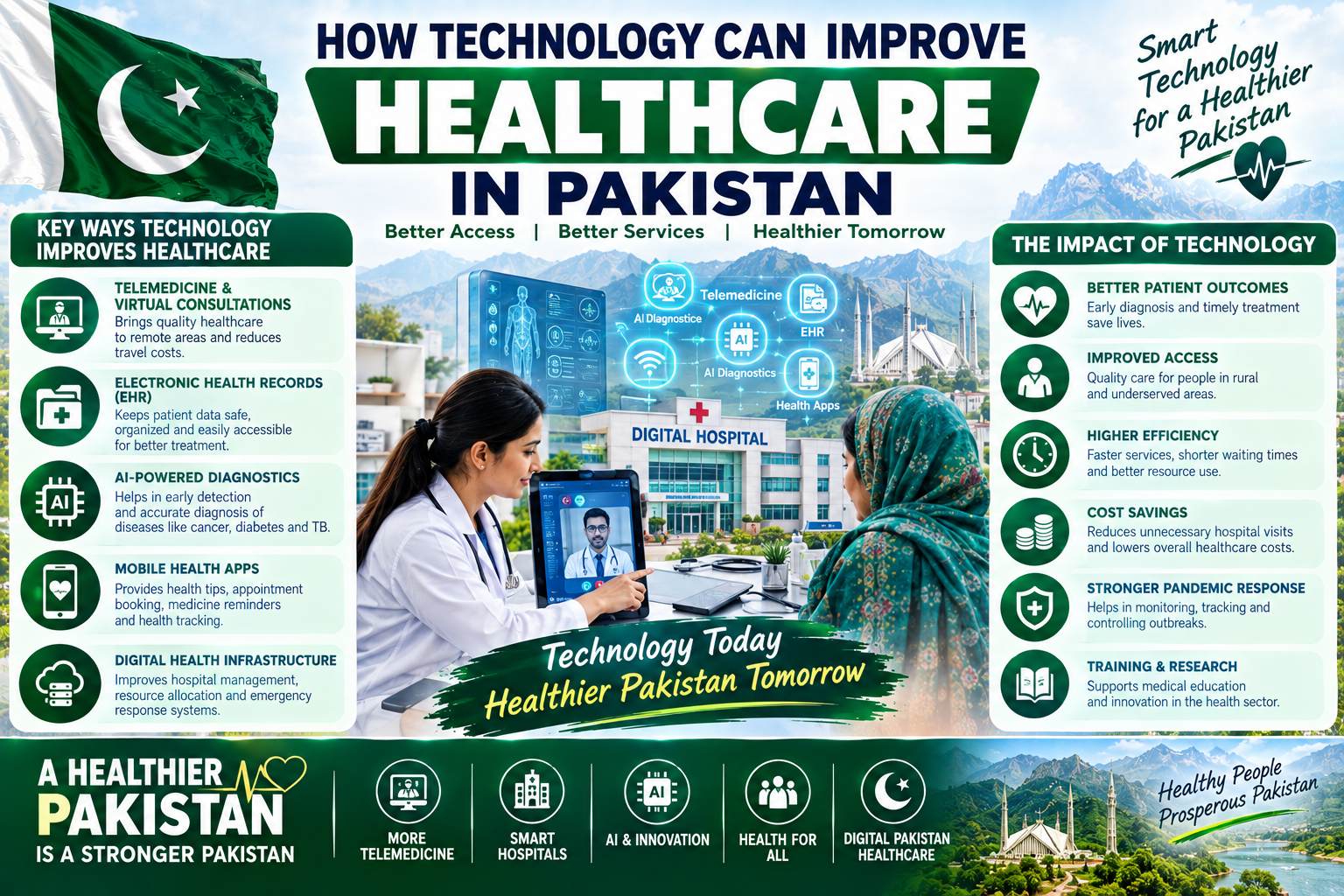
Technology has become an important part of modern life. It has changed how people communicate, study, work, shop, and access information. Healthcare is another area where technology can create significant opportunities. In Pakistan, the use of digital technology can help improve healthcare access, communication, medical education, record management, and public health awareness.
Pakistan has a large population with communities spread across cities, towns, villages, and remote areas. Healthcare facilities and medical professionals are not equally available everywhere. Technology can help connect patients and healthcare professionals, especially when distance makes physical access difficult.
Digital healthcare does not replace hospitals, doctors, nurses, or other healthcare professionals. Instead, it can support them by making healthcare services more organized, accessible, and efficient.
What Is Healthcare Technology?
Healthcare technology refers to the use of digital tools, medical equipment, communication systems, software, and other technologies to support healthcare.
Examples include electronic health records, telemedicine, online appointment systems, digital health education, medical databases, diagnostic technologies, and mobile health applications.
When used responsibly, these technologies can support patients, healthcare professionals, hospitals, and public health organizations.
Importance of Technology in Pakistan's Healthcare System
Technology can help address several challenges faced by Pakistan's healthcare system. It can improve communication, reduce unnecessary travel, organize patient information, support medical education, and provide access to health information.
Technology can be particularly useful in areas where healthcare facilities are limited.
However, successful digital healthcare requires reliable internet, electricity, trained staff, data protection, and affordable access to technology.
Telemedicine
Telemedicine allows healthcare professionals to communicate with patients remotely using digital communication tools.
For people living far from hospitals or specialists, remote consultations may provide a convenient way to discuss certain health concerns.
Telemedicine can reduce travel time and make some healthcare services more accessible. However, not every medical problem can be handled remotely. Physical examinations, emergency care, and certain diagnostic procedures may still require an in-person visit.
Digital Health Records
Electronic health records can help healthcare facilities organize patient information digitally.
Digital records may make it easier for authorized healthcare professionals to access relevant medical information when needed. They can also reduce dependence on paper-based systems.
Proper security and privacy protections are essential because health information is sensitive.
Online Appointment Systems
Technology can make appointment scheduling easier. Hospitals and clinics can use online systems to allow patients to request or manage appointments.
Such systems can reduce waiting times and improve organization.
They may also help healthcare facilities manage patient flow more efficiently.
Digital Medical Information
The internet provides access to a large amount of health information. Reliable digital resources can help people learn about general health, prevention, hygiene, nutrition, and healthcare services.
However, online information should be checked carefully. Social media and websites can also contain inaccurate or misleading health claims.
People should rely on trustworthy healthcare organizations and qualified professionals for important health decisions.
Technology for Rural Healthcare
Rural healthcare is one area where technology can have a particularly useful role.
People living in remote communities may have difficulty reaching specialists. Digital communication can help connect local healthcare workers with specialists when appropriate.
Telemedicine, mobile health services, digital education, and electronic records can support rural healthcare delivery.
Technology should be combined with investment in local healthcare infrastructure rather than used as a complete replacement for physical facilities.
Mobile Health Services
Mobile phones are widely used in Pakistan and can support various health-related services.
Mobile platforms can provide health education, appointment reminders, vaccination information, general awareness messages, and communication with healthcare providers.
Mobile technology can therefore become a useful tool for reaching communities with reliable health information.
Technology and Disease Prevention
Technology can support disease prevention through awareness campaigns, digital reminders, health education, and public health communication.
Digital platforms can help organizations share information quickly during public health campaigns.
Technology can also support systems used by health authorities to monitor disease trends and plan appropriate responses.
Technology and Vaccination Awareness
Digital communication can help spread information about vaccination programs and public health campaigns.
SMS messages, websites, social media, and mobile applications can be used to provide information about recommended services and campaign activities.
Accurate information is important because misinformation can create confusion about vaccination.
Artificial Intelligence in Healthcare
Artificial intelligence is becoming increasingly important in healthcare around the world.
AI can support healthcare professionals in areas such as analyzing information, organizing data, medical research, and certain diagnostic processes.
However, AI should not be treated as a replacement for qualified healthcare professionals. Medical decisions require appropriate professional judgment, context, and responsibility.
Pakistan can benefit from responsible AI development while maintaining strong standards for safety, privacy, and accuracy.
Medical Education and Technology
Technology has transformed medical education. Doctors, nurses, students, and other healthcare professionals can use online courses, digital libraries, educational videos, simulations, and research databases.
Online learning can provide access to educational materials that may not be available locally.
Medical education can therefore become more flexible and accessible through responsible use of technology.
Technology for Healthcare Workers
Healthcare professionals can use technology to communicate, access medical information, manage records, organize appointments, and coordinate patient care.
Digital systems can reduce some administrative work and help healthcare facilities operate more efficiently.
Proper training is essential so that healthcare workers can use digital tools effectively.
Hospital Management Systems
Hospitals can use software systems to manage appointments, patient records, laboratory information, pharmacy services, billing, and other administrative activities.
Integrated systems can improve organization and reduce duplication of work.
Effective hospital technology should be user-friendly and supported by proper staff training.
Digital Diagnostic Technologies
Modern medical technology has improved diagnostic capabilities in many areas.
Digital imaging, laboratory systems, monitoring equipment, and other technologies can support healthcare professionals in evaluating patients.
Technology can improve speed and organization, but qualified professionals are still needed to interpret results and make appropriate medical decisions.
Health Information for Students
Students can use reliable online resources to learn about health, nutrition, hygiene, exercise, disease prevention, and other topics.
Schools can teach students how to identify trustworthy health information and avoid misleading online content.
Digital health literacy is becoming increasingly important in the modern world.
Technology and Mental Health Awareness
Digital platforms can support mental health awareness by providing educational resources and information about professional services.
Online communication may also make it easier for some people to learn about available support.
However, online information should not replace professional assessment when someone has significant mental health concerns.
Technology and Emergency Response
Technology can help healthcare organizations communicate during emergencies.
Digital communication systems can support coordination between hospitals, emergency teams, government agencies, and communities.
Accurate information can also help people understand emergency instructions and public health guidance.
Technology During Disease Outbreaks
During infectious disease outbreaks, timely information is extremely important.
Digital systems can support communication, awareness campaigns, reporting, and coordination between healthcare organizations.
Technology can therefore strengthen public health preparedness and response when supported by reliable systems.
Digital Health Awareness
Technology can make health education available to a large number of people.
Government organizations, hospitals, universities, and healthcare professionals can use websites and social media to share reliable health information.
Health campaigns should use simple language and avoid confusing or misleading claims.
Challenges of Healthcare Technology in Pakistan
Although technology offers many benefits, Pakistan also faces challenges in adopting digital healthcare.
These include limited internet access in some areas, electricity problems, lack of digital skills, financial barriers, privacy concerns, cybersecurity risks, and insufficient technical infrastructure.
Addressing these challenges is essential for making digital healthcare useful and inclusive.
Digital Divide
Not everyone has the same access to smartphones, computers, internet services, or digital platforms.
The digital divide can create another form of inequality if healthcare services become heavily dependent on technology.
Digital healthcare should therefore be designed to support people with different levels of access and technological skills.
Internet Connectivity
Reliable internet connectivity is important for telemedicine and other online healthcare services.
Remote areas may have weaker connectivity than major cities.
Expanding digital infrastructure can help more communities benefit from technology-based healthcare services.
Data Privacy and Security
Healthcare systems handle sensitive information. Protecting patient data should therefore be a major priority.
Hospitals and technology providers need appropriate security measures, access controls, and responsible data-management practices.
Patients should have confidence that their personal health information is handled responsibly.
Cost of Technology
Modern healthcare technology can require significant investment.
Hospitals may need computers, software, medical equipment, internet services, cybersecurity systems, and trained staff.
Government investment, responsible private-sector participation, and careful planning can help make technology more accessible.
Training Healthcare Professionals
Technology is only useful when healthcare professionals know how to use it properly.
Doctors, nurses, technicians, administrators, and other workers may need training in digital systems.
Continuous professional development can help healthcare workers adapt to changing technologies.
Role of Government
The government can support digital healthcare through policies, infrastructure investment, digital standards, healthcare technology programs, and professional training.
Government institutions can also help ensure that technology is used safely and responsibly.
Digital healthcare policies should focus on accessibility, privacy, quality, and patient safety.
Role of Hospitals
Hospitals can introduce technology according to their needs and available resources.
Electronic records, appointment systems, digital communication, laboratory software, and other tools can improve hospital management.
Hospitals should also train employees and regularly evaluate whether digital systems are improving services.
Role of Private Companies
Technology companies can contribute by developing healthcare platforms, software, communication systems, and other digital solutions.
Partnerships between technology companies and healthcare organizations can create innovative services.
However, healthcare technology should prioritize safety, privacy, affordability, and reliability.
Role of Universities
Universities can support healthcare technology through research, education, innovation, and collaboration.
Medical and technology students can work together on solutions for local healthcare challenges.
Research can help identify which digital tools are most useful for different communities.
Role of Communities
Communities can benefit from digital health education and help spread reliable information.
Local organizations can support awareness programs and help people learn how to use appropriate digital healthcare services.
Community participation can make technology-based programs more effective.
Technology and Healthcare Costs
Technology may help reduce certain administrative and travel costs. For example, remote communication can sometimes reduce the need for unnecessary travel for basic consultations.
Digital records can also reduce some paperwork and administrative duplication.
However, technology itself requires investment, so cost savings depend on how systems are designed and implemented.
Technology and Preventive Healthcare
Digital platforms can support preventive healthcare through health education, reminders, awareness campaigns, and communication.
People can receive information about healthy habits and recommended healthcare services through digital channels.
Technology can therefore complement broader public health programs.
Technology and Public Health Research
Digital data systems can support research and planning when information is collected and managed responsibly.
Researchers can use appropriate data to understand health trends, evaluate programs, and develop better strategies.
Privacy and ethical standards should always be considered when handling health information.
Future of Healthcare Technology in Pakistan
The future of healthcare technology in Pakistan has significant potential.
Telemedicine, digital records, artificial intelligence, mobile health platforms, digital education, and modern diagnostic technologies may become increasingly important.
However, technology should be introduced according to real healthcare needs. Digital solutions should not create additional barriers for people who have limited access to technology.
A successful digital healthcare system should combine innovation with accessibility, safety, affordability, and human expertise.
How Pakistan Can Improve Digital Healthcare
Pakistan can improve digital healthcare through several important steps.
First, digital infrastructure should be expanded, particularly in underserved communities. Second, healthcare professionals should receive appropriate training.
Third, strong privacy and cybersecurity standards should be established. Fourth, digital health platforms should be designed to be simple and accessible.
Finally, government institutions, hospitals, universities, technology companies, and communities should work together.
Benefits for Patients
Technology can make some healthcare services more convenient for patients.
Patients may benefit from easier appointment scheduling, access to reliable health information, digital records, and remote consultations when appropriate.
Technology can also help patients communicate with healthcare providers more efficiently.
Benefits for Healthcare Professionals
Healthcare professionals can use technology to access information, organize patient records, communicate with colleagues, and manage certain administrative tasks.
Digital tools can support professional decision-making when used appropriately and responsibly.
Importance of Human Connection
Even as healthcare becomes more digital, human interaction remains essential.
Patients need qualified healthcare professionals who can listen, understand individual circumstances, communicate clearly, and provide appropriate care.
Technology should support the relationship between patients and healthcare professionals rather than eliminate it.
Conclusion
Technology can play an important role in improving healthcare in Pakistan. Telemedicine, electronic records, mobile health services, digital education, artificial intelligence, and modern diagnostic technologies can support better healthcare access and organization.
However, technology alone cannot solve every healthcare problem. Pakistan also needs strong hospitals, trained healthcare professionals, affordable services, clean water, preventive healthcare, and effective public health programs.
The best approach is to combine technology with human expertise and strong healthcare infrastructure. With responsible planning, investment, training, and attention to privacy and accessibility, technology can contribute to a healthier and more connected Pakistan.
FAQs
1. How can technology improve healthcare in Pakistan?
Technology can improve healthcare through telemedicine, digital records, online appointments, health education, and modern diagnostic tools.
2. What is telemedicine?
Telemedicine allows healthcare professionals and patients to communicate remotely using digital communication technologies.
3. Can technology improve rural healthcare?
Yes. Telemedicine and digital communication can help connect people in remote areas with healthcare professionals when appropriate.
4. What are the challenges of digital healthcare?
Challenges include internet access, cost, digital skills, privacy, cybersecurity, electricity, and technical infrastructure.
5. Can artificial intelligence replace doctors?
No. AI can support healthcare professionals in certain tasks, but qualified professionals remain essential for appropriate medical assessment and decision-making.




