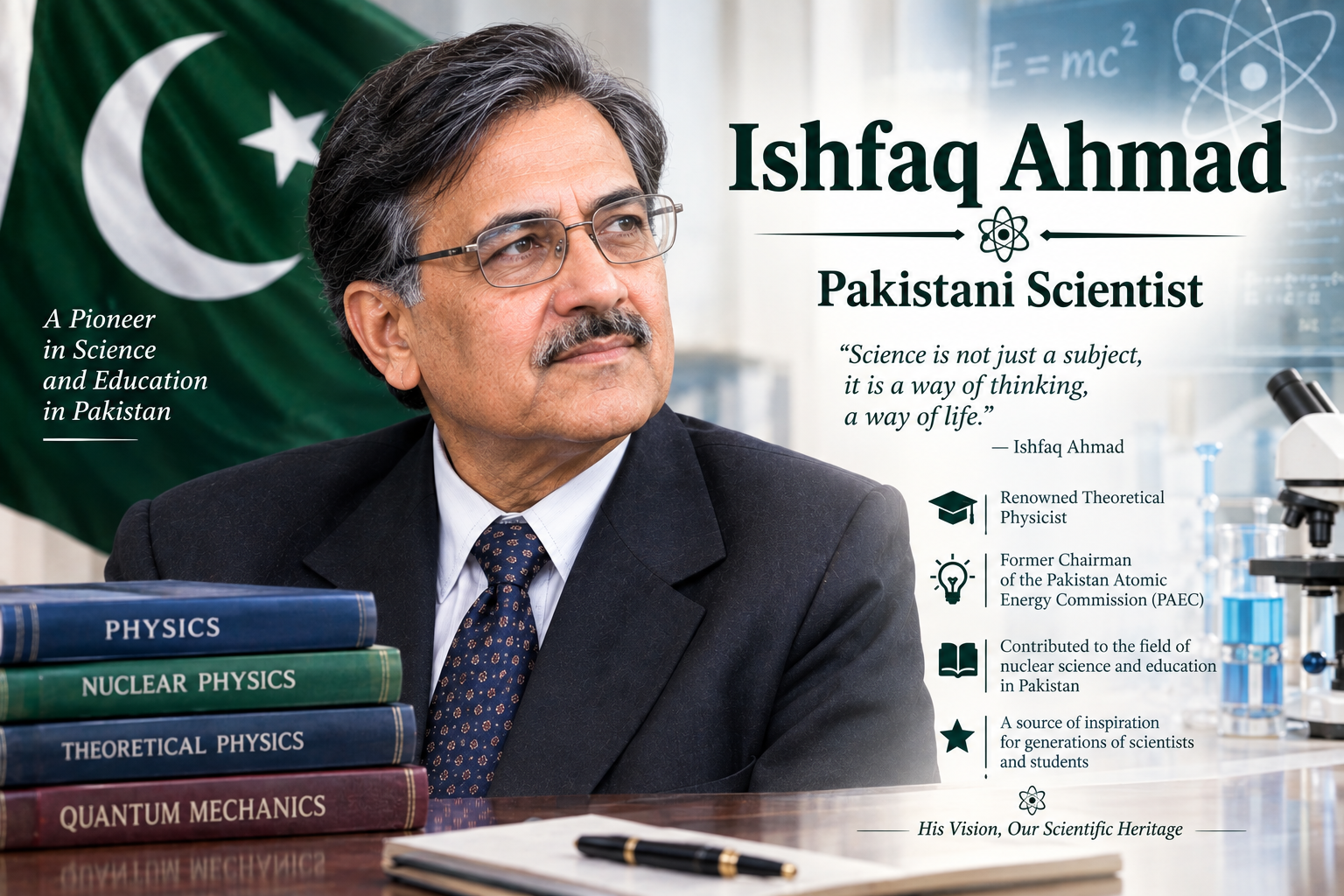
Ishfaq Ahmad was a well-known Pakistani scientist and nuclear physicist. He made important contributions to physics, scientific research, education, and the development of scientific institutions in Pakistan. He was especially associated with nuclear and high-energy physics, particle detectors, and nuclear technology.
Ishfaq Ahmad was born on 3 November 1930 in Gurdaspur, British India. He later became an important figure in Pakistan's scientific community and served in several senior positions. He was Chairman of the Pakistan Atomic Energy Commission from 1991 to 2001 and later worked as a science adviser to the Government of Pakistan.
His academic journey started at Government College Lahore. He completed his M.Sc. in Physics from the University of the Punjab in 1951. He later moved to Canada and received his D.Sc. in Physics from the University of Montreal in 1958.
Throughout his long career, Ishfaq Ahmad worked as a teacher, researcher, scientific administrator, and adviser. He also played a role in building scientific cooperation between Pakistan and international organizations.
His life provides an example of how education and scientific research can become a lifelong service to a country.
Early Life
Ishfaq Ahmad was born on 3 November 1930 in Gurdaspur, which was then part of British India. He belonged to a period when opportunities for advanced scientific education in the region were limited.
As a young student, he developed an interest in science and physics. Physics studies the basic laws of nature, including matter, energy, motion, radiation, and the behavior of particles.
His interest in physics eventually led him to Government College Lahore. This institution was an important center of education and produced many scientists, scholars, writers, and public figures.
His early academic years helped him build the foundation for a career that later took him into advanced research.
Education at Government College Lahore
Ishfaq Ahmad studied at Government College Lahore and later received his M.Sc. in Physics from the University of the Punjab in 1951.
Studying physics at this stage gave him knowledge of mathematics, mechanics, electricity, magnetism, atomic physics, and other important areas.
Physics requires students to understand both concepts and mathematical relationships. It also encourages logical thinking and problem-solving.
After completing his studies in Pakistan, Ishfaq Ahmad continued his education abroad. This allowed him to gain experience in international scientific research.
Higher Education in Canada
Ishfaq Ahmad went to Canada for advanced studies. He studied at the University of Montreal and received his D.Sc. in Physics in 1958.
His time in Canada exposed him to advanced research methods and international scientific communities.
International education can be important for scientists because it provides access to modern laboratories, research equipment, experienced researchers, and scientific literature.
After completing his higher education, Ishfaq Ahmad returned to Pakistan and began building his scientific career.
Beginning of His Teaching Career
Ishfaq Ahmad started his professional career as a lecturer at Government College Lahore. According to the Pakistan Academy of Sciences, he served as a lecturer from 1952 to 1960.
Teaching gave him the opportunity to share scientific knowledge with students.
A good teacher does more than explain textbook material. Teachers can encourage students to ask questions, understand difficult concepts, and develop an interest in their subjects.
His early teaching career also connected him with the academic community in Pakistan.
Research Career
Ishfaq Ahmad's research interests included particle detectors, nuclear physics, high-energy physics, and nuclear technology.
Nuclear physics studies the nucleus of atoms. High-energy physics studies particles and interactions at very small scales.
Particle detectors are scientific instruments used to detect and measure particles produced during physical processes.
Research in these areas requires advanced mathematical knowledge, experimental skills, scientific instruments, and careful data analysis.
Ishfaq Ahmad spent much of his career working in these fields and helping develop scientific research in Pakistan.
Post-Doctoral Research
Ishfaq Ahmad continued his scientific training after completing his doctorate.
The Pakistan Academy of Sciences records that he was a post-doctoral research fellow at the Niels Bohr Institute of Theoretical Physics in Copenhagen from 1961 to 1962. He also worked as a post-doctoral fellow at the University of Montreal and the University of Ottawa during 1963 and 1964. In 1969, he was a post-doctoral research fellow at the Sorbonne in Paris.
These experiences gave him opportunities to work with international scientific communities.
Post-doctoral research is an important stage for scientists because it allows them to specialize further and work on advanced research problems.
Work at Pakistan Atomic Energy Commission
Ishfaq Ahmad became closely associated with the Pakistan Atomic Energy Commission, or PAEC.
According to the Pakistan Academy of Sciences, he served as Senior Scientific Officer from 1960 to 1966, Secretary of PAEC from 1967 to 1969, Director of the Atomic Energy Center in Lahore from 1969 to 1971, and Director of the Pakistan Institute of Nuclear Science and Technology from 1971 to 1976.
These positions show how his career developed from scientific research toward organizational leadership.
Scientific organizations need both researchers and administrators. Researchers conduct experiments and studies, while scientific leaders organize people, laboratories, projects, and resources.
Director of PINSTECH
Ishfaq Ahmad served as Director of the Pakistan Institute of Nuclear Science and Technology, commonly known as PINSTECH, from 1971 to 1976.
PINSTECH became an important scientific research institution in Pakistan.
Institutes such as PINSTECH provide opportunities for scientists to work on research, scientific instruments, nuclear science, and related technologies.
Leadership in such an institution requires scientific knowledge as well as management skills.
Work in Nuclear and High-Energy Physics
Ishfaq Ahmad's major research interests were particle detectors, nuclear physics, high-energy physics, and nuclear technology.
Nuclear physics helps scientists understand the structure and behavior of atomic nuclei.
High-energy physics explores fundamental particles and the interactions between them.
Particle detectors are important because scientists cannot directly see individual subatomic particles. Instead, detectors record signals produced when particles interact with matter.
The development and use of scientific instruments therefore play a major role in experimental physics.
Scientific Publications
Ishfaq Ahmad published scientific research during his career. The Pakistan Academy of Sciences obituary notes that he had more than 40 major publications.
Scientific publications are important because they allow researchers to share their findings with other scientists.
Research papers normally explain the problem being studied, the methods used, the results obtained, and the conclusions reached.
Scientific knowledge develops when researchers communicate their work and other scientists examine, repeat, or build upon it.
Work with International Scientific Organizations
Ishfaq Ahmad worked to strengthen Pakistan's scientific cooperation with international organizations.
The Pakistan Academy of Sciences records his involvement in developing cooperation with organizations including CERN, the International Institute for Applied Systems Analysis, and the Abdus Salam International Centre for Theoretical Physics.
International cooperation is important in science because many scientific questions require knowledge and expertise from different countries.
Scientists can benefit from conferences, research collaborations, shared facilities, academic exchanges, and international scientific networks.
Connection with Abdus Salam
Ishfaq Ahmad was part of Pakistan's scientific community during the same period as Abdus Salam.
The Pakistan Academy of Sciences records that Ishfaq Ahmad spoke about Salam's support for young Pakistani scientists and researchers.
The two scientists were part of an important generation of Pakistani physicists who helped develop modern scientific institutions in the country.
Their careers show the importance of building research opportunities for young scientists.
Chairman of Pakistan Atomic Energy Commission
One of the most important positions held by Ishfaq Ahmad was Chairman of the Pakistan Atomic Energy Commission.
He served as Chairman from 1991 to 2001. Before becoming chairman, he had already served for many years in technical and senior positions within the organization.
As chairman, he was responsible for a large national scientific organization.
The position involved scientific research, institutional management, coordination, and long-term planning.
His decade-long service as chairman made him an important figure in Pakistan's scientific history.
Scientific Leadership
Scientific leadership is different from ordinary management.
A scientific leader needs to understand research while also being able to organize teams and institutions.
Large scientific programs may involve physicists, engineers, technicians, computer experts, administrators, and many other professionals.
Ishfaq Ahmad's career included leadership of major scientific organizations and participation in national science planning.
His work shows that scientific development requires both technical knowledge and strong institutions.
Role in Scientific Institutions
Ishfaq Ahmad was involved in several scientific institutions during his career.
He served at the Pakistan Atomic Energy Commission, PINSTECH, and other research organizations.
He also became associated with the National Centre for Physics in Islamabad.
According to the Pakistan Academy of Sciences, he served as the founding chairman of the Board of Governors of the National Centre for Physics until his death in 2018.
Scientific institutions provide places where researchers can teach, study, experiment, and exchange ideas.
National Centre for Physics
The National Centre for Physics, located in Islamabad, is connected with research and education in physics.
Ishfaq Ahmad served as its founding chairman of the Board of Governors.
Institutions like the National Centre for Physics are important because they provide opportunities for researchers and students to study modern physics.
The development of physics research centers can help encourage young people to choose careers in science.
Pakistan Academy of Sciences
Ishfaq Ahmad became a Fellow of the Pakistan Academy of Sciences in 1983. He later served as President of the Academy from 2007 to 2010.
The Pakistan Academy of Sciences is an important national scientific organization.
It brings together scientists from different fields and promotes scientific research and cooperation.
As president, Ishfaq Ahmad was involved in strengthening scientific links with academies and organizations in other countries.
International Scientific Cooperation
During his leadership in the Pakistan Academy of Sciences, Ishfaq Ahmad helped establish cooperation with scientific academies in other countries.
The Pakistan Academy of Sciences records cooperation with organizations such as the Academy of Sciences of the Czech Republic and the Royal Society of Edinburgh.
International cooperation helps researchers exchange ideas and develop scientific networks.
For developing countries, international connections can be especially useful because they provide opportunities for students and researchers to learn from scientists around the world.
Government Science Adviser
After his time as Chairman of PAEC, Ishfaq Ahmad served as an adviser to the Prime Minister of Pakistan from 2001 to 2007 with the status of Federal Minister.
This position allowed him to contribute his scientific experience to government discussions and planning.
Science advisers can help governments understand technical issues and develop policies related to science, technology, energy, environment, and research.
Work in the Planning Commission
Ishfaq Ahmad later worked with Pakistan's Planning Commission.
The Pakistan Academy of Sciences records that he served as Member of the Planning Commission with the status of Minister of State from 2007 to 2009. He then served as Adviser on Development and Global Climate Change from 2009 to 2012.
This part of his career shows that his interests expanded beyond physics into broader development and environmental issues.
Interest in Climate Change
Climate change became an important part of Ishfaq Ahmad's later professional activities.
According to the Pakistan Academy of Sciences, he established a Centre of the Science of Climate Change in Pakistan.
Climate science studies long-term changes in Earth's climate and their effects on people, ecosystems, agriculture, water, and other areas.
Scientific research can help countries understand environmental risks and develop better planning strategies.
Earthquake Studies
Ishfaq Ahmad was also associated with earthquake research.
The Pakistan Academy of Sciences records that he helped establish an Earthquake Studies Centre for earthquake forecasting research in Pakistan.
Earthquake science involves geology, physics, seismology, engineering, and data analysis.
Pakistan lies in a region where earthquakes can occur, making earthquake research important for understanding seismic activity and improving preparedness.
Scientific Education
Education was an important part of Ishfaq Ahmad's career.
He began as a lecturer and later worked with major research institutions.
A scientist who teaches can influence future generations of researchers.
Students who learn physics can later enter fields such as engineering, medicine, computer science, astronomy, energy, and research.
Scientific education therefore has benefits beyond one particular subject.
Importance of Research
Ishfaq Ahmad's career also demonstrates the importance of research.
Research helps scientists understand problems, test ideas, develop technologies, and improve knowledge.
His research interests in particle detectors, nuclear physics, and high-energy physics required careful experiments and scientific analysis.
Research also requires patience because scientific questions are often difficult and may take many years to investigate.
Science and National Development
Scientific development is closely connected with national development.
Countries need scientists and engineers to work on energy, healthcare, agriculture, environmental problems, communications, industry, and education.
Ishfaq Ahmad worked in several areas of science and later contributed to national planning.
His career shows how a scientist can move from laboratory research into broader scientific leadership.
Awards and Recognition
Ishfaq Ahmad received recognition from scientific organizations in Pakistan and abroad.
He became a Fellow of the Pakistan Academy of Sciences in 1983 and a Fellow of the Islamic World Academy of Sciences in 2000.
These fellowships recognized his long scientific career and contributions to physics.
His association with international scientific organizations also reflected the global nature of his work.
A Quiet Scientist
The Pakistan Academy of Sciences described Ishfaq Ahmad as a scientist who generally avoided media publicity and worked quietly on scientific responsibilities.
For students, this can provide an important lesson: scientific work is often measured by research, knowledge, teaching, and institutional contributions rather than public attention.
Many scientists spend years working in laboratories, universities, and research institutions without becoming widely known outside scientific circles.
Personality and Professional Approach
Ishfaq Ahmad's career involved long-term service in scientific institutions.
He worked in research, education, administration, and government advisory roles.
Such a career requires discipline and the ability to work with people from different professional backgrounds.
His long service also demonstrates the importance of consistency in a scientific career.
Contribution to Young Scientists
Scientific progress depends on young researchers.
Experienced scientists can help young researchers by providing training, research opportunities, academic guidance, and connections with international scientific communities.
Ishfaq Ahmad's involvement with scientific institutions and academies helped strengthen the environment in which researchers worked.
His career was part of a broader effort to develop Pakistan's scientific workforce.
Importance of International Experience
Ishfaq Ahmad's education and post-doctoral research took him to Canada, Denmark, and France.
These international experiences exposed him to different scientific environments.
International experience can help scientists learn new research techniques and develop professional networks.
When scientists return to their home countries, they can share their knowledge with students and colleagues.
Lessons for Students
The life of Ishfaq Ahmad provides several lessons for students.
The first lesson is the importance of education. He continued his studies from Pakistan to advanced research abroad.
The second lesson is specialization. He developed expertise in physics and later worked in nuclear and high-energy physics.
The third lesson is continuous learning. His career included research, teaching, administration, and science policy.
The fourth lesson is teamwork. Large scientific organizations depend on many people working together.
The fifth lesson is service. His career was closely connected with Pakistani scientific institutions.
Inspiration for Future Scientists
Students interested in physics can learn from Ishfaq Ahmad's academic journey.
They can begin by developing strong knowledge of mathematics and physics.
They should also learn how to use computers, understand graphs, solve problems, and communicate scientific ideas clearly.
Students who want to become researchers should develop patience and curiosity.
Science is not only about memorizing formulas. It is about understanding why things happen and finding evidence through observation and experiments.
Scientific Thinking
Scientific thinking means asking questions and looking for evidence.
A scientist does not simply accept an idea without examination. Instead, the scientist studies available information, develops explanations, tests them, and analyzes the results.
Physics is especially useful for developing this type of thinking.
Ishfaq Ahmad's career in experimental and high-energy physics demonstrates the importance of careful scientific investigation.
His Final Years
Ishfaq Ahmad continued to contribute to scientific activities during the later part of his life.
He remained associated with the National Centre for Physics and scientific institutions.
The Pakistan Academy of Sciences records that he died on 18 January 2018 at the age of 87.
His death was followed by tributes from scientific organizations in Pakistan.
Legacy
Ishfaq Ahmad's legacy is connected with physics, scientific institutions, education, and national science policy.
He spent decades working in Pakistani scientific organizations and held senior positions in the Pakistan Atomic Energy Commission.
He also served as President of the Pakistan Academy of Sciences and as a government science adviser.
His work in scientific cooperation helped connect Pakistani researchers with international organizations.
His later involvement in climate change and earthquake studies also shows the broad range of scientific issues that he addressed.
Conclusion
Ishfaq Ahmad was an important Pakistani scientist and nuclear physicist whose career lasted for several decades.
Born in Gurdaspur in 1930, he studied physics at Government College Lahore and the University of the Punjab before completing advanced studies at the University of Montreal. He later conducted post-doctoral research in Canada, Denmark, and France.
His main research interests included particle detectors, nuclear physics, high-energy physics, and nuclear technology. He held many positions at the Pakistan Atomic Energy Commission and served as its chairman from 1991 to 2001.
He also became President of the Pakistan Academy of Sciences and helped strengthen scientific cooperation between Pakistan and international scientific organizations.
His later career included work as a government science adviser and involvement in climate-change and earthquake research. He also served as founding chairman of the Board of Governors of the National Centre for Physics.
Ishfaq Ahmad's life demonstrates the importance of education, research, teamwork, and long-term service. His journey from a physics student to a senior scientist and scientific leader can inspire students who want to choose science as a career.
For young Pakistani students, his story shows that science can provide many opportunities. A strong foundation in physics and mathematics, combined with curiosity and hard work, can lead to careers in research, teaching, engineering, technology, and scientific leadership.
FAQs
1. Who was Ishfaq Ahmad?
Ishfaq Ahmad was a Pakistani scientist and nuclear physicist known for his work in nuclear physics, high-energy physics, particle detectors, and scientific institutions.
2. When was Ishfaq Ahmad born?
Ishfaq Ahmad was born on 3 November 1930 in Gurdaspur, British India.
3. Where did Ishfaq Ahmad study?
He studied at Government College Lahore and received his M.Sc. in Physics from the University of the Punjab. He later earned his D.Sc. in Physics from the University of Montreal.
4. What position did Ishfaq Ahmad hold at PAEC?
He served as Chairman of the Pakistan Atomic Energy Commission from 1991 to 2001.
5. When did Ishfaq Ahmad die?
Ishfaq Ahmad died on 18 January 2018 at the age of 87.




