Introduction
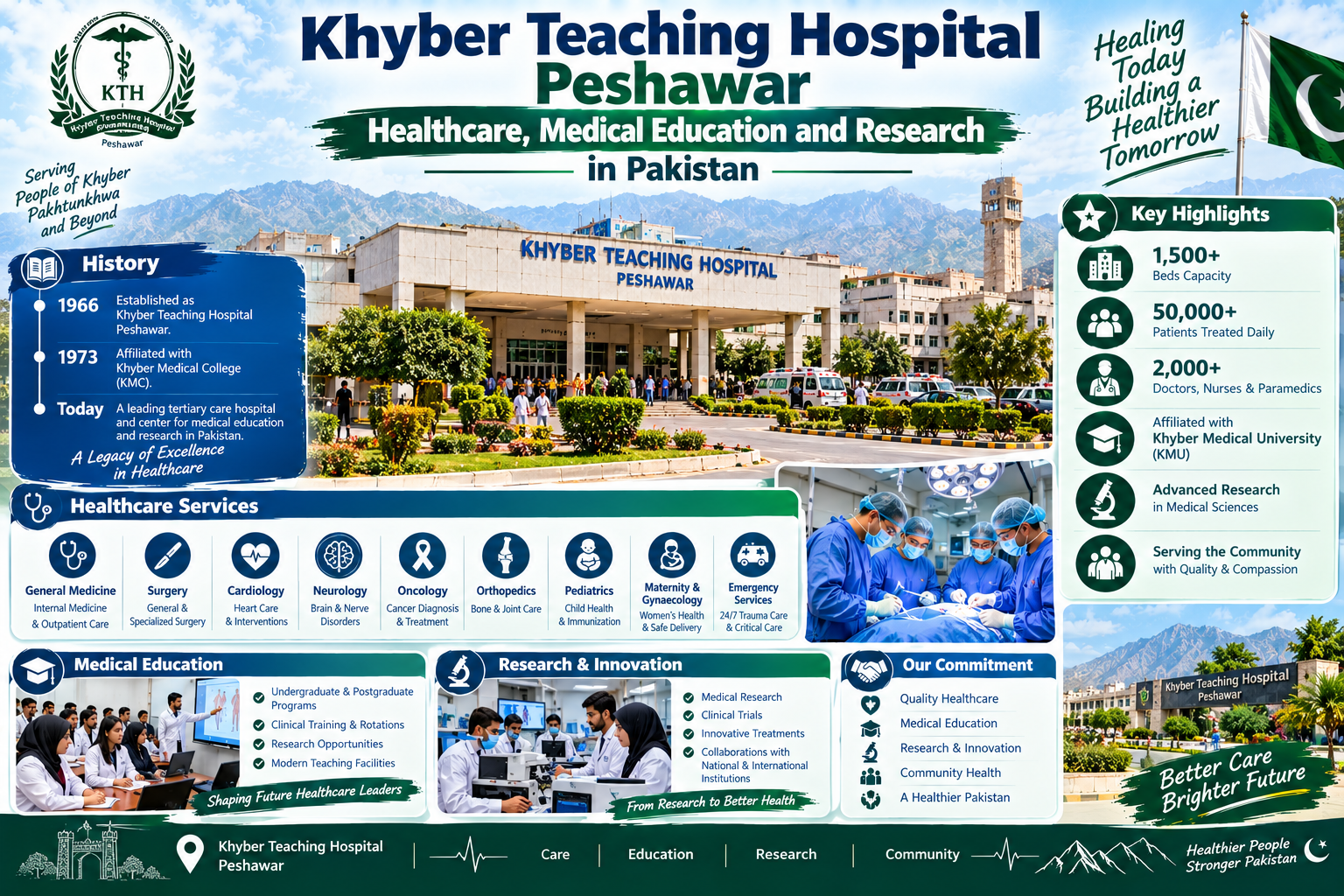
Khyber Teaching Hospital Peshawar is one of the major public-sector teaching hospitals in Khyber Pakhtunkhwa. Located on University Road in Peshawar, the hospital provides tertiary healthcare, emergency treatment, specialist medical and surgical services, diagnostic facilities, rehabilitation, and clinical education. It is also closely connected with Khyber Medical College and other educational institutions, making it an important center for medical training and professional development.
According to the hospital's official history, Khyber Teaching Hospital has been providing tertiary healthcare and teaching facilities since 1977. Its foundation and development were part of the expansion of organized healthcare and medical education in the province. Today, the hospital covers a large area and has more than 1,600 beds, while its official website describes services across more than 20 healthcare specialties.
The hospital's importance extends beyond Peshawar. Its large clinical structure allows it to serve patients from different parts of Khyber Pakhtunkhwa and neighboring regions. At the same time, its teaching role helps prepare doctors, nurses, and other healthcare professionals for Pakistan's future healthcare needs.
History of Khyber Teaching Hospital
The history of Khyber Teaching Hospital goes back several decades. According to the hospital's official historical record, planning for the hospital began in 1958. Its foundation stone was laid on November 30, 1967, and it was officially inaugurated by Prime Minister Zulfikar Ali Bhutto on February 19, 1977.
The hospital was developed as part of an effort to strengthen healthcare and medical education in Khyber Pakhtunkhwa.
Over the decades, Khyber Teaching Hospital has expanded its clinical departments, diagnostic facilities, emergency services, educational activities, and supporting infrastructure.
Its development reflects the growing healthcare needs of Peshawar and the wider province.
Location and Importance
Khyber Teaching Hospital is located on University Road in Peshawar. Its location places it within an important educational and healthcare area of the city. The hospital's official contact information identifies University Road, Peshawar, as its location.
Peshawar is an important urban center and serves as a gateway between different parts of Khyber Pakhtunkhwa and neighboring regions. Because of this geographical position, major hospitals in the city can receive patients from a wide area.
Khyber Teaching Hospital therefore has an important role in providing specialist healthcare to patients who may need services that are not available at smaller healthcare facilities.
Tertiary Healthcare Services
Khyber Teaching Hospital functions as a tertiary-care institution.
Tertiary healthcare generally involves specialized medical services that require advanced facilities, experienced healthcare professionals, specialist departments, and diagnostic support.
Patients may be referred to a tertiary hospital when they need specialist assessment, complex treatment, surgery, intensive monitoring, or advanced diagnostic services.
Khyber Teaching Hospital's official website describes its healthcare services as including medical, surgical, emergency, preventive, rehabilitative, and diagnostic care.
Emergency Department
Emergency care is one of the most important services provided by Khyber Teaching Hospital.
The hospital's Accident and Emergency Department operates around the clock and is designed to assess and manage patients requiring urgent medical attention. The hospital states that the department can receive up to 3,000 patients per day.
The emergency department includes a trauma bay, minor operating room, and a six-bed high-dependency area used for resuscitation. It also has separate clinical decision units and specialist support from internal medicine, cardiology, pediatrics, general surgery, orthopedics, and gynecology.
An important feature of the emergency service is the availability of dedicated pathology, radiology, and pharmacy support. This can help reduce the need for emergency patients to leave the department for essential investigations and treatment support.
Outpatient Department
The Outpatient Department, commonly known as OPD, is another important part of the hospital.
OPDs allow patients to receive medical consultation, diagnosis, treatment, and follow-up without necessarily requiring overnight admission.
The hospital provides OPD services across multiple specialties. Its official website lists regular OPD hours from Monday to Friday, while emergency services remain available 24 hours a day.
For patients with non-emergency health concerns, outpatient services can provide an important first point of contact with specialist doctors.
Medical and Allied Specialties
Khyber Teaching Hospital has a broad range of medical and allied specialties.
The hospital's official list includes:
General Medicine
Cardiology
Dermatology
Endocrinology
Neurology
Nephrology
Gastroenterology
Rheumatology
Pulmonology
Oncology
Psychiatry
Physical Therapy
Pediatrics
These specialties allow patients with different medical conditions to receive specialized assessment and treatment within the hospital system.
General Medicine
General medicine is one of the core departments of a teaching hospital.
The Department of Medicine at Khyber Teaching Hospital has multiple functional units and is involved in patient care, undergraduate teaching, postgraduate training, research, and professional development.
According to the hospital, the department provides 24-hour services for patients admitted with acute and critical illnesses. It also participates in clinical conferences, journal clubs, procedural skills training, and other academic activities.
This combination of patient care and education makes general medicine particularly important for medical students and postgraduate trainees.
Cardiology
Cardiology focuses on diseases and disorders of the heart and circulatory system.
A major teaching hospital requires cardiology services because cardiovascular conditions can require specialist assessment, diagnostic testing, monitoring, and treatment.
Khyber Teaching Hospital lists cardiology among its medical and allied specialties. The specialty also contributes to emergency care because some urgent medical conditions require rapid cardiac assessment.
Cardiology can work closely with emergency medicine, internal medicine, radiology, pathology, surgery, and other departments.
Nephrology
Nephrology deals with kidney-related diseases and conditions.
Patients with kidney problems may require specialist consultation, laboratory testing, imaging, medication management, and other forms of treatment.
Khyber Teaching Hospital lists nephrology among its specialist medical departments. The hospital's current procurement information also demonstrates ongoing investment in nephrology-related equipment and supplies.
Gastroenterology
Gastroenterology focuses on the digestive system, including the stomach, intestines, liver, and related organs.
Patients with digestive disorders may require clinical evaluation, laboratory testing, imaging, endoscopic procedures, or specialist treatment.
The availability of gastroenterology as a specialist service adds to the hospital's ability to provide comprehensive tertiary healthcare.
Neurology
Neurology focuses on disorders involving the brain, spinal cord, and nervous system.
Neurological patients may require detailed clinical examination, imaging, laboratory investigations, and specialist management.
Neurology is particularly important in a teaching hospital because students need practical exposure to neurological examination and clinical reasoning.
The hospital lists neurology among its medical and allied specialties.
Pulmonology
Pulmonology deals with diseases of the lungs and respiratory system.
Respiratory conditions can range from common illnesses to complex diseases requiring specialist care.
A hospital such as Khyber Teaching Hospital needs respiratory specialists because patients with serious breathing problems may require emergency assessment, diagnostic imaging, laboratory testing, and inpatient treatment.
Pediatrics
Pediatric healthcare is a major part of Khyber Teaching Hospital's services.
The hospital's Department of Pediatrics is a 129-bed department established in May 1974. It provides healthcare for infants, children, and adolescents. The department includes general pediatric units, a pediatric intensive-care unit, a neonatal intensive-care unit, a nutrition rehabilitation unit, an infectious disease unit, and an emergency pediatric service.
The presence of specialized pediatric facilities makes the hospital an important center for children's healthcare.
Surgical and Allied Specialties
Khyber Teaching Hospital also provides a broad range of surgical services.
Its official list includes:
General Surgery
Orthopedics
Urology
Pediatric Urology
ENT
Gynecology
Neurosurgery
Ophthalmology
Plastic Surgery
Pediatric Surgery
This range allows the hospital to address many conditions requiring surgical assessment and treatment.
General Surgery
The General Surgery Department is an important part of the hospital's clinical structure.
The hospital describes its surgery department as an active surgical unit performing a wide range of procedures. It is supported by surgeons, postgraduate trainees, and medical officers.
Surgical care involves more than the operation itself. Patients may require preoperative assessment, anesthesia, diagnostic testing, postoperative monitoring, nursing care, and rehabilitation.
Orthopedic Services
Orthopedics focuses on the musculoskeletal system.
Patients with fractures, injuries, joint problems, and other orthopedic conditions may require specialist assessment and treatment.
Orthopedic care often involves collaboration with radiology, emergency medicine, physiotherapy, surgery, and rehabilitation services.
Khyber Teaching Hospital lists orthopedics among its surgical and allied specialties
Neurosurgery
Neurosurgery is a highly specialized field dealing with conditions affecting the brain, spine, and nervous system that may require surgical treatment.
Its presence within a major teaching hospital is important because patients with complex neurological and surgical conditions may need coordinated care involving neurology, radiology, intensive care, anesthesia, and rehabilitation.
Gynecology
Gynecology provides specialist healthcare related to women's reproductive health.
The hospital lists gynecology among its surgical and allied specialties and also includes gynecology support within its emergency services.
Teaching hospitals are particularly important for training doctors in women's healthcare because they provide exposure to a broad range of clinical cases.
ENT Services
ENT, or ear, nose, and throat medicine, is another specialist area available at Khyber Teaching Hospital.
ENT services can include medical consultations, diagnostic assessment, and surgical procedures.
The specialty often works with pediatrics, neurology, audiology, speech-related services, and other healthcare fields.
Ophthalmology
Ophthalmology focuses on eye health and vision-related conditions.
Patients may require eye examinations, diagnostic assessment, medical treatment, or surgical care.
The inclusion of ophthalmology among the hospital's surgical and allied specialties allows patients to access specialist eye services within a large tertiary-care environment.
Radiology and Medical Imaging
Radiology plays a critical role in modern healthcare.
Khyber Teaching Hospital provides diagnostic imaging services including MRI, CT scans, ultrasound, and X-rays. The hospital describes its radiology services as being equipped with modern technology.
Medical imaging can support diagnosis in many departments, including emergency medicine, orthopedics, neurology, surgery, cardiology, and oncology.
Pathology and Laboratory Services
Pathology is another essential part of the hospital.
Laboratory testing helps doctors diagnose and monitor diseases.
Khyber Teaching Hospital states that its pathology services provide laboratory results and personalized services, with round-the-clock phlebotomy for both inpatients and outpatients.
The emergency department also has dedicated pathology support, helping urgent patients receive necessary diagnostic investigations without leaving the emergency area.
Pharmacy Services
Pharmacy services are essential for safe and organized medication management.
Khyber Teaching Hospital lists pharmacy as one of its main services. The emergency department also has dedicated pharmacy support.
Hospital pharmacy teams can support medication supply, storage, dispensing, and appropriate use under established clinical procedures.
Nursing Department
Nurses are an essential part of healthcare delivery.
They monitor patients, provide bedside care, administer medicines according to professional instructions, communicate with healthcare teams, support patients and families, and contribute to infection prevention and patient safety.
Khyber Teaching Hospital has a dedicated Nursing Department and nursing leadership within its organizational structure.
Medical Education
Medical education is one of Khyber Teaching Hospital's central responsibilities.
The hospital is connected with Khyber Medical College and Khyber College of Dentistry. Its official website identifies these as educational institutions associated with the hospital.
Clinical teaching allows students to connect theoretical knowledge with real healthcare environments.
Medical students can learn about patient communication, physical examination, diagnosis, clinical decision-making, teamwork, medical ethics, and patient safety under appropriate supervision.
Postgraduate Training
Postgraduate training is also an important part of the hospital's academic role.
The Department of Medicine, for example, states that it provides postgraduate medicine training through relevant professional training pathways and participates in research and procedural skills development.
Postgraduate training helps doctors develop advanced knowledge and practical skills in their chosen specialties.
Research and Evidence-Based Medicine
Medical research supports the development of better healthcare.
Khyber Teaching Hospital's mission specifically emphasizes continuous research, education, and evidence-based practice.
Research can help healthcare professionals understand local disease patterns, improve treatment approaches, evaluate healthcare systems, and identify opportunities for better patient care.
Academic activities such as conferences, journal clubs, clinical discussions, and research projects can help create a culture of continuous learning.
Rehabilitation Services
Rehabilitation is an important part of modern healthcare.
Patients recovering from injuries, neurological conditions, surgeries, or other illnesses may require physiotherapy and rehabilitation.
Khyber Teaching Hospital lists physical therapy among its medical and allied services and includes rehabilitation within its wider healthcare service structure.
Rehabilitation can help patients work toward improved mobility, independence, and quality of life.
Information Technology and Digital Healthcare
Modern hospitals increasingly depend on information technology.
Khyber Teaching Hospital has a Management Information System department that supports the hospital's computer applications and technology infrastructure.
The hospital states that its MIS department works on healthcare information systems designed to improve medical care, public health systems, efficiency, and patient satisfaction.
The hospital also reports fiber-optic networking supporting more than 500 CCTV cameras.
Digital systems can help hospitals organize patient information, coordinate departments, improve communication, and reduce administrative errors.
Biomedical Engineering
Medical equipment requires regular maintenance and technical support.
Khyber Teaching Hospital has a Biomedical Engineering Department responsible for supporting the safe and reliable operation of medical equipment.
The department manages biomedical equipment, maintenance planning, troubleshooting, repairs, and related technical services.
This function is especially important in a modern hospital because diagnostic and treatment services depend on reliable medical technology.
Quality and Patient Safety
Quality healthcare involves more than having doctors and equipment.
It also requires effective systems for patient safety, staff training, monitoring, feedback, and continuous improvement.
Khyber Teaching Hospital's quality policy emphasizes accessible, affordable, and quality healthcare, professional education, medical research, staff development, technology, and continuous improvement.
The hospital also emphasizes patient feedback and performance monitoring as part of quality improvement.
Affordable and Accessible Healthcare
The hospital's mission emphasizes accessible and affordable quality healthcare without discrimination based on gender, caste, religion, disability, or social status.
This reflects the important role of public hospitals in Pakistan.
Large public-sector hospitals can provide specialist services to patients from different socioeconomic backgrounds and help make advanced healthcare more accessible.
Community Role
A teaching hospital can have an impact beyond the hospital building.
Through medical education, community interaction, preventive healthcare, research, and professional training, hospitals can contribute to broader public health.
Khyber Teaching Hospital's stated vision includes patient care, medical education, research, and community interaction.
This combination demonstrates how a hospital can contribute to healthcare at both individual and community levels.
Challenges and Future Development
Large teaching hospitals often face challenges related to high patient demand, infrastructure, staffing, equipment maintenance, and increasing healthcare needs.
The continued development of Khyber Teaching Hospital therefore requires investment in modern technology, staff training, infrastructure, research, and patient-care systems.
The hospital's recent activities show continuing attention to infrastructure, diagnostic services, medical equipment, quality systems, and institutional oversight. In January 2026, for example, its Board of Governors conducted a comprehensive visit covering the OPD, emergency department, laboratories, pediatric emergency services, and nursing hostel.
Future development can further strengthen the hospital's ability to provide high-quality healthcare while supporting medical education.
Importance for Khyber Pakhtunkhwa
Khyber Teaching Hospital has an important place in the healthcare system of Khyber Pakhtunkhwa.
Its large number of beds, specialist departments, emergency services, diagnostic facilities, teaching programs, and research activities allow it to serve multiple purposes.
The hospital's official history describes it as one of the major hospitals in the region, with more than 1,600 beds and services across more than 20 healthcare specialties.
Its importance therefore extends beyond routine patient care. It also contributes to the training of the next generation of healthcare professionals.
Conclusion
Khyber Teaching Hospital Peshawar is a major public-sector teaching and tertiary-care hospital in Khyber Pakhtunkhwa.
Since its official inauguration in 1977, the institution has developed into a large healthcare and educational center. Its more than 1,600 beds, broad range of medical and surgical specialties, 24-hour emergency services, diagnostic facilities, rehabilitation services, and academic connections make it an important part of the region's healthcare infrastructure.
The hospital's connection with Khyber Medical College and other educational institutions strengthens its role in medical education. Students and postgraduate trainees can gain practical clinical experience while working in a multidisciplinary healthcare environment.
Its emergency department, specialist medical services, surgical departments, pediatric facilities, radiology, pathology, pharmacy, nursing services, and rehabilitation programs provide support for a wide variety of healthcare needs.
Khyber Teaching Hospital also emphasizes research, evidence-based medicine, quality improvement, technology, and community interaction. These areas are increasingly important as Pakistan's healthcare requirements continue to grow.
For Peshawar and the wider Khyber Pakhtunkhwa region, Khyber Teaching Hospital represents an important combination of patient care, medical education, research, and professional development. Its continued modernization and investment in healthcare professionals and technology can help strengthen its contribution to Pakistan's healthcare system in the years ahead.
FAQs
1. When was Khyber Teaching Hospital Peshawar officially inaugurated?
Khyber Teaching Hospital was officially inaugurated on February 19, 1977.
2. Where is Khyber Teaching Hospital located?
Khyber Teaching Hospital is located on University Road in Peshawar, Khyber Pakhtunkhwa.
3. Does Khyber Teaching Hospital provide emergency services?
Yes. Its Accident and Emergency Department provides emergency care 24 hours a day.
4. What medical specialties are available at Khyber Teaching Hospital?
The hospital offers numerous medical and surgical specialties, including medicine, cardiology, neurology, nephrology, pediatrics, general surgery, orthopedics, urology, ENT, gynecology, neurosurgery, ophthalmology, and others.
5. Is Khyber Teaching Hospital involved in medical education?
Yes. Khyber Teaching Hospital is closely associated with medical education and provides clinical training and postgraduate learning opportunities.




