Introduction
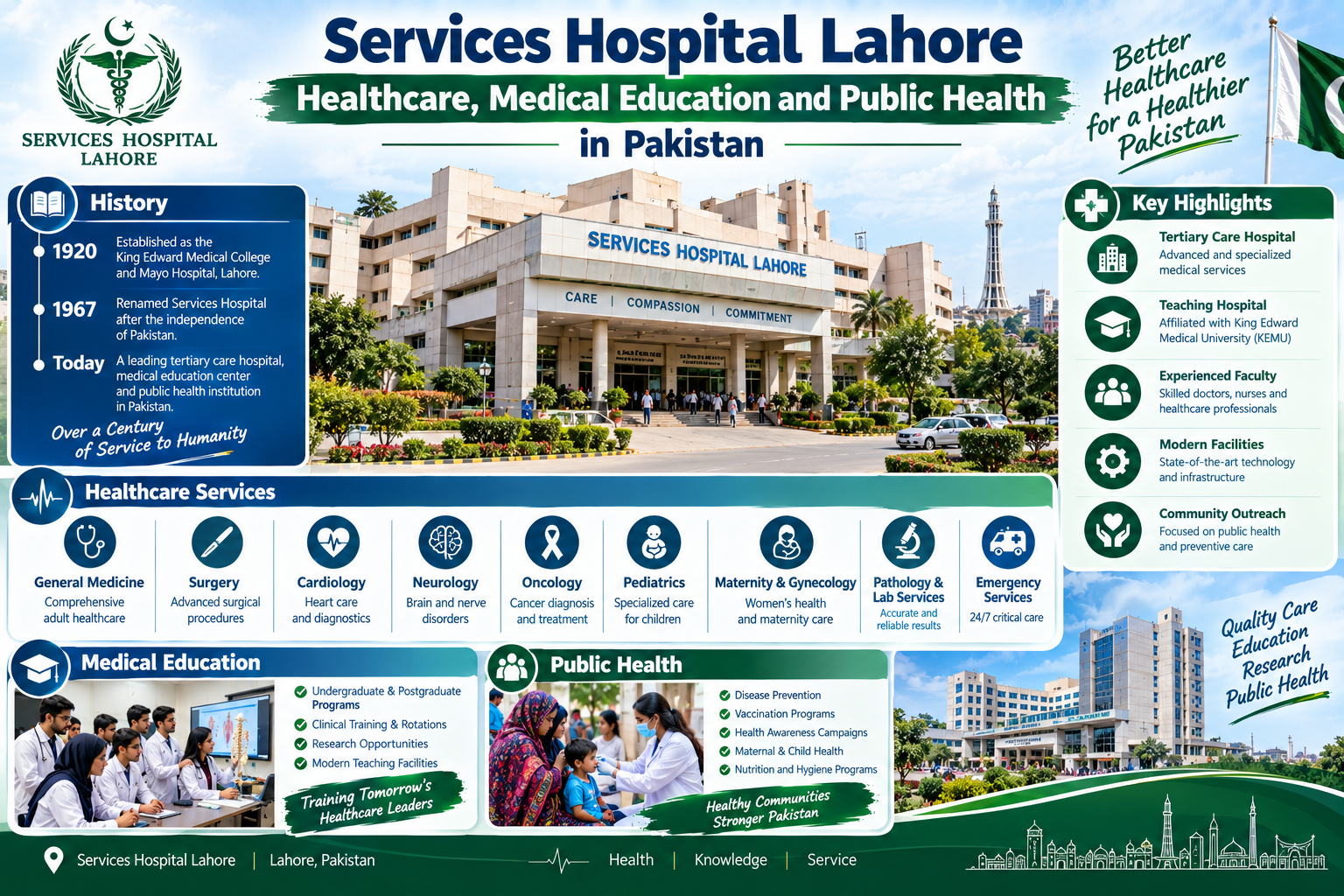
Services Hospital Lahore is an important public-sector teaching hospital in Lahore, Punjab. It provides a wide range of medical and surgical services while also playing a major role in medical education and professional training. The hospital is closely associated with the Services Institute of Medical Sciences (SIMS), creating an environment where patient care, medical education, clinical training, and research can work together.
As a large public hospital, Services Hospital serves patients from Lahore as well as surrounding areas. Its role is particularly significant because public-sector hospitals provide healthcare services to large sections of the population and also help train the doctors, nurses, and other healthcare professionals needed by Pakistan's healthcare system.
Over the years, Services Hospital has developed into a major healthcare institution with multiple specialties, diagnostic facilities, emergency services, surgical departments, intensive-care facilities, and teaching units. Its connection with SIMS further strengthens its importance as a center of medical education.
History of Services Hospital Lahore
The development of Services Hospital is connected with the growth of organized public healthcare in Lahore. As the city expanded, the need for hospitals capable of providing specialist and teaching services also increased.
Services Hospital gradually developed into a major teaching institution. Its association with Services Institute of Medical Sciences helped establish a stronger connection between clinical practice and medical education.
Teaching hospitals are different from ordinary healthcare facilities because they have an additional responsibility: they must provide an environment in which medical students and postgraduate trainees can learn professional skills while patients receive appropriate care.
This dual role has helped Services Hospital become an important part of Lahore's healthcare and medical education infrastructure.
Location and Role in Lahore
Services Hospital is located in Lahore and serves a large population from the city and surrounding communities.
Lahore is one of Pakistan's largest urban centers and has a high demand for healthcare services. Public hospitals such as Services Hospital therefore have an important responsibility in providing accessible medical care.
Patients visiting a large public teaching hospital may require services ranging from routine outpatient consultations to specialist treatment, emergency care, surgery, diagnostic investigations, and inpatient management.
The hospital's location in Lahore also makes it an important clinical training environment for medical students associated with SIMS.
Services Institute of Medical Sciences
The connection between Services Hospital and the Services Institute of Medical Sciences is one of the institution's most important features.
Medical education requires students to move beyond textbooks and classroom lectures. A teaching hospital allows them to observe clinical practice and, under appropriate supervision, develop professional skills.
Students can learn about patient history, physical examination, diagnosis, communication, medical ethics, teamwork, and clinical decision-making.
The hospital also provides an environment for postgraduate training, where doctors can develop specialist knowledge and practical skills in their chosen fields.
A Major Teaching Hospital
Services Hospital has a broad clinical structure that supports both healthcare delivery and medical education.
A large teaching hospital usually includes outpatient departments, inpatient wards, operating theatres, emergency facilities, intensive-care units, laboratories, imaging departments, pharmacies, and specialized clinical units.
These facilities allow students and trainees to see how different parts of a healthcare system work together.
For example, a patient may first arrive through an outpatient clinic or emergency department, undergo diagnostic testing, receive a specialist consultation, and then be admitted or referred to another department.
This integrated environment is valuable for medical education because students can understand the complete patient-care process.
Emergency Healthcare
Emergency medicine is one of the most important responsibilities of a large public hospital.
Services Hospital provides emergency healthcare for patients who require urgent assessment and treatment. Emergency departments need teams capable of responding to a wide range of medical and surgical conditions.
Emergency care often requires coordination between doctors, nurses, laboratory professionals, radiology staff, surgeons, anesthetists, and other healthcare workers.
The teaching environment also allows medical trainees to learn about emergency assessment and professional teamwork under appropriate supervision.
A well-organized emergency department is particularly important in a large city because urgent healthcare needs can occur at any time.
Medical and Surgical Departments
Services Hospital provides healthcare through a wide range of medical and surgical specialties.
Medical specialties generally focus on conditions managed through medical diagnosis and treatment, while surgical departments focus on conditions that may require operative procedures.
A large teaching hospital can bring these specialties together under one healthcare system.
Common areas in a major hospital may include medicine, surgery, pediatrics, obstetrics and gynecology, orthopedics, cardiology, neurology, dermatology, ENT, ophthalmology, psychiatry, radiology, anesthesiology, and other specialist fields.
The availability of multiple departments is particularly useful when patients require multidisciplinary care.
Internal Medicine
Internal medicine is a fundamental specialty in any large hospital.
Physicians in internal medicine deal with a wide variety of adult health conditions and often coordinate care when patients have multiple medical problems.
In a teaching hospital, internal medicine is also important for medical education because students learn how to approach symptoms, organize diagnostic information, understand laboratory findings, and develop appropriate clinical plans under supervision.
The department can also work closely with cardiology, nephrology, endocrinology, gastroenterology, pulmonology, neurology, and other specialties.
Surgery
Surgical services are an important component of Services Hospital.
General surgery and specialist surgical departments provide care for patients who require operative assessment or procedures.
Surgery in a teaching hospital also involves a strong educational component. Medical students and postgraduate trainees can learn about surgical assessment, operating-room teamwork, patient preparation, postoperative care, and professional responsibilities.
Operating theatres require cooperation between surgeons, anesthetists, nurses, technicians, and other staff.
Anesthesiology
Anesthesiology plays a central role in modern surgical care.
Anesthesiologists are involved in preparing patients for surgery, providing anesthesia, monitoring patients during procedures, and supporting recovery.
They may also contribute to intensive-care services and pain management.
In a teaching hospital, anesthesiology provides important opportunities for postgraduate training because the specialty requires detailed knowledge of physiology, pharmacology, monitoring, emergency care, and patient safety.
Obstetrics and Gynecology
Women's healthcare is another important part of a major public hospital.
Obstetrics focuses on pregnancy and childbirth, while gynecology addresses conditions involving the female reproductive system.
Teaching hospitals provide important clinical environments for medical students and postgraduate trainees in these specialties.
Women's healthcare may involve outpatient consultations, diagnostic services, pregnancy-related care, surgery, emergency management, and coordination with other departments.
The availability of obstetrics and gynecology services in a public teaching hospital is especially important because these services may be needed by patients from a wide range of socioeconomic backgrounds.
Pediatrics
Children have different healthcare requirements from adults, making pediatric medicine an important specialty.
Pediatric services may include outpatient consultations, inpatient care, emergency management, diagnostic services, and specialist treatment.
A teaching hospital also provides opportunities for medical students and pediatric trainees to learn how healthcare needs change according to a child's age and development.
Pediatric care often requires communication with parents or guardians as well as careful attention to the child's individual needs.
Orthopedic Care
Orthopedics deals with conditions affecting bones, joints, muscles, ligaments, and other parts of the musculoskeletal system.
Services Hospital's teaching environment supports orthopedic education and clinical care.
Orthopedic departments may deal with injuries, fractures, joint conditions, spinal problems, and other musculoskeletal disorders.
The specialty also works closely with radiology, physiotherapy, rehabilitation, emergency medicine, and surgery.
Cardiology
Cardiology focuses on diseases and conditions involving the heart and circulatory system.
A major teaching hospital requires cardiology services because cardiovascular conditions are an important part of adult healthcare.
Cardiology may involve diagnostic evaluation, medical treatment, monitoring, and coordination with other specialties when advanced intervention is required.
For medical students, cardiology also provides an important area of clinical learning because cardiovascular examination and diagnosis are core parts of medical education.
Neurology
Neurology focuses on conditions involving the brain, spinal cord, nerves, and related systems.
Neurological care can involve detailed clinical assessment, diagnostic testing, imaging, and collaboration with other departments.
In a teaching hospital, neurology provides opportunities for students and trainees to learn about neurological examination and the diagnosis of complex conditions.
Neurology may also work closely with neurosurgery, radiology, rehabilitation, psychiatry, and emergency medicine.
Dermatology
Dermatology focuses on diseases and conditions involving the skin, hair, and nails.
Dermatology services are important because skin conditions are common and can affect people of all ages.
Teaching hospitals also provide an academic environment for dermatology students and trainees, allowing them to study different clinical patterns and diagnostic approaches.
Dermatology can sometimes require collaboration with internal medicine, rheumatology, infectious diseases, pathology, and other specialties.
Ear, Nose and Throat Services
ENT is another important specialist area.
ENT doctors manage conditions involving the ear, nose, throat, and related structures.
The specialty can include medical consultations as well as surgical procedures. It also overlaps with areas such as audiology, speech therapy, pediatrics, neurology, and respiratory medicine.
Teaching hospitals provide an environment where students can develop their understanding of ENT examination and common clinical conditions.
Ophthalmology
Eye care is an essential part of comprehensive healthcare.
Ophthalmology deals with diseases and conditions affecting the eyes and vision.
Large hospitals may provide outpatient assessment, diagnostic testing, medical management, and surgical services related to eye health.
For medical education, ophthalmology provides students with opportunities to learn about eye examination and the relationship between visual symptoms and broader health conditions.
Diagnostic Services
Modern healthcare depends on accurate diagnosis.
Services Hospital's clinical departments are supported by diagnostic facilities such as laboratories and imaging services. These facilities provide healthcare professionals with important information needed to assess patients.
Laboratory testing can help evaluate blood, urine, and other biological samples. Imaging can help doctors examine internal structures and identify abnormalities.
Diagnostic departments are also important teaching environments because medical students and trainees need to understand how clinical findings are connected with laboratory and imaging results.
Radiology
Radiology is an important supporting specialty in a modern hospital.
Radiologists interpret medical images and work with clinical teams to support diagnosis.
Imaging can be particularly important in emergency medicine, surgery, orthopedics, neurology, cardiology, and oncology.
The teaching environment also helps students understand the appropriate role of different imaging methods and how imaging findings contribute to clinical decisions.
Intensive Care
Intensive-care services are required for patients who need close monitoring and advanced medical support.
Large teaching hospitals typically have intensive-care facilities supported by physicians, nurses, anesthesiologists, respiratory professionals, laboratory teams, and other specialists.
Intensive care also plays an important role in medical education because trainees can learn about monitoring, teamwork, critical illness, and patient safety.
Nursing and Allied Health Professionals
Doctors are only one part of a healthcare team.
Nurses, pharmacists, physiotherapists, laboratory professionals, radiology technicians, respiratory therapists, dietitians, and other allied health workers all contribute to patient care.
A teaching hospital provides an environment where these different professionals can work together.
Nurses in particular play an essential role in monitoring patients, providing bedside care, communicating with families, supporting doctors, preventing infections, and helping patients understand aspects of their care.
Medical Education
Medical education is one of Services Hospital's defining characteristics.
The hospital's association with Services Institute of Medical Sciences allows medical students to gain practical clinical exposure.
Classroom learning provides the scientific foundation of medicine, but clinical education teaches students how that knowledge is applied to real patients.
Students learn professional behavior, communication, teamwork, clinical examination, diagnostic reasoning, and patient-care principles.
Postgraduate education further develops doctors in specialist fields.
Importance of Clinical Training
Clinical training is essential for healthcare professionals.
A student may learn about a disease from a textbook, but clinical training provides opportunities to observe how patients present with symptoms and how healthcare professionals investigate and manage those conditions.
Teaching hospitals expose students to different patient populations and a broad range of clinical situations.
This experience can help future doctors develop confidence, communication skills, and professional judgment under supervision.
Research and Academic Activities
Medical research is another important function of teaching hospitals.
Research can help healthcare professionals understand diseases, evaluate healthcare practices, identify local health challenges, and improve patient services.
The connection between Services Hospital and a medical education institution creates opportunities for clinical research and academic activities.
Research may involve medical students, postgraduate trainees, faculty members, and healthcare professionals from different specialties.
Academic activities can include seminars, conferences, workshops, case discussions, and research projects.
Public-Sector Healthcare
Services Hospital has an important role as a public-sector healthcare institution.
Public hospitals serve communities with different financial circumstances and therefore have an important social responsibility.
For many patients, public hospitals are an important source of specialist healthcare.
Large public teaching hospitals also help reduce the pressure on smaller healthcare facilities by providing specialist departments, diagnostic services, surgery, emergency care, and inpatient treatment.
Healthcare Accessibility
Accessibility is a major issue in healthcare.
Hospitals that serve large populations must manage high demand while maintaining appropriate standards of care.
Services Hospital's public-sector role makes it an important institution for people who need medical services in Lahore and surrounding areas.
Improving healthcare accessibility involves not only increasing the number of beds or departments but also improving staffing, equipment, infrastructure, diagnostic services, patient communication, and administrative systems.
Technology in Modern Healthcare
Healthcare technology continues to develop rapidly.
Modern hospitals increasingly use advanced imaging, laboratory systems, electronic medical records, digital communication, telemedicine, and data-management tools.
Technology can support healthcare professionals by making information easier to access and helping departments coordinate their work.
However, technology must be supported by trained professionals, appropriate infrastructure, maintenance, cybersecurity, and responsible use of patient information.
Patient Safety
Patient safety is an essential part of hospital quality.
It includes accurate identification of patients, safe medication practices, infection prevention, appropriate surgical procedures, effective communication, and careful monitoring.
Teaching hospitals have an additional educational responsibility because future healthcare professionals learn professional safety practices in these environments.
Developing a culture of patient safety can therefore benefit both current patients and future healthcare workers.
Challenges Facing Large Public Hospitals
Large public hospitals can face several challenges.
High patient numbers can put pressure on outpatient departments, emergency services, wards, diagnostic facilities, and healthcare professionals.
Maintaining buildings and equipment also requires continuous investment.
Another challenge is ensuring that healthcare professionals have access to updated training and modern technology.
Despite these challenges, public teaching hospitals remain extremely important because they combine healthcare delivery with professional education.
Opportunities for Future Development
Services Hospital has opportunities to strengthen its role through modernization and continued investment.
Digital healthcare could improve administrative and clinical processes. Modern diagnostic technologies could support more efficient clinical evaluation. Improved infrastructure could enhance patient comfort and workflow.
Medical education can also benefit from simulation laboratories, digital learning platforms, updated libraries, and research facilities.
Investment in nursing and allied health education is equally important because healthcare depends on multidisciplinary teams.
Services Hospital and the Future of Healthcare
Pakistan's healthcare system will need a growing number of trained doctors, nurses, technicians, pharmacists, physiotherapists, and other professionals.
Teaching hospitals such as Services Hospital can contribute significantly to meeting this need.
The combination of clinical care and medical education gives the hospital a long-term role in healthcare development.
As medicine becomes more technology-driven, the hospital's educational environment can help future professionals understand both traditional clinical skills and modern healthcare systems.
Conclusion
Services Hospital Lahore is an important public-sector teaching hospital that contributes to healthcare, medical education, clinical training, and professional development in Pakistan.
Its connection with Services Institute of Medical Sciences strengthens its educational role and provides medical students and trainees with opportunities to gain practical experience in a large clinical environment.
The hospital's broad range of medical and surgical services allows it to serve patients with different healthcare needs. Emergency medicine, surgery, internal medicine, pediatrics, obstetrics and gynecology, cardiology, orthopedics, neurology, dermatology, ENT, ophthalmology, diagnostic medicine, intensive care, and other specialties form part of the wider healthcare environment found in a major teaching hospital.
Its public-sector status also gives it an important social role. Large public hospitals remain essential for providing healthcare to diverse communities while training the healthcare professionals needed for the future.
As Pakistan's healthcare needs continue to evolve, Services Hospital can continue to contribute through better infrastructure, modern technology, medical education, research, professional development, and patient-centered care.
The combination of healthcare delivery and education makes Services Hospital more than simply a place for medical treatment. It is an important part of Lahore's medical infrastructure and a significant contributor to the development of Pakistan's healthcare workforce.
FAQs
1. Where is Services Hospital Lahore located?
Services Hospital is located in Lahore, Punjab, and is closely associated with Services Institute of Medical Sciences.
2. Is Services Hospital a teaching hospital?
Yes. Services Hospital is a major teaching hospital associated with Services Institute of Medical Sciences and supports undergraduate and postgraduate medical education.
3. What type of healthcare does Services Hospital provide?
It provides a wide range of medical, surgical, emergency, diagnostic, inpatient, and specialist healthcare services.
4. Why is Services Hospital important for medical students?
The hospital provides a clinical environment where medical students and trainees can connect classroom knowledge with supervised practical experience.
5. Does Services Hospital contribute to Pakistan's healthcare system?
Yes. Its role includes public healthcare, specialist treatment, medical education, clinical training, and the development of healthcare professionals.