Introduction
Liaquat National Hospital Karachi is one of Pakistan's prominent private-sector healthcare institutions. Located near the National Cricket Stadium on Stadium Road, Karachi, the hospital has developed over several decades into a large tertiary-care healthcare and medical education center.
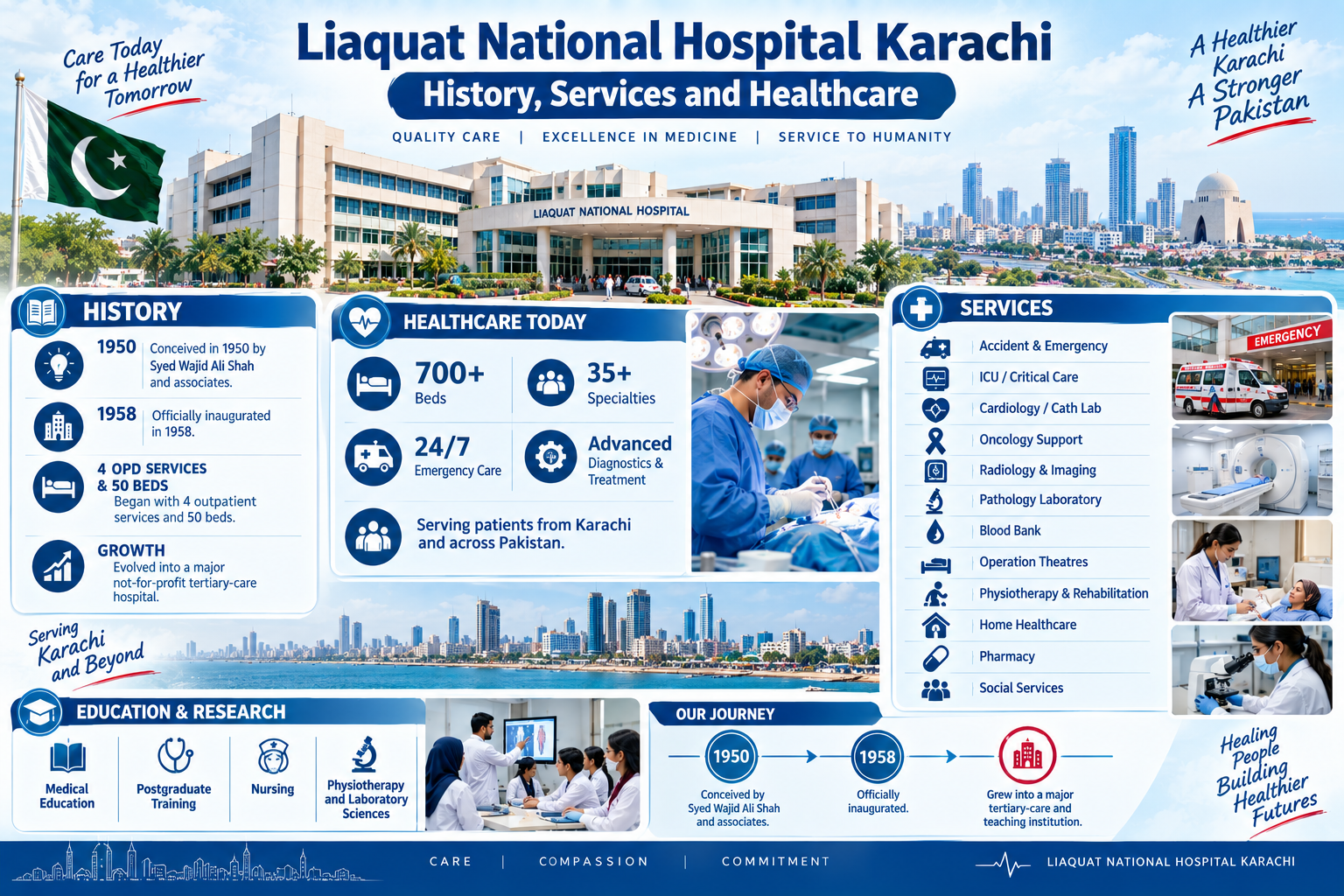
The institution was conceived in 1950 by Syed Wajid Ali Shah and his associates and was officially inaugurated in 1958. It began with four outpatient services and 50 beds and gradually expanded into a large healthcare organization serving patients from Karachi as well as other parts of Pakistan. Liaquat National Hospital describes itself as a non-profit organization committed to providing quality healthcare at affordable rates.
Today, Liaquat National Hospital provides a wide range of medical, surgical, diagnostic, emergency, rehabilitation, nursing, and allied healthcare services. Its educational institutions also train doctors, nurses, medical technologists, physiotherapists, laboratory professionals, and other healthcare workers.
The hospital's combination of patient care, education, research, and professional training makes it an important institution within Pakistan's healthcare system.
History of Liaquat National Hospital
The history of Liaquat National Hospital goes back to the early years after the creation of Pakistan. Its founders envisioned an institution that could provide quality medical care to people from different socioeconomic backgrounds.
The organization was conceived in 1950 and officially inaugurated in 1958. At that time, the hospital had only four outpatient services and 50 beds. Over the following decades, it expanded its infrastructure, specialties, diagnostic facilities, and educational programs.
The growth of the hospital reflects the changing healthcare requirements of Karachi. As the city expanded and medical science developed, the institution introduced new specialties and technologies.
From a relatively small hospital, Liaquat National developed into a major tertiary-care institution with hundreds of beds and dozens of medical and surgical specialties.
Location in Karachi
Liaquat National Hospital is located on Stadium Road in Karachi, close to the National Cricket Stadium. Its central location provides access from different parts of the city.
Karachi is Pakistan's largest metropolitan area and an important center of commerce, education, and healthcare. A large hospital located within the city therefore serves a significant population.
The hospital also receives patients from outside Karachi. LNH states that its services are used by people from Sindh, Balochistan, Khyber Pakhtunkhwa, Punjab, and other parts of the country.
A Large Tertiary-Care Hospital
Liaquat National Hospital has developed into a large tertiary-care institution.
Its official information reports more than 700 beds, while its recent medical college prospectus describes a bed strength of around 800. The hospital also reports more than 35 specialties on its main About Us page, while its 2025–26 prospectus refers to more than 45 medical and surgical specialties.
This broad range of services allows the hospital to provide care for many different medical conditions.
A tertiary-care hospital generally brings together specialist physicians, surgeons, nurses, diagnostic teams, rehabilitation professionals, pharmacists, and other healthcare workers.
This multidisciplinary environment is especially valuable when patients require consultation from more than one specialty.
Medical Specialties
Liaquat National Hospital has numerous departments covering medical and surgical disciplines.
Its official department directory includes Accident and Emergency, Anaesthesiology, Breast Surgery, Cardiac Surgery, Cardiology, Chest Medicine, Clinical Biochemistry, Dental and Maxillofacial Surgery, Dermatology, Diabetes and Endocrinology, ENT, Family Medicine, and many other departments.
The hospital's educational programs also list specialties such as gastroenterology, internal medicine, nephrology, neurology, neurosurgery, oncology, ophthalmology, orthopaedic surgery, pediatrics, plastic surgery, psychiatry, radiology, rheumatology, urology, and vascular surgery.
Having such a broad range of specialties allows different clinical teams to work within one healthcare system.
Emergency Services
Emergency medicine is an essential part of a major hospital.
Liaquat National Hospital provides 24-hour emergency services for patients requiring urgent medical attention. The hospital's official services directory includes Accident and Emergency among its major services.
Emergency departments need coordinated teams capable of responding to different types of urgent situations.
Doctors, nurses, laboratory staff, radiology professionals, surgeons, anesthetists, and other healthcare workers may need to work together depending on the patient's condition.
The availability of emergency care within a large tertiary-care hospital also means that specialist departments can become involved when necessary.
Intensive Care
Intensive care is another major component of tertiary healthcare.
Patients with serious medical conditions may require close monitoring and specialized support. Liaquat National Hospital lists Intensive Care Unit services among its major facilities.
Critical care depends heavily on teamwork. Doctors from different specialties may collaborate with intensivists, anesthetists, nurses, respiratory professionals, laboratory teams, and other healthcare workers.
Modern intensive care also depends on advanced monitoring equipment and carefully organized clinical protocols.
Diagnostic Services
Accurate diagnosis is an important foundation of healthcare.
Liaquat National Hospital provides pathology laboratory services, radiology and imaging, clinical laboratory services, blood bank facilities, and other diagnostic support. Its services directory also lists nuclear medicine facilities.
Diagnostic services allow doctors to gather information needed to understand a patient's medical condition.
Laboratory investigations can provide information about blood, urine, tissues, and other samples, while imaging can help physicians examine internal structures.
Because these facilities are integrated into a large hospital environment, diagnostic teams can work closely with clinical departments.
Cardiology and Cardiac Care
Cardiology is one of the established specialties at Liaquat National Hospital.
The hospital's department directory includes both Cardiology and Cardiac Surgery.
Cardiac healthcare may involve diagnostic assessment, medical management, interventional procedures, surgery, rehabilitation, and long-term follow-up.
LNH also lists a Cath Lab among its services.
A comprehensive cardiac program requires cooperation between cardiologists, cardiac surgeons, nurses, diagnostic specialists, anesthetists, and rehabilitation professionals.
Oncology and Cancer Support
Cancer care is another important part of modern hospital services.
Liaquat National Hospital lists Oncology Support Services among its healthcare services.
Cancer care generally involves several professional disciplines. Depending on the patient's condition, cancer healthcare can involve oncology, surgery, pathology, radiology, pharmacy, nursing, nutrition, rehabilitation, and psychological support.
The presence of multiple related departments within one institution can help create a multidisciplinary approach to cancer care.
Breast Surgery
Liaquat National Hospital has also developed specialized services in breast surgery.
The hospital identifies breast surgery as one of the areas in which it has pioneered specialized services.
Specialized breast healthcare can involve clinical examination, diagnostic imaging, pathology, surgery, oncology, and follow-up care.
A multidisciplinary approach is especially useful because breast-related conditions can require cooperation between several specialties.
Orthopedic Services
Orthopedic medicine focuses on the musculoskeletal system, including bones, joints, muscles, and related structures.
Liaquat National Hospital offers orthopedic surgery among its medical and surgical specialties. Its educational programs also provide opportunities for training in orthopedic surgery.
Orthopedic care may include the evaluation and management of injuries, joint problems, sports-related conditions, and other musculoskeletal issues.
The hospital has also identified arthroscopy among the specialties and procedures it pioneered.
Neurosciences
Neurology and neurosurgery are important specialties in modern tertiary-care hospitals.
Liaquat National Hospital's educational programs list both neurology and neurosurgery among its specialties.
Neurology focuses on disorders involving the nervous system, while neurosurgery involves surgical management of selected conditions affecting the brain, spine, and related structures.
These specialties often work alongside radiology, rehabilitation, intensive care, and other departments.
Pediatrics
Children require healthcare services designed around their age and developmental needs.
Liaquat National Hospital provides pediatric medicine and pediatric surgery among the areas available through its medical education and clinical programs.
Pediatric healthcare can involve preventive care, diagnosis, treatment, emergency services, surgery, and rehabilitation.
A multidisciplinary pediatric environment can be especially important for children who require specialist assessment.
Women's Healthcare
Women's health is another important component of the hospital's clinical services.
LNH's educational programs list Obstetrics and Gynaecology among its medical and surgical specialties.
The hospital also lists Women Imaging Services among its healthcare services.
Women's healthcare can include reproductive health, pregnancy-related services, gynecological conditions, diagnostic imaging, and surgical care.
The combination of clinical and diagnostic services allows healthcare professionals to address different aspects of women's health.
Rehabilitation Services
Healthcare does not always end when a medical procedure or hospital stay is completed.
Rehabilitation can help patients work toward improved mobility, function, communication, and independence depending on their individual needs.
Liaquat National Hospital offers physiotherapy and rehabilitation services. Its educational programs include cardiac rehabilitation, pulmonary rehabilitation, sports rehabilitation, pediatric rehabilitation, intensive-care rehabilitation, musculoskeletal rehabilitation, and neurological rehabilitation.
Rehabilitation teams can include physiotherapists, occupational therapists, speech therapists, and other allied health professionals.
Home Healthcare Services
Modern healthcare increasingly includes services beyond the hospital building.
Liaquat National Hospital lists Home Healthcare Services among its available services.
Home healthcare can be useful for patients who need continuing support outside a hospital environment, depending on their individual healthcare requirements.
This approach can help connect hospital-based treatment with longer-term care.
Services for Older Adults
LNH also provides services focused on elderly healthcare.
Its services directory includes Elderly Healthcare Services and a Senior Citizens Primary Care Unit.
Older adults may have multiple healthcare needs at the same time, making coordinated primary and specialist care particularly important.
Specialized elderly-care services can help healthcare teams consider the different needs associated with aging.
Nursing Services
Nurses are an essential part of every hospital.
Liaquat National Hospital provides nursing services and also operates a College of Nursing as part of its educational system.
Nurses contribute to patient monitoring, communication, clinical care, education, infection prevention, medication administration, and many other areas.
The integration of nursing education with a major hospital gives students opportunities to connect classroom learning with supervised clinical experience.
Medical Education
One of Liaquat National Hospital's most important roles is medical education.
LNH operates Liaquat National Hospital and Medical College and provides undergraduate and postgraduate education. Its educational system also includes the School of Medical Technology, College of Nursing, School of Physiotherapy, School of Diagnostic Laboratory Sciences, College of Speech Therapy, and other educational units.
The hospital's postgraduate training programs support professional development in different clinical and medical specialties.
LNH also offers elective and observership programs for eligible healthcare students, giving participants opportunities to observe clinical and educational activities under qualified faculty.
This makes the hospital not only a healthcare provider but also a major training environment.
Research and Skills Development
Research and professional skills development are important parts of modern medical education.
Liaquat National Hospital established its Research and Skills Development Centre in 1996 as a pioneering skills laboratory. The facility later expanded into a dedicated clinical simulation center.
The center provides training in emergency cardiovascular care, clinical skills, undergraduate healthcare skills, and professional development.
It is also an American Heart Association International Training Centre and has ISO 9001:2015 certification according to LNH's official information.
Simulation-based education allows healthcare students and professionals to practice skills in controlled educational environments.
Health Professions Education
Healthcare education involves much more than teaching clinical procedures.
LNH's Department of Health Professions Education focuses on teaching, assessment, educational research, curriculum development, and professional development.
The department supports faculty development through workshops, certificate courses, journal clubs, curriculum design activities, assessment training, educational research, and technology-related education.
This approach helps improve the quality of teaching across different healthcare professions.
Continuing Medical Education
Medical knowledge changes constantly, so healthcare professionals need opportunities for continued learning.
Liaquat National Hospital organizes Continuing Medical Education programs, seminars, workshops, symposia, and training sessions. The institution states that these activities are designed not only for LNH professionals but also for healthcare providers from across Pakistan.
Continuing education allows healthcare workers to learn about new research, technologies, clinical practices, and professional developments.
Research Culture
Research is another major part of Liaquat National Hospital's identity.
The institution describes itself as a forum for academics and research and includes research and skills development among its educational activities.
Medical research can contribute to better understanding of diseases, healthcare delivery, patient safety, diagnostic methods, and treatment approaches.
A large teaching hospital provides researchers with access to different specialties and a broad clinical environment, creating opportunities for interdisciplinary research.
Social Welfare and Affordable Healthcare
One of the distinctive aspects of Liaquat National Hospital is its non-profit identity.
The hospital states that its mission includes providing affordable and quality medical diagnosis and treatment to all and maintaining a focus on compassion, excellence, education, and research.
LNH also provides social services and financial sponsorship support for eligible patients.
This welfare-oriented approach is significant in a country where healthcare costs can be a challenge for many families.
Technology and Modern Healthcare
Healthcare technology has changed significantly over the last few decades.
Liaquat National Hospital provides modern diagnostic and therapeutic facilities and advanced operating theaters. Its official information also highlights advanced technology across its clinical services.
Technology in a modern hospital can include diagnostic imaging, laboratory systems, surgical equipment, digital information systems, intensive-care monitoring, and simulation-based medical education.
However, technology works most effectively when combined with trained healthcare professionals and appropriate clinical systems.
Patient-Centered Healthcare
LNH emphasizes compassion, empathy, quality, and patient care as part of its institutional values.
The hospital's mission identifies it as a non-commercial and non-profit organization that is open to everyone and focused on affordable medical diagnosis and treatment.
Patient-centered healthcare involves more than diagnosis and treatment. It also includes communication, respect, privacy, safety, comfort, and consideration of the patient's circumstances.
These principles are particularly important in a large hospital where patients may arrive with different needs and expectations.
Role in Karachi's Healthcare System
Karachi has a large and diverse population with significant demand for medical services.
Liaquat National Hospital has played an important role in the city's healthcare environment for decades. Its central location, large capacity, broad specialty base, emergency services, diagnostics, and educational programs make it an important healthcare institution.
The hospital also serves patients from outside Karachi, giving it a broader national role.
Its combination of clinical care and education means that its contribution extends beyond individual patients.
Future of Liaquat National Hospital
The future of healthcare will increasingly depend on medical technology, research, digital systems, professional education, and multidisciplinary care.
Liaquat National Hospital already has several foundations for continued development. These include its medical college, nursing college, allied health schools, research facilities, clinical simulation center, continuing medical education programs, and broad network of clinical specialties.
Continued investment in healthcare professionals, modern diagnostic technologies, patient safety, research, and educational infrastructure can help the institution respond to changing healthcare needs.
The growing importance of preventive care and digital healthcare may also create new opportunities for hospitals to connect with patients outside traditional hospital settings.
Conclusion
Liaquat National Hospital Karachi has developed from a small institution with four outpatient services and 50 beds into one of Pakistan's major private-sector tertiary-care healthcare organizations. Conceived in 1950 and officially inaugurated in 1958, the hospital has built a long history of healthcare delivery, medical education, research, and professional training.
Today, LNH provides a wide range of medical and surgical specialties along with emergency care, intensive care, diagnostic services, rehabilitation, home healthcare, elderly care, nursing services, and social welfare support.
Its educational institutions further strengthen its contribution to Pakistan's healthcare system. Medical students, nurses, medical technologists, physiotherapists, laboratory professionals, and other healthcare workers can receive academic and practical training through the institution.
The Research and Skills Development Centre, continuing medical education programs, and health professions education department demonstrate the hospital's commitment to professional development and lifelong learning.
With its long history, broad clinical services, educational institutions, research activities, and non-profit mission, Liaquat National Hospital continues to hold an important place in Pakistan's healthcare landscape.
in Karachi
FAQs
1. When was Liaquat National Hospital established?
Liaquat National Hospital was conceived in 1950 and officially inaugurated in 1958.
2. Where is Liaquat National Hospital located?
The main hospital is located on Stadium Road in Karachi, near the National Cricket Stadium.
3. What services does Liaquat National Hospital provide?
LNH provides emergency care, inpatient and outpatient services, intensive care, diagnostics, surgery, rehabilitation, nursing, pharmacy, home healthcare, and numerous specialist services.
4. Does Liaquat National Hospital provide medical education?
Yes. LNH operates medical, nursing, medical technology, physiotherapy, diagnostic laboratory sciences, speech therapy, and other healthcare education programs.
5. Is Liaquat National Hospital involved in research and professional training?
Yes. The hospital has a Research and Skills Development Centre and also conducts continuing medical education and health professions education programs.