Introduction
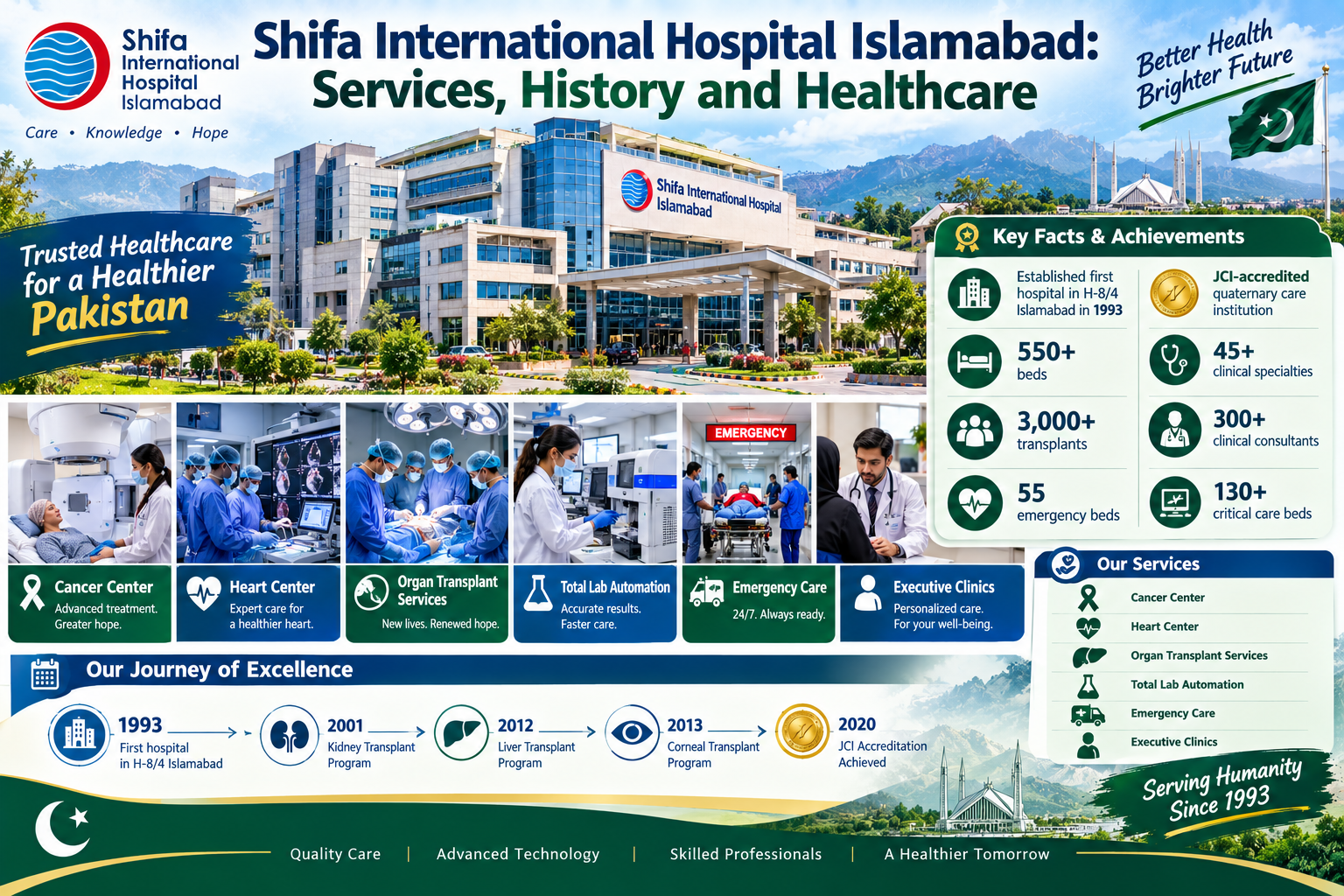
Shifa International Hospital Islamabad is one of Pakistan's well-known private healthcare institutions, offering a broad range of medical and surgical services. Located in Sector H-8/4, Islamabad, the hospital has developed into a major healthcare organization providing specialist treatment, diagnostic services, emergency care, critical care, transplantation, medical education, research, and community services.
Shifa International Hospitals Limited describes its Islamabad institution as a Joint Commission International (JCI)-accredited quaternary-care hospital. The organization currently states that it offers more than 45 clinical specialties and operates with advanced infrastructure and internationally trained professionals.
The hospital's story began in the early 1990s. Its first outpatient department patient was recorded in June 1993, while the first admitted patient was recorded in September of the same year. Since then, Shifa has expanded its clinical services and developed programs in areas such as transplantation, cancer care, surgery, diagnostics, and medical education.
History of Shifa International Hospital
The history of Shifa International Hospitals Limited goes back to 1987, when the company was incorporated in Pakistan. It later became a public limited company, and its first hospital was established in Islamabad in 1993.
The early years were marked by the development of important clinical services. Shifa records its first laparoscopic cholecystectomy in 1994, arthroscopy in the same year, total knee replacement in 1995, and coronary artery bypass surgery in 1996.
These milestones illustrate the hospital's gradual development from a newly established healthcare facility into a center offering increasingly specialized medical and surgical services.
Over the years, the institution expanded beyond basic hospital services. It developed medical education programs, nursing education, postgraduate medical education, transplantation services, diagnostic facilities, and specialized centers.
Location and Healthcare Network
The main Shifa International Hospital is located on Pitras Bukhari Road in Sector H-8/4, Islamabad. The organization has also expanded its healthcare network through medical centers, laboratories, clinics, pharmacies, and other healthcare facilities.
Shifa's wider network now includes healthcare facilities beyond Islamabad. Its official information lists locations and associated services in different parts of Pakistan, including Faisalabad.
This growing network allows the organization to connect hospital-based services with outpatient care, diagnostics, and other healthcare facilities.
A Broad Range of Medical Specialties
One of Shifa International Hospital's major characteristics is the large number of medical specialties available through its healthcare system.
The Islamabad facility currently lists more than 45 clinical specialties. These include cardiology, cardiac surgery, anesthesiology, dermatology, emergency medicine, endocrinology and diabetes, ENT, gastroenterology and hepatology, general surgery, infectious diseases, internal medicine, nephrology, neurology, and several other specialties.
Having multiple specialties within one healthcare system can be valuable for patients who need consultation from more than one medical discipline.
For example, a patient with a complex condition may require diagnostic testing as well as consultation with physicians from different specialties. A large hospital can coordinate these services within the same healthcare environment.
Emergency Medicine
Emergency departments are an essential part of modern hospitals because patients may require medical attention at any time.
Shifa International Hospital provides emergency services as part of its clinical infrastructure. Its Islamabad facility currently reports more than 50 emergency beds and more than 130 critical-care beds across its listed capacity indicators.
Emergency medicine involves rapid assessment, diagnosis, stabilization, and coordination with specialist teams when required.
The availability of multiple specialties within the same institution can support emergency teams when patients need further specialist evaluation.
Critical Care Services
Critical care is another important area of a large tertiary or quaternary-care hospital.
Critically ill patients may require continuous monitoring and support from specialized medical teams. Shifa's current Islamabad information reports more than 130 critical-care beds.
Anesthesia services also support critical care and complex procedures. Shifa's anesthesia department describes its role as including perioperative care, critical-care support, and pain management.
The relationship between anesthesia, surgery, intensive care, and emergency medicine is especially important in hospitals handling complex cases.
Organ Transplantation
Organ transplantation is one of the areas for which Shifa has developed a notable reputation.
The hospital's history records the beginning of its kidney transplant program in 2001, followed by bone marrow transplantation in 2009, liver transplantation in 2012, and corneal transplantation in 2013.
Shifa currently reports more than 3,000 transplants through its transplant services. Its official Islamabad page identifies liver, bone marrow, and kidney transplantation among its major transplant programs.
Transplantation is highly specialized and requires cooperation between surgeons, physicians, anesthetists, laboratory professionals, nurses, pharmacists, and other healthcare workers.
The development of these programs has therefore contributed to Shifa's role as a center for complex medical care.
Kidney Transplant and Nephrology
Kidney healthcare is another major specialty at Shifa.
The nephrology department provides services including dialysis, continuous renal replacement therapy for critically ill patients, management of chronic kidney disease, and coordination around transplantation.
Shifa records the introduction of dialysis services in the 1990s and the initiation of kidney transplantation around 2000–2001.
Nephrology often requires long-term patient management. Patients with kidney conditions may need regular monitoring, laboratory testing, specialist consultations, and, in some cases, dialysis or transplantation.
Liver and Gastroenterology Services
Gastroenterology and hepatology are important components of Shifa's specialist healthcare system.
The hospital's gastroenterology department provides services related to digestive and liver conditions. Its reported facilities include endoscopic procedures, advanced endoscopic ultrasound, ERCP, liver disease management, inflammatory bowel disease care, and other specialist services.
Shifa's official history records the development of a living-donor liver transplant program in 2012.
The combination of gastroenterology, hepatology, diagnostic services, surgery, and transplantation allows complex liver and digestive healthcare to be managed through a multidisciplinary environment.
Cancer Care
Cancer care is another important area within Shifa's healthcare network.
The Islamabad facility currently promotes its Cancer Center as a dedicated center offering oncology services, advanced technology, and multidisciplinary care.
Shifa's historical milestones also show that its Radiation Oncology Department was established in 1996.
Cancer treatment can involve multiple disciplines, including medical oncology, radiation oncology, surgery, pathology, radiology, nursing, and supportive care.
A multidisciplinary cancer center can help coordinate these different areas around the needs of individual patients.
General Surgery
General surgery is another established department at Shifa International Hospital.
The hospital's surgical services have developed significantly since the 1990s. Shifa reports the introduction of laparoscopic procedures and later expansion into advanced minimally invasive surgery and specialized surgical units.
The hospital's reported surgical developments include procedures involving the digestive system, hernias, colorectal conditions, endocrine surgery, and other areas.
Minimally invasive surgery has become increasingly important in modern healthcare because it can allow surgeons to perform certain procedures through smaller incisions compared with traditional approaches.
Cardiology and Cardiac Surgery
Heart healthcare is an important part of Shifa's medical services.
The hospital's Islamabad specialty list includes cardiology and cardiac surgery.
Shifa's history also records coronary artery bypass surgery among its early major surgical milestones, with the first bypass surgery listed in 1996.
Cardiac care often requires collaboration between cardiologists, cardiac surgeons, anesthetists, intensive-care teams, nurses, and diagnostic specialists.
The availability of these services within a large hospital supports coordinated management of complex cardiovascular cases.
Internal Medicine
Internal medicine provides a foundation for the diagnosis and management of many adult health conditions.
Shifa's Internal Medicine Department describes services covering preventive health, chronic disease management, inpatient medicine, diagnostic evaluation, geriatric care, and coordination with other specialties.
The department also reports access to laboratory and imaging services and teleconsultation options.
Internal medicine is particularly important because many patients have more than one health condition at the same time. Coordination between internal medicine and specialties such as cardiology, nephrology, endocrinology, and gastroenterology can therefore be valuable.
Medical Diagnostics
Accurate diagnosis is an essential part of healthcare.
Shifa's healthcare system includes laboratory and imaging facilities designed to support its clinical departments. The hospital's internal medicine service, for example, describes integrated laboratory and imaging support for outpatient and inpatient care.
Diagnostic services can include laboratory investigations, imaging, pathology, and specialized tests depending on the patient's needs.
The integration of diagnostic services with specialist departments can help healthcare teams make informed clinical decisions.
Women's and Children's Healthcare
Healthcare for women and children requires specialized services.
Shifa's Islamabad facility lists obstetrics and gynecology among its healthcare specialties, while its broader clinical system includes multiple specialist services.
Women's healthcare can involve routine consultations, pregnancy-related care, gynecological services, surgery, and specialist management.
Children may also require dedicated pediatric services and specialist support. Large hospitals can provide access to multiple departments when children need more complex evaluation or care.
Medical Education
Shifa's contribution to healthcare extends beyond direct patient services.
The hospital's history records the development of Shifa College of Medicine and the beginning of its entrance testing in 1998. House job training began in 1998, while postgraduate medical education began in 2003.
Medical education is important because healthcare institutions need a continuous supply of well-trained doctors and other professionals.
Teaching hospitals provide an environment where students and trainees can connect theoretical knowledge with practical clinical experience under appropriate supervision.
Nursing Education
Nurses play a central role in healthcare, and Shifa has also developed nursing education.
Shifa's history records the establishment of Shifa College of Nursing and the graduation of its first Bachelor of Science in Nursing batch in 2007.
Nursing education combines academic learning with practical clinical experience.
Well-trained nurses contribute to patient monitoring, communication, medication administration, clinical procedures, patient education, infection prevention, and many other areas of healthcare.
Research and Medical Innovation
Research is an important part of modern healthcare because medical knowledge continues to change.
Shifa describes itself as being engaged in medical education and research in collaboration with Shifa Tameer-e-Millat University and Shifa Foundation.
Research can help healthcare professionals evaluate clinical practices, study diseases, improve patient safety, and explore new approaches to healthcare.
A large hospital with numerous specialties can provide opportunities for multidisciplinary research involving doctors, nurses, scientists, pharmacists, and other professionals.
Patient-Centered Care
Shifa's stated mission is "Healthcare with Compassion for all." The organization identifies compassion, commitment, teamwork, quality, respect, and accountability among its values.
Patient-centered healthcare means considering the patient's needs, communication, comfort, safety, and overall experience rather than focusing only on a medical condition.
Communication is particularly important in healthcare because patients and families often need clear explanations about investigations, procedures, treatment options, and follow-up.
Digital Healthcare
Technology is becoming increasingly important in healthcare.
Shifa has developed the eShifa digital health platform as part of its broader healthcare network. The organization also reports teleconsultation services through its internal medicine department.
Digital healthcare can make certain services more convenient, particularly for people who have difficulty traveling or require follow-up consultations.
However, digital services work best when combined with appropriate clinical evaluation and professional medical judgment.
Quality and Accreditation
Quality standards are important for hospitals that provide complex medical services.
Shifa International Hospitals describes its Islamabad institution as JCI-accredited.
International accreditation involves standards relating to healthcare quality and patient safety. Such standards can encourage hospitals to maintain organized systems for clinical care, infection prevention, medication management, documentation, patient rights, and other areas.
Accreditation is therefore one part of a hospital's broader quality-management framework.
Community Service and Welfare
Healthcare organizations also have responsibilities beyond hospital walls.
Shifa identifies community service as one of its areas of activity and works with Shifa Foundation. Its history records the establishment of a Shifa Welfare Council in 1999.
Community healthcare can include awareness programs, welfare support, preventive health initiatives, and other services intended to reach people who may face barriers to healthcare.
Such activities can complement hospital-based treatment.
Shifa's Role in Pakistan's Healthcare System
Shifa International Hospital Islamabad represents an important example of a modern private-sector healthcare institution in Pakistan.
Its role extends across several areas: specialist medical treatment, surgery, emergency care, diagnostics, transplantation, medical education, nursing education, research, digital healthcare, and community service.
The hospital's development since 1993 demonstrates how a healthcare institution can expand its services over several decades.
Its growing network also reflects the increasing demand for coordinated healthcare services in Pakistan.
Future of Shifa International Hospital
The future of healthcare is likely to involve greater use of digital systems, advanced diagnostics, minimally invasive procedures, multidisciplinary care, and research-driven medicine.
Shifa's existing focus on advanced clinical services, transplantation, diagnostics, education, research, and digital healthcare provides a foundation for continued development.
Healthcare organizations will also need to respond to changing patient expectations, growing demand for specialist services, technological developments, and the need for efficient and compassionate care.
Continued investment in healthcare professionals, medical technology, research, nursing, and patient safety can help institutions such as Shifa remain prepared for these changes.
Conclusion
Shifa International Hospital Islamabad has developed from a hospital established in 1993 into a broad healthcare organization offering specialist and advanced medical services. Its history includes important milestones in surgery, transplantation, cancer care, medical education, and nursing education.
Today, Shifa reports more than 45 clinical specialties, more than 550 beds, more than 300 clinical consultants, and more than 3,000 transplants through its healthcare system.
Its services cover areas such as emergency medicine, cardiology, cardiac surgery, nephrology, gastroenterology, internal medicine, oncology, surgery, and many other specialties.
The hospital's connection with medical education and research adds another important dimension to its role. Through clinical services, professional training, research, digital healthcare, and community activities, Shifa International Hospital continues to contribute to the development of healthcare in Pakistan.
FAQs
1. When was Shifa International Hospital Islamabad established?
Shifa's first hospital in Islamabad was established in 1993.
2. Where is Shifa International Hospital located?
The main hospital is located in Sector H-8/4, Islamabad, on Pitras Bukhari Road.
3. How many specialties does Shifa International Hospital offer?
Shifa currently reports more than 45 clinical specialties at its Islamabad facility.
4. Is Shifa International Hospital involved in organ transplantation?
Yes. Shifa has developed kidney, liver, bone marrow, and corneal transplant programs among its specialized services.
5. Does Shifa International Hospital contribute to medical education?
Yes. Its history includes medical education, house job training, postgraduate medical education, and nursing education.