Introduction
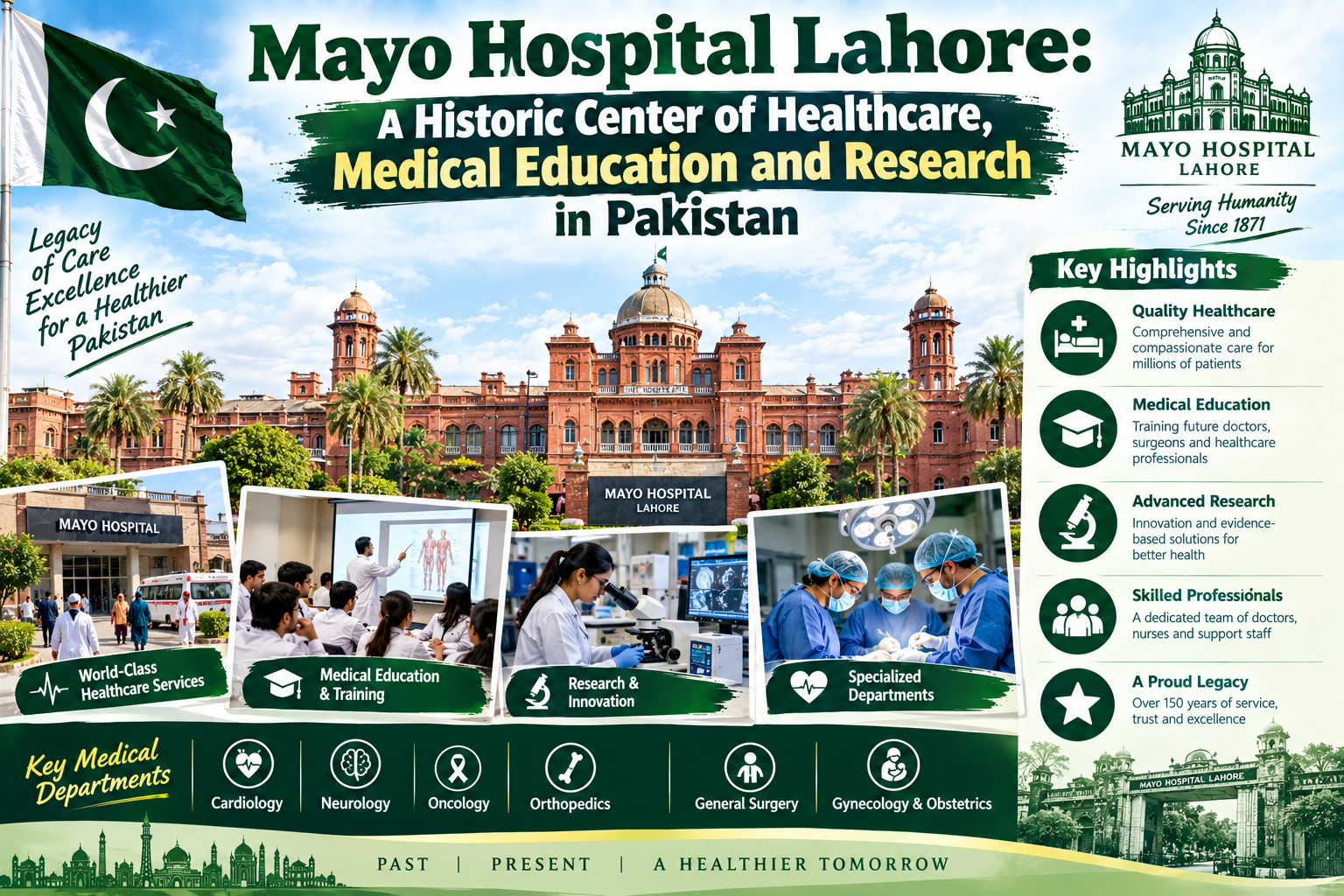
Mayo Hospital Lahore is one of the oldest and most significant teaching hospitals in Pakistan. Located in Lahore and closely associated with King Edward Medical University (KEMU), the hospital has played an important role in healthcare, medical education, clinical training, and research for generations. Its long history, large patient base, wide range of medical departments, and connection with one of the country's oldest medical institutions have made it an important part of Pakistan's healthcare system.
The hospital was completed in 1883 and was named after Viceroy Edward Mayo. Over the decades, Mayo Hospital developed from a historic medical facility into a large teaching hospital with numerous clinical and academic departments. KEMU describes Mayo Hospital as one of the oldest and largest teaching hospitals in Pakistan. Its College of Nursing also operates on the hospital premises and provides practical clinical training to nursing students.
Mayo Hospital is important not only because of its age but also because of its educational and professional role. Medical students, postgraduate trainees, nurses, and other healthcare professionals receive practical exposure in its clinical environment. The hospital's departments cover many areas of medicine and surgery, making it an important center for both patient care and medical learning.
A Brief History of Mayo Hospital Lahore
The history of Mayo Hospital is closely connected with the development of modern medical education in Lahore. The hospital was completed in 1883, during a period when organized medical education and healthcare institutions were expanding in the region.
Its association with medical education became particularly important through its connection with what later became King Edward Medical University. KEMU's history dates back to the nineteenth century, and the institution has evolved into a major center for undergraduate and postgraduate medical education.
The growth of Mayo Hospital over time reflects the changing needs of society. As Lahore's population expanded and medical science developed, the hospital added new departments, specialized services, educational facilities, and clinical units.
The hospital therefore represents more than a historic building. It represents a long medical tradition in which healthcare delivery and education developed side by side.
Connection with King Edward Medical University
One of the most important characteristics of Mayo Hospital is its close relationship with King Edward Medical University. This connection gives the hospital a strong teaching and training identity.
KEMU describes its mission as preparing healthcare professionals according to high professional standards, promoting evidence-based medicine, supporting research, and maintaining patient-centered healthcare.
For medical students, a teaching hospital provides an environment where theoretical knowledge can be connected with practical experience. Students can learn about clinical examination, diagnosis, patient communication, medical procedures, teamwork, and professional ethics under appropriate supervision.
Postgraduate education is another important part of this environment. Mayo Hospital departments support specialist training in various medical and surgical fields. This helps develop doctors who can contribute to healthcare services in Pakistan and beyond.
A Large Teaching Hospital
Mayo Hospital has grown considerably since its establishment. KEMU's College of Nursing describes it as one of Pakistan's oldest and largest teaching hospitals and reports approximately 2,800 beds.
A hospital of this scale has a major responsibility. It must manage a wide range of healthcare needs while also supporting education and training.
Large teaching hospitals are particularly important because they bring together different medical specialties. Patients with complicated health conditions may require input from multiple departments, while students and trainees gain exposure to a broad variety of clinical situations.
This combination of healthcare, education, and professional training makes Mayo Hospital an important institution within Lahore's medical landscape.
Medical and Surgical Services
Mayo Hospital has numerous departments covering different areas of medicine and surgery. Its clinical structure includes specialized services that support patients with a wide range of health conditions.
For example, KEMU's orthopedic department reports services and training in areas including spine surgery, bone tumors, pediatric orthopedics, hand and upper-limb surgery, pelvic surgery, arthroscopy, foot and ankle surgery, and joint replacement procedures.
The presence of specialized departments allows patients to receive care from professionals trained in particular medical fields. It also creates an educational environment for students who want to understand how different specialties work together.
Emergency and Critical Care
Emergency healthcare is a major responsibility for large teaching hospitals. Mayo Hospital has departments and facilities involved in emergency and critical care, while its anesthesia services support both elective and emergency operating theatres.
According to KEMU, the anesthesia department at Mayo Hospital provides perioperative care across specialties and has a particular focus on intensive care and pain management.
Emergency medicine requires teamwork between doctors, nurses, anesthetists, surgeons, laboratory professionals, radiology teams, and other healthcare workers. A large teaching hospital provides an environment where these professionals can work together.
Critical care is also an important area of modern healthcare because seriously ill patients may require continuous monitoring and specialized support.
Pediatrics and Children's Healthcare
Children require specialized medical attention, and Mayo Hospital's pediatric services have a long history.
KEMU's Department of Pediatrics explains that the pediatric department began in a small room in the outpatient department of Mayo Hospital in 1948. It later expanded into dedicated facilities and developed specialized services. The Children's Medical Specialty Block includes pediatric emergency services, neonatal pediatrics, a pediatric intensive care unit, and pediatric specialties.
This development demonstrates how children's healthcare has become increasingly specialized.
Pediatric medicine requires healthcare professionals to understand the different medical needs of infants, children, and adolescents. Specialized pediatric facilities also support medical education and postgraduate training.
Orthopedic Care
Orthopedic medicine focuses on conditions involving bones, joints, muscles, ligaments, and related structures.
Mayo Hospital's orthopedic department has a long history. KEMU records that the Department of Orthopaedic Surgery was established at King Edward Medical College and Mayo Hospital in 1956. The department later expanded into specialized units and developed services across multiple orthopedic fields.
The department's reported areas include bone tumors, spine surgery, pediatric orthopedics, arthroplasty, hand and upper-limb surgery, pelvic surgery, arthroscopy, and foot and ankle surgery.
Such services demonstrate the broad range of specialist care available within a major teaching hospital.
Dermatology Services
Dermatology is another important specialty associated with Mayo Hospital.
The KEMU dermatology department has a long record of introducing specialized diagnostic and treatment technologies. Its facilities have included phototherapy, patch testing, laser therapy, teledermatology, and dermatosurgery.
The department's history also demonstrates how medical technology can gradually become part of public-sector healthcare.
Teledermatology is particularly interesting because it allows dermatology expertise to be connected with patients beyond the immediate hospital environment. KEMU reports that its teledermatology service has also been used for academic and patient-management purposes.
Rheumatology and Internal Medicine
Mayo Hospital also has specialized services within internal medicine.
KEMU reports that its rheumatology division provides specialized care and postgraduate training related to rheumatological conditions. The rheumatology outpatient clinic was established in 2017 within the East Medical Ward.
Rheumatology deals with conditions affecting joints, muscles, bones, and the immune system. The specialty often requires long-term patient evaluation and collaboration with other medical departments.
The academic environment at Mayo Hospital allows clinical services to contribute to teaching and research as well.
Chest Medicine and Pulmonary Healthcare
Respiratory healthcare is another established area associated with the Mayo Hospital and KEMU medical system.
The Institute of TB & Chest Medicine has a long history dating back to 1920. KEMU describes it as an important institution for pulmonary care and education and reports renovation and development work in its wards, outpatient department, offices, MDR-TB clinic, and diagnostic block in 2024.
Respiratory medicine remains an important part of public healthcare because respiratory illnesses can affect people of different ages and backgrounds.
The combination of clinical services and medical education also helps train future specialists in pulmonary medicine.
Nursing Education
Healthcare cannot function without trained nurses, and Mayo Hospital has a long association with nursing education.
The College of Nursing KEMU is located on the premises of Mayo Hospital. Its history goes back to 1883, and it has developed into a major nursing education institution. The college provides theoretical instruction as well as practical clinical experience.
According to KEMU, the college includes lecture halls, demonstration halls, laboratories, a library, an auditorium, and student accommodation facilities. It offers Bachelor of Science in Nursing and Post-RN education.
Practical exposure is especially important in nursing because students need to develop both academic knowledge and professional skills.
Medical Education and Training
Mayo Hospital's role in medical education is one of its strongest features.
A teaching hospital provides students with opportunities to observe and learn from real clinical environments. Under professional supervision, students can understand how doctors and healthcare teams assess patients, communicate with families, organize investigations, and develop appropriate management plans.
Postgraduate training is also essential for producing specialists. KEMU currently lists postgraduate programs and training activities in various disciplines.
The hospital therefore contributes to healthcare not only by treating patients today but also by helping educate healthcare professionals who will serve patients in the future.
Research and Innovation
Modern healthcare depends heavily on research. Medical research helps professionals understand diseases, improve healthcare systems, evaluate treatments, and develop new approaches to patient care.
KEMU identifies innovative and collaborative research as part of its institutional mission.
Mayo Hospital's large patient population and diverse clinical departments create an important environment for clinical research. Researchers can study health issues relevant to Pakistan's population and healthcare system.
Research conducted through teaching hospitals can also help connect academic knowledge with practical healthcare needs.
Importance of Public Healthcare
Mayo Hospital is part of the public healthcare system and has a major role in serving patients in Lahore and surrounding areas.
Public hospitals are particularly important in countries where many families depend on government healthcare institutions. Large public teaching hospitals can provide access to specialist services while also supporting medical education.
The importance of such institutions goes beyond individual treatment. They contribute to medical training, research, nursing education, emergency care, and the development of healthcare professionals.
Technology in Modern Healthcare
Healthcare is changing rapidly because of technology. Digital health, telemedicine, electronic information systems, medical imaging, laboratory technology, and artificial intelligence are increasingly influencing modern medicine.
KEMU's current vision recognizes developments including artificial intelligence, precision medicine, digital health, genomics, clinical informatics, and data science as important parts of the future of medicine.
Mayo Hospital and its associated academic departments have already demonstrated examples of technology adoption. The dermatology department, for example, has used teledermatology for patient management and academic purposes.
Future healthcare systems will likely require an even stronger connection between traditional clinical knowledge and digital technology.
Role in Lahore's Healthcare System
Lahore is one of Pakistan's largest cities and has a substantial demand for healthcare services. Mayo Hospital has therefore become an important part of the city's medical infrastructure.
Its location and association with KEMU place it within a wider network of medical education and healthcare institutions.
For decades, the hospital has provided an environment where healthcare professionals can work, students can learn, researchers can conduct studies, and patients can receive specialist care.
Professional Development of Healthcare Workers
Healthcare quality depends on continuous professional development.
Doctors, nurses, technicians, and other healthcare workers must keep learning because medical knowledge changes over time. Teaching hospitals provide opportunities for continuing education through clinical discussions, workshops, seminars, training programs, and research activities.
KEMU departments regularly document academic activities and professional development programs. These activities help connect healthcare practice with education and new knowledge.
This educational culture is an important part of Mayo Hospital's identity.
The Importance of Multidisciplinary Care
Many health conditions cannot be addressed by a single specialty. Patients may need doctors from different departments, along with nurses, physiotherapists, laboratory specialists, radiologists, pharmacists, and other professionals.
A large teaching hospital provides an environment where multidisciplinary collaboration can take place.
For example, complex orthopedic cases may involve surgeons, anesthetists, physiotherapists, radiologists, and rehabilitation professionals. Similarly, critically ill patients may require intensive collaboration between multiple specialties.
This teamwork is an important characteristic of modern healthcare.
Mayo Hospital and the Future of Healthcare
The future of healthcare in Pakistan will require investment in medical education, research, technology, nursing, specialist services, and patient-centered care.
Institutions such as Mayo Hospital can contribute to this future because they combine healthcare delivery with education and research.
Artificial intelligence and digital healthcare may provide new opportunities, but technology will need to work alongside trained healthcare professionals. KEMU's current vision specifically highlights emerging areas such as AI, digital health, genomics, and data science.
For Mayo Hospital, continuing modernization while preserving its historic educational role can help it remain relevant in a rapidly changing healthcare environment.
Challenges and Opportunities
Large public teaching hospitals face complex challenges. A high patient load, demand for specialist services, the need for modern equipment, staff development, infrastructure maintenance, and technological modernization all require continuous attention.
At the same time, these challenges create opportunities.
Improved digital systems can make healthcare information easier to manage. Better training facilities can strengthen medical education. Research collaborations can support innovation. Modern diagnostic and clinical technologies can improve healthcare processes.
The combination of a long institutional history and modern medical education gives Mayo Hospital a strong foundation for continued development.
Why Mayo Hospital Remains Important
Mayo Hospital remains important because it brings together several essential elements of healthcare.
It is a historic hospital, a teaching institution, a clinical training environment, a center associated with medical research, and an important part of Lahore's public healthcare system.
Its connection with King Edward Medical University strengthens its educational role. Departments across medicine and surgery provide specialist services while also contributing to the training of future healthcare professionals.
Its nursing education facilities further expand its contribution to healthcare development.
Conclusion
Mayo Hospital Lahore has a unique place in Pakistan's healthcare history. Established in the nineteenth century and completed in 1883, it has grown into a large teaching hospital associated with King Edward Medical University.
Its importance comes from more than its long history. The hospital supports patient care, medical education, nursing education, specialist training, and research. Its departments cover a broad range of healthcare fields, including pediatrics, orthopedics, dermatology, anesthesia, rheumatology, pulmonary medicine, and many other specialties.
As Pakistan's healthcare needs continue to change, Mayo Hospital's future will depend on combining its historic strengths with modern technology, research, professional training, and patient-centered healthcare.
With its long-standing connection to medical education and its extensive clinical environment, Mayo Hospital continues to represent an important chapter in the development of healthcare and medical education in Pakistan.
FAQs
1. When was Mayo Hospital Lahore established?
Mayo Hospital Lahore was completed in 1883 and has since developed into one of Pakistan's major teaching hospitals.
2. Which medical university is associated with Mayo Hospital?
Mayo Hospital is closely associated with King Edward Medical University in Lahore.
3. What makes Mayo Hospital important?
Its importance comes from its long history, large-scale healthcare services, specialist departments, medical education, nursing education, and research role.
4. Does Mayo Hospital have pediatric services?
Yes. Its pediatric department includes pediatric emergency, neonatal pediatrics, pediatric intensive care, and other pediatric specialties.
5. Does Mayo Hospital contribute to medical education?
Yes. Mayo Hospital provides an important clinical environment connected with undergraduate and postgraduate medical education through King Edward Medical University.