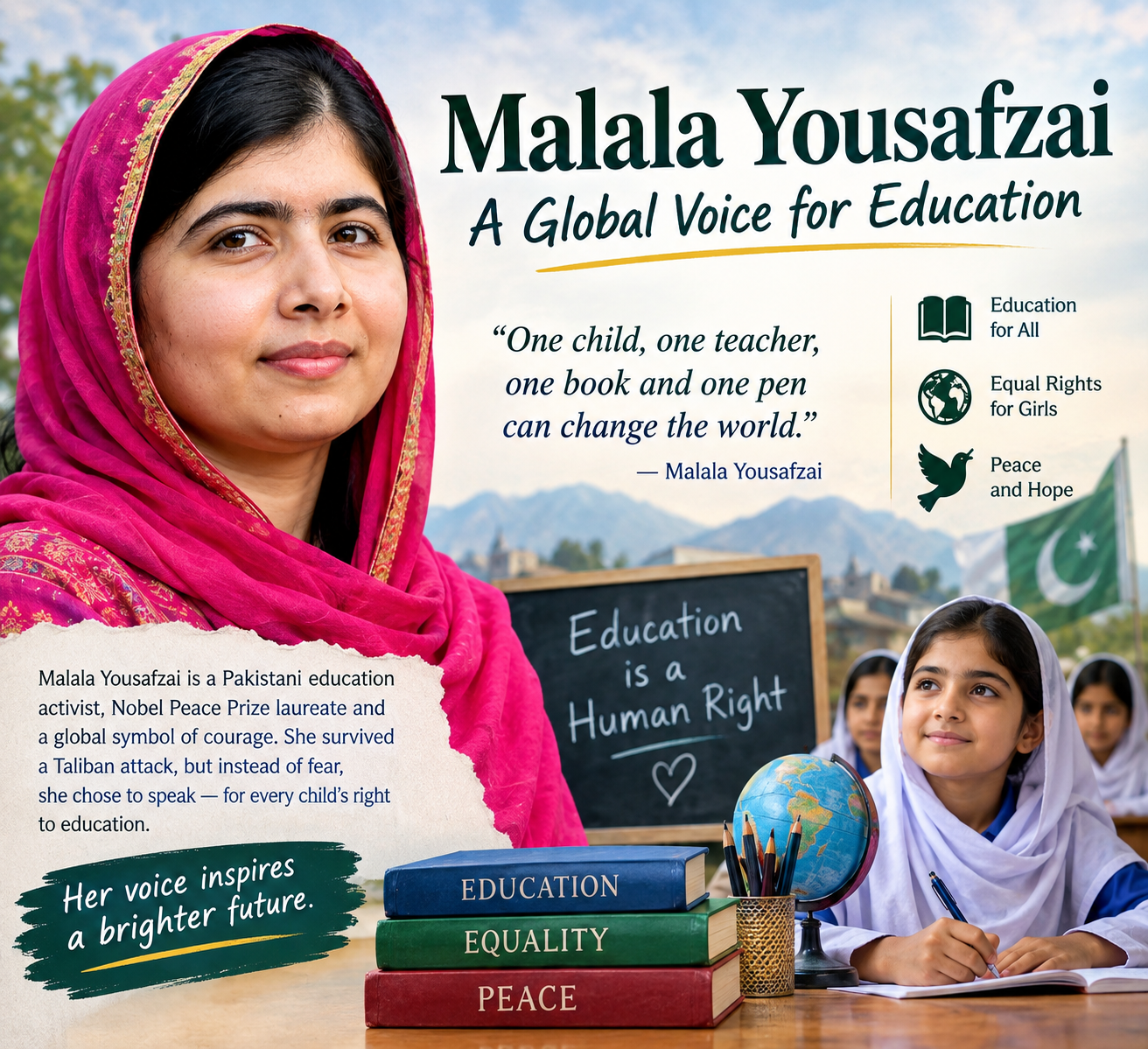
Malala Yousafzai is one of Pakistan’s most internationally recognized personalities and one of the strongest voices for girls’ education in the world. Her journey from a young student in Pakistan’s Swat Valley to a global education activist has inspired millions of people. She became known for speaking openly about the importance of education at a time when many girls in her region faced serious restrictions on attending school. Her courage, determination, and commitment to learning turned her personal experience into a worldwide campaign for the educational rights of children.
Malala’s story is not only about fame or international recognition. It is about the power of education, the importance of courage, and the belief that every child deserves the opportunity to learn. Through her speeches, advocacy work, writing, and philanthropic efforts, she has continued to highlight the challenges faced by girls who are denied access to education.
Early Life and Family Background
Malala Yousafzai was born on July 12, 1997, in Mingora, Swat Valley, Pakistan. She grew up in a family that valued education. Her father, Ziauddin Yousafzai, was a teacher and education activist who ran a school. His passion for education had a major influence on Malala from an early age.
Unlike many children who simply attend school, Malala grew up surrounded by conversations about education, teachers, students, and the importance of learning. Her father encouraged her to express her opinions and develop confidence in speaking publicly. This environment helped her develop a strong interest in education and public speaking.
Malala enjoyed going to school and wanted to continue her studies. She believed that education could give young people the knowledge and confidence needed to build better futures. Her early experiences eventually shaped the mission that would become central to her life.
Life in Swat Valley
The Swat Valley is known for its natural beauty, mountains, rivers, and rich cultural history. However, during Malala’s childhood, the region experienced significant social and political difficulties. The growing influence of the Pakistani Taliban created fear and uncertainty for many families.
Girls’ education became one of the major issues affected by the changing situation. Schools for girls were threatened, and many families became worried about sending their daughters to school. For Malala, however, education was too important to abandon.
She continued to attend school and increasingly became aware of the importance of speaking about what was happening around her. Her experiences made her realize that education should not be treated as a privilege available only to some children. Instead, she believed it should be a basic opportunity for everyone.
Her Voice for Girls’ Education
Malala first gained wider attention as a young student when she began speaking publicly about the importance of education for girls. She also wrote anonymously for the BBC about life under Taliban influence in Swat.
Her writing described the challenges faced by students who wanted to continue their education. Through her words, readers around the world learned about the difficulties experienced by ordinary families.
What made Malala particularly remarkable was her age. She was still a schoolgirl when she began speaking about issues that many adults were afraid to discuss. Her message was simple but powerful: girls should have the right to go to school and learn.
Her voice gradually became stronger, and she appeared in interviews and spoke to media organizations. She became a symbol of young people’s determination to protect their right to education.
The Attack That Changed Her Life
In October 2012, Malala was attacked while returning home from school. The attack was an attempt to silence her advocacy for girls’ education.
Malala survived the attack and was later treated in the United Kingdom. Her recovery was difficult, but the experience did not end her campaign. Instead, international attention toward her story increased dramatically.
People around the world expressed support for Malala and for the wider cause of girls’ education. Her experience became a reminder that education can be considered a powerful force for social change.
Rather than allowing fear to define her future, Malala continued to speak about education. Her determination attracted international attention and transformed her into one of the most recognizable young advocates for education.
Recovery and New Beginning
After receiving medical treatment in the United Kingdom, Malala continued her education. Her new life also gave her an international platform to discuss the importance of education.
Moving to another country was a major change for a young student, but Malala continued to focus on her mission. She worked to turn international attention into meaningful advocacy.
Her story demonstrated that a person’s circumstances do not necessarily determine the size of their dreams. Despite facing an extremely difficult experience, she continued to pursue education and encourage others to do the same.
Malala’s Historic United Nations Speech
One of the most important moments in Malala’s public life came when she addressed the United Nations on July 12, 2013, her 16th birthday.
In her speech, she emphasized the importance of education and peaceful action. She spoke on behalf of children who wanted the opportunity to attend school.
The speech received international attention because of its message of hope, education, and peaceful resistance. Malala presented education not simply as a personal benefit but as a means of creating stronger communities and societies.
Her United Nations appearance helped establish her as a global advocate rather than only a Pakistani activist.
Malala Fund
Malala and her father co-founded the Malala Fund, an organization focused on advocating for girls’ education.
The organization works with education advocates and partners in different parts of the world. Its broader mission is to support girls’ right to receive free, safe, and quality education.
The Malala Fund has helped bring international attention to educational barriers. It emphasizes that girls should have opportunities to complete secondary education and develop the skills needed for their futures.
Through this work, Malala has continued the same mission that began when she was a student in Swat: ensuring that girls are not denied education because of gender, poverty, conflict, or social circumstances.
Nobel Peace Prize
In 2014, Malala Yousafzai was awarded the Nobel Peace Prize along with Indian activist Kailash Satyarthi.
At the age of 17, she became the youngest-ever Nobel Prize laureate. The award recognized their work for children’s rights and the right of every child to education.
The Nobel Peace Prize was a major milestone in Malala’s life. It also brought additional attention to the global education crisis.
For Pakistan, Malala’s achievement became part of the country’s international story. Her recognition showed that a young Pakistani woman could influence a global conversation about education and children’s rights.
Her Academic Journey
Despite becoming internationally famous at a young age, Malala continued her academic journey.
She studied at Oxford University, where she read Philosophy, Politics and Economics. She graduated in 2020.
Her decision to continue formal education was consistent with the message she had promoted throughout her public life. She did not simply advocate for education; she also continued her own studies.
Her academic experience provided her with additional knowledge and perspectives that could support her advocacy work.
Malala as an Author
Malala has also shared her story through books. Her memoir, I Am Malala, tells the story of her childhood, education campaign, family, and experiences in Pakistan and abroad.
The book introduced international readers to her personal journey and helped explain why education became so important to her.
Writing allowed Malala to communicate her experiences to people who might never have experienced the challenges faced by students in conflict-affected communities.
Her story has also become part of educational discussions in schools and universities around the world.
Global Education Advocacy
Malala’s work extends beyond Pakistan. She has traveled to different countries and met political leaders, educators, students, and activists.
Her advocacy focuses particularly on girls who face barriers to secondary education. In many parts of the world, girls may leave school because of poverty, conflict, early marriage, discrimination, lack of safe transportation, or inadequate educational facilities.
Malala repeatedly emphasizes that educating girls benefits not only individual students but also families, communities, and economies.
When girls receive quality education, they can gain knowledge, develop professional skills, make informed decisions, and participate more actively in society.
Why Girls’ Education Matters
Education is one of the strongest tools for improving opportunities. It can help young people develop critical thinking, communication skills, confidence, and professional abilities.
For girls, education can have long-term effects on families and communities. Educated women can contribute to different areas of society, including medicine, teaching, science, technology, business, public service, and many other professions.
Malala’s advocacy therefore focuses on more than simply getting girls into classrooms. She supports the idea that girls should have access to safe, quality education that allows them to complete their studies.
Her message also challenges the idea that girls’ education is less important than boys’ education. According to her advocacy, societies cannot reach their full potential if a large part of their population is prevented from learning.
Malala’s Connection with Pakistan
Although Malala has lived and studied abroad, Pakistan remains an important part of her identity and story.
Her experiences in Swat shaped her understanding of education and gave her a strong connection to the challenges faced by Pakistani students.
Her international work has also drawn attention to Pakistan’s educational potential and challenges. Pakistan has millions of talented young people, but access to quality education remains an important issue.
Malala’s story demonstrates the potential of Pakistani youth when they receive opportunities, encouragement, and education.
Challenges Faced by Pakistani Girls
Pakistan has made progress in education, but many girls still face barriers to schooling. These barriers can include poverty, distance from schools, lack of facilities, social pressures, and insecurity in some areas.
The situation differs significantly from one region to another. Urban areas may have greater access to schools, while rural and remote communities can face greater difficulties.
Malala’s advocacy has encouraged international organizations and policymakers to pay attention to these challenges.
Her message is especially relevant because education is not only about classrooms. It also involves safety, qualified teachers, learning materials, transportation, family support, and opportunities after school.
Malala’s Message of Peace
Another important part of Malala’s public message is peaceful advocacy.
Instead of promoting revenge or hatred, she has generally presented education as a peaceful response to violence and discrimination. Her speeches have emphasized the power of knowledge and peaceful action.
This message has helped make her advocacy appealing to audiences beyond political or cultural boundaries.
Her approach demonstrates that young people can participate in important conversations without needing positions of formal political power.
Influence on Young People
Malala has become an inspiration for many young people. Her story shows that age does not necessarily prevent someone from contributing to society.
Young students can raise awareness, participate in educational activities, volunteer in their communities, support classmates, and speak respectfully about issues they care about.
Malala’s journey encourages students to value their education rather than taking it for granted.
For young girls especially, her story sends an important message: their ambitions and education matter.
Awards and International Recognition
Over the years, Malala has received numerous awards and honors for her advocacy.
Her Nobel Peace Prize is perhaps the most internationally recognized. However, her influence is also reflected in the number of organizations, leaders, schools, universities, and young people who have engaged with her message.
Her recognition demonstrates how a local issue can become an international movement when a powerful and authentic story reaches a global audience.
Malala’s Leadership Style
Malala’s leadership is largely based on advocacy, education, communication, and persistence.
She did not begin her journey with political authority or significant institutional power. She began as a student who wanted to attend school.
Her leadership developed through her willingness to speak about an important issue and continue doing so after facing serious challenges.
Her example shows that leadership does not always mean holding an official position. Sometimes leadership begins when an individual identifies an important problem and encourages others to work toward a solution.
Lessons from Malala’s Life
There are many lessons that can be learned from Malala Yousafzai’s journey.
The first lesson is the value of education. Knowledge can change the direction of an individual’s life and create opportunities for the future.
The second lesson is courage. Speaking respectfully about an important issue can require courage, especially when others disagree.
The third lesson is persistence. Malala continued her education and advocacy despite facing major challenges.
The fourth lesson is the importance of using opportunities responsibly. Her international platform has been used to highlight the educational needs of others.
The fifth lesson is that young people can contribute to meaningful social change.
Malala’s Continuing Mission
Malala continues to advocate for girls’ education through the Malala Fund and other public activities.
Her work remains connected to the belief that every girl deserves the opportunity to learn. She has continued to draw attention to educational challenges in countries affected by conflict, poverty, discrimination, and political instability.
Her mission is particularly important because educational problems cannot always be solved quickly. Building schools, training teachers, improving safety, reducing poverty, and changing social attitudes require long-term commitment.
Malala’s work keeps these issues visible in international discussions.
A Symbol of Hope
Malala Yousafzai’s journey has made her a symbol of hope for many people.
Her story began in a small part of Pakistan but eventually reached audiences around the world. Her experience demonstrates how a young person’s voice can become part of a global conversation.
The most important part of Malala’s story is not simply the awards she has received. It is the idea behind her work: every child should have the chance to learn, dream, and build a better future.
Her journey also reminds society that education is not merely about passing examinations. It can develop confidence, independence, critical thinking, and the ability to participate in society.
Conclusion
Malala Yousafzai is one of Pakistan’s most influential modern personalities and a globally recognized advocate for girls’ education. From her childhood in Swat to her international work, her journey has been shaped by a strong belief in the power of education.
She faced serious challenges but continued her studies and advocacy. Her Nobel Peace Prize, academic achievements, writing, and work with the Malala Fund have given her an important international platform.
Her story is particularly meaningful for students because it shows that education can be both a personal opportunity and a force for positive change.
Malala’s message continues to be simple and powerful: children deserve the opportunity to learn, and girls should have the same educational opportunities as boys.
For Pakistan and the wider world, her journey represents courage, education, persistence, and hope. Her life demonstrates that even a young student can raise an important voice—and that voice can inspire millions.
FAQs
1. Who is Malala Yousafzai?
Malala Yousafzai is a Pakistani education activist known internationally for advocating girls’ right to education. She became the youngest Nobel Peace Prize laureate in 2014.
2. Why is Malala famous?
Malala became famous for speaking publicly about girls’ education in Pakistan’s Swat Valley. Her advocacy later developed into an international campaign for girls’ access to education.
3. When did Malala win the Nobel Peace Prize?
Malala Yousafzai won the Nobel Peace Prize in 2014 alongside Kailash Satyarthi for their work supporting children’s rights and education.
4. What is the Malala Fund?
The Malala Fund is an organization co-founded by Malala Yousafzai and her father. It advocates for girls’ education and supports efforts to ensure girls can access quality secondary education.
5. What can students learn from Malala Yousafzai?
Students can learn the importance of education, courage, persistence, confidence, and peaceful advocacy from Malala’s journey. Her life shows that young people can contribute positively to society.




