Introduction
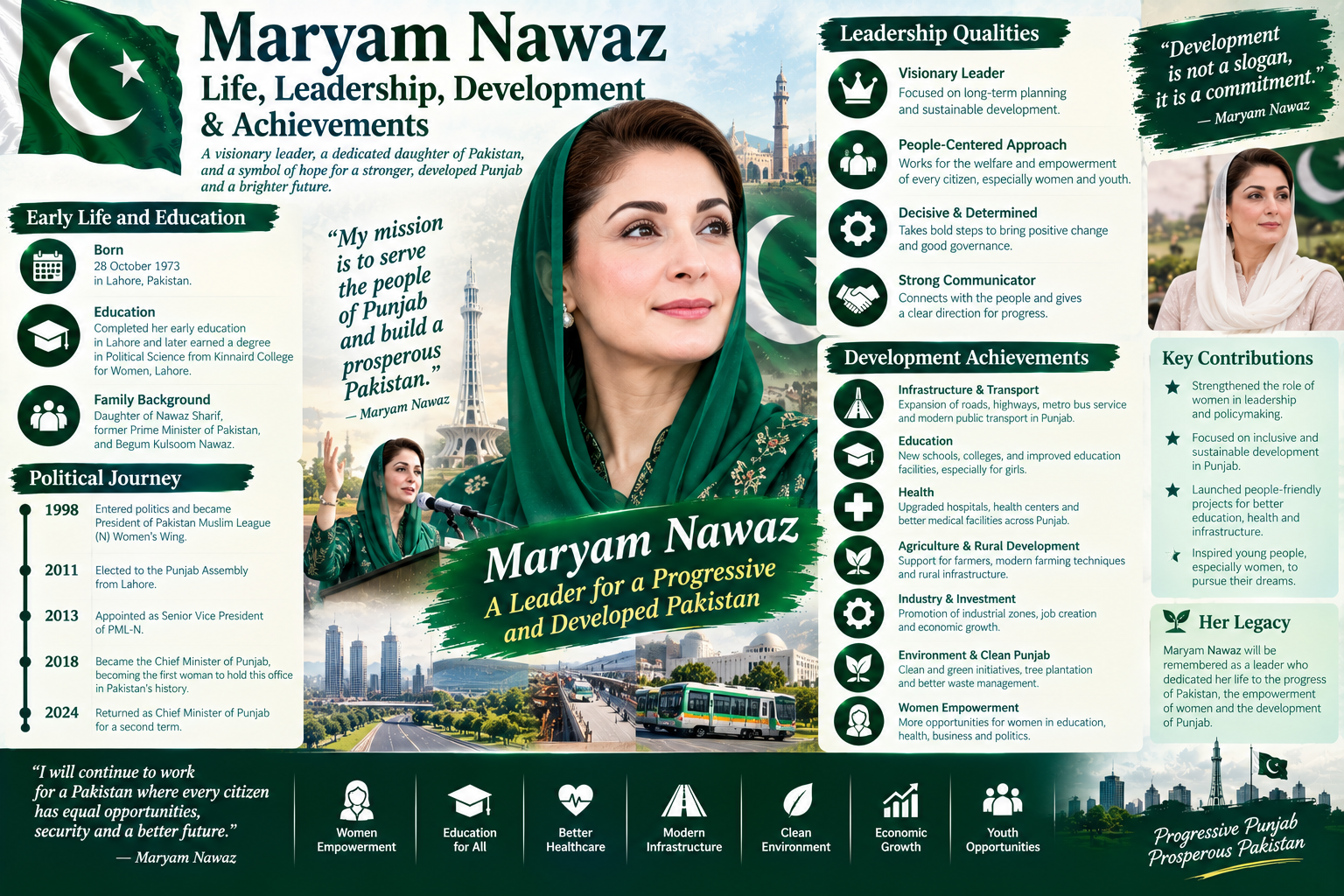
Maryam Nawaz Sharif is one of the most prominent contemporary political personalities in Pakistan. She has become an important figure in Pakistani politics through her political journey, public leadership, and role in the development of Punjab. On February 26, 2024, she became the Chief Minister of Punjab, becoming the first woman to hold this position in the province.
Since taking office, her administration has presented a development agenda covering education, healthcare, agriculture, housing, transportation, technology, youth empowerment, women's support, urban development, and public welfare.
Her government has also introduced several digital and citizen-focused initiatives intended to make public services easier to access. The Punjab government's official portal currently lists a range of flagship projects under her administration.
Maryam Nawaz's leadership is particularly significant because Punjab is Pakistan's largest province by population and one of the country's most important economic, agricultural, educational, and industrial regions.
Early Life and Background
Maryam Nawaz Sharif was born on October 28, 1973, in Lahore. She belongs to the Sharif family, which has played a major role in Pakistan's political and public life.
Her father, Nawaz Sharif, has served as Prime Minister of Pakistan on multiple occasions. Her uncle, Shehbaz Sharif, has also served as Prime Minister and previously held the position of Chief Minister of Punjab.
Growing up in a politically active family gave Maryam exposure to public affairs from an early age. However, her own political career developed gradually over time.
She became increasingly active in political activities and eventually emerged as an important leader within the Pakistan Muslim League-Nawaz (PML-N).
Beginning of Political Career
Maryam Nawaz became more publicly involved in politics during the period leading up to the 2013 general election.
Her political activities gradually expanded, particularly in organizational work, public communication, and campaigning.
Over the years, she developed a strong political presence and became one of the better-known female political leaders in Pakistan.
Her political journey eventually led to her becoming Chief Minister of Punjab in 2024.
Historic Position as Chief Minister
Maryam Nawaz made history when she became the first woman Chief Minister of Punjab on February 26, 2024.
This was a significant moment for women in Pakistani politics.
Punjab is a province of enormous importance. It contains major cities such as Lahore, Faisalabad, Rawalpindi, Multan, Gujranwala, Sialkot, and many others.
Leading such a large province requires managing education, healthcare, agriculture, local government, transportation, infrastructure, law and order, technology, and social welfare.
Maryam Nawaz's government has therefore focused on a broad development programme rather than a single sector.
Vision for a Modern Punjab
The official Chief Minister's Office describes the administration's mission around developing a healthy, sustainable, safe, and prosperous Punjab.
This vision includes improving public services while also introducing technology and modern systems into government.
The Punjab government's flagship-project listings include programmes related to agriculture, information technology, transportation, youth, business, education, and other areas.
A modern province requires more than roads and buildings. It also needs educated young people, efficient public services, digital systems, strong healthcare, modern agriculture, and opportunities for businesses.
Education Development
Education is one of the most important areas of Punjab's development.
Maryam Nawaz's government has placed considerable emphasis on students, educational opportunities, technology, and youth development.
At the beginning of 2026, she declared 2026 the "Year of Youth" and highlighted several major public projects, including educational and healthcare initiatives.
The focus on young people is important because Pakistan has a large youth population.
Students need access to quality schools, colleges, universities, scholarships, digital resources, professional skills, and career opportunities.
Modern education is also increasingly connected with technology. Students who learn computer science, artificial intelligence, software development, digital skills, and other modern subjects can compete in a global economy.
Technology and Digital Government
Technology has become an important part of the Punjab government's approach.
One example is the Maryam Ko Batayn initiative, an official digital platform designed to connect citizens with government services and complaint-resolution systems. The Punjab government describes it as a technology-driven system offering free access to public welfare and grievance-redressal services.
Digital government can make public services more convenient.
Instead of visiting several government offices, citizens can increasingly use online platforms to submit complaints, request information, and access certain services.
The government's Talk to CM portal is another digital engagement initiative launched in February 2026 to improve communication between citizens and the provincial government.
These initiatives show how technology can be used to create a more connected relationship between government and citizens.
Housing for Low-Income Families
Housing is another major area of the Punjab development agenda.
The Apni Zameen Apna Ghar Program was launched by the Punjab government to provide free land to deserving low-income and homeless families. The official Punjab portal describes it as an initiative aimed at helping poor families obtain land for housing.
The government has also promoted housing-related support for families who face difficulty owning a home.
Housing programmes can have a major social impact because a secure home provides families with stability and dignity.
For low-income households, owning land or a house can also become an important long-term financial asset.
Urban Development and Sohna Punjab
Urban development has received significant attention under Maryam Nawaz's administration.
The Maryam Nawaz Ka Sohna Punjab development programme has focused on improving civic infrastructure and neighbourhood conditions across Punjab.
In January 2026, the Punjab government reported that the first phase was being targeted for completion by June 2026, with attention to improving local infrastructure.
The broader development programme has also included drainage, sewerage, roads, neighbourhood rehabilitation, and other civic facilities.
According to APP reporting in June 2026, the development programme included plans for thousands of kilometres of sewerage lines, new drainage networks, and disposal stations.
Such projects are important because good urban infrastructure directly affects everyday life.
Healthcare Development
Healthcare is another major priority.
In February 2026, Maryam Nawaz announced major development projects in the education and healthcare sectors during a public meeting in Mianwali. She also inaugurated a new cardiac catheterization laboratory at the district headquarters hospital there.
The Punjab government's 2026 development agenda has also highlighted projects such as the Nawaz Sharif Cancer Hospital and the Sargodha Cardiology Institute.
Healthcare facilities outside Lahore and other major cities are particularly important.
People living in smaller cities and rural areas can face difficulties when specialized treatment is available only in major urban centres.
Developing hospitals and specialized medical services in different regions can help bring healthcare closer to communities.
Support for Women
As Punjab's first woman Chief Minister, Maryam Nawaz's leadership also carries symbolic importance for women across Pakistan.
Her administration has introduced and supported initiatives involving women, families, healthcare, employment, and childcare.
In June 2026, the Punjab Women Development Department reported plans for 650 daycare centres in hospitals for working women.
Daycare facilities can support working mothers by helping them manage professional responsibilities while ensuring that their young children have a safe place during working hours.
Women's participation in education and employment can contribute significantly to household incomes and economic growth.
Agriculture and Farmers
Punjab is the agricultural heartland of Pakistan.
Millions of people depend directly or indirectly on agriculture. Farmers need modern machinery, better seeds, irrigation, financial support, technology, and access to markets.
The Punjab government's flagship projects include agricultural initiatives such as the High-Tech Farm Mechanization Finance Program and other farmer-focused programmes.
Modernizing agriculture can increase productivity and reduce the physical burden on farmers.
Technology can also help farmers improve water use, crop management, harvesting, and farm planning.
Supporting agriculture is important not only for farmers but also for food security and the wider economy.
Youth Empowerment
Youth empowerment is one of the most visible themes of Maryam Nawaz's development agenda.
The Punjab government has described 2026 as the "Year of Youth."
Young people need opportunities to study, work, start businesses, learn technical skills, and participate in the digital economy.
Punjab's flagship projects include initiatives related to IT internships, technology, transportation, and youth opportunities.
Such programmes can help young people move from education into practical careers.
For students interested in computer science, software development, artificial intelligence, freelancing, and other digital fields, technology-focused programmes can be particularly valuable.
Information Technology and Digital Skills
The world economy is rapidly becoming digital.
Punjab has a large population of young people who can potentially contribute to Pakistan's technology sector.
Government programmes related to IT internships and technology are therefore important for building professional skills.
Young people with practical IT skills can work locally or internationally through remote employment and freelancing.
Digital skills can also help students establish businesses and create employment for others.
Public Transport and Modern Mobility
Transportation is essential for students, workers, businesses, and families.
The Punjab government has included transportation among its flagship development areas.
Modern public transport can reduce travel difficulties and make it easier for people to reach schools, colleges, hospitals, offices, and markets.
Cleaner transportation systems can also contribute to better urban environments.
Developing public transport is particularly important in large cities where traffic and commuting are major daily challenges.
Development Across Districts
One important feature of the current development approach is greater attention to districts outside Lahore.
In May 2026, Maryam Nawaz approved multi-billion-rupee development projects across Punjab under the District Development Plan and directed commissioners to monitor progress and public welfare projects.
District-level development can help distribute public investment more widely.
Punjab is much larger than Lahore. Cities such as Faisalabad, Multan, Sargodha, Bahawalpur, Gujranwala, Rawalpindi, Sialkot, and many smaller towns also need strong infrastructure and public services.
Balanced development can help reduce regional differences.
Improving Basic Infrastructure
Basic infrastructure may not always receive as much attention as large mega-projects, but it has a major effect on daily life.
Clean streets, drainage, sewerage, roads, parks, street lighting, and waste management directly affect communities.
The Sohna Punjab programme and related development work have focused on improving such civic facilities.
Better neighbourhood infrastructure can make cities cleaner, safer, and more comfortable for residents.
Public Service and Citizen Facilitation
A modern government needs to communicate effectively with citizens.
Digital platforms such as Maryam Ko Batayn and Talk to CM are examples of attempts to create direct communication channels between citizens and government.
Citizen feedback can help governments identify problems that may not be visible from government offices.
When complaints and requests are recorded digitally, departments can also track their progress more efficiently.
Leadership Style
Maryam Nawaz's political style has become associated with active public appearances, development reviews, project monitoring, and frequent announcements of welfare initiatives.
Her position as Punjab's first woman Chief Minister has also made her a prominent symbol of women's participation in Pakistani politics.
Leadership in a large province requires the ability to work with government departments, local administrations, elected representatives, professionals, businesses, teachers, healthcare workers, farmers, and citizens.
Importance of Her Leadership for Women
Maryam Nawaz's rise to the Chief Minister's office is significant for women in Pakistan.
Women have participated in Pakistani politics for decades, but reaching the highest provincial executive office is an important milestone.
Her position can encourage young women to consider careers in politics, law, public administration, education, business, and other fields.
Leadership opportunities for women can strengthen representation and bring different perspectives into public decision-making.
A Message for Young Pakistanis
One of the most important themes in Maryam Nawaz's current political agenda is youth.
Pakistan's young population is a major national asset.
Students should use educational opportunities to develop practical skills rather than relying only on degrees.
Learning English, computer skills, communication, entrepreneurship, digital technology, and professional skills can increase career opportunities.
Young people can contribute to Pakistan through education, business, technology, science, medicine, engineering, agriculture, law, and public service.
Vision for Punjab's Future
Punjab has enormous potential.
It has major agricultural land, industrial centres, universities, hospitals, businesses, technology professionals, and a large young population.
The province can become stronger by combining traditional economic strengths with modern technology.
Better schools can produce skilled students.
Better hospitals can improve health outcomes.
Modern agriculture can support food security.
Digital government can make public services easier.
Modern transport can improve mobility.
Business support can create employment.
Housing programmes can provide greater stability to deserving families.
These areas together form an important part of the broader development vision associated with Maryam Nawaz's government.
Conclusion
Maryam Nawaz has become one of the most significant contemporary female political leaders in Pakistan.
Since becoming Chief Minister of Punjab on February 26, 2024, she has led a broad provincial development agenda covering education, healthcare, housing, agriculture, technology, transportation, women's support, youth empowerment, urban development, and citizen services.
Her administration's recent initiatives include the Apni Zameen Apna Ghar housing programme, Maryam Ko Batayn digital citizen services, Talk to CM, district development projects, Sohna Punjab urban improvements, healthcare expansion, youth-focused initiatives, and programmes supporting agriculture and technology.
Her journey is also important from the perspective of women's leadership because she became the first woman Chief Minister of Punjab.
The long-term success of any development programme depends on implementation, continuity, transparency, and the ability to deliver services effectively. Nevertheless, the range of initiatives launched under her administration shows a broad focus on modernizing Punjab and improving public services.
For Pakistan's young generation, her leadership also highlights the growing role of women in public life and the importance of education, technology, skills, and active participation in society.
Maryam Nawaz's political career continues to develop, and her role in Punjab remains an important part of Pakistan's contemporary political and development story.
FAQs
1. Who is Maryam Nawaz?
Maryam Nawaz is a Pakistani politician and the Chief Minister of Punjab since February 26, 2024.
2. What is Maryam Nawaz known for?
She is known for her political leadership and Punjab development initiatives in education, healthcare, housing, agriculture, youth and technology.
3. What is Apni Zameen Apna Ghar?
It is a Punjab government housing initiative aimed at providing free land to deserving low-income and homeless families.
4. What is Maryam Ko Batayn?
It is a digital Punjab government platform designed to provide citizen facilitation, public services and grievance redressal.
5. Why is Maryam Nawaz historically important?
She became the first woman to serve as Chief Minister of Punjab.
6. What are some major areas of development under her government?
Major areas include education, healthcare, housing, agriculture, youth development, digital services, transportation and urban infrastructure.




