Introduction
Muhammad Shehbaz Sharif is one of the well-known political personalities of Pakistan. Over several decades, he has remained involved in public life and has served Pakistan in important political and administrative positions. He is particularly known for his long service in Punjab, where he served as Chief Minister on multiple occasions, and for his role in federal politics as Prime Minister of Pakistan.
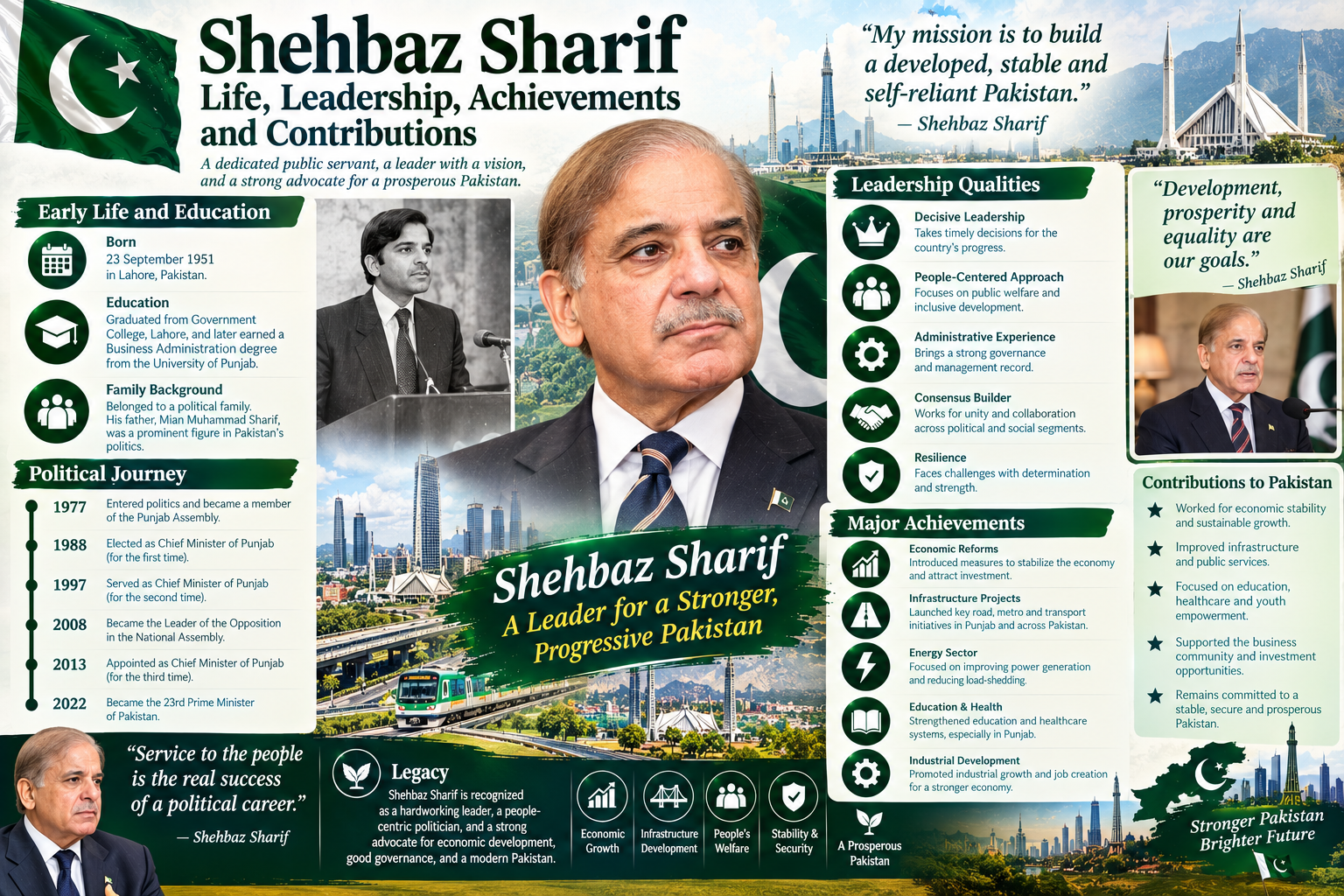
Shehbaz Sharif was born on September 23, 1951, in Lahore, Pakistan. According to the official Punjab government profile, he has been associated with the Pakistan Muslim League-Nawaz (PML-N) and served as Chief Minister of Punjab during several periods.
His political career reflects a long journey from provincial politics to national leadership. His supporters often describe him as an energetic administrator who focuses on development, infrastructure, education, health, and public services.
Early Life and Background
Shehbaz Sharif was born into the Sharif family in Lahore. Growing up in a family with strong business and public connections, he developed an interest in public affairs and national development.
Lahore has historically been an important political, educational, and cultural centre of Pakistan. Growing up in this environment exposed Shehbaz Sharif to the social and economic challenges faced by ordinary citizens.
His early experiences helped shape his approach toward administration and public service. Throughout his political career, he has frequently emphasized development projects, better public facilities, education, healthcare, transportation, and economic opportunities.
Beginning of Political Career
Shehbaz Sharif entered practical politics during a period when Pakistan was experiencing significant political changes. He became associated with the Pakistan Muslim League-Nawaz and gradually developed experience in parliamentary and administrative affairs.
His political career became particularly important when he entered provincial leadership in Punjab. Punjab is Pakistan's largest province by population and has a major role in the country's economy, agriculture, education, industry, and culture.
Working in Punjab gave Shehbaz Sharif an opportunity to deal with large-scale administrative responsibilities. His political career therefore became strongly associated with governance and development.
Chief Minister of Punjab
One of the most important parts of Shehbaz Sharif's political career has been his service as Chief Minister of Punjab.
The official Punjab government records list his periods as Chief Minister as 1997–1999, 2008–2013, and 2013–2018.
During these periods, his administration focused heavily on development and public-service projects. His style of governance became associated with frequent reviews of development schemes and direct attention to administrative performance.
As Chief Minister, he regularly held meetings to review projects in Lahore and other cities. Government records from his tenure show attention to development projects, education, healthcare, and public welfare.
Focus on Education
Education has been an important area of public policy during Shehbaz Sharif's political career.
Punjab has a very large student population, and improving access to education is important for the province's future. During his tenure as Chief Minister, the Punjab government promoted programmes aimed at supporting talented students and expanding educational opportunities.
Government records from 2016 describe programmes for promoting quality education and supporting talented students.
Shehbaz Sharif has frequently emphasized the importance of education for national development. Education provides young people with knowledge, skills, confidence, and opportunities to build better careers.
For Pakistan, investment in education is especially important because a young population can become a major strength when students receive quality education and useful skills.
Interest in Healthcare
Healthcare has also been an important part of the development agenda associated with Shehbaz Sharif's administration.
Government records from his time as Punjab Chief Minister mention spending on the health sector and efforts to improve facilities for citizens.
Healthcare affects every part of society. Better hospitals, trained medical professionals, medicines, diagnostic services, and awareness programmes can improve the quality of life of ordinary people.
The development of public healthcare therefore became one of the areas receiving attention during his provincial leadership.
Infrastructure and Development
Another important part of Shehbaz Sharif's political image is his focus on infrastructure.
Large cities require roads, transportation systems, public buildings, educational institutions, healthcare facilities, and other infrastructure to support growing populations.
During his time in Punjab, development projects were regularly reviewed by the provincial government. Official Punjab government records show meetings concerning development projects in Lahore and other cities.
Infrastructure development can have a long-term impact because it supports transportation, business activity, education, employment, and urban growth.
Administrative Style
Shehbaz Sharif is often associated with an active and hands-on administrative style.
Rather than focusing only on policy announcements, his political career has frequently included meetings and reviews of ongoing projects. This approach emphasizes monitoring, deadlines, implementation, and administrative performance.
His supporters consider this style useful for completing development projects and improving public services.
Effective administration is important because even a good policy cannot produce results without proper implementation. Government departments need planning, coordination, monitoring, and accountability.
Role in National Politics
After gaining extensive experience in Punjab, Shehbaz Sharif became an important national political leader.
His experience as Chief Minister gave him knowledge of government administration, public finance, development planning, and political management.
Over time, he became one of the leading figures of the Pakistan Muslim League-Nawaz.
His political career eventually reached the highest level of federal government when he became Prime Minister of Pakistan.
First Term as Prime Minister
Shehbaz Sharif first became Prime Minister in April 2022.
His first federal government faced a challenging economic and political environment. Pakistan was dealing with inflation, financial pressures, energy issues, and other national challenges.
As Prime Minister, Shehbaz Sharif emphasized economic stability, investment, international cooperation, and development.
His government also focused on strengthening relations with friendly countries and international partners.
Return to the Prime Minister's Office
Shehbaz Sharif returned as Prime Minister in March 2024.
The National Assembly's current records list him as Prime Minister/Leader of the House.
His return to the office represented another important stage in his political career.
In his second term, his government has continued to focus on economic management, development, investment, employment, social welfare, and international relations.
The Prime Minister's Office continues to publish his official messages on national and international issues. In 2026, these included messages concerning education, labour rights, national development, and other public matters.
Economic Development
Economic development is one of the most important responsibilities of any Pakistani government.
Pakistan has a large population and a growing need for employment, investment, exports, energy, and economic opportunities.
Shehbaz Sharif's government has emphasized economic stability and development. His administration has promoted investment and cooperation with international partners.
Economic progress requires cooperation between the government, businesses, workers, farmers, students, and investors.
A stable economy can create more employment opportunities and improve living standards.
Support for Youth
Pakistan has a very young population. Young people represent one of the country's greatest opportunities.
Shehbaz Sharif has frequently highlighted education, skills, employment, and opportunities for young people.
Youth development is important because students who receive quality education and professional skills can contribute to technology, business, science, agriculture, industry, and public service.
Pakistan's future therefore depends heavily on its ability to educate and empower young people.
Importance of Skills and Education
Modern economies require more than traditional education. Students also need practical skills.
Computer science, artificial intelligence, information technology, engineering, business, digital marketing, communication, and technical education can help young Pakistanis compete in a changing global economy.
A strong education system can also help reduce unemployment by preparing students for modern careers.
This makes investment in education and skills an important part of Pakistan's long-term development.
International Relations
As Prime Minister, Shehbaz Sharif has an important role in Pakistan's foreign policy.
Pakistan maintains relationships with many countries, including China, Saudi Arabia, the United Arab Emirates, Turkey, Qatar, and other international partners.
International relations are important for trade, investment, energy cooperation, education, technology, and diplomatic support.
The Prime Minister's Office regularly publishes statements and messages related to Pakistan's international relations and national interests.
Relationship with China
China is one of Pakistan's major international partners.
Economic cooperation between Pakistan and China includes infrastructure, energy, transportation, investment, and other development areas.
Pakistan-China relations are also connected with the China-Pakistan Economic Corridor, commonly known as CPEC.
For Pakistan, international economic partnerships can provide opportunities for infrastructure development, investment, technology transfer, and employment.
Public Welfare
Public welfare remains an important responsibility of government.
People need access to education, healthcare, clean water, transportation, employment, and social protection.
Shehbaz Sharif's political career has included attention to public welfare projects, especially during his periods as Chief Minister of Punjab.
Official Punjab government records from his earlier tenure highlight welfare-oriented development and investment in sectors such as health and education.
Commitment to Children
Children represent the future of Pakistan.
In an official 2026 message on World Day Against Child Labour, Prime Minister Shehbaz Sharif emphasized the importance of protecting children from exploitation and providing opportunities through education. His government message also highlighted social protection and educational support initiatives.
Protecting children and improving education are important for creating a healthier and more educated future generation.
Leadership Qualities
Shehbaz Sharif's long political career has given him extensive experience in administration and government.
Some qualities commonly associated with his leadership style include:
Administrative experience
Focus on development
Attention to public projects
Interest in education
Emphasis on healthcare
Strong political organization
Focus on economic management
International diplomacy
Public-service orientation
Leadership in a country as large and diverse as Pakistan requires coordination between federal and provincial governments, institutions, businesses, and citizens.
Contribution to Punjab
Shehbaz Sharif's most visible political contribution has been his long association with Punjab.
As Chief Minister, he worked on projects involving education, healthcare, infrastructure, transportation, and public services.
His multiple terms as Chief Minister gave him extensive experience of provincial administration. The official Punjab government records confirm his three major periods in the office.
Punjab's size and importance mean that decisions taken in the province can influence Pakistan's overall economic and social development.
Contribution to Pakistan's Political System
Shehbaz Sharif has also contributed to Pakistan's parliamentary politics through decades of political participation.
He has served as a member of the National Assembly and as Prime Minister. His current National Assembly profile identifies him as Prime Minister of the Islamic Republic of Pakistan.
His career demonstrates how political leadership can develop through different levels of government, from provincial administration to federal leadership.
A Message for Young Pakistanis
One of the most important lessons young people can take from a long political career is the value of persistence.
Pakistan's youth face many challenges, but they also have enormous opportunities.
Students should focus on education, practical skills, discipline, communication, technology, and responsible citizenship.
Whether a young person chooses medicine, engineering, law, business, computer science, teaching, agriculture, or another field, professional knowledge can contribute to national progress.
The future of Pakistan will depend greatly on educated and skilled young people.
Vision for a Better Pakistan
A better Pakistan requires progress in many areas at the same time.
The country needs:
Quality education
Better healthcare
Strong infrastructure
Economic stability
Employment opportunities
Modern technology
Agricultural development
Industrial growth
Social protection
Good governance
Political leadership can help create policies for these areas, but national development is ultimately a shared responsibility.
Government institutions, businesses, teachers, students, workers, farmers, and citizens all have roles to play.
Legacy and Public Life
Shehbaz Sharif has spent many years in Pakistani public life.
His political journey from provincial politics to the office of Prime Minister represents decades of experience in governance.
His supporters particularly associate him with development-oriented administration, infrastructure projects, education programmes, healthcare initiatives, and active government monitoring.
His continuing role in national politics means that his public career remains an important part of Pakistan's contemporary political history.
Conclusion
Muhammad Shehbaz Sharif is a prominent Pakistani political personality whose career has been closely connected with public administration and development.
From his early political career to his multiple terms as Chief Minister of Punjab and his service as Prime Minister, he has remained an important figure in Pakistan's political landscape.
His work has included attention to education, healthcare, infrastructure, economic development, youth opportunities, and public welfare. His long experience in provincial and federal government has given him a significant role in Pakistan's modern political history.
For young Pakistanis, his career also highlights the importance of education, leadership, administration, and public service.
Pakistan is a country with a large young population and enormous potential. With better education, modern skills, economic opportunities, strong institutions, and responsible leadership, the country can continue moving toward a stronger and more prosperous future.
Shehbaz Sharif's political journey remains an important example of long-term participation in public life and government administration. His continuing role as Prime Minister makes him one of the significant contemporary political personalities of Pakistan.
FAQs
1. Who is Shehbaz Sharif?
Shehbaz Sharif is a Pakistani political leader and the Prime Minister of Pakistan.
2. When was Shehbaz Sharif born?
He was born on September 23, 1951, in Lahore.
3. How many times did Shehbaz Sharif serve as Chief Minister of Punjab?
He served as Chief Minister of Punjab during three major periods: 1997–1999, 2008–2013 and 2013–2018.
4. What is Shehbaz Sharif known for?
He is particularly known for his administrative experience and focus on development, education, healthcare and infrastructure.
5. What is Shehbaz Sharif's political party?
He is associated with the Pakistan Muslim League-Nawaz (PML-N).




