Introduction
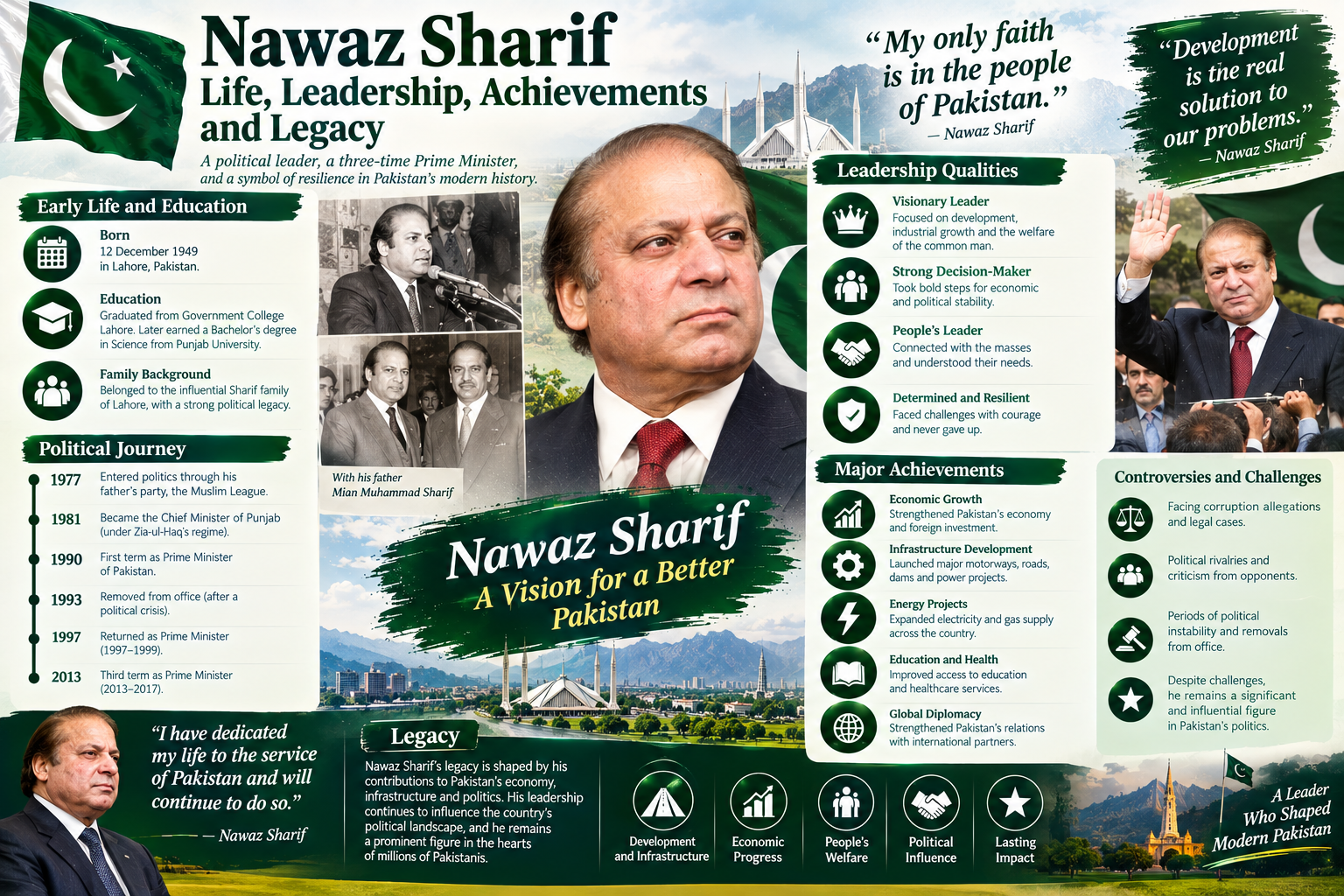
Mian Muhammad Nawaz Sharif is one of the most prominent political leaders in Pakistan's modern history. He has had a long political career spanning several decades and has served as the Prime Minister of Pakistan three times. His political journey is closely connected with Pakistan's economic development, infrastructure, energy projects, business activity and democratic politics.
Nawaz Sharif first became Prime Minister in 1990, returned to the office in 1997, and became Prime Minister for a third time in 2013. The National Assembly's official record confirms all three periods of his premiership.
His career is also closely connected with Punjab, where he served as Chief Minister before becoming Prime Minister. His experience in provincial administration helped shape his approach to national development.
Nawaz Sharif remains an active figure in Pakistani public life. The National Assembly's current profile lists him as a member from NA-130, Lahore, with the Pakistan Muslim League-Nawaz (PML-N).
Early Life of Nawaz Sharif
Nawaz Sharif was born on December 25, 1949, in Lahore, Punjab.
He grew up in a business-oriented family. His father, Mian Muhammad Sharif, was a businessman and industrialist. The family developed an interest in industry and business, which later became an important part of Nawaz Sharif's professional background.
Growing up in Lahore gave Nawaz Sharif an opportunity to observe the economic and social development of one of Pakistan's largest cities.
His early life was influenced by education, business and family values. These experiences later played a role in shaping his interest in economic development and public administration.
Education
Nawaz Sharif received his education in Lahore.
He studied at Government College Lahore and later completed his law education at the University of the Punjab.
His educational background gave him an understanding of law, business and public affairs.
Education is particularly important for people who enter public life because government decisions often involve economics, law, administration and social development.
Nawaz Sharif's combination of education and business experience later became part of his political career.
Business Background
Before entering national politics, Nawaz Sharif had experience in the family business.
The Sharif family's industrial background gave him an understanding of manufacturing, investment and economic activity.
Business and industry are important parts of a country's economy because they create employment, produce goods and encourage investment.
This background influenced Nawaz Sharif's political emphasis on economic development and industrial growth.
Entry into Politics
Nawaz Sharif entered politics during an important period in Pakistan's history.
He gradually became involved in provincial government and developed political experience in Punjab.
His early political career allowed him to understand the practical responsibilities of government administration.
He eventually became Chief Minister of Punjab, one of the most important provincial offices in Pakistan.
This experience provided a foundation for his later role as Prime Minister.
Chief Minister of Punjab
Nawaz Sharif served as Chief Minister of Punjab during the 1980s.
Punjab is Pakistan's most populous province and has a major role in agriculture, industry, education and commerce.
Serving as Chief Minister gave Nawaz Sharif experience in managing a large provincial government.
During this period, his political profile increased significantly.
His work in Punjab helped establish him as a major national political figure.
Becoming Prime Minister for the First Time
Nawaz Sharif became Prime Minister of Pakistan for the first time on November 6, 1990. The National Assembly's historical record confirms his first premiership.
His first government focused on economic development, investment and infrastructure.
He emphasized the importance of private-sector activity and economic growth.
Pakistan was going through important economic and political changes, and the government attempted to encourage investment and development.
His first term also helped establish his identity as a national political leader.
Economic Development
Economic development has remained one of the major themes associated with Nawaz Sharif's political career.
He has frequently emphasized industry, investment, infrastructure and business activity.
A strong economy can create employment opportunities and improve living standards.
Economic development also requires reliable energy, transportation, communication systems and financial institutions.
These areas became important parts of the development agenda during his different periods in government.
Infrastructure Development
Infrastructure has been one of the most visible areas associated with Nawaz Sharif's governments.
Roads, highways, bridges and transportation networks received significant attention during different periods of his leadership.
Infrastructure is important because it connects cities and rural areas and makes it easier for people and businesses to move.
Better roads can also support tourism, agriculture and trade.
For a developing country such as Pakistan, infrastructure development can contribute to long-term economic activity.
Motorways and Transportation
Nawaz Sharif's governments became particularly associated with motorway and highway development.
Modern highways can reduce travel time between major cities and improve connections between commercial centers.
Transportation networks also help businesses move products from factories and farms to markets.
For ordinary citizens, improved roads can make travel easier and provide better access to education, healthcare and employment.
Energy Development
Energy has been another important part of Pakistan's development challenges.
Industries, businesses, schools and homes all require reliable electricity.
During Nawaz Sharif's third government, several energy projects were pursued to increase electricity generation and address shortages.
The government also worked on power-generation projects and energy infrastructure.
Reliable energy is essential for industrial growth and economic activity.
China-Pakistan Cooperation
Relations between Pakistan and China have been an important part of Nawaz Sharif's political career.
During his third term as Prime Minister, cooperation with China expanded significantly, particularly through the China-Pakistan Economic Corridor (CPEC).
CPEC became associated with infrastructure, energy, transportation and investment projects.
Pakistan's relationship with China has a long history, and economic cooperation became an important part of the development agenda during Nawaz Sharif's third government.
CPEC and Development
The China-Pakistan Economic Corridor became one of the major development initiatives associated with Nawaz Sharif's third government.
The broader CPEC framework includes projects related to energy, infrastructure, transportation and economic cooperation.
Such projects are important because Pakistan needs investment in infrastructure and energy to support long-term growth.
CPEC also increased international attention toward Pakistan's geographical position and its potential role in regional trade.
Focus on Energy Projects
During the third Nawaz Sharif government, energy projects received considerable attention.
The objective was to increase electricity supply and support economic activity.
Energy availability is particularly important for industries because factories and businesses require stable power.
For students and ordinary households, reliable electricity also supports education, communication and daily life.
Business and Investment
Nawaz Sharif has consistently emphasized the role of private businesses in economic development.
Businesses can create jobs, produce goods and services and contribute to government revenue.
Investment can also help introduce new technology and improve productivity.
His political approach often highlighted the importance of creating an environment where businesses could operate and contribute to economic growth.
Agriculture and Rural Development
Agriculture is one of Pakistan's most important economic sectors.
Punjab, in particular, has a large agricultural economy.
Government policies relating to roads, irrigation, energy and markets can affect farmers and rural communities.
Development of rural infrastructure can help farmers transport agricultural products to markets more efficiently.
Agricultural development is therefore connected with transportation, energy and economic planning.
Education and Youth
Education has always been important for Pakistan's future.
Nawaz Sharif's governments have included education and youth development among public policy priorities.
Young people represent a large part of Pakistan's population.
Providing students with quality schools, universities, technical training and professional opportunities is essential for economic development.
A skilled young population can contribute to technology, medicine, engineering, business, education and many other fields.
Importance of Technical Education
Modern economies require technical skills.
Students need opportunities to learn computer science, engineering, vocational skills and other practical subjects.
Technical education can help young people enter the job market and start businesses.
Pakistan's future development depends on creating a workforce that can compete in modern industries.
Healthcare and Public Services
Healthcare is another important area of government responsibility.
Hospitals, medical colleges and public health services help improve the quality of life of citizens.
Nawaz Sharif's political career has included attention to public service delivery and development projects.
Strong healthcare systems are important for both urban and rural communities.
Democratic Politics
Nawaz Sharif has spent much of his political career within the parliamentary system.
He has served as a Member of Parliament and Prime Minister and has remained an important leader of the Pakistan Muslim League-Nawaz.
His political journey has included participation in elections, parliamentary politics and party organization.
The National Assembly's records list him among Pakistan's former Prime Ministers and also record his current membership in the National Assembly.
Third Term as Prime Minister
Nawaz Sharif became Prime Minister for the third time on June 5, 2013.
The National Assembly records that he was elected Prime Minister after the 2013 general elections.
His third government focused strongly on infrastructure, energy, economic development and international investment.
This period was also associated with increased cooperation with China and major development projects.
Foreign Relations
Foreign relations have always been important for Pakistan.
During his different terms as Prime Minister, Nawaz Sharif worked on relationships with neighboring countries and major international partners.
Pakistan's relationships with China, Saudi Arabia, Turkey, the United States and other countries are important for trade, investment, diplomacy and regional cooperation.
Nawaz Sharif also participated in international forums and represented Pakistan on global platforms.
Relationship with China
Pakistan and China have traditionally maintained close relations.
During Nawaz Sharif's third term, economic cooperation with China received particular attention.
The development of CPEC strengthened economic discussions between the two countries.
China became an important partner in Pakistan's infrastructure and energy development plans.
Peace and Regional Relations
South Asia is a region where cooperation between neighboring countries is important.
Pakistan's relations with India and Afghanistan have significant effects on regional peace and economic development.
Nawaz Sharif's governments participated in diplomatic efforts and emphasized the importance of peaceful relations and regional stability.
Peaceful regional relationships can support trade, tourism and economic cooperation.
Leadership Style
Nawaz Sharif is known for focusing strongly on development projects and economic issues.
His leadership style has often emphasized practical development, infrastructure and investment.
He has also maintained a strong political organization through the Pakistan Muslim League-Nawaz.
His long career has given him extensive experience in government and parliamentary politics.
Political Experience
One of Nawaz Sharif's most distinctive qualities is his long experience in public life.
He entered politics decades ago and served at provincial and federal levels.
Over the years, he gained experience in economic policy, foreign relations, administration and parliamentary politics.
This long experience has made him one of Pakistan's best-known political figures.
Role in Pakistan Muslim League-Nawaz
Nawaz Sharif is the central political figure associated with the Pakistan Muslim League-Nawaz.
The party has remained one of Pakistan's major political organizations.
It has won elections at both provincial and national levels and has formed governments in Punjab and at the federal level.
Nawaz Sharif's leadership has played a major role in shaping the party's identity.
Nawaz Sharif and Punjab
Punjab has always been important in Nawaz Sharif's political career.
He served as Chief Minister of Punjab and later became Prime Minister.
His political base and public support have remained strongly connected with Punjab.
Punjab's large population and major role in Pakistan's agriculture, industry and education make it especially important in national politics.
Contribution to Infrastructure
Infrastructure development remains one of the most visible parts of Nawaz Sharif's political legacy.
Motorways, highways, bridges and transportation projects can have long-term effects on economic activity.
Infrastructure connects people and markets.
When roads improve, businesses can transport goods more easily and citizens can travel more efficiently.
Contribution to Economic Growth
Economic growth requires cooperation between government, businesses, workers and investors.
Nawaz Sharif's political approach has generally placed strong importance on economic development and private-sector activity.
His governments attempted to increase investment and expand infrastructure to support the economy.
These efforts form an important part of his political identity.
Nawaz Sharif as a Senior Political Leader
Today, Nawaz Sharif is a senior figure in Pakistan's political landscape.
The National Assembly's current profile lists him as an elected member from NA-130 in Lahore.
His decades of experience give him an important role in political discussions.
He continues to be associated with the Pakistan Muslim League-Nawaz and remains influential within the party.
Family and Political Legacy
The Sharif family's political story extends beyond Nawaz Sharif.
His younger brother, Shehbaz Sharif, has also served as Prime Minister and Chief Minister of Punjab.
The next generation includes Maryam Nawaz, who became the first woman Chief Minister of Punjab in 2024, and Hamza Shehbaz, who has also served as Chief Minister of Punjab.
This makes the Sharif family an important part of Pakistan's modern political history.
Lessons for Pakistani Students
Nawaz Sharif's long career provides several lessons for young people.
1. Education Is Important
Education provides the knowledge needed to understand society and professional life.
Students should develop strong educational foundations.
2. Experience Matters
Success often develops over many years.
Students should focus on learning skills and gaining experience instead of expecting immediate results.
3. Leadership Requires Responsibility
Leadership means taking responsibility for decisions and working toward clear goals.
4. Development Needs Planning
Large projects require planning, resources and teamwork.
Pakistan needs skilled professionals who can contribute to infrastructure, technology, business and public services.
5. Communication Is Essential
Good leaders need strong communication skills.
Students should practice writing, speaking and listening.
6. Technology Is Important
Modern Pakistan needs students who understand technology and digital skills.
Young people can contribute through computer science, artificial intelligence, software development and entrepreneurship.
Why Nawaz Sharif Remains Important
Nawaz Sharif remains important because of his long political career and his three terms as Prime Minister.
His governments were associated with infrastructure development, energy projects, economic policies and international cooperation.
His current membership in the National Assembly also shows that he remains active in Pakistan's political system.
His career provides students with an opportunity to study how political leadership, economic policy and public administration have developed in Pakistan.
Conclusion
Mian Muhammad Nawaz Sharif is one of the most recognizable political leaders in Pakistan's modern history.
His political career began in Punjab and eventually took him to the position of Prime Minister of Pakistan three times. The National Assembly officially records his premierships in 1990–1993, 1997–1999 and 2013–2017.
His political identity has been strongly associated with economic development, infrastructure, energy projects, investment, business activity and international cooperation.
His third government was particularly associated with major infrastructure and energy initiatives and increased economic cooperation with China.
Nawaz Sharif's long career also demonstrates the importance of experience, organization and communication in public life.
For Pakistani students, his journey offers useful lessons about education, professional development, leadership and the importance of contributing to national development.
Today, Nawaz Sharif remains a senior political figure and an elected member of the National Assembly from Lahore.
His long political journey has made him an important part of Pakistan's modern political history, and his role in the country's development continues to be studied and discussed.
FAQs
1. Who is Nawaz Sharif?
Nawaz Sharif is a prominent Pakistani political leader and senior member of the Pakistan Muslim League-Nawaz.
2. How many times has Nawaz Sharif been Prime Minister?
He has served as Prime Minister of Pakistan three times: 1990–1993, 1997–1999 and 2013–2017.
3. What is Nawaz Sharif known for?
He is known for his long political career and focus on economic development, infrastructure, energy and investment.
4. Is Nawaz Sharif currently active in politics?
Yes. The National Assembly currently lists him as an elected member from NA-130, Lahore.
5. What political party is Nawaz Sharif associated with?
He is associated with the Pakistan Muslim League-Nawaz (PML-N).
6. What are some major areas associated with Nawaz Sharif's governments?
Infrastructure, energy, economic development, investment and international cooperation are major areas associated with his governments.
7. Why is Nawaz Sharif important in Pakistan's history?
His three premierships and decades-long political career have made him one of the major figures in Pakistan's modern political history.