Introduction
Pervez Musharraf was an important Pakistani military and political leader who played a significant role in the country's history during the late 1990s and 2000s. He served as the President of Pakistan from 2001 to 2008 and remained an influential figure in national and international affairs for many years.
Musharraf was known for his military career, interest in modernization, emphasis on technology and efforts to strengthen Pakistan's position in the international community. His period of leadership included important developments in telecommunications, media, infrastructure, education and economic activity.
The official record of the Presidency lists Pervez Musharraf as President of Pakistan from June 20, 2001, to August 18, 2008.
His life provides several lessons about leadership, discipline, education, professional development and the importance of adapting to changing times.
Early Life of Pervez Musharraf
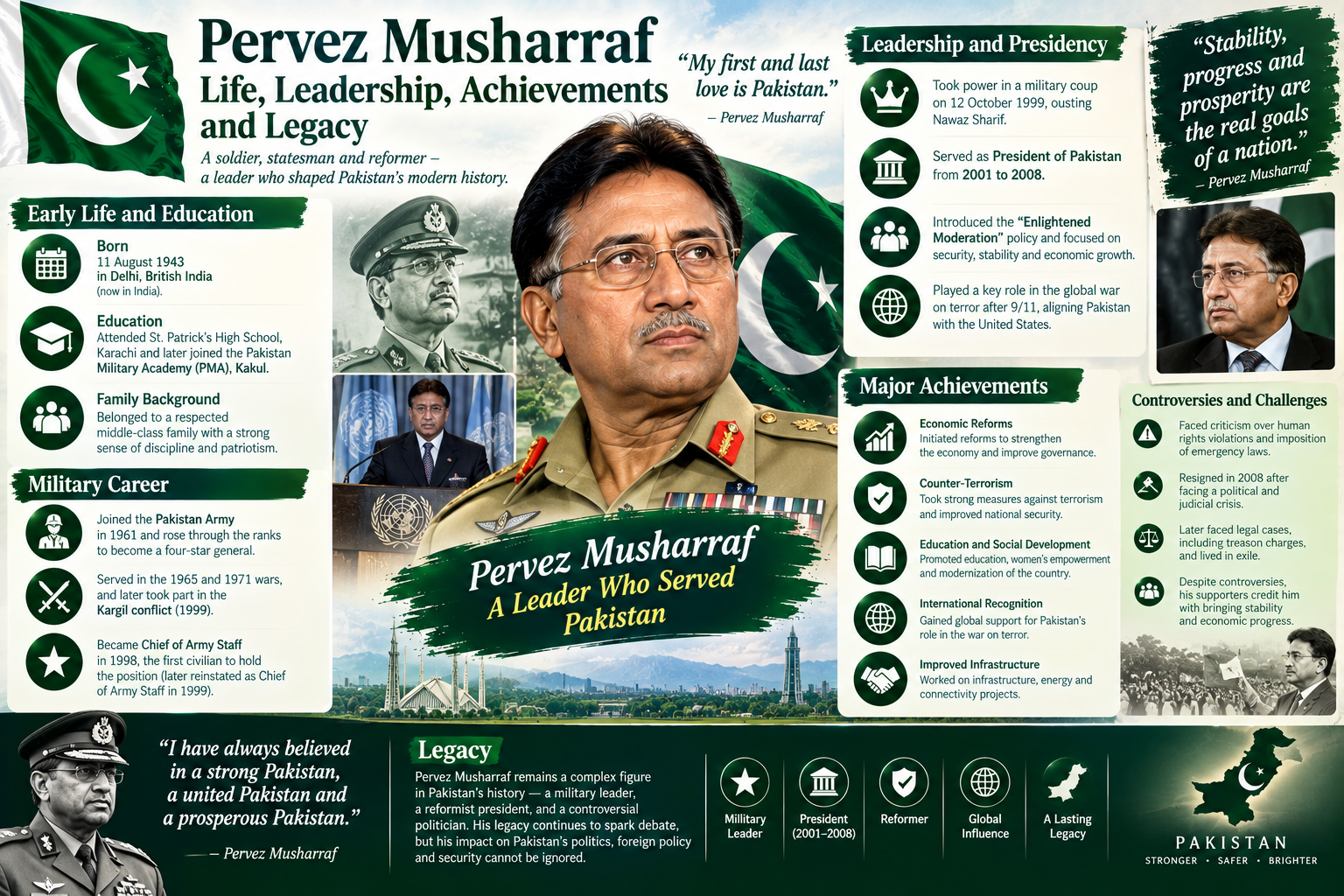
Pervez Musharraf was born on August 11, 1943, in Delhi, British India.
His family moved to Pakistan after the creation of Pakistan in 1947. Like many families of that period, his family became part of the new country's developing society.
Growing up in the early years of Pakistan gave Musharraf an understanding of the challenges faced by a newly established country.
His childhood and early education helped prepare him for a professional career in the armed forces.
Education
Education played an important role in Musharraf's development.
He received his early education in Pakistan and later attended Forman Christian College in Lahore.
He eventually joined the Pakistan Military Academy at Kakul, where he received military training.
His education was combined with professional military training, which helped him develop discipline, leadership and decision-making skills.
For students, his educational journey demonstrates the importance of combining academic knowledge with practical skills.
Joining the Pakistan Army
Pervez Musharraf joined the Pakistan Army in 1964.
During his military career, he served in different positions and gained experience in leadership, planning and national security.
His professional journey progressed over several decades.
He eventually became Chief of Army Staff, one of the most senior military positions in Pakistan.
His rise through the military demonstrated the importance of professional training, discipline and experience.
Military Career
Musharraf served in different military assignments during his career.
His service included important responsibilities and opportunities to develop leadership skills.
The military environment required discipline, teamwork, planning and the ability to make decisions under pressure.
These qualities later became part of his public leadership style.
His military career was also connected with important periods in Pakistan's history, giving him extensive experience in national and international affairs.
Becoming Chief of Army Staff
Pervez Musharraf became Chief of Army Staff in 1998.
This was a major achievement in his professional career.
As Army Chief, he became one of the country's most important national figures.
His position required him to work with government institutions and senior officials on matters related to national security and foreign relations.
His experience during this period later influenced his approach to national leadership.
Becoming President of Pakistan
Pervez Musharraf became President of Pakistan in 2001.
The official Presidency website lists his presidential tenure as June 20, 2001, to August 18, 2008.
His presidency began during a period of major international changes.
Pakistan became an important country in international diplomacy, particularly because of developments in South Asia and Pakistan's relations with major world powers.
Musharraf represented Pakistan at various international forums and worked to strengthen the country's diplomatic position.
Focus on Modernization
One of the major themes associated with Musharraf's period was modernization.
His government promoted the expansion of technology, telecommunications and media.
Pakistan experienced rapid growth in mobile phone usage and internet connectivity during the 2000s.
The expansion of digital communication helped connect people across different parts of the country.
This period contributed to the development of Pakistan's modern information and communication environment.
Growth of Telecommunications
The telecommunications sector experienced major expansion during the 2000s.
Mobile phones became increasingly accessible to ordinary Pakistanis.
Communication became easier between cities, villages and different regions.
This development created opportunities for businesses, students and families.
For students today, smartphones and internet access are normal parts of daily life. The rapid development of telecommunications during the 2000s played an important role in creating this modern communication environment.
Expansion of Media
Another important development associated with Musharraf's period was the expansion of private electronic media.
Television channels increased significantly, creating more opportunities for news, entertainment and public discussion.
The growth of television also changed the way Pakistanis received information.
Media became an increasingly important part of national life.
The development of broadcasting created new opportunities for journalists, presenters, producers and other media professionals.
Information Technology
Information technology received increased attention during the Musharraf era.
The government promoted the use of computers, internet services and digital communication.
The growth of IT created new possibilities for young Pakistanis.
Students became more interested in computer education, software development and internet-based careers.
Today, Pakistan's large technology and freelancing community benefits from the broader digital transformation that developed over many years.
Education and Higher Learning
Education was another important area of national development during this period.
Higher education institutions received increased attention, and universities expanded their academic programs.
The growth of higher education created opportunities for students to study subjects such as computer science, engineering, business and social sciences.
For Pakistan's young population, access to higher education is essential for developing professional skills.
The emphasis on education and technology helped connect Pakistani students with new academic and professional opportunities.
Infrastructure Development
Infrastructure development was also an important part of the country's development during Musharraf's period.
Roads, highways, communication networks and urban infrastructure received attention.
Better infrastructure helps businesses move goods, allows people to travel more easily and connects communities.
Development in transportation and communication can also support tourism and economic activity.
Economic Development
Musharraf's period included years of economic growth and increased business activity.
The government focused on investment, privatization, financial development and expanding economic opportunities.
A growing economy can create employment opportunities and encourage entrepreneurship.
The period also saw increasing interest in information technology, telecommunications and modern business services.
For young Pakistanis, the expansion of new industries created opportunities beyond traditional professions.
Promotion of Technology
Technology became increasingly important in Pakistan's development strategy.
Computers, internet services and mobile communication became more common.
The growth of technology helped Pakistan move toward a more digitally connected society.
This development later supported areas such as online education, freelancing, e-commerce and digital communication.
Young people today can benefit from these developments by learning computer skills and using technology for education and professional growth.
Tourism and International Image
Pakistan's international image was another area of importance during Musharraf's leadership.
The government worked to maintain international relations and present Pakistan as an important country in the region.
Pakistan's geographical location gave it strategic importance in South Asia and beyond.
International relationships can influence trade, tourism, education and investment.
Musharraf's leadership period therefore included extensive engagement with international governments and organizations.
Diplomacy and Foreign Relations
Foreign policy was one of the major areas of Musharraf's leadership.
Pakistan developed important relationships with countries including the United States, China, Saudi Arabia and other international partners.
Diplomacy requires communication, negotiation and understanding between countries.
Musharraf frequently represented Pakistan internationally and participated in diplomatic meetings.
His military background also gave him extensive experience in international security discussions.
Relations with China
China has historically been an important partner of Pakistan.
During Musharraf's period, Pakistan continued to strengthen relations with China.
Cooperation between the two countries included economic, diplomatic and strategic areas.
China's importance to Pakistan's economy and infrastructure continued to grow over time.
The relationship remains an important part of Pakistan's foreign policy.
Development of Leadership Skills
Musharraf's professional career provides several lessons about leadership.
He spent decades in the military before reaching the highest levels of national leadership.
His career demonstrates the importance of discipline, professional training and experience.
Leadership also requires communication and the ability to understand changing circumstances.
Young people can learn from this by developing skills gradually rather than expecting immediate success.
Importance of Discipline
Discipline was a major part of Musharraf's military background.
Military institutions place strong emphasis on punctuality, responsibility, teamwork and professional standards.
These qualities are useful not only in military careers but also in education and ordinary professional life.
Students can benefit from developing good habits such as attending classes regularly, completing assignments on time and organizing their studies.
Importance of Technology for Pakistan
One of the most important lessons from the modernization period is the importance of technology.
Countries that invest in technology can create opportunities for young people and businesses.
Pakistan has a large young population, making digital skills particularly valuable.
Students today can learn programming, graphic design, digital marketing, cybersecurity, artificial intelligence and other technology-related skills.
The expansion of digital communication during the 2000s helped create an environment in which these opportunities could grow.
Impact on Young People
Pakistan's youth population has always been one of the country's greatest assets.
During Musharraf's period, increasing access to computers, mobile phones and the internet gave young people new ways to communicate and learn.
Students could access information from around the world.
This helped change traditional approaches to education and career development.
Today, Pakistani students can study online, work remotely and connect with international communities.
Women and Professional Opportunities
The period also included discussions and policies related to women's participation in public and professional life.
Women increasingly participated in education, media, business and professional careers.
Greater access to education and employment is important for national development because countries benefit when all citizens can contribute their skills.
The participation of women in Pakistan's professional sectors has continued to grow over time.
Lessons for Pakistani Students
Pervez Musharraf's life provides several lessons for students.
1. Education Builds Skills
Education provides the knowledge needed for professional success.
Students should focus on learning rather than simply memorizing information.
2. Discipline Creates Progress
Good habits can make a major difference in academic life.
Regular study, time management and responsibility help students reach their goals.
3. Technology Creates Opportunities
Modern technology has created new career paths.
Students should learn useful digital skills and use technology responsibly.
4. Communication Is Important
Leadership requires the ability to communicate ideas clearly.
Students should practice speaking, writing and listening skills.
5. Professional Experience Matters
Success often develops gradually.
People can improve their abilities through education, training and practical experience.
6. International Relations Matter
Pakistan's development depends partly on strong relationships with other countries.
Understanding the world can help students become better-informed citizens.
Pervez Musharraf's Legacy
Pervez Musharraf remains an important figure in Pakistan's modern history.
His period of leadership was associated with modernization, telecommunications growth, media expansion, technology development and extensive international engagement.
He also remains notable for having served as both Chief of Army Staff and President of Pakistan.
The official Presidency record lists him among Pakistan's former presidents, with his presidential tenure ending on August 18, 2008.
His legacy is therefore connected with a period of significant technological and social change in Pakistan.
Remembering His Professional Journey
Musharraf's professional journey lasted several decades.
He began as a young military officer and eventually reached the country's highest offices.
His career demonstrates how long-term professional development can lead to major responsibilities.
His life also shows how national leaders can influence different areas, including technology, diplomacy, education and economic policy.
Importance of His Era for Modern Pakistan
The early 2000s were an important period in Pakistan's transition toward a more connected society.
Mobile phones, internet access, private television and digital technologies became increasingly common.
These developments changed how people communicated and received information.
They also created new industries and professional opportunities.
The effects of this technological transition can still be seen in Pakistan today.
Conclusion
Pervez Musharraf was an important Pakistani military and political leader whose career covered several decades.
He served as Chief of Army Staff and later as President of Pakistan from 2001 to 2008.
His period of leadership was associated with major developments in telecommunications, information technology, media, higher education, infrastructure and international diplomacy.
His professional journey also provides useful lessons about discipline, education, communication and leadership.
For Pakistani students, one of the most relevant aspects of his era is the growth of technology and digital communication. The expansion of mobile phones, internet services and information technology helped create new opportunities for education and careers.
Pervez Musharraf passed away in 2023, but his period of leadership remains an important part of Pakistan's modern history. His professional journey and the developments associated with his era continue to be studied and discussed by students and researchers.
Understanding the history of different Pakistani leaders can help young people better understand how the country developed and how today's Pakistan was shaped by different periods of leadership.
FAQs
1. Who was Pervez Musharraf?
Pervez Musharraf was a Pakistani military and political leader who served as President of Pakistan from 2001 to 2008.
2. When did Pervez Musharraf become President?
He became President in 2001. The official Presidency record lists his tenure from June 20, 2001, to August 18, 2008.
3. What was Pervez Musharraf known for?
He was known for his military career, presidency, modernization policies, technology development, media expansion and international diplomacy.
4. When did Pervez Musharraf pass away?
Pervez Musharraf passed away on February 5, 2023.
5. Why is Musharraf important in Pakistan's history?
He played a major role in Pakistan's political and military history and led the country during an important period of technological and international change.
6. What can students learn from Musharraf's career?
Students can learn about discipline, professional development, leadership, communication and the importance of education and technology.