Introduction
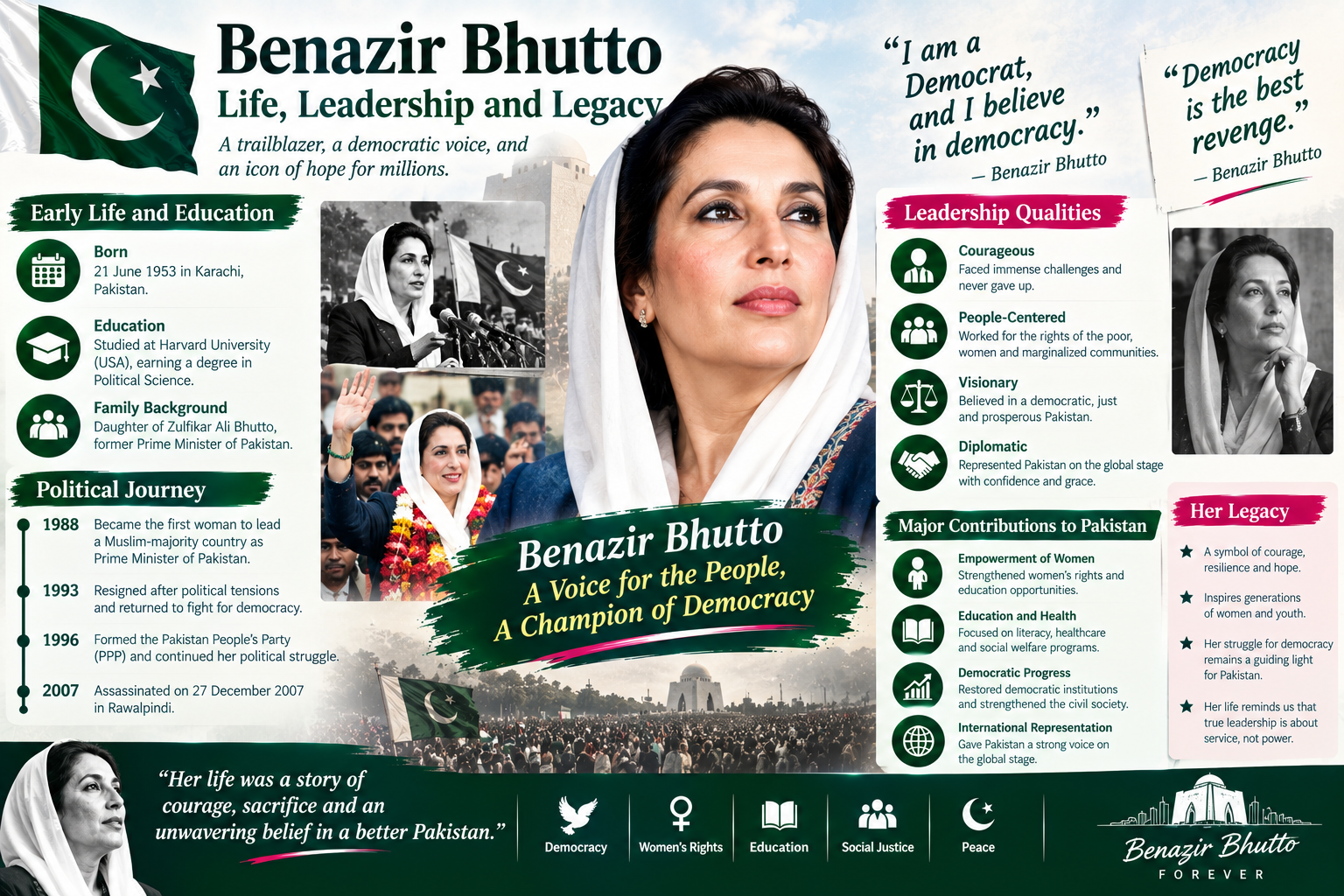
Benazir Bhutto was one of the most important political leaders in Pakistan's history. She became the first woman to serve as Prime Minister of Pakistan and is widely recognized as the first democratically elected woman Prime Minister of the Muslim world. Her political journey became a symbol of courage, education, democratic participation and women's leadership. The National Assembly of Pakistan continues to recognize her contribution to democracy, constitutional supremacy, women's empowerment and public life.
Benazir Bhutto belonged to a prominent political family, but her own career was shaped by education, political experience, public service and determination. She became an important figure in Pakistani politics at a relatively young age and remained closely associated with the Pakistan Peoples Party (PPP).
Her life is particularly inspiring for young people because she demonstrated that education, confidence, communication skills and determination can help a person take on major responsibilities.
Early Life of Benazir Bhutto
Benazir Bhutto was born on June 21, 1953, in Karachi, Pakistan. She was the daughter of Zulfikar Ali Bhutto, a major Pakistani political leader and founder of the Pakistan Peoples Party, and Begum Nusrat Bhutto.
Growing up in a political environment gave Benazir an early understanding of national affairs. However, her journey was not based only on her family background. She received an excellent education and developed her own understanding of politics, democracy and international relations.
From an early age, she showed interest in learning and public affairs. Her later political career reflected the importance she placed on education and intellectual development.
Education
Education was one of the strongest foundations of Benazir Bhutto's life.
She studied at Harvard University in the United States, where she attended Radcliffe College. She later studied at the University of Oxford in the United Kingdom.
Her educational experience exposed her to international politics, democratic institutions, political philosophy and different cultures.
Studying abroad also helped her develop communication skills and confidence. These qualities later became valuable when she entered national politics.
Her educational journey provides an important lesson for Pakistani students: education can open doors and help young people understand the world beyond their immediate surroundings.
Interest in Politics
Benazir Bhutto's interest in politics developed naturally because of her family environment and her own experiences.
She became increasingly involved in the political activities of the Pakistan Peoples Party. Her political understanding developed during a period of major changes in Pakistan.
Instead of choosing an ordinary private life, she decided to continue working in public life.
Her decision required courage and determination because Pakistani politics was highly challenging during the period in which she entered national leadership.
Becoming a Political Leader
Benazir Bhutto gradually emerged as one of the leading figures of the Pakistan Peoples Party.
She became an important voice for democratic politics and constitutional government.
Her speeches focused on democracy, public participation, social justice and the rights of ordinary citizens.
She also became an important symbol for women who wanted to participate in politics and public service.
The National Assembly has described her as a leader who encouraged women to take a greater role in political and public life.
First Woman Prime Minister of Pakistan
One of the greatest milestones in Benazir Bhutto's life came in 1988.
Pakistan held general elections in November 1988, and the Pakistan Peoples Party emerged as the leading political force. Benazir Bhutto took the oath as Prime Minister on December 2, 1988.
Her election was historic because she became the first woman Prime Minister of Pakistan and the first democratically elected woman Prime Minister of the Muslim world.
This achievement attracted international attention and became an important milestone in the history of women in politics.
Her success demonstrated that women could lead a national government and participate at the highest level of political decision-making.
Leadership and Democracy
Democracy was central to Benazir Bhutto's political identity.
She consistently presented herself as a supporter of democratic institutions, constitutional government and public participation.
The National Assembly has repeatedly recognized her struggle for the restoration and strengthening of democracy in Pakistan.
Her political career helped keep democratic ideas in public discussion during difficult periods.
She believed that political institutions should represent the people and that citizens should have a meaningful role in determining the direction of their country.
Focus on Women’s Empowerment
One of Benazir Bhutto's most important contributions was her influence on women's political participation.
Her own position as Pakistan's first female Prime Minister became a powerful example for women throughout the country.
She demonstrated that women could hold senior positions in government and contribute to national decision-making.
The National Assembly's Women's Parliamentary Caucus has recognized her contributions to women's empowerment and described her as a symbol of hope, progress and greater participation of women in public life.
Her example encouraged many young Pakistani women to consider careers in politics, education, law, government and other fields.
Education and Opportunities for Women
Benazir Bhutto strongly emphasized the importance of education and opportunities for women.
Education gives women knowledge, confidence and the ability to participate more effectively in society.
During discussions of her legacy, Pakistan's Parliament has highlighted her efforts relating to education, healthcare and economic opportunities for women and marginalized communities.
Her life itself also demonstrated the value of education. Her studies at Harvard and Oxford showed how academic knowledge can contribute to leadership and public service.
Healthcare and Social Development
Public welfare was another important part of Benazir Bhutto's political vision.
Her political legacy is associated with efforts to improve social conditions and expand opportunities for ordinary citizens.
Healthcare, education and economic opportunities are essential for building a strong society. A country can progress when its citizens have access to basic services and opportunities for personal development.
Benazir's political message often connected national development with the welfare and dignity of ordinary people.
Human Rights and Social Justice
Benazir Bhutto was also associated with human rights and social justice.
She emphasized the importance of equal citizenship and the rights of people from different backgrounds.
The National Assembly has described her as a champion of democracy, human rights, social justice and an equitable society.
These principles remain important for modern Pakistan because a strong society depends on fairness, respect and equal opportunities.
Her Second Term as Prime Minister
Benazir Bhutto returned to the office of Prime Minister in 1993.
The National Assembly's historical record states that she took the oath as Prime Minister on October 19, 1993.
Her second term demonstrated her continued political influence and ability to return to national leadership.
During this period, her government continued to focus on development, democracy, international relations and social welfare.
Her return to office also showed that women could maintain a long-term presence at the highest levels of Pakistani politics.
International Recognition
Benazir Bhutto became an internationally recognized political figure.
Her position as the first female Prime Minister of Pakistan attracted attention from governments, political organizations and international media around the world.
She represented Pakistan at international forums and worked to present the country's perspective on global issues.
Her international experience helped her understand the importance of diplomacy and cooperation between countries.
She became an example of how Pakistani women could represent their country on major international platforms.
Political Communication
Benazir Bhutto was known for her ability to communicate with large audiences.
She could discuss complicated political matters while also connecting them with the everyday concerns of ordinary people.
Good communication was one of her important leadership qualities.
For students, this is an important lesson. Academic knowledge becomes more useful when a person can explain ideas clearly, listen to others and communicate respectfully.
Courage and Determination
Courage was one of the qualities most associated with Benazir Bhutto.
Her political journey included many difficult periods, yet she continued to participate in public life.
The National Assembly has described her as a leader known for courage, resilience and determination.
Her life demonstrates that leadership requires patience and the ability to remain committed to important principles even when circumstances are difficult.
A Role Model for Pakistani Women
Benazir Bhutto became an important role model for many Pakistani women.
Before her election as Prime Minister, women in Pakistan had already contributed to politics, education, social work and national development. However, her election created a particularly powerful example because she became the head of the national government.
Her achievement showed young women that leadership positions were possible for them as well.
Today, women across Pakistan continue to participate in politics, education, business, law, medicine, technology and public administration.
Benazir's historic achievement remains part of that broader story of women's participation.
Importance of Democratic Institutions
Benazir Bhutto strongly associated her political vision with democratic institutions.
She supported the idea that Parliament, the Constitution and elected representatives should have an important role in national decision-making.
The National Assembly has repeatedly highlighted her commitment to constitutional supremacy and democratic values.
Her legacy therefore remains connected with Pakistan's continuing discussion about democracy and constitutional government.
Relationship with Young People
Young people were an important part of Benazir Bhutto's political message.
She understood that Pakistan had a large young population and that the country's future depended on educated and active young citizens.
Education, employment, political awareness and opportunities are particularly important for young people.
Her life encourages students to take education seriously and to develop leadership qualities from an early age.
Lessons for Students
Benazir Bhutto's life provides several valuable lessons for students.
1. Education Is Powerful
Her studies at Harvard and Oxford demonstrate the value of education and international learning.
Students should develop a habit of reading, asking questions and learning about different subjects.
2. Confidence Matters
Leadership requires confidence.
Benazir's political career shows the importance of believing in one's abilities while continuing to learn and improve.
3. Women Can Lead
Her historic election as Prime Minister proved that women can take major leadership responsibilities.
Girls and young women can pursue careers in politics, law, science, medicine, business, technology and many other fields.
4. Communication Is Important
A leader must be able to explain ideas clearly.
Students can improve their communication through reading, writing, presentations and respectful discussions.
5. Democracy Requires Participation
A healthy democracy depends on citizens who understand their rights and responsibilities.
Young people should learn about their country's Constitution, institutions and history.
6. Determination Helps During Difficult Times
Benazir's political journey was not always easy, but her continued involvement in public life demonstrated determination.
Students can learn from this by remaining focused on their goals and continuing to work hard.
Benazir Bhutto's Legacy
Benazir Bhutto's legacy extends beyond her two terms as Prime Minister.
She is remembered as a symbol of democratic politics, women's empowerment and public leadership.
The National Assembly has described her as a champion of democracy and noted that her struggle continues to inspire future generations.
Her influence can also be seen in the continued political activity of the Pakistan Peoples Party and in the participation of women in Pakistani politics.
Her name remains an important part of Pakistan's political history.
Influence on Future Generations
The most lasting impact of a leader can often be seen in the people who come after them.
Benazir Bhutto's example influenced many young women who wanted to participate in public life.
Her story continues to be discussed in schools, universities, political studies and discussions about women's leadership.
In 2026, Pakistan's Women's Parliamentary Caucus again highlighted her contributions to democracy, women's empowerment and political development, showing that her legacy remains relevant decades after her first election as Prime Minister.
Benazir Bhutto and Pakistan's Political History
Benazir Bhutto occupies a special place in Pakistan's political history.
She inherited a major political legacy from her father, Zulfikar Ali Bhutto, but she also developed her own identity as a political leader.
Her election in 1988 represented an important moment not only for Pakistan but also for women across the Muslim world.
Her political career helped keep democracy, constitutional government and women's participation in national discussions.
Remembering Benazir Bhutto
Benazir Bhutto died on December 27, 2007. Her death became one of the major tragedies in Pakistan's political history.
She is remembered by many Pakistanis for her political struggle, leadership and commitment to democratic values.
Her supporters continue to honor her memory, while Parliament and other institutions regularly recognize her contributions to Pakistan.
Her life remains an important part of the country's modern history.
Why Benazir Bhutto Still Matters Today
Benazir Bhutto remains relevant because many of the issues associated with her political vision are still important today.
Democracy, education, women's participation, healthcare, social justice and economic opportunities continue to influence Pakistan's national development.
Her example also demonstrates how education can prepare people for leadership.
For today's students, her life can be viewed as an example of how knowledge, confidence, communication and determination can help a person make a difference.
Conclusion
Benazir Bhutto was a historic Pakistani leader whose life had a lasting influence on the country's political and social development.
She became Pakistan's first woman Prime Minister and the first democratically elected woman Prime Minister of the Muslim world. Her achievement opened an important new chapter for women's participation in politics.
Her political career was closely connected with democracy, constitutional supremacy, human rights, social justice and women's empowerment.
For Pakistani students, Benazir Bhutto's life offers many positive lessons. Her educational background teaches the importance of learning. Her political career highlights the value of communication and confidence. Her historic achievement demonstrates that women can successfully take on major leadership responsibilities.
Benazir Bhutto remains an important figure in Pakistan's history, and her legacy continues to inspire discussions about democracy, leadership, education and the role of women in national development.
FAQs
1. Who was Benazir Bhutto?
Benazir Bhutto was a Pakistani political leader who became the country's first woman Prime Minister.
2. When did Benazir Bhutto become Prime Minister?
She first became Prime Minister on December 2, 1988.
3. How many times did Benazir Bhutto serve as Prime Minister?
She served as Prime Minister twice, first from 1988 and later from 1993.
4. What was Benazir Bhutto famous for?
She was famous for becoming Pakistan's first woman Prime Minister and for her role in promoting democracy and women's participation in public life.
5. Where did Benazir Bhutto study?
She studied at Harvard University and the University of Oxford.
6. Why is Benazir Bhutto important for women?
Her election demonstrated that a woman could lead the government of Pakistan and encouraged greater participation of women in politics.
7. What is Benazir Bhutto's legacy?
Her legacy is strongly associated with democracy, constitutional values, women's empowerment, public welfare and political participation.