Introduction
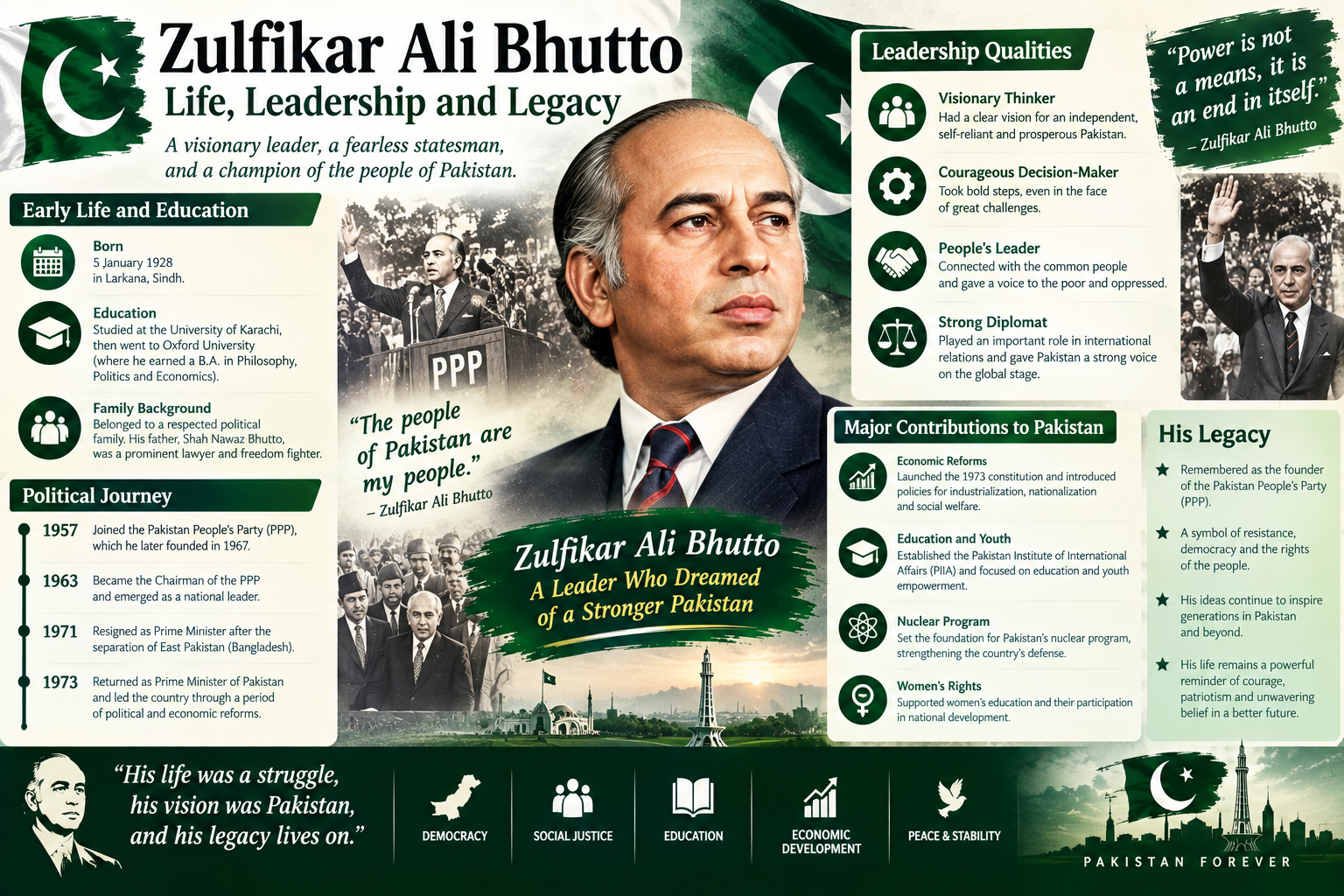
Zulfikar Ali Bhutto was one of the most influential political leaders in the history of Pakistan. He played an important role in shaping Pakistan's political, constitutional, diplomatic and social direction during the 1970s. He served as the President of Pakistan from 1971 to 1973 and later became Prime Minister from 1973 to 1977. The National Assembly of Pakistan recognizes his important role in the country's political history and describes him as a visionary leader who contributed to democratic awareness, public rights, diplomacy and the 1973 Constitution.
Bhutto was known for his powerful personality, strong communication skills, political confidence and ability to connect with ordinary people. He became particularly well known for presenting politics as something connected with the lives and hopes of common citizens.
His political journey remains an important part of Pakistan's history. His contribution to the Constitution of 1973, international diplomacy, political organization and public participation continues to be discussed and studied.
Early Life of Zulfikar Ali Bhutto
Zulfikar Ali Bhutto was born on January 5, 1928, in Sindh. He belonged to a prominent family and received a strong educational background. From an early age, he developed an interest in politics, law, international affairs and public life.
His education helped develop his understanding of political systems and international relations. He later studied at the University of California, Berkeley, and Oxford University, where he received opportunities to learn about law, politics and political thought.
His educational experiences played an important role in developing his confidence and worldview. He became interested in how nations could strengthen themselves through education, political institutions and effective leadership.
Education and Professional Development
Education was an important part of Bhutto's early life. His studies abroad exposed him to different political ideas and international environments.
He studied political science at the University of California, Berkeley, and later studied law at Oxford. His education helped him understand constitutional systems, diplomacy and international politics.
After completing his education, he returned to Pakistan and began developing his professional and political career. His knowledge of law and international affairs later became useful during his government responsibilities.
His educational journey is an example of how higher education can help young people develop confidence, analytical skills and leadership abilities.
Entry into Politics
Zulfikar Ali Bhutto entered national politics during an important period in Pakistan's history. His abilities, confidence and understanding of international affairs helped him rise quickly.
He became associated with government responsibilities and eventually served in important positions. His political career became particularly prominent during the 1960s.
Bhutto believed that Pakistan needed a strong voice in international affairs and that its foreign policy should protect national interests.
His speeches and political communication attracted considerable public attention. He developed a reputation as a leader who could communicate complicated political issues in a way that ordinary citizens could understand.
Role as Foreign Minister
One of the important stages of Bhutto's career was his service as Foreign Minister of Pakistan.
During this period, Pakistan was dealing with important international and regional developments. Bhutto worked on strengthening Pakistan's relationships with other countries and increasing the country's diplomatic importance.
His approach to foreign policy emphasized national independence, dignity and the protection of Pakistan's interests.
His experience in foreign affairs later became valuable when he became President and Prime Minister. His understanding of international politics helped him represent Pakistan on important diplomatic platforms.
Formation of Pakistan Peoples Party
In 1967, Zulfikar Ali Bhutto founded the Pakistan Peoples Party, commonly known as PPP.
The party presented itself as a political movement focused on democracy, social justice and the participation of ordinary citizens. Its political message attracted many young people, workers and sections of the middle and lower classes.
The creation of PPP was an important development in Pakistan's political history because it helped expand mass political participation.
Bhutto became known for connecting political discussions with everyday economic and social concerns. His political style encouraged people to become more interested in national affairs.
The Pakistan Peoples Party later became one of Pakistan's major political parties and continued to play an important role in national politics.
Bhutto and the People
One of the most important aspects of Bhutto's political personality was his connection with ordinary citizens.
He frequently emphasized the importance of giving common people a voice in politics. His speeches focused on social justice, political participation and national development.
His supporters viewed him as a leader who gave confidence to people who previously felt distant from national politics.
This connection with the public became an important part of his political identity. Even decades later, his name remains closely associated with mass politics in Pakistan.
President of Pakistan
After the major political changes of 1971, Zulfikar Ali Bhutto became President of Pakistan on December 20, 1971. The National Assembly records his presidential tenure from December 20, 1971, to August 14, 1973.
Pakistan was facing serious challenges at that time. The country needed political stability, institutional development and a renewed sense of national confidence.
Bhutto's government focused on rebuilding national institutions and establishing a political framework for the country.
One of the most important achievements of this period was the work toward a new Constitution.
The 1973 Constitution
The Constitution of 1973 is one of the most important achievements associated with Zulfikar Ali Bhutto's political career.
The National Assembly states that the Constitution was unanimously passed by the Assembly on April 10, 1973, authenticated on April 12, 1973, and promulgated on August 14, 1973. On the same day, Bhutto became Prime Minister while Fazal Elahi Chaudhry became President.
The Constitution established a parliamentary form of government and created a bicameral Parliament consisting of the President, National Assembly and Senate.
The Constitution also contains important principles concerning democracy, equality, fundamental rights, social justice, freedom and protection of minorities.
Bhutto played a major political role in bringing different political forces together for the constitutional process. The unanimous approval of the Constitution made it an important example of political cooperation.
Today, the 1973 Constitution remains the basic constitutional framework of Pakistan, although it has been amended many times.
Prime Minister of Pakistan
Zulfikar Ali Bhutto became Prime Minister of Pakistan on August 14, 1973.
As Prime Minister, he focused on strengthening national institutions, developing Pakistan's economy, expanding political participation and increasing the country's international importance.
His government introduced a number of policies aimed at changing Pakistan's economic and social structure.
His period as Prime Minister remains significant because it combined political reforms, constitutional development, diplomacy and national development initiatives.
Economic and Industrial Policies
Bhutto's government introduced policies that increased the role of the state in major parts of the economy.
The government sought to bring important industries under greater public control and aimed to use national resources for wider economic development.
These policies represented an attempt to reshape the relationship between the state, industries and ordinary citizens.
Bhutto believed that economic development should benefit a broad section of society. His political philosophy placed considerable importance on reducing economic inequality and improving opportunities for ordinary people.
Labour and Social Welfare
Labour and social welfare were also important themes during Bhutto's period.
His government emphasized the rights and welfare of workers and attempted to improve their participation in the economic system.
The broader political message of his government focused on social justice and improving the position of people with fewer economic resources.
This approach helped make social welfare an important part of political discussion in Pakistan.
Agricultural Development
Agriculture has always been central to Pakistan's economy, and Bhutto's government introduced policies aimed at changing land ownership and improving the position of farmers.
Land reforms were presented as an effort to create greater opportunities for people connected with agriculture.
Agriculture also received attention as part of the country's broader economic development strategy.
Although Pakistan's agricultural challenges continued over time, the period remains important for understanding the development of agricultural and land-related policies.
Education and National Development
Education was considered an important tool for national development during Bhutto's period.
His government emphasized wider access to education and greater participation of ordinary citizens in national life.
Education helps societies develop skilled workers, informed citizens and future leaders. The focus on education therefore formed part of the wider goal of developing Pakistan's human resources.
For Pakistani students today, this remains an important lesson: education is not only useful for getting a job but also for developing confidence, responsibility and leadership.
Diplomatic Leadership
Bhutto was an experienced diplomat and understood the importance of international relationships.
As Prime Minister, he worked to strengthen Pakistan's relations with Muslim countries and other states.
He promoted the idea that Pakistan should maintain an independent foreign policy and develop strong relationships with countries across Asia, the Middle East and the wider international community.
His diplomatic efforts helped Pakistan remain active on major international platforms.
The Simla Agreement
One of the important diplomatic developments during Bhutto's leadership was the Simla Agreement with India in 1972.
The agreement represented an effort to establish a framework for peaceful relations and dialogue between the two countries after the difficult events surrounding the 1971 war.
Bhutto's diplomatic role during this period is an important part of his foreign-policy legacy.
The agreement demonstrated the importance of diplomacy and negotiation in dealing with difficult regional relationships.
Islamic Summit in Lahore
Another major event associated with Bhutto's leadership was the Islamic Summit held in Lahore in 1974.
The summit brought together leaders from several Muslim countries and gave Pakistan an opportunity to demonstrate its diplomatic importance.
Hosting such an international gathering was significant for Pakistan's international image.
Bhutto strongly supported cooperation among Muslim countries and believed that collective cooperation could strengthen their political and economic position.
The Lahore summit remains an important event in Pakistan's diplomatic history.
Pakistan's Nuclear Development
Bhutto's government also gave considerable importance to Pakistan's scientific and strategic capabilities.
During the 1970s, Pakistan's nuclear program received strong political attention and institutional support.
The development of scientific and technological capabilities was viewed as important for national security and long-term independence.
Bhutto's government helped establish political support for this direction, while scientists, engineers and later governments also played important roles in Pakistan's nuclear development.
This history shows how national scientific programs usually depend on institutions, experts and long-term planning rather than the efforts of one individual alone.
Political Communication and Leadership Style
Bhutto had a distinctive style of political communication.
He was known for energetic speeches, strong arguments and direct communication with the public.
He could discuss national and international issues with confidence and often presented political questions in a way that attracted public attention.
His communication skills helped him build a strong political following.
For students, his life offers an interesting lesson about the importance of communication. A leader may have good ideas, but the ability to explain those ideas clearly is also extremely important.
Relationship with Democracy
Bhutto's political legacy is closely connected with democratic politics and mass participation.
The National Assembly's 2026 tribute to Bhutto described him as a leader who awakened democratic consciousness and helped people become aware of their fundamental rights.
His political movement brought many ordinary citizens into active politics.
The Constitution of 1973 also became an important institutional achievement of his period. The National Assembly has described it as a foundation of Pakistan's democratic system.
A Leader of Strong Political Vision
Bhutto had a clear political vision for Pakistan.
He wanted Pakistan to become more confident, independent and active in international affairs. He also wanted ordinary people to have a stronger voice in national politics.
His political ideas emphasized national dignity, social justice and economic opportunity.
Whether discussing diplomacy, constitutional development, education or economic policies, he presented a vision of Pakistan that placed strong importance on national identity and public participation.
Influence on Pakistani Politics
Zulfikar Ali Bhutto had a lasting influence on Pakistani politics.
The Pakistan Peoples Party continued to be a major political force after his death. His political ideas also influenced later generations of political leaders.
His daughter Benazir Bhutto later became a major political leader and Prime Minister of Pakistan, continuing the family's political connection with the Pakistan Peoples Party.
Bhutto's political legacy can therefore be seen not only in the institutions and policies of his own period but also in the generations of political activists and leaders who followed.
Importance for Pakistani Students
The life of Zulfikar Ali Bhutto offers several lessons for students.
1. Education Builds Confidence
Bhutto's educational background shows the importance of learning and exposure to different ideas.
Students should develop knowledge not only from textbooks but also through reading, discussion and observation.
2. Communication Matters
Bhutto's ability to communicate with people was one of his most recognizable leadership qualities.
Students can learn to speak clearly, listen carefully and express their ideas respectfully.
3. Leadership Requires Responsibility
Leadership is not simply about having authority. It involves making decisions, accepting responsibility and working for national goals.
4. Political Awareness Is Important
A healthy democracy depends on citizens who understand their rights and responsibilities.
Bhutto's political career demonstrates how political awareness can become a major part of national life.
5. National Development Needs Education
A strong country needs educated citizens, skilled professionals, scientists, teachers and responsible leaders.
Students are therefore an important part of Pakistan's future.
Bhutto's Legacy
Zulfikar Ali Bhutto's legacy is strongly connected with the 1973 Constitution, mass political participation, diplomacy and the Pakistan Peoples Party.
The National Assembly continues to recognize his contribution to Pakistan's political development. In its 2026 message marking his 47th death anniversary, the Speaker highlighted his political and democratic struggle, his contribution to the 1973 Constitution and his role in Pakistan's diplomatic and public achievements.
His political ideas continue to be discussed in universities, schools, political organizations and historical studies.
For many Pakistanis, Bhutto represents a period when political participation expanded and ordinary citizens became more involved in national politics.
Zulfikar Ali Bhutto's Place in History
Every historical leader has a unique place in the story of a country. Bhutto's place in Pakistan's history is particularly important because his career covered diplomacy, constitutional development, mass politics and national leadership.
His years in government came during a challenging period, yet his administration produced several developments that continued to influence Pakistan for decades.
The 1973 Constitution remains the strongest institutional symbol associated with his period of leadership.
His political organization also created a movement that continued long after his own time.
Final Years and Remembering Bhutto
Zulfikar Ali Bhutto died on April 4, 1979. His death marked the end of the life of one of Pakistan's most prominent political figures.
Over the years, his supporters have continued to remember him as a leader who gave ordinary people a stronger political voice.
His political journey remains an important subject for anyone interested in Pakistan's history, democracy and political development.
Conclusion
Zulfikar Ali Bhutto was an important leader who left a deep mark on Pakistan's political history. He served as President and Prime Minister, played a major role in Pakistan's diplomatic affairs, founded the Pakistan Peoples Party and contributed significantly to the development of the 1973 Constitution.
His leadership was based on ideas of national dignity, political participation, social justice and a stronger role for Pakistan in international affairs.
The 1973 Constitution remains one of the most important achievements associated with his period, while his political movement continues to influence Pakistani politics.
For students, Bhutto's life provides valuable lessons about education, communication, leadership, political awareness and commitment to national development.
Zulfikar Ali Bhutto remains a significant name in Pakistan's history, and his contributions continue to be studied and remembered by new generations.
FAQs
1. Who was Zulfikar Ali Bhutto?
Zulfikar Ali Bhutto was a prominent Pakistani political leader who served as President and Prime Minister of Pakistan.
2. When did Zulfikar Ali Bhutto become Prime Minister?
He became Prime Minister on August 14, 1973.
3. What is Zulfikar Ali Bhutto famous for?
He is especially remembered for his political leadership, the Pakistan Peoples Party, diplomacy and his major role in the development of the 1973 Constitution.
4. What was the 1973 Constitution?
It is Pakistan's major constitutional framework, unanimously passed by the National Assembly on April 10, 1973, and promulgated on August 14, 1973.
5. When did Zulfikar Ali Bhutto serve as President?
He served as President from December 20, 1971, to August 14, 1973.
6. Which political party did Bhutto establish?
He founded the Pakistan Peoples Party (PPP) in 1967.
7. Why is Bhutto important in Pakistan's history?
He played an important role in constitutional development, mass politics, diplomacy and national leadership.