Introduction
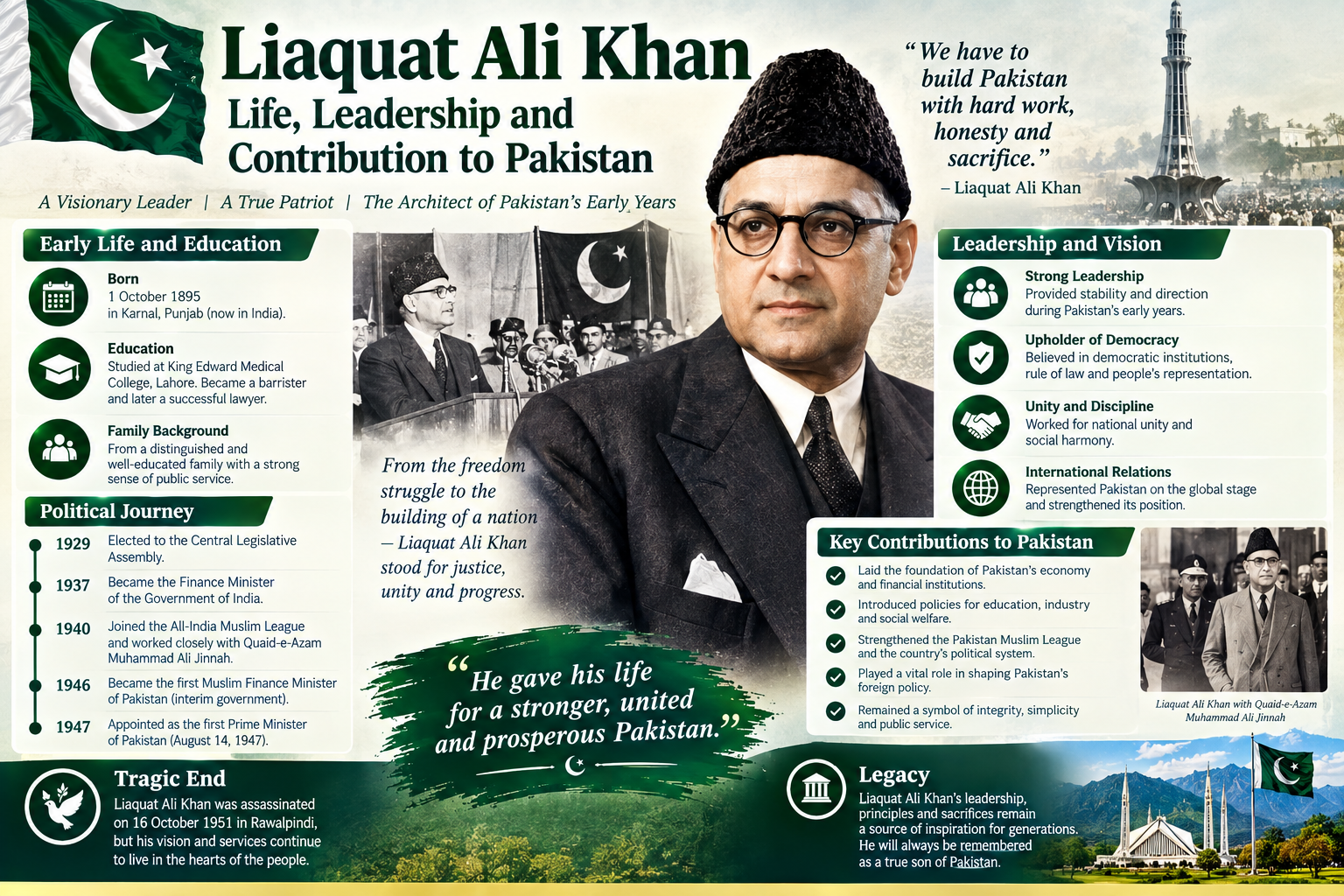
Liaquat Ali Khan is one of the most important personalities in the early history of Pakistan. He is remembered as the country's first Prime Minister and as one of the closest political associates of Quaid-e-Azam Muhammad Ali Jinnah. His services during the Pakistan Movement and the early years of Pakistan played an important role in helping the newly created country establish its political and administrative foundations.
Born into a respected family, Liaquat Ali Khan received a strong education and developed an interest in public affairs and politics. His educational background, political understanding, leadership qualities, and dedication made him an important figure in the Muslim League.
After the creation of Pakistan in August 1947, Liaquat Ali Khan became the first Prime Minister of the country. Pakistan was a new state facing many challenges, including the establishment of government institutions, economic difficulties, migration, administrative needs, and international recognition. During this important period, Liaquat Ali Khan worked to strengthen the country and support the vision of its founder.
His political career is an important part of Pakistan's history. His contributions continue to be remembered, particularly his role in strengthening parliamentary government and helping establish Pakistan's early foreign and economic policies.
Early Life of Liaquat Ali Khan
Liaquat Ali Khan was born on October 1, 1895, in Karnal, which was then part of British India.
He belonged to a prominent family and received an education that prepared him for public life. His early years helped develop his interest in society, politics, and public service.
Education played a major role in shaping his personality. He understood that knowledge and political awareness were essential for communities seeking greater representation and opportunities.
As he grew older, his interest in politics increased. He eventually became involved in the political activities of Muslims in the Indian subcontinent.
Education of Liaquat Ali Khan
Liaquat Ali Khan received his early education in India before continuing his studies in England.
He studied at Oxford University, where he developed his understanding of law, politics, and public affairs. His time in England exposed him to parliamentary traditions and political institutions.
His education later proved valuable during his political career. His knowledge of constitutional matters helped him participate effectively in political negotiations and legislative discussions.
Education remained an important part of his life and helped him develop the skills needed for leadership.
Beginning of His Political Career
Liaquat Ali Khan entered politics during an important period in the history of the Indian subcontinent.
The political situation was changing rapidly, and questions about representation, constitutional rights, and the future of different communities were becoming increasingly important.
Liaquat Ali Khan joined the All-India Muslim League and gradually became one of its prominent leaders.
He worked alongside other Muslim political leaders and became particularly close to Muhammad Ali Jinnah.
His political activities focused on strengthening Muslim political representation and supporting constitutional methods.
Relationship with Quaid-e-Azam
Liaquat Ali Khan had a close political relationship with Quaid-e-Azam Muhammad Ali Jinnah.
He was one of Jinnah's most trusted colleagues during the Pakistan Movement. His organizational abilities and dedication made him an important member of the Muslim League leadership.
Jinnah provided the central leadership of the Pakistan Movement, while Liaquat Ali Khan played a significant supporting and organizational role.
Their cooperation became particularly important during the years leading to the creation of Pakistan.
Liaquat Ali Khan helped represent the Muslim League in important political discussions and legislative activities.
Role in the Pakistan Movement
The Pakistan Movement was a long political struggle that required organization, public awareness, negotiations, and political leadership.
Liaquat Ali Khan played an important role in this movement.
He supported the Muslim League's political objectives and worked to strengthen the organization.
He also participated in important political negotiations and helped communicate Muslim League positions.
His dedication contributed to the broader political movement that eventually resulted in the creation of Pakistan in 1947.
Liaquat Ali Khan as the First Prime Minister
After Pakistan became independent on August 14, 1947, Liaquat Ali Khan became the country's first Prime Minister.
This was a historic responsibility.
Pakistan had just been created and needed to establish a functioning government almost from the beginning. The new administration had to manage numerous challenges while building institutions and maintaining national stability.
As Prime Minister, Liaquat Ali Khan worked closely with Quaid-e-Azam and other government leaders.
His responsibilities included managing government affairs, supporting economic planning, dealing with foreign governments, and helping establish Pakistan's parliamentary system.
Challenges Facing the New Pakistan
Pakistan faced many difficulties during its early years.
Millions of people were affected by the partition of British India and large numbers of Muslims migrated to Pakistan.
The new country needed to provide shelter and assistance to people who had left their homes.
Government departments and institutions also had to be established.
Pakistan needed financial resources, administrative structures, trained officials, and international diplomatic relationships.
Liaquat Ali Khan worked during this challenging period to strengthen the government and help the country move toward stability.
Supporting Refugees
The migration associated with the creation of Pakistan created a major humanitarian and administrative challenge.
Large numbers of people arrived in Pakistan and needed homes, food, employment, and other forms of assistance.
The government had to establish systems to manage rehabilitation and settlement.
As Prime Minister, Liaquat Ali Khan was involved in the government's efforts to address these challenges.
The work required cooperation between federal and provincial authorities, civil servants, local communities, and various organizations.
The response to this major challenge became an important part of Pakistan's early state-building process.
Liaquat Ali Khan and Parliamentary Government
Liaquat Ali Khan believed in parliamentary government and constitutional development.
He played an important role in establishing Pakistan's early parliamentary traditions.
The new country needed a constitutional framework that could guide its institutions and define the relationship between the government and citizens.
Liaquat Ali Khan participated actively in the Constituent Assembly and supported efforts to develop constitutional principles.
His parliamentary approach became an important part of his political legacy.
The Objectives Resolution
One of Liaquat Ali Khan's most significant political contributions was his role in presenting the Objectives Resolution in the Constituent Assembly in 1949.
The Objectives Resolution became an important document in Pakistan's constitutional history.
It outlined broad principles concerning democracy, freedom, equality, tolerance, social justice, and the role of the people in exercising authority.
The resolution later became an important reference point in Pakistan's constitutional development.
Its presentation demonstrated the government's effort to establish a framework for the country's future political system.
Economic Development
Economic development was another important challenge for Pakistan after independence.
The country needed to establish financial institutions, improve trade, support agriculture, and develop industries.
The government under Liaquat Ali Khan worked toward building an independent economic system.
Pakistan inherited limited industrial infrastructure at independence compared with the needs of the new country.
The government therefore had to focus on developing economic resources and strengthening financial institutions.
Liaquat Ali Khan supported efforts to create an economic foundation that could help Pakistan become more self-reliant.
Importance of Agriculture
Agriculture was, and remains, an important part of Pakistan's economy.
During the early years of Pakistan, agriculture provided employment and supported a large part of the population.
Improving agricultural production was therefore important for food security and economic stability.
The government recognized the importance of agricultural development and rural communities.
Investment in irrigation, agricultural production, and rural development became important areas of national planning.
Foreign Policy of Early Pakistan
Pakistan also needed to establish diplomatic relationships with other countries.
As a newly independent state, Pakistan had to introduce itself to the international community and develop relationships that could support its security, economy, and international position.
Liaquat Ali Khan played an important role in shaping Pakistan's early foreign policy.
His government worked to establish friendly relations with various countries and strengthen Pakistan's international position.
Pakistan's diplomatic relations during this period laid foundations for its future foreign policy.
Liaquat Ali Khan's Visit to the United States
One of the notable events in Liaquat Ali Khan's foreign policy career was his visit to the United States in 1950.
The visit was important because Pakistan was a newly independent country seeking to develop international partnerships.
During the visit, Liaquat Ali Khan met American officials and discussed political and economic matters.
The visit attracted international attention and represented Pakistan's effort to build diplomatic relationships beyond the region.
It also demonstrated the importance Pakistan placed on international cooperation during its early years.
Relations with Muslim Countries
Liaquat Ali Khan also emphasized relationships with Muslim-majority countries.
Pakistan sought to strengthen ties with countries sharing historical, cultural, and religious connections.
Cooperation among Muslim countries was an important theme in Pakistan's foreign policy.
Liaquat Ali Khan's diplomatic activities contributed to the development of Pakistan's relationships with other countries in the Muslim world.
These relationships later became an important component of Pakistan's international diplomacy.
Liaquat Ali Khan as a Parliamentary Leader
Liaquat Ali Khan was known for his ability to communicate political ideas through parliamentary debate.
As Prime Minister, he addressed the Constituent Assembly and participated in discussions concerning the country's future.
His parliamentary work was important because Pakistan was developing its democratic institutions.
Parliamentary debate provides an opportunity for representatives to discuss laws, policies, national priorities, and public concerns.
Liaquat Ali Khan's participation helped establish early traditions of parliamentary government in Pakistan.
Leadership Qualities
Several qualities are associated with Liaquat Ali Khan's leadership.
Determination
He remained committed to his political objectives and continued working during difficult periods.
Education
His strong educational background helped him understand complex political and constitutional issues.
Organization
He played an important organizational role within the Muslim League.
Public Service
His political career was strongly connected with the development and service of the newly created country.
Diplomacy
He participated in important diplomatic efforts and helped establish Pakistan's international relationships.
Parliamentary Skills
His work in the Constituent Assembly contributed to Pakistan's early parliamentary traditions.
Liaquat Ali Khan and National Unity
National unity was particularly important during Pakistan's early years.
The new country consisted of people from different regions, languages, and cultural backgrounds.
Building a sense of national identity was therefore an important responsibility.
Liaquat Ali Khan encouraged people to work together for the development of Pakistan.
National unity helped the country face the challenges associated with establishing a new state.
Importance of Strong Institutions
Liaquat Ali Khan understood that Pakistan needed strong institutions to become a stable country.
Government departments, courts, parliament, financial institutions, universities, and administrative structures all needed to develop.
The early government worked to establish these institutions despite limited resources.
Strong institutions remain essential for Pakistan's development today.
Modern Pakistan can learn from the early state-building efforts by focusing on effective administration, education, economic development, and responsible governance.
Liaquat Ali Khan's Contribution to Education
Education was an important part of national development during the early years of Pakistan.
A newly created country needed educated citizens, teachers, civil servants, professionals, scientists, lawyers, and administrators.
The government recognized the importance of developing educational institutions.
Education could provide the human resources needed to build the country.
The emphasis on education during the early period remains relevant because Pakistan's young population represents one of its greatest opportunities for future development.
Importance of His Constitutional Vision
Liaquat Ali Khan's contribution to constitutional development is one of the most significant aspects of his legacy.
The Objectives Resolution became an important reference in Pakistan's constitutional history.
It discussed broad principles such as democracy, equality, freedom, social justice, and respect for the rights of citizens.
These principles continue to be discussed in relation to Pakistan's constitutional and political development.
Liaquat Ali Khan's Personal Character
Liaquat Ali Khan was widely recognized as a serious and dedicated political leader.
He devoted much of his life to public affairs.
His professional background, education, and political experience helped him become an effective national leader.
His simple and disciplined approach to political responsibilities made him an important figure in Pakistan's early history.
His dedication during the difficult years immediately following independence is an important part of his legacy.
Martyrdom of Liaquat Ali Khan
Liaquat Ali Khan's life came to a tragic end in 1951.
On October 16, 1951, he was assassinated while addressing a public gathering in Rawalpindi.
His death shocked the nation and was a major loss for Pakistan.
He was given the title Shaheed-e-Millat, meaning "Martyr of the Nation."
His services to Pakistan continued to be remembered after his death.
Liaquat Bagh
The location where Liaquat Ali Khan was assassinated in Rawalpindi became known as Liaquat Bagh.
The place is historically significant because of its connection with one of Pakistan's earliest national leaders.
It remains associated with important events in Pakistan's political history.
The name Liaquat Bagh is a lasting reminder of Liaquat Ali Khan's contribution to the country.
Legacy of Liaquat Ali Khan
Liaquat Ali Khan left an important legacy in Pakistan's political history.
He was the first Prime Minister of Pakistan and worked during a crucial period when the country was establishing its foundations.
His contributions included political organization, parliamentary development, constitutional work, foreign diplomacy, and early state-building.
The Objectives Resolution remains one of the most important documents associated with his political career.
His role in supporting Quaid-e-Azam and helping guide the country during its earliest years also remains an important part of Pakistan's history.
Lessons for Pakistani Students
Young people can learn many useful lessons from Liaquat Ali Khan's life.
Education Matters
His educational journey demonstrates the value of knowledge and learning.
Serve Your Country
His political career shows the importance of contributing to society and the nation.
Stay Determined
Major achievements require patience and consistent effort.
Develop Leadership Skills
Good leadership requires communication, organization, responsibility, and understanding.
Respect Democratic Institutions
Parliamentary institutions and constitutional principles are important for a stable society.
Work for National Development
Young people can contribute through education, technology, business, science, law, medicine, agriculture, and public service.
Why Liaquat Ali Khan Remains Important Today
Liaquat Ali Khan remains important because he was part of the generation that helped transform the idea of Pakistan into a functioning state.
His work took place during a period of enormous challenges.
Today, Pakistan has a much larger population, a more developed economy, advanced technology, and more complex institutions. However, many principles associated with the country's early leaders remain relevant.
Education, national unity, responsible leadership, constitutional development, economic progress, and international cooperation continue to be important for Pakistan.
The study of Liaquat Ali Khan's life can help students understand how Pakistan's early political institutions developed.
Conclusion
Liaquat Ali Khan holds a special place in the history of Pakistan. As the country's first Prime Minister, he played a major role in guiding Pakistan during its earliest and most important years.
His close association with Quaid-e-Azam Muhammad Ali Jinnah, contribution to the Pakistan Movement, parliamentary work, constitutional efforts, foreign diplomacy, and involvement in early state-building made him an important national leader.
The presentation of the Objectives Resolution in 1949 was one of his most significant contributions to Pakistan's constitutional history.
His government also worked to address the enormous challenges facing the new country, including refugee rehabilitation, economic development, institution building, and international diplomacy.
Liaquat Ali Khan's life provides valuable lessons about education, dedication, leadership, organization, public service, and national responsibility.
Although his life was cut short in 1951, his contributions continued to influence Pakistan's political history. He is remembered as Shaheed-e-Millat and as one of the founding leaders who helped build the foundations of Pakistan.
For today's generation, his life remains an example of how education, determination, and public service can contribute to the development of a nation.
FAQs
Who was Liaquat Ali Khan?
Liaquat Ali Khan was the first Prime Minister of Pakistan and one of the important leaders of the Pakistan Movement.
When was Liaquat Ali Khan born?
He was born on October 1, 1895, in Karnal, British India.
What was Liaquat Ali Khan's role in the Pakistan Movement?
He was a prominent Muslim League leader and an important political associate of Quaid-e-Azam Muhammad Ali Jinnah.
What was the Objectives Resolution?
The Objectives Resolution was presented by Liaquat Ali Khan in Pakistan's Constituent Assembly in 1949 and became an important document in the country's constitutional history.
When did Liaquat Ali Khan become Prime Minister?
He became Pakistan's first Prime Minister after independence in August 1947.
What is Liaquat Ali Khan remembered for?
He is remembered for his role in the Pakistan Movement, serving as Pakistan's first Prime Minister, supporting constitutional development, and helping establish the country's early institutions.
When did Liaquat Ali Khan die?
Liaquat Ali Khan was assassinated on October 16, 1951, in Rawalpindi.
What title is associated with Liaquat Ali Khan?
He is widely known as Shaheed-e-Millat, meaning "Martyr of the Nation."