Introduction
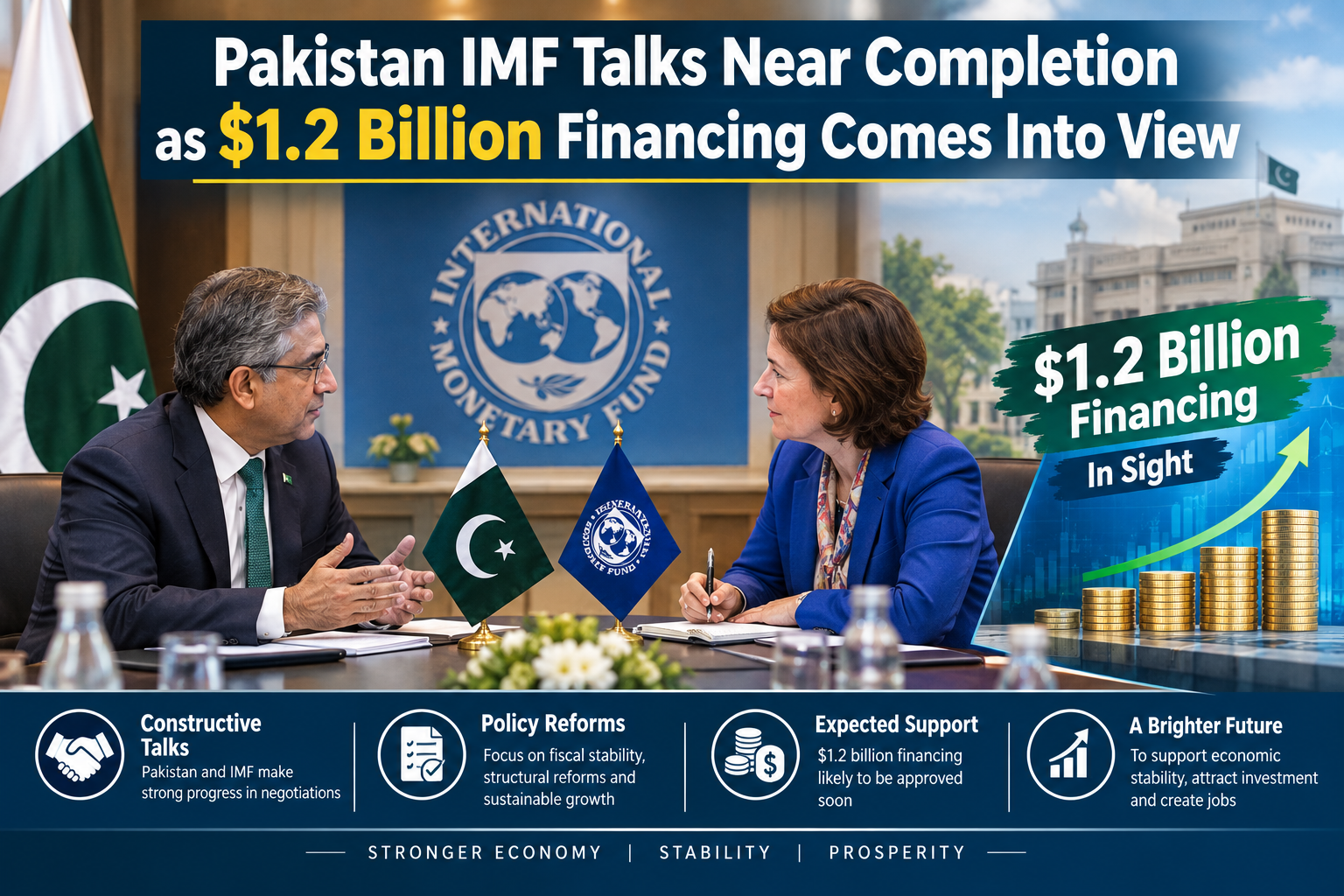
Pakistan and the International Monetary Fund (IMF) are nearing the conclusion of their latest review talks, with discussions expected to clear the way for approximately $1.2 billion in additional financing. The current negotiations cover Pakistan’s $7 billion Extended Fund Facility (EFF) and its $1.4 billion Resilience and Sustainability Facility (RSF). According to reports published on October 6, 2026, the two sides are finalising the Memorandum of Economic and Fiscal Policies after completing most of the substantive discussions.
The development is important for Pakistan’s economy because successful completion of the reviews would allow the IMF to recommend further financing. Around $1 billion is expected under the EFF, while another $200 million could come through the climate-focused RSF arrangement. Final disbursement would still require the IMF’s Executive Board approval.
The latest talks are taking place as Pakistan continues efforts to improve tax collection, strengthen energy-sector finances, reform state-owned enterprises, increase transparency, and maintain macroeconomic stability.
Pakistan and IMF Reach Final Stage of Current Review
The IMF staff mission, led by Iva Petrova, has been conducting discussions with Pakistani authorities as part of the latest review of the country’s economic programme. The mission has held meetings with officials from the Finance Ministry, State Bank of Pakistan, Federal Board of Revenue and provincial governments.
By October 6, the talks had entered their final stage. Pakistani and IMF officials were working on the final draft of the Memorandum of Economic and Fiscal Policies, which records the policy commitments and understandings reached during the review.
The positive progress has raised expectations that Pakistan could soon move toward the next stage of the IMF process.
However, the expected financing should not be viewed as an automatic payment. The IMF staff review must be completed, and the Fund’s Executive Board must subsequently approve the arrangement before the funds can be released.
About the $1.2 Billion Financing
The expected $1.2 billion financing comes from two separate IMF arrangements.
The first is the $7 billion Extended Fund Facility, which supports Pakistan’s broader economic stabilisation and reform programme. The second is the $1.4 billion Resilience and Sustainability Facility, which is connected to reforms designed to strengthen Pakistan’s ability to deal with climate-related and structural risks.
If the current reviews are successfully completed, Pakistan could receive approximately:
$1 billion under the EFF
$200 million under the RSF
Total: approximately $1.2 billion
The financing would provide additional external support at a time when Pakistan is working to strengthen its foreign-exchange position and maintain economic stability.
Why the IMF Programme Matters
Pakistan has relied on IMF programmes several times during periods of serious economic pressure. The current programme was designed to help stabilise the economy while encouraging reforms that could improve long-term growth.
The IMF programme focuses on areas including public finances, taxation, energy-sector reforms, state-owned enterprises, monetary stability and structural improvements.
The IMF’s Executive Board previously completed the third EFF review and second RSF review in May 2026. That decision allowed Pakistan to draw approximately $1.1 billion under the EFF and about $220 million under the RSF, taking total disbursements under the two arrangements to around $4.8 billion at that stage.
The latest review is therefore another important milestone in Pakistan’s ongoing economic programme.
Stronger Tax Collection Supports Pakistan’s Position
Tax collection has been one of the most important areas of Pakistan’s IMF programme.
The government needs to increase revenue while improving the efficiency and fairness of the tax system. Stronger tax collection can reduce pressure on government borrowing and help finance public services.
According to the latest reporting, Pakistan’s revenue collection during the first quarter performed strongly and exceeded the target. Sources indicated that the overall revenue target remained unchanged, although attention was being placed on meeting the target for the first half of the financial year.
Improved tax performance is significant because it demonstrates progress toward fiscal targets agreed under the IMF programme.
At the same time, maintaining revenue growth throughout the year will remain important. A strong first quarter alone is not enough to guarantee that annual targets will be achieved.
Energy Sector Remains a Major Challenge
Pakistan’s energy sector remains one of the most difficult areas of economic reform.
Issues involving electricity tariffs, gas pricing, subsidies, payment arrears and circular debt have created long-term financial pressures.
The latest IMF discussions have included energy-sector matters, including gas pricing and the financial position of gas companies. According to recent reporting, gas companies have raised concerns about pricing gaps and the impact of consumer categories on circular debt.
The government is also working on reforms designed to make energy subsidies more targeted.
An IMF structural benchmark requires Pakistan to replace the existing tariff-differential subsidy and cross-subsidy system with a targeted, budgeted subsidy framework for lower-income consumers through the Benazir Income Support Programme. The government is expected to work toward technical arrangements for identifying eligible consumers.
These reforms could have a significant impact on Pakistan’s electricity and energy-sector finances.
Electricity Subsidy Reforms
Electricity subsidies are another important component of the IMF programme.
Pakistan has historically used various forms of subsidies to reduce the cost of electricity for certain consumers. While subsidies can provide relief to households, poorly targeted subsidies can also place a major burden on the national budget.
The IMF-supported reform approach aims to make assistance more targeted so that support reaches households that need it most.
The proposed approach would move toward a system where government assistance is included transparently in the budget and targeted toward eligible lower-income consumers.
This could help reduce financial distortions in the electricity sector while protecting vulnerable households.
State-Owned Enterprises and Privatisation
Pakistan’s state-owned enterprises have also remained an important part of the IMF discussions.
The government has been working on reforms involving state-owned companies and its broader privatisation agenda. Recent reports indicate that the IMF has received updates on plans to privatise three electricity distribution companies, including information about expressions of interest.
The government has also been addressing reforms related to the Sovereign Wealth Fund and governance mechanisms for state-owned enterprises.
Improving governance and transparency in state-owned companies is considered important because inefficient public enterprises can create financial liabilities for the government.
Privatisation or restructuring can potentially reduce those pressures, although successful implementation requires careful planning, transparency and appropriate regulation.
New Public Procurement Rules
Pakistan has also taken steps to improve public procurement.
The government recently notified the Public Procurement Rules 2026, which introduce measures intended to improve transparency, competition and efficiency in federal procurement. The new framework also strengthens the role of digital procurement systems.
The reforms are significant because public procurement involves large amounts of government spending.
Greater transparency can help reduce waste, improve competition among suppliers and strengthen confidence in public institutions.
The IMF programme includes structural reforms that go beyond taxation and government budgets. Improving governance and procurement systems can also contribute to better use of public resources.
Sovereign Wealth Fund Reform
Another issue discussed with the IMF involves Pakistan’s Sovereign Wealth Fund.
Authorities have faced delays in meeting a structural benchmark related to amendments to the Sovereign Wealth Fund Act. The proposed changes are intended to strengthen governance mechanisms and safeguards concerning state-owned assets.
The issue illustrates that IMF programmes are not only about receiving money. They also involve commitments to policy and institutional reforms.
Pakistan may need to address some delayed reforms and request waivers for certain unavoidable slippages.
Climate Resilience and the RSF
The Resilience and Sustainability Facility is particularly relevant because Pakistan faces significant climate-related risks.
The facility supports reforms aimed at strengthening economic resilience against climate-related shocks. Its focus includes areas such as disaster planning, water management and incorporating climate risks into public investment decisions.
Pakistan has experienced major floods, heatwaves and other extreme weather events in recent years.
For a country vulnerable to climate change, improving resilience is not simply an environmental objective. It is also an economic priority.
Major natural disasters can damage infrastructure, reduce agricultural production, disrupt businesses and increase government spending.
Therefore, climate resilience can play an important role in protecting Pakistan’s long-term economic stability.
IMF and Pakistan’s Economic Stability
The IMF programme has played a major role in Pakistan’s recent efforts to stabilise its economy.
The IMF’s May 2026 review noted that policy implementation had helped maintain economic stability and improve financing and external conditions. The Fund also emphasised the importance of continuing strong policies and structural reforms.
Economic stabilisation can involve several different areas.
These include maintaining adequate foreign-exchange reserves, controlling inflation, improving government revenue, managing public expenditure and reducing external financing pressures.
The latest $1.2 billion review therefore matters not only because of the amount itself but also because it represents continued progress under Pakistan’s broader economic programme.
Impact on Foreign Exchange Reserves
Additional IMF financing can help strengthen Pakistan’s external position.
Foreign-exchange reserves are important because Pakistan needs foreign currency to pay for imports, service external debt and meet international payment obligations.
An IMF disbursement can provide additional support to the country’s official reserves and strengthen confidence among international lenders and investors.
However, reserves cannot be strengthened permanently through borrowing alone.
Pakistan also needs to increase exports, attract investment, maintain stable remittance flows and improve the competitiveness of the domestic economy.
This is why IMF programmes generally combine financing with structural reforms.
Impact on Investor Confidence
Progress in IMF negotiations can also affect investor sentiment.
When investors see that Pakistan remains on track with its international economic programme, concerns about short-term financing pressures can decrease.
A successful review may therefore support confidence in the country’s financial stability.
Pakistan has also been working to improve its credit profile and investment climate. During the opening meeting with the IMF mission, Finance Minister Muhammad Aurangzeb briefed the Fund team about macroeconomic indicators, credit-rating improvements and the investment environment.
However, investor confidence depends on more than IMF financing.
Long-term confidence requires predictable policies, stronger institutions, improved infrastructure, reliable energy supplies and sustainable economic growth.
Challenges Ahead
Despite positive progress, Pakistan still faces several challenges.
One major challenge is maintaining fiscal discipline while protecting households from excessive economic pressure.
Another challenge is energy-sector reform. Circular debt and pricing issues have remained persistent problems.
Tax reform is also important. The government needs to maintain revenue growth while encouraging investment and economic activity.
Pakistan must also continue implementing structural reforms involving state-owned enterprises, procurement, governance and public-sector efficiency.
External shocks could create additional risks.
Changes in global energy prices, geopolitical tensions and disruptions to international trade can affect Pakistan’s import bill and inflation.
The government will therefore need to maintain careful economic management even after the latest IMF review is completed.
What Happens After the Talks?
The current IMF staff-level discussions are expected to conclude after the remaining policy and technical details are finalised.
The two sides are currently working on the Memorandum of Economic and Fiscal Policies. Once the staff review is completed, the case can move toward the IMF Executive Board process.
If the Executive Board approves the review, Pakistan would be able to receive the associated financing.
This means that the current talks are an important step, but the final disbursement still depends on completion of the required IMF procedures.
Importance for Ordinary Pakistanis
The IMF programme may sound like a subject limited to economists and government officials, but its effects can reach ordinary households.
Economic policies influence taxes, electricity prices, gas prices, inflation, government spending and employment conditions.
When the government receives external financing and improves economic stability, it can reduce immediate pressure on the country’s balance of payments.
However, IMF-linked reforms can also involve difficult measures, including changes in taxation, energy pricing and subsidies.
The challenge for policymakers is therefore to maintain economic discipline while protecting lower-income households.
Targeted assistance is particularly important because broad subsidies can be expensive and may benefit higher-income consumers as well.
Long-Term Economic Reform
The biggest question for Pakistan is whether IMF-supported reforms can lead to sustainable economic improvement.
Short-term financing can help a country overcome immediate financial pressure, but lasting economic strength requires deeper changes.
Pakistan needs stronger exports, improved productivity, better tax administration, efficient energy markets, competitive industries and a stable investment environment.
The IMF programme can provide a framework for some of these reforms, but their long-term success depends on Pakistan’s own institutions and policymakers.
Pakistan’s Economic Outlook
The latest progress in IMF talks provides a positive development for Pakistan’s economic outlook.
A successful review would demonstrate that the country remains engaged with its reform commitments and can continue accessing international financing.
The expected $1.2 billion would also provide additional financial support.
Nevertheless, the country must continue focusing on fiscal discipline, energy reforms, taxation, governance and climate resilience.
Economic stability should ultimately be measured not only by international financing but also by stronger domestic growth, greater investment, job creation and improved living standards.
Conclusion
Pakistan and the International Monetary Fund are approaching the conclusion of their latest review talks, with the negotiations potentially clearing the way for approximately $1.2 billion in financing. The amount would include around $1 billion under the $7 billion Extended Fund Facility and $200 million under the $1.4 billion Resilience and Sustainability Facility.
The latest discussions have covered taxation, energy-sector finances, state-owned enterprises, procurement, governance and climate resilience. Pakistani authorities are now working with the IMF team to finalise the Memorandum of Economic and Fiscal Policies.
The expected financing could strengthen Pakistan’s external position and support economic confidence. However, the country still faces important challenges, particularly in energy-sector reform, fiscal management, revenue collection and structural changes.
The successful completion of the review would be another significant milestone in Pakistan’s ongoing IMF programme. More importantly, continued implementation of reforms will determine whether the country can move from repeated financial stabilisation programmes toward a stronger, more sustainable and resilient economy.
FAQs
1. How much IMF financing could Pakistan receive after the latest review?
Pakistan could receive approximately $1.2 billion, including about $1 billion under the EFF and $200 million under the RSF.
2. What is the IMF’s Extended Fund Facility?
The EFF is an IMF financing arrangement designed to support countries implementing medium-term economic reforms.
3. What is the Resilience and Sustainability Facility?
The RSF supports reforms that help countries address longer-term structural challenges, including climate-related economic risks.
4. When could Pakistan receive the expected financing?
The financing would follow completion of the review and the required approval by the IMF Executive Board.
5. What reforms are being discussed between Pakistan and the IMF?
Key areas include taxation, energy-sector finances, subsidies, state-owned enterprises, procurement, governance and climate resilience.




