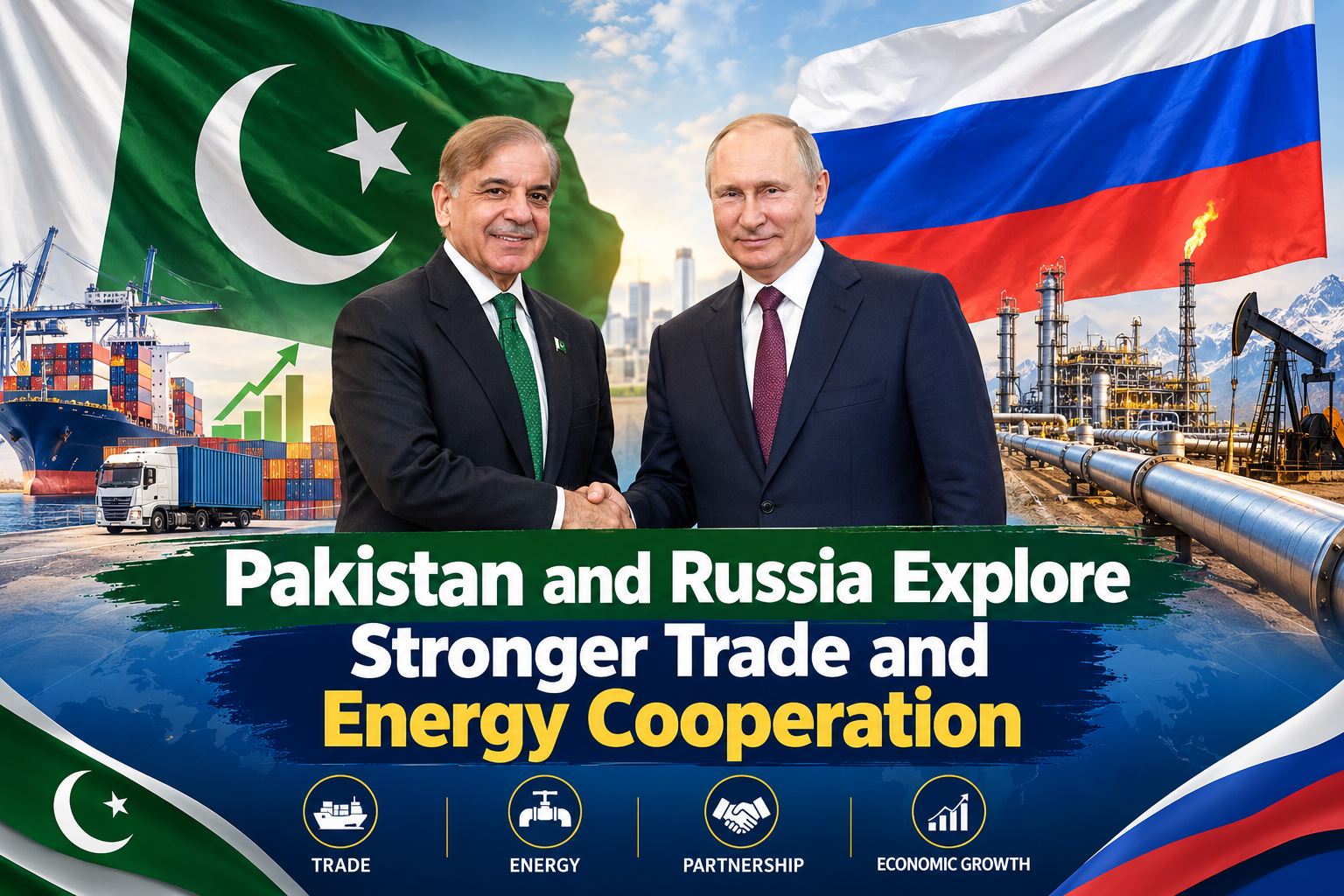
Pakistan and Russia are exploring opportunities to strengthen their economic relationship through trade, energy cooperation, investment, information technology, agriculture, transportation, and industrial development. Both countries have opportunities to expand commercial activities and develop partnerships that could benefit businesses, investors, and consumers.
In recent years, Pakistan has shown interest in diversifying its international economic relationships, while Russia has continued exploring commercial partnerships with countries across Asia and other regions. This creates opportunities for both countries to identify areas of mutual interest and establish stronger business connections.
Energy remains an important part of discussions between Pakistan and Russia. However, their economic relationship extends beyond oil and gas. Agricultural products, information technology services, pharmaceuticals, surgical instruments, sports goods, and transportation services could also contribute to future trade growth.
Business organizations have an important role in connecting companies, identifying potential investors, organizing trade delegations, and helping exporters understand international markets. By improving communication between business communities, Pakistan and Russia could identify practical opportunities to expand trade.
Nevertheless, stronger economic relations will require careful planning. Financial arrangements, transportation costs, regulatory requirements, international payment systems, and changing global economic conditions can influence the success of bilateral projects.
The future of Pakistan-Russia economic cooperation will therefore depend on the ability of both countries to turn discussions into practical agreements, commercially viable projects, and sustainable business partnerships.
1. Understanding Pakistan-Russia Economic Relations
Pakistan and Russia have maintained diplomatic relations for decades, and their economic relationship has developed gradually through discussions involving trade, investment, energy, regional connectivity, and industrial cooperation.
Historically, Pakistan's major trading relationships have included countries in Asia, the Middle East, Europe, and North America. Russia offers another potential market for Pakistani businesses seeking to diversify their export destinations.
For Russia, Pakistan represents a country with a large population, an important geographic position, an agricultural economy, and growing demand for energy, infrastructure, technology, and industrial products.
Both countries can benefit from identifying products and services that match the needs of their respective markets. Pakistani exporters may find opportunities in agricultural goods, textiles, surgical instruments, sports equipment, and selected manufactured products. Russian companies may explore opportunities in energy, industrial technology, machinery, fertilizers, and other sectors, subject to applicable commercial and regulatory conditions.
However, geographical distance and differences in business practices mean that companies need reliable market information before entering either market. Understanding consumer preferences, product standards, import regulations, and payment requirements is essential.
A stronger economic relationship should focus on realistic opportunities rather than broad announcements alone. Commercial partnerships become more valuable when businesses can identify customers, negotiate contracts, arrange payments, and deliver products consistently.
2. Energy Cooperation Between Pakistan and Russia
Energy is one of the most significant areas of potential cooperation between Pakistan and Russia. Pakistan requires dependable energy supplies to support households, agriculture, transportation, manufacturing, and commercial activities.
Energy availability and affordability influence nearly every part of the economy. When energy costs increase, businesses may face higher production expenses, transportation charges, and operating costs. These pressures can affect the prices consumers pay for essential goods and services.
Russia has substantial experience in the oil and gas industries, including energy production, processing, transportation, and related infrastructure. This creates potential areas for technical discussions and commercial cooperation with countries seeking to improve energy security.
For Pakistan, any future cooperation would need to be evaluated according to its financial feasibility, supply reliability, infrastructure requirements, and compatibility with international regulations.
Oil and Gas Opportunities
Oil and gas are important components of Pakistan's energy system. The country depends significantly on imported energy resources, making international supply relationships an important part of its energy planning.
Potential cooperation with Russian companies could involve discussions about supply arrangements, energy infrastructure, technical expertise, and industrial investment. Each proposal would need to be assessed individually to determine whether it offers competitive prices and dependable delivery.
Commercial arrangements should also account for transportation expenses, insurance, payment mechanisms, contract conditions, and potential disruptions. A supply agreement that appears attractive at first may become less beneficial if these additional costs are not considered carefully.
Pakistan should therefore compare multiple suppliers and assess long-term costs before entering major energy contracts.
Improving Energy Security
Energy security means having access to sufficient and dependable energy at reasonable and manageable costs. It does not necessarily depend on one supplier or one type of fuel.
Pakistan can strengthen energy security by diversifying suppliers, improving domestic production where feasible, reducing transmission and distribution losses, and expanding renewable energy sources.
Cooperation with Russia could form one part of a wider strategy, provided that commercial agreements meet Pakistan's economic and regulatory requirements.
A balanced approach would help Pakistan avoid excessive dependence on a single external source while maintaining access to different energy technologies and suppliers.
Energy Infrastructure and Technical Expertise
Energy cooperation may also include technical training, engineering services, industrial equipment, and improvements to existing facilities.
Infrastructure projects typically require significant investment and long planning periods. Their success depends on transparent procurement, appropriate financing, environmental assessment, and competent project management.
Both governments and participating businesses would need to clarify responsibilities, financing arrangements, construction schedules, and maintenance requirements before launching large projects.
3. Expanding Agricultural Trade
Agriculture is another important sector for Pakistan-Russia economic relations. Pakistan has a substantial agricultural economy and produces rice, fruits, vegetables, cotton, and other agricultural commodities.
Russia also participates significantly in international agricultural markets, particularly in grain production and exports. Differences in agricultural production and seasonal availability may create opportunities for trade, although actual demand depends on prices, quality, and market conditions.
Pakistani exporters could explore opportunities to supply rice and other suitable agricultural products to Russian buyers. Such opportunities would require careful attention to food safety standards, packaging requirements, transportation arrangements, and import regulations.
Opportunities for Pakistani Rice Exporters
Rice is an important Pakistani export product and has established markets in several countries. Expanding access to additional destinations could help exporters diversify their customer base.
To compete successfully, exporters must provide consistent product quality, reliable delivery schedules, competitive pricing, and appropriate documentation.
Different markets may have different preferences regarding rice varieties, grain quality, packaging sizes, and price ranges. Businesses therefore need to research the Russian market before committing to large shipments.
Direct relationships between importers and exporters could make it easier to understand demand and negotiate mutually beneficial agreements.
Fruits and Other Agricultural Products
Pakistan produces several fruits and agricultural commodities that may interest international buyers. However, perishable products require specialized handling and transportation.
Cold-storage facilities, suitable packaging, temperature management, and efficient logistics are important for maintaining product quality during long-distance transportation.
Exporters must also comply with phytosanitary requirements and other food safety regulations. Failure to meet these standards can lead to shipment delays, additional expenses, or rejected consignments.
Improving agricultural processing and packaging could help Pakistani businesses increase the value of their products and compete more effectively in international markets.
Benefits for Farmers and Rural Communities
Successful export expansion can create opportunities for farmers, agricultural processors, transport companies, warehouse operators, and packaging businesses.
When exporters develop reliable international customers, they may be able to plan production more effectively and invest in improved processing facilities.
However, export growth does not automatically guarantee higher incomes for every farmer. The benefits depend on purchasing arrangements, production costs, market prices, and how value is distributed across the supply chain.
Transparent contracts and dependable payment arrangements would therefore be important for ensuring that agricultural trade creates sustainable opportunities.
4. Information Technology and Digital Services
Information technology offers Pakistan another potential route for expanding economic cooperation with Russia.
Pakistan has a growing digital-services sector that includes software development, website development, business automation, information technology consulting, and other technology-related activities.
Digital services can be particularly attractive because some of them can be delivered internationally without transporting physical goods. Nevertheless, businesses must still address contractual, regulatory, taxation, data-protection, and payment requirements.
Software Development Opportunities
Pakistani software companies could explore partnerships with Russian businesses seeking customized digital solutions.
Potential areas of cooperation include business-management software, websites, mobile applications, cloud-based systems, data processing, and digital transformation services.
The commercial success of such partnerships would depend on technical quality, competitive pricing, clear communication, and the ability to meet deadlines.
Businesses should begin with well-defined projects and written agreements that explain deliverables, ownership rights, payment schedules, confidentiality, and support arrangements.
Digital Freelancing and Small Businesses
International partnerships can also create opportunities for smaller technology companies and independent professionals.
Freelancers and small agencies may be able to serve overseas clients in areas such as software development, graphic design, digital marketing, and technical support, provided they can establish compliant payment and contractual arrangements.
However, international clients often require evidence of professional experience, reliable communication, and consistent work quality.
Training programs, business networking, and participation in professional events could help Pakistani technology companies understand potential markets and develop stronger commercial relationships.
Digital Security and Regulatory Compliance
Technology partnerships require careful attention to cybersecurity and data protection.
Companies handling customer information must understand the legal requirements that apply to the data, systems, and countries involved. Businesses should also establish appropriate security controls and protect confidential commercial information.
Clear compliance procedures can build trust between companies and reduce the risk of costly disputes.
5. Pharmaceuticals and Healthcare Products
Pharmaceuticals and healthcare-related products may offer additional opportunities for commercial cooperation.
Pakistan has pharmaceutical manufacturers that supply medicines to domestic and international markets. Russia has its own pharmaceutical industry and regulatory framework, making market access dependent on product-specific requirements.
Pakistani manufacturers interested in entering the Russian market would need to evaluate registration procedures, quality standards, labeling rules, distribution arrangements, and applicable import regulations.
Healthcare products must meet strict safety and quality requirements. Companies cannot assume that approval in one country automatically provides authorization to sell a product in another.
Quality Standards and Product Registration
Regulatory compliance is essential for pharmaceutical exports. Manufacturers must ensure that their production systems, documentation, testing procedures, and products meet the standards required by the destination market.
Importers and distributors also need to understand their responsibilities regarding storage, transportation, and product traceability.
Developing reliable distribution partnerships could help manufacturers understand local requirements and identify realistic market opportunities.
Potential Economic Benefits
Successful pharmaceutical exports can support manufacturing, research, packaging, logistics, and specialized employment.
However, market entry can require substantial investment and time. Companies should conduct detailed feasibility studies before pursuing major export plans.
Commercial expansion must always be balanced with patient safety, product quality, and transparent regulatory practices.
6. Surgical Instruments and Sports Goods
Pakistan has established manufacturing capabilities in surgical instruments and sports goods, particularly in industrial clusters with experience serving international customers.
These industries may offer opportunities to diversify exports and establish new business relationships with Russian importers, wholesalers, distributors, and institutions.
Surgical Instruments
Surgical instruments require precision manufacturing, reliable materials, quality control, and compliance with applicable medical-device regulations.
Exporters must understand the requirements governing product classification, testing, certification, packaging, and distribution in their intended markets.
Building trust with international buyers can take time because medical products must meet demanding standards.
Manufacturers that invest in quality systems, modern production methods, and dependable customer service may be better positioned to compete internationally.
Sports Equipment
Sports goods offer another potential area of cooperation. Pakistani manufacturers produce different types of sporting equipment and related products for domestic and international customers.
Russian distributors may evaluate imported products according to quality, durability, pricing, design, and delivery reliability.
Manufacturers seeking to enter this market should identify the specific categories in which they can compete effectively rather than attempting to export every product type.
Participation in trade exhibitions, business-to-business meetings, and direct negotiations could help companies understand customer preferences.
Supporting Small and Medium-Sized Enterprises
Small and medium-sized enterprises are important to employment and industrial development.
Many smaller manufacturers lack the resources to conduct international market research independently. Business associations could help by organizing trade delegations, sharing regulatory information, and arranging meetings with potential buyers.
Such assistance would make international expansion more accessible to businesses that have strong production capabilities but limited overseas networks.
7. Transportation and Regional Connectivity
Transportation is an important factor in the success of international trade between Pakistan and Russia.
The movement of products across long distances involves shipping, road transport, rail networks, customs procedures, insurance, storage, and border-crossing arrangements.
When logistics are expensive or unpredictable, businesses may struggle to compete even when their products are of good quality.
Reducing Transportation Costs
Exporters need reliable information about transportation routes, estimated delivery times, customs requirements, and handling charges.
Improved coordination among shipping companies, freight forwarders, customs agents, and importers could reduce avoidable delays.
Businesses should compare alternative routes and evaluate the full cost of transportation before signing contracts.
The cheapest route is not necessarily the most economical if it creates substantial delays or increases the risk of damaged goods.
Regional Trade Connectivity
Pakistan's geographical position provides connections to South Asia, Central Asia, the Middle East, and maritime trade routes.
Russia also has extensive transport infrastructure and commercial connections across several regions.
Developing efficient regional trade arrangements could support broader economic cooperation, but the feasibility of individual routes depends on infrastructure, customs procedures, political conditions, and commercial demand.
Transport projects should be evaluated on realistic cargo volumes, operating costs, financing arrangements, and long-term maintenance requirements.
Customs and Documentation
International shipments require accurate invoices, product descriptions, certificates, customs declarations, and other documents.
Incomplete or incorrect documentation can lead to delays, penalties, or additional costs.
Training exporters in international trade procedures would help businesses manage shipments more efficiently and reduce administrative difficulties.
8. Financial Arrangements and International Payments
Reliable payment systems are essential for expanding trade between Pakistan and Russia.
Businesses need confidence that payments can be made securely, received on time, and processed in accordance with applicable laws and regulations.
International transactions can become more complicated when banks face restrictions, compliance requirements, currency-conversion issues, or limitations involving particular counterparties.
Improving Payment Reliability
Before entering an export or import contract, businesses should confirm that the proposed payment method is available and lawful for all parties involved.
Banks and financial institutions must carry out the relevant compliance checks and determine whether they can process a particular transaction.
Companies should avoid assuming that a payment arrangement will work simply because it has been used successfully in another country.
Written agreements should clearly specify the currency, payment deadline, documentation requirements, responsibilities, and procedures for resolving disputes.
Managing Currency Risks
Exchange-rate movements can affect the cost of imported goods and the value of export earnings.
A company that agrees to a price in one currency may receive a different amount in its domestic currency by the time payment is completed.
Businesses should evaluate these risks when preparing quotations and negotiating contracts.
Appropriate financial planning and professional advice can help companies understand their exposure and avoid unexpected losses.
Transparency and Compliance
Transparent financial arrangements are essential for sustainable trade.
Businesses should follow applicable anti-money-laundering rules, banking requirements, tax obligations, and international restrictions.
Attempts to bypass legal requirements can expose companies to serious financial and legal consequences.
A dependable trade relationship requires payment systems that are practical, transparent, and compliant with the rules governing the transaction.
9. Investment Opportunities and Industrial Development
Trade can help businesses sell existing products, while investment can support the development of new production capacity, technology, and infrastructure.
Pakistan and Russia could explore investment opportunities where commercial demand, financing, and technical capabilities make projects economically viable.
Potential areas for discussion include industrial equipment, agricultural processing, energy-related infrastructure, manufacturing, logistics, and technology services.
Attracting Responsible Investment
Investors generally evaluate market demand, operating costs, regulations, political and economic risks, infrastructure, and expected returns.
Pakistan can make investment opportunities more attractive by improving regulatory clarity, simplifying administrative procedures where possible, and maintaining transparent business rules.
Investors also need confidence that contracts will be respected and that disputes can be resolved through established legal processes.
Investment promotion should therefore focus on providing accurate information rather than promising benefits that have not been demonstrated.
Technology Transfer and Skills Development
Investment can contribute more than financial capital. It may also support technical training, modern production methods, improved management systems, and knowledge-sharing.
Partnerships between businesses, universities, technical institutes, and research organizations could help develop skills relevant to industrial growth.
Training programs should be designed around actual industry needs so that workers gain practical knowledge that employers can use.
Employment and Local Supply Chains
Well-designed industrial investments may create direct employment and generate additional business for local suppliers, maintenance providers, transportation companies, and service firms.
The scale of these benefits depends on the type of project, the proportion of local inputs, the skills required, and the long-term commercial performance of the investment.
Projects should also consider environmental standards, workplace safety, and responsible resource management.
10. Challenges That Could Slow Bilateral Trade
Although Pakistan and Russia have several potential areas of economic cooperation, their businesses may face significant challenges when developing new markets.
Recognizing these obstacles is important because sustainable trade requires practical solutions rather than optimistic statements alone.
Banking and Payment Difficulties
Payment arrangements can be affected by international banking restrictions, compliance requirements, and the availability of participating financial institutions.
Companies should establish workable payment procedures before shipping products or making large advance payments.
Limited Market Information
Exporters may lack reliable information about customer demand, competing products, import requirements, and local distribution networks.
Business associations, trade missions, and professional advisers could help close this information gap.
Transportation Expenses
Long-distance transportation may increase the final price of goods and reduce competitiveness.
Efficient logistics, reliable shipping schedules, and better coordination among service providers can help businesses manage these expenses.
Regulatory Differences
Every country has its own rules governing product safety, customs, taxation, company registration, and commercial activity.
Companies must understand the rules relevant to their products and transactions before entering a new market.
Competition from Other Suppliers
Pakistani exporters would need to compete with suppliers from other countries on price, quality, delivery times, and customer service.
The most successful strategy would be to identify products that offer clear value to buyers rather than relying exclusively on lower prices.
Changing International Conditions
Global economic developments can affect transportation routes, commodity prices, financial arrangements, and investor confidence.
Businesses should assess these risks regularly and avoid making major commitments without appropriate contingency plans.
11. The Role of Business Organizations
Business organizations can help translate broad economic discussions into commercial opportunities.
The Rawalpindi Chamber of Commerce and Industry and other business associations can support exporters by facilitating networking, organizing meetings, providing market information, and encouraging direct communication between companies.
Organizing Trade Delegations
Trade delegations allow business representatives to meet potential partners, learn about local markets, and evaluate commercial opportunities.
These visits are most effective when participants have clear objectives and conduct meetings with relevant buyers, distributors, and investors.
Follow-up communication is equally important. Businesses must continue negotiations, exchange documentation, and evaluate proposals after the delegation concludes.
Sharing Market Information
Exporters need reliable information about product demand, pricing, import procedures, distribution channels, and commercial risks.
Business associations can help members understand these issues and connect them with qualified advisers.
Such services are particularly valuable for smaller companies that cannot afford extensive international research independently.
Supporting Business-to-Business Partnerships
Direct relationships between companies can help identify specific products and services that buyers need.
For example, an agricultural exporter may seek a distributor, while a technology company may need a local partner to understand customer requirements.
These relationships are more likely to succeed when responsibilities, commercial expectations, payment terms, and quality standards are clearly established.
12. How Pakistan Could Strengthen Its Export Strategy
Pakistan can improve its chances of expanding trade with Russia by developing a focused and practical export strategy.
Rather than pursuing every possible sector simultaneously, businesses and policymakers could prioritize products and services that already demonstrate competitive strengths and have identifiable demand.
Conducting Market Research
Market research should examine customer preferences, import regulations, competing suppliers, distribution costs, and realistic selling prices.
Companies should also calculate whether their products remain profitable after transportation, insurance, customs charges, and other expenses.
A clear understanding of market conditions can help businesses avoid costly mistakes.
Improving Product Quality
International buyers expect products to meet agreed specifications consistently.
Manufacturers should invest in quality control, reliable packaging, timely delivery, and customer support.
These improvements can help exporters develop long-term relationships instead of depending on occasional orders.
Promoting Pakistani Products
Trade exhibitions, business meetings, product demonstrations, and professional networking can introduce Pakistani manufacturers to potential buyers.
Marketing efforts should highlight verified product capabilities, certifications where applicable, production capacity, and delivery reliability.
Accurate information helps buyers make informed decisions and strengthens business credibility.
Developing Exporter Skills
Training programs can help companies understand customs documentation, international contracts, logistics, financial planning, and export compliance.
Smaller businesses may benefit particularly from practical guidance on preparing quotations, negotiating contracts, and evaluating foreign customers.
Measuring Results
Trade promotion programs should be evaluated according to measurable outcomes.
Useful indicators include completed business contracts, export orders, successful payments, repeat customers, investment commitments that reach implementation, and improvements in delivery performance.
Measuring results would help policymakers and business associations identify which initiatives produce meaningful economic benefits.
13. Opportunities for Pakistan's Young Entrepreneurs
Stronger international trade relations could also create opportunities for young Pakistani entrepreneurs.
New businesses may explore digital services, export support, product sourcing, agricultural processing, logistics coordination, and business-to-business services.
However, entering international markets requires preparation, professional communication, and an understanding of legal and commercial responsibilities.
Starting with Small Projects
Entrepreneurs do not necessarily need to begin with large investments.
A small technology firm might first develop a service for an international customer. An agricultural business could research demand for one product before planning a major export operation.
Starting with manageable projects allows entrepreneurs to learn about customer expectations and identify problems before committing substantial resources.
Building Professional Networks
Professional networking can help entrepreneurs discover potential customers, suppliers, and advisers.
Business associations, industry exhibitions, educational institutions, and digital professional communities may provide opportunities to establish useful contacts.
Maintaining reliable communication and meeting commitments are essential for building trust.
Developing Practical Business Skills
Entrepreneurs need more than a good product idea. They also require knowledge of pricing, cash-flow management, customer service, contract negotiation, and risk assessment.
Training in these areas can improve the chances of building a sustainable business.
Young entrepreneurs should verify potential partners carefully and avoid making payments or commitments without appropriate checks.
14. Environmental Sustainability and Responsible Growth
Economic cooperation should also consider environmental sustainability.
Energy projects, industrial production, agriculture, and transportation can affect natural resources, air quality, water use, and waste generation.
Businesses that plan for these issues from the beginning may be better positioned to manage long-term costs and meet relevant environmental requirements.
Cleaner Industrial Practices
Manufacturers can explore ways to reduce waste, improve energy efficiency, and use resources more effectively.
The feasibility of these measures depends on the production process, available technology, financing, and applicable standards.
Sustainable Agriculture
Agricultural exporters must consider water availability, soil health, storage, and food safety.
Improved handling and processing can reduce product losses while helping businesses deliver better-quality goods.
Responsible Infrastructure
Large infrastructure projects should include appropriate environmental assessments and plans for long-term maintenance.
Responsible planning helps reduce avoidable risks and supports more sustainable economic development.
15. The Future of Pakistan-Russia Economic Cooperation
The future of Pakistan-Russia economic relations will depend on how effectively both countries identify commercially viable opportunities and address practical obstacles.
Energy may remain an important area of discussion, but agriculture, pharmaceuticals, technology services, industrial products, and transportation could also contribute to a broader economic relationship.
Business organizations can help by facilitating direct communication and providing exporters with the information needed to make informed decisions.
Governments can support commercial activity through transparent policies, clear regulations, and constructive engagement, while businesses must ensure that their projects are financially sound and compliant with applicable laws.
Progress should be measured through actual commercial results rather than announcements alone.
Successful agreements, completed shipments, dependable payment arrangements, repeat customers, and sustainable investments would provide stronger evidence of progress than discussions that do not lead to implementation.
Both countries also need to recognize that trade relationships develop over time. Building trust, understanding market requirements, and establishing reliable distribution networks often requires sustained effort.
A gradual approach that begins with realistic opportunities and expands as successful partnerships develop may offer a practical path forward.
Conclusion
Pakistan and Russia have several potential areas for strengthening trade and economic cooperation. Energy, agriculture, information technology, pharmaceuticals, surgical instruments, sports goods, transportation, and industrial development could all contribute to future commercial activity.
Pakistan's exporters may benefit from exploring additional markets, while Russian businesses may find opportunities in Pakistan's consumer market, agricultural sector, and industrial economy.
However, successful cooperation will require more than diplomatic engagement. Companies need reliable payment arrangements, efficient transportation, clear regulations, competitive products, and dependable business partners.
Business associations can help connect companies and provide useful market information, while governments can support transparent and predictable commercial conditions.
Pakistan should approach potential partnerships through careful research, realistic financial planning, regulatory compliance, and measurable objectives.
If both countries can translate discussions into practical agreements and sustainable business activity, stronger economic relations could create new opportunities for exporters, manufacturers, investors, and skilled professionals.
Ultimately, the value of Pakistan-Russia cooperation will be determined by the quality of the projects developed, the benefits they deliver, and their ability to support long-term economic growth.
FAQs
1. Why are Pakistan and Russia exploring stronger trade relations?
Pakistan and Russia are exploring opportunities to expand commercial partnerships, diversify export markets, attract investment, and cooperate in sectors such as energy, agriculture, and technology.
2. Which industries could benefit from Pakistan-Russia cooperation?
Potential sectors include oil and gas, agricultural products, information technology, pharmaceuticals, surgical instruments, sports goods, manufacturing, and transportation.
3. How could energy cooperation benefit Pakistan?
Potentially beneficial arrangements could diversify energy supplies, support infrastructure development, and provide access to technical expertise, depending on their commercial feasibility and regulatory compliance.
4. What challenges affect trade between Pakistan and Russia?
Challenges may include international payment arrangements, transportation costs, regulatory differences, limited market information, and competition from other international suppliers.
5. How can Pakistani businesses benefit from the Russian market?
Businesses can research market demand, establish reliable partnerships, meet product standards, improve logistics, and negotiate transparent payment and delivery arrangements before expanding exports.
Add a stronger news-style openingRemove repetitive economic explanations




