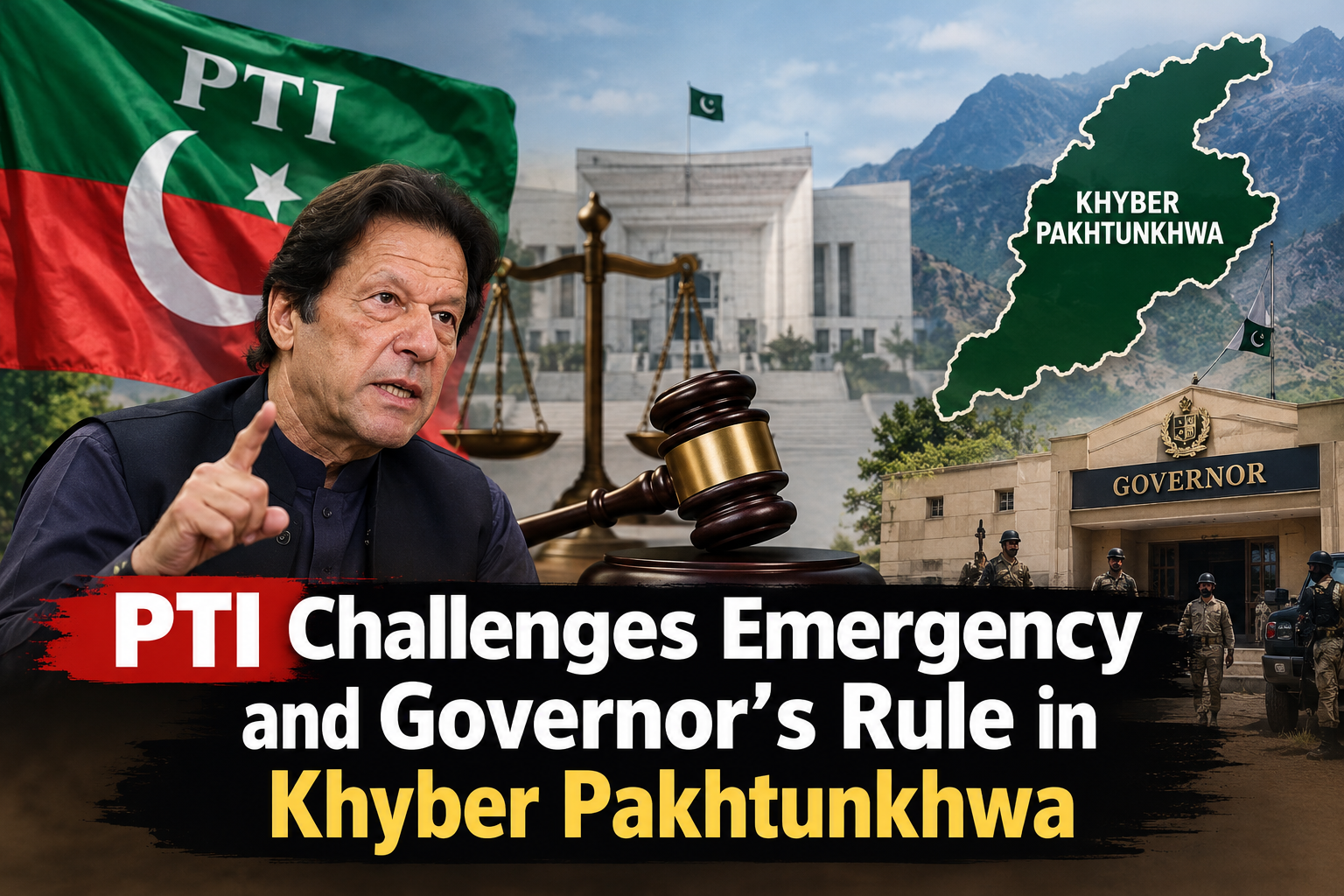
Pakistan Tehreek-e-Insaf (PTI) has challenged the imposition of emergency and governor’s rule in Khyber Pakhtunkhwa (KP), seeking the restoration of the province’s elected government. The case has become a significant political and constitutional development, raising questions about provincial autonomy, democratic representation, public security, and the limits of federal authority.
Introduction
The political situation in Khyber Pakhtunkhwa has become a major national issue following the federal government's decision to impose emergency measures and governor’s rule in the province on October 11, 2026. PTI Chairman Barrister Gohar Ali Khan filed a petition in the Peshawar High Court on October 14, challenging the decision and requesting the restoration of the elected provincial government. The court scheduled a preliminary hearing for October 20.
The dispute has brought several important questions into public debate. These include the constitutional authority of the federal government, the powers of provincial institutions, the responsibilities of elected representatives, and the need to address security challenges effectively.
While the federal government has defended its decision on security grounds, PTI has argued that the measures are unconstitutional and undermine the democratic mandate of the people of Khyber Pakhtunkhwa. The legal proceedings will provide an opportunity for the court to examine these competing positions.
What Led to Emergency Rule in Khyber Pakhtunkhwa?
According to reports, the federal government cited deteriorating security conditions and concerns about counterterrorism cooperation when explaining its decision to impose emergency measures in Khyber Pakhtunkhwa.
The move came after weeks of political tensions between the federal government and the PTI-led provincial administration. Negotiations between the government and opposition had also failed to resolve disagreements concerning security policy and the political demands of PTI, including its calls for the release of party founder Imran Khan.
The federal government argued that stronger coordination was necessary to respond to security challenges in the province. PTI, however, rejected the justification for suspending the elected provincial administration and maintained that political differences should not be used to remove an elected government from its functions.The disagreement reflects a wider challenge in Pakistan's political system: how to respond to serious security concerns while maintaining constitutional procedures and democratic representation.
Security and democracy are both important responsibilities of the state. The central question in this dispute is whether the measures adopted by the federal government satisfy the constitutional requirements that govern emergency powers.
PTI Takes the Matter to the Peshawar High Court
PTI Chairman Barrister Gohar Ali Khan challenged the emergency proclamation and governor’s rule through a constitutional petition filed in the Peshawar High Court.
The petition requests that the court declare the federal government's decision unconstitutional and set aside the measures introduced under the proclamation. It also questions the legal basis for transferring provincial administrative and legislative functions to other authorities.
The petition raises concerns about provincial autonomy, the constitutional position of the elected provincial government, and the deployment of security forces under the emergency arrangement.
PTI has also requested access to the official records and material used to justify the decision. This request is intended to allow the court to examine the basis on which the emergency was declared.
Filing a petition does not automatically suspend a government decision. The measures remain subject to the relevant legal process unless a competent court issues an order changing their operation. The scheduled hearing will therefore be an important step in determining how the challenge proceeds.
Why PTI Says the Decision Is Unconstitutional
PTI's legal challenge centres on the argument that emergency powers must be exercised according to the Constitution rather than used as a substitute for normal democratic governance.
The party argues that the proclamation did not satisfy the relevant constitutional requirements and that the provincial assembly's role was bypassed. It has also challenged the legality of actions taken against the provincial leadership and the creation of new administrative arrangements.
Another argument raised by PTI concerns equal treatment. The party has pointed to security challenges in other parts of Pakistan and questioned why similar emergency measures were not adopted there.
PTI maintains that it supports efforts to combat terrorism but disputes the federal government's assessment of the provincial administration's performance and the legality of the response.
These are claims made by the petitioner, not a final judicial determination. The court must consider the relevant constitutional provisions, the government's justification, the available record, and the arguments presented by all parties before reaching a legal conclusion.
The Federal Government's Position
The federal government has defended the emergency measures by referring to the province's security situation and the need for more effective coordination against militant violence.
From the government's perspective, the measures are intended to strengthen administrative coordination and support efforts to restore law and order. Officials have argued that the provincial administration's approach to counterterrorism has not been sufficient.
The government has also introduced an advisory structure to assist the governor in performing provincial administrative functions. Reports described this as an 11-member technocratic advisory council.
However, the government's security justification does not remove the need for constitutional scrutiny. Emergency powers carry significant consequences for elected institutions and must be exercised within the limits established by law.
The court's examination will be important because it can assess the legal basis of the proclamation without assuming that either the government's justification or the opposition's objections are automatically correct.
Understanding Emergency Powers Under Pakistan's Constitution
Pakistan's Constitution establishes procedures for extraordinary situations in which the state believes emergency measures are necessary. Articles 232 and 234 are central to the current dispute.
Article 232 concerns the proclamation of an emergency under specified circumstances, while Article 234 addresses certain situations involving a failure of constitutional machinery in a province.
The application of these provisions involves legal requirements and constitutional safeguards. The existence of a security problem alone does not answer every question about whether a particular emergency measure has been adopted lawfully.
In the present case, PTI has questioned whether the required procedures were followed and whether the proclamation provides a sufficient legal basis for the actions taken afterwards.
The federal government, meanwhile, has defended its decision on security and administrative grounds.
A constitutional court must examine the applicable provisions, the wording of the proclamation, the supporting record, and the arguments advanced by the parties. This process is essential for determining whether emergency powers have been exercised within their lawful limits.
The dispute also highlights why constitutional procedures matter during periods of political tension. Clear legal standards help prevent uncertainty and provide a framework for resolving disagreements between different levels of government.
What Governor’s Rule Means for Provincial Administration
Governor’s rule changes how provincial executive responsibilities are exercised. Under the current arrangement in Khyber Pakhtunkhwa, Governor Faisal Karim Kundi has been assigned responsibility for provincial affairs, assisted by an advisory council.
The federal government has also established administrative arrangements intended to address security and governance concerns in selected districts.
Such changes can affect the way provincial decisions are made, how departments coordinate their work, and how elected representatives participate in policy-making.
Supporters of the emergency measures may argue that a more centrally coordinated structure can help address urgent challenges. Critics, however, warn that transferring powers away from elected provincial institutions can weaken democratic accountability.
The legal challenge makes these questions particularly significant. If the court finds that any measures were adopted contrary to the Constitution, it may consider the appropriate legal remedy. If it upholds the government's position, the relevant arrangements will continue subject to the applicable constitutional framework.
Until the court issues a decision, it is important to distinguish between the existing administrative situation and the final legal status of the challenged measures.
Provincial Autonomy and Democratic Representation
Provincial autonomy is an important element of Pakistan's federal system. It allows provincial institutions to exercise responsibilities assigned to them under the Constitution and applicable laws.
The issue is particularly sensitive when an elected provincial administration loses its executive powers through an emergency proclamation.
PTI argues that the decision interferes with the mandate received by the provincial government and weakens the authority of elected representatives. The party has requested the restoration of the provincial leadership and cabinet.
The federal government's position is that the security situation requires exceptional action. The dispute therefore involves both the protection of democratic representation and the state's responsibility to respond to security threats.
A stable political system needs clear rules for resolving such conflicts. Emergency powers should be subject to legal safeguards, while provincial authorities must also fulfil their responsibilities under the law.
Judicial review provides a formal mechanism for examining whether the balance between federal authority and provincial autonomy has been maintained.
The Role of the Peshawar High Court
The Peshawar High Court is central to the legal process because the petitions challenge the constitutionality of the emergency proclamation and related administrative actions.
The court can examine the arguments presented by the petitioners and the responses submitted by the relevant authorities. It can also consider the constitutional provisions and official records relevant to the dispute.
The preliminary hearing scheduled for October 20 is an important procedural development. A hearing date does not mean that the court has already accepted either side's arguments or reached a final decision.
Depending on the proceedings, the court may consider questions about the maintainability of the petitions, the legal basis of the proclamation, requests for interim relief, and the next steps in the case.
The outcome could have consequences for provincial administration and the interpretation of emergency powers. It may also help clarify the legal limits governing relations between the federal government and provincial institutions.
For this reason, the proceedings are likely to attract considerable attention from political parties, constitutional experts, civil society, and citizens across the country.
Political Tensions Between PTI and the Federal Government
The emergency dispute has developed against a backdrop of continuing political disagreement between PTI and the federal government.
PTI has made the release of its founder, Imran Khan, and related political demands central to its campaign. The federal government has emphasised security cooperation and has criticised the provincial administration's approach to counterterrorism.
These differences have complicated negotiations and increased tensions between the two sides.
When political dialogue breaks down, disagreements can move from negotiation tables to public demonstrations and courtrooms. Legal proceedings can provide a structured way to address disputes, but they do not necessarily resolve the wider political differences that produced them.
Both sides face pressure to communicate their positions clearly and avoid actions that could further destabilise the political environment.
A constructive approach would include respect for judicial proceedings, adherence to the Constitution, and continued efforts to address security concerns through lawful and effective measures.
How the Situation Affects Citizens
Political and administrative changes are not limited to government offices. They can also influence citizens' confidence in public institutions and their expectations about governance.
Residents of Khyber Pakhtunkhwa need reliable public services, effective security arrangements, functioning schools and hospitals, and responsive local administration.
When provincial governance becomes the subject of a major constitutional dispute, people may worry about whether essential services will continue without disruption.
Authorities should therefore make sure that administrative uncertainty does not prevent citizens from receiving necessary services. Public departments should communicate any changes clearly and ensure that routine responsibilities continue according to the law.
Security measures should also be implemented in ways that protect civilians and respect their legal rights.
For residents, the most important outcomes are practical ones: greater safety, effective public services, accountable administration, and confidence that government decisions are made through lawful procedures.
The Importance of Counterterrorism Cooperation
Security remains a central issue in the debate over emergency rule. Khyber Pakhtunkhwa has faced serious security challenges, and effective counterterrorism efforts require coordination among relevant authorities.
Such cooperation may involve intelligence sharing, policing, border security, judicial processes, and support for communities affected by violence.
Political disagreements should not prevent necessary cooperation against threats to public safety. At the same time, security policy must operate within the law and maintain appropriate civilian and institutional oversight.
A sustainable strategy also requires attention to the needs of affected communities. Access to education, economic opportunities, public services, and reliable local administration can contribute to stability.
No single administrative measure can resolve every security challenge. Long-term progress depends on effective institutions, cooperation between authorities, public trust, and policies that address both immediate risks and broader community needs.
Possible Outcomes of the Court Proceedings
The petitions before the Peshawar High Court could lead to several possible outcomes, depending on the court's assessment of the constitutional and legal questions.
First, the court may find grounds to grant relief to the petitioners if it determines that the challenged measures were adopted unlawfully. Depending on the findings, this could affect the proclamation or actions taken under it.
Second, the court may decline to grant the requested relief if it concludes that the legal requirements have been met or that the petitioners have not established grounds for the orders they seek.
Third, the court may issue procedural directions or seek further information before deciding the central questions. Constitutional cases can involve complex records and arguments, so their resolution may require multiple stages.
These are general possibilities rather than predictions. The outcome cannot be known until the court considers the case and issues its orders.
Citizens should be cautious about social media claims suggesting that the emergency has already been cancelled or that the elected government has been restored unless such developments are confirmed by an official court decision.
Why Constitutional Stability Matters for Pakistan
Constitutional stability helps ensure that political disputes are resolved through established institutions rather than prolonged confrontation.
When federal and provincial authorities disagree, clear procedures can provide a lawful route for addressing their differences. Courts, legislatures, and elected governments each have responsibilities within the constitutional system.
Respecting these responsibilities is important regardless of which political party holds office. Constitutional principles should be applied consistently rather than according to short-term political advantage.
The Khyber Pakhtunkhwa dispute provides an opportunity to examine how emergency powers should be used and what safeguards are needed to protect democratic representation during security crises.
A clear judicial decision could help the parties understand their legal obligations and reduce uncertainty about the relevant constitutional provisions.
Ultimately, stable governance requires both effective security policies and respect for the legal framework that gives public institutions their authority.
Conclusion
PTI's challenge to emergency and governor’s rule in Khyber Pakhtunkhwa has become a major constitutional and political issue in Pakistan. The party is asking the Peshawar High Court to declare the measures unconstitutional and restore the elected provincial government, while the federal government has defended its decision on security grounds.
The court's preliminary hearing, scheduled for October 20, 2026, is an important next step. The legal process will examine the constitutional provisions, the grounds for the proclamation, and the arguments submitted by the parties.
Regardless of the outcome, the situation highlights the importance of transparent government decisions, effective counterterrorism cooperation, provincial autonomy, and respect for democratic institutions.
Pakistan's long-term stability depends on resolving political disputes through lawful procedures while ensuring that citizens remain safe and public services continue to function. A balanced approach that respects both security needs and constitutional safeguards will be essential as the case moves forward.
1. Why has PTI challenged emergency rule in Khyber Pakhtunkhwa?
PTI argues that the emergency proclamation and governor’s rule violate constitutional requirements and undermine the province's elected government.
2. When was the emergency imposed in Khyber Pakhtunkhwa?
The emergency and governor’s rule were imposed on October 11, 2026.
3. When will the Peshawar High Court hear the case?
The preliminary hearing of PTI Chairman Barrister Gohar Ali Khan's petition was scheduled for October 20, 2026.
4. What is the federal government's justification for emergency rule?
The federal government has cited security concerns and the need for stronger coordination in counterterrorism efforts.
5. Has the court restored the elected provincial government?
The reports available as of October 19, 2026, confirm that the petition is scheduled for a preliminary hearing. They do not establish that the court has restored the elected provincial government.




