Introduction
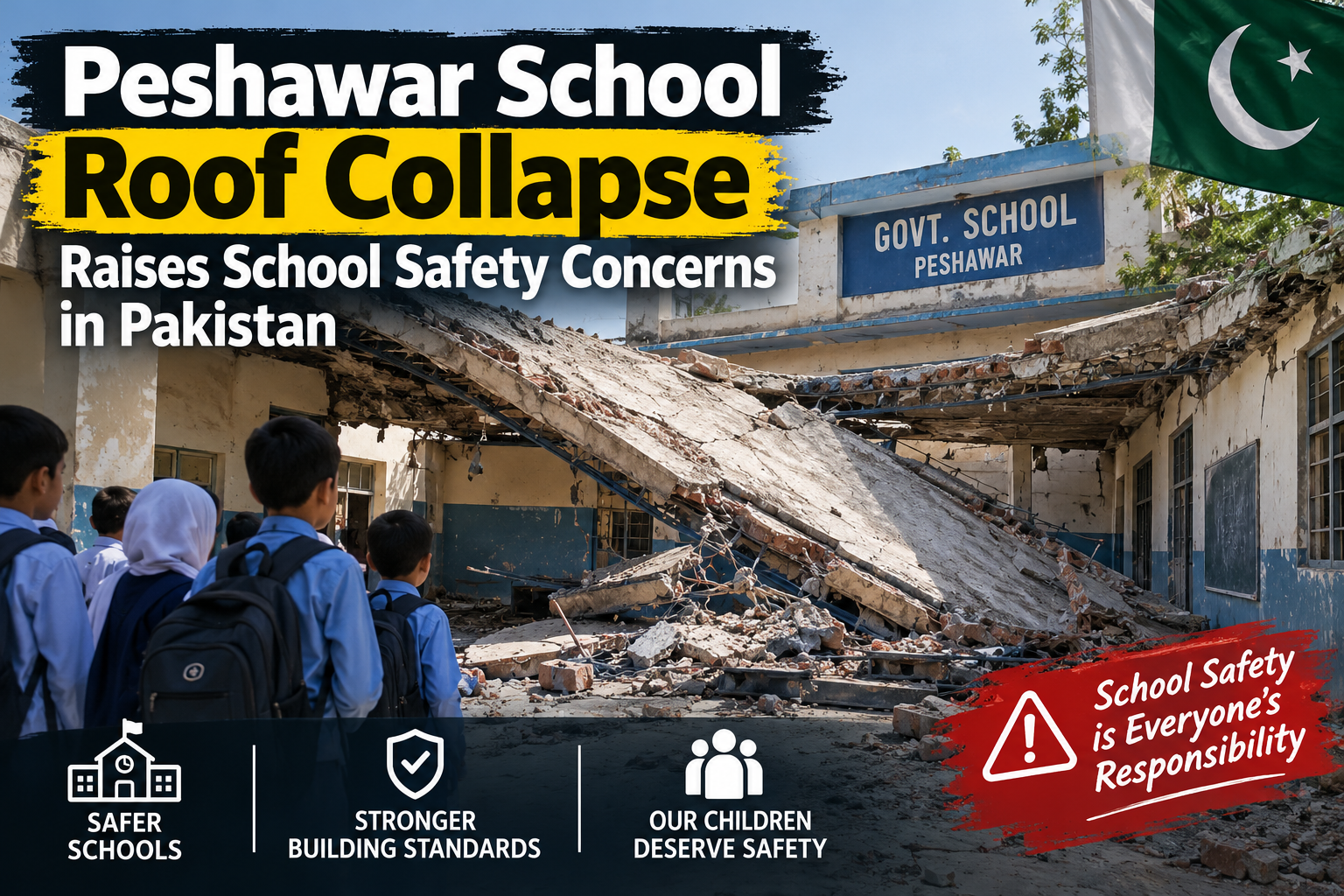
The tragic roof collapse at a private school in Peshawar has raised serious concerns about the safety of educational institutions across Pakistan. The incident occurred on October 15, 2026, at Al-Khair Education Centre in the Dir Colony area of Peshawar, Khyber Pakhtunkhwa. Students were attending classes when the building's roof collapsed, resulting in the deaths of dozens of children and a female teacher and leaving many others injured. The incident shocked families and communities and renewed calls for stronger construction standards, regular inspections, and accountability for those responsible for maintaining school buildings.
Schools are expected to provide children with a safe environment where they can learn, develop confidence, and prepare for their future. When a school building becomes unsafe, it threatens not only students but also teachers, administrative staff, and families who trust educational institutions with their children's well-being.
The Peshawar tragedy has therefore become an important national issue. Beyond the immediate rescue operation and investigation, it has highlighted the need to examine how school buildings are constructed, approved, maintained, and inspected throughout Pakistan.
Details of the Peshawar School Incident
The incident took place during morning classes at Al-Khair Education Centre, a private educational institution in Peshawar. According to reports published after the collapse, the roof of an upper portion of the building gave way, affecting classrooms below. Students and teachers were inside the school when the structure collapsed.
Rescue teams, emergency workers, local residents, and other responders rushed to the scene. They worked to recover trapped people, assist injured students, and transport victims to nearby medical facilities. The narrow streets in the surrounding residential area created additional difficulties for emergency access, according to reports about the incident.
The loss of young lives made the incident particularly heartbreaking. Children attend school to gain knowledge and build a better future, and parents naturally expect classrooms to meet basic safety requirements. The tragedy left families grieving and raised difficult questions about whether the building had been adequately assessed before it was used for education.
Reports initially gave differing casualty figures as rescue work continued. Subsequent coverage reported that at least 30 students and a female teacher had died, while many others were injured. The final figures and circumstances should be understood in light of official updates and the continuing investigation.Government Orders an Investigation
Following the incident, Prime Minister Shehbaz Sharif expressed grief over the loss of life and directed authorities to conduct a comprehensive investigation. He also called for legal action against anyone found responsible and urged officials to ensure appropriate medical treatment for the injured.
An investigation is essential to establish what caused the building to collapse and whether preventable failures contributed to the disaster. Investigators need to examine the building's design, construction materials, structural condition, approval documents, and maintenance history.
The inquiry should also determine whether any concerns about the building had previously been reported and, if so, how the relevant authorities and school management responded. These questions are important because identifying the underlying causes can help prevent similar incidents in the future.
Accountability must be based on evidence and due legal process. If investigators establish that negligence, violations of building regulations, or failures to address known safety problems contributed to the collapse, appropriate legal action should follow.
Concerns About Construction Quality and Building Maintenance
One of the most important issues raised by the Peshawar tragedy is the quality of construction in educational buildings. Reports following the incident referred to allegations of substandard construction materials and structural weaknesses. Police registered a case against individuals associated with the school's ownership and construction, while the investigation continued. These allegations must be assessed through the legal process rather than treated as final findings before the case is concluded.
A school building must be designed according to appropriate engineering standards. Its foundations, columns, beams, walls, and roof must be capable of supporting the expected loads. Construction work must also comply with approved plans and applicable building regulations.
Poor-quality materials, inadequate engineering, unauthorized alterations, and insufficient maintenance can create serious risks. A building may appear usable from the outside while containing structural weaknesses that require professional assessment.
Regular maintenance is therefore not simply an administrative responsibility. It is a fundamental part of protecting students and staff. School management should arrange qualified inspections, maintain records of repairs, and respond promptly to any concerns raised about the structure.
Why School Building Inspections Are Necessary
After the Peshawar incident, authorities in Khyber Pakhtunkhwa moved towards wider inspections of school buildings. Reports indicated that district-level committees were established to examine private schools and assess their structural condition.
Such inspections can help identify dangerous conditions before another tragedy occurs. However, inspections must be meaningful, professionally conducted, and followed by practical action.
A comprehensive school safety assessment should consider:
The condition of roofs, ceilings, walls, columns, beams, and foundations.
Signs of structural movement, cracks, water damage, or deterioration.
Whether construction and renovation work follows approved plans.
The suitability of classrooms for the number of students using them.
Emergency exits, staircases, corridors, and access for rescue services.
Maintenance records and the completion of previously recommended repairs.
Schools identified as unsafe should receive clear instructions and deadlines for corrective action. Where a qualified assessment identifies an immediate danger, the affected area should not remain in use until it has been made safe.
Inspection systems should also include follow-up visits. A report alone cannot protect students if its recommendations are ignored or repairs are never completed.
Protecting Children in Public and Private Schools
Pakistan has a diverse education system that includes government schools, private schools, community institutions, and low-cost educational centres. Their buildings differ in age, size, ownership, and available resources. Nevertheless, every child deserves a safe learning environment.
Safety standards should apply consistently across the education sector. A student's protection should not depend on whether their family can afford an expensive school or whether the institution operates in a major city or a smaller community.
Public authorities have a responsibility to establish and enforce building regulations. School owners and administrators must ensure that their premises meet those requirements. Construction professionals must follow appropriate engineering practices, and regulatory bodies must carry out their responsibilities transparently.
Low-cost schools may face financial challenges when repairs are needed. Those challenges should be addressed through practical support and clear compliance requirements rather than by allowing children to study in buildings that have not been shown to be safe.
Where public funding or assistance programmes are available, they should prioritize urgent structural risks and schools serving disadvantaged communities. Any financial support should be accompanied by professional assessments and proper oversight.
The Role of School Administrations
School management has an important role in preventing building-related emergencies. Administrators should not wait for a major incident before taking maintenance concerns seriously.
Every school should maintain a record of building inspections, repair work, construction approvals, and safety-related complaints. A designated person should be responsible for communicating structural concerns to qualified professionals and relevant authorities.
Teachers and other staff members should know how to report hazards. If a ceiling shows signs of serious damage or a qualified inspector identifies a structural risk, management should take immediate steps to protect everyone using the affected area.
Administrators should also ensure that emergency procedures are understood by staff. These procedures should cover how to contact emergency services, how to guide students to safe locations, and how to communicate with parents during an incident.
Such planning cannot prevent every possible emergency, but it can improve preparedness and reduce confusion when urgent action is required.
The Importance of Qualified Engineers
Structural safety assessments should be carried out by qualified professionals with the appropriate technical expertise. Informal visual checks by people without relevant training are not a substitute for a proper engineering evaluation.
Engineers can assess whether a building's structure is suitable for its intended use and identify conditions that require repair, further testing, or restrictions on occupancy. They can also evaluate whether additions or renovations have affected the building's stability.
Local authorities should maintain reliable systems for approving construction plans and verifying that buildings meet applicable requirements. Where necessary, independent technical reviews can help strengthen confidence in inspection results.
Construction contractors and building owners should also maintain accurate documentation of the work carried out. Clear records can assist investigators in determining whether a structure was built and maintained according to the required standards.
Parents and Communities Can Help Raise Safety Concerns
Parents and local communities can contribute to school safety by communicating concerns through appropriate channels. Families may notice visible deterioration, persistent water leakage, damaged ceilings, or other conditions that require professional attention.
Such observations should be reported to school management and the relevant regulatory authority. However, people should avoid making unsupported public accusations or attempting to determine structural safety without professional assistance.
Schools should provide a clear process for receiving and responding to safety complaints. Families need to know that their concerns will be taken seriously and that urgent problems will be referred to qualified experts.
Community awareness can support official inspections, but responsibility for technical assessment and enforcement must remain with the appropriate professionals and authorities.
Improving Emergency Preparedness in Schools
School safety involves more than the strength of a building. Institutions also need effective emergency arrangements that help protect students during unexpected events.
Emergency plans should explain evacuation procedures, staff responsibilities, communication with emergency services, and the process for accounting for students. Regular drills can help staff and students understand what to do during different emergencies.
Schools should keep emergency contact information current and ensure that entrances and access routes remain usable by responders. Staff members should receive appropriate training so that they can act calmly and follow established procedures.
Emergency preparedness cannot replace safe construction. Instead, it complements building inspections, maintenance, and enforcement by helping schools respond more effectively if an incident occurs.
Education Authorities Must Ensure Accountability
The Peshawar tragedy highlights the importance of effective oversight by education departments and regulatory authorities. A safety framework is only effective when regulations are enforced and violations are addressed.
Authorities should maintain accurate records of registered schools, building approvals, inspection results, and unresolved safety concerns. Inspection schedules should be based on risk, with particular attention to buildings that are old, visibly deteriorated, heavily occupied, or undergoing significant construction work.
Officials should also establish transparent procedures for reporting unsafe conditions and tracking corrective action. If an institution fails to address a serious hazard, regulators should have the authority to take appropriate measures under the law.
Public reporting on inspection programmes can help communities understand whether identified problems are being resolved. At the same time, enforcement decisions should be supported by documented findings and consistent procedures.
A National Conversation About School Safety
Although the incident occurred in Peshawar, its implications extend beyond one city or province. Schools throughout Pakistan need reliable systems to ensure that their buildings remain suitable for education.
A coordinated national effort could help provincial authorities share inspection practices, technical guidance, and lessons learned from building-related emergencies. Each province would still need to apply the relevant laws and address local conditions, but common safety principles could improve consistency.
The government, education departments, school owners, engineers, parents, and civil society all have a role in this process. Their responsibilities differ, but their shared objective should be to prevent avoidable harm and protect children's access to education.
School safety should not be treated as a temporary concern that receives attention only after a tragedy. It requires regular inspections, adequate funding, professional expertise, effective regulation, and a culture in which reported hazards are addressed promptly.
Supporting Affected Families and Students
The consequences of a school collapse continue long after rescue operations end. Families who have lost children face profound grief, while injured students may require ongoing medical care and rehabilitation.
Surviving students, teachers, and witnesses may also need emotional support. Returning to school after a traumatic incident can be difficult, particularly for children who lost classmates or teachers.
Authorities and education providers should work with qualified professionals to offer appropriate support to affected families and children. Any return to normal educational activities should take place only when the relevant premises have been assessed and declared safe.
Support must be delivered with sensitivity and respect for the privacy of those affected. Children and families should not be pressured to discuss painful experiences publicly.
Conclusion
The Peshawar school roof collapse is a heartbreaking reminder that the safety of educational buildings must never be overlooked. The deaths of students and a teacher, along with the injuries suffered by many others, have brought urgent attention to construction quality, building maintenance, inspection systems, and institutional accountability.
The investigation must establish the circumstances of the collapse and determine whether any failures contributed to the tragedy. At the same time, authorities should continue efforts to inspect school buildings and address structural hazards before they cause further harm.
School owners must maintain safe premises, qualified engineers must provide reliable assessments, and regulatory bodies must enforce applicable standards. Parents and communities should have accessible ways to raise concerns, while students and staff should receive appropriate emergency guidance.
Every child deserves the opportunity to learn in a secure environment. Turning the lessons of this tragedy into lasting improvements would be an important step towards protecting students throughout Pakistan and ensuring that schools fulfil their essential purpose: helping children learn, grow, and build their futures safely.
FAQs
1. What happened in the Peshawar school roof collapse?
On October 15, 2026, a roof collapsed at Al-Khair Education Centre in Peshawar while students were attending classes, causing multiple deaths and injuries.
2. Where did the school roof collapse occur?
The incident occurred at a private school in the Dir Colony area of Peshawar, Khyber Pakhtunkhwa, Pakistan.
3. What caused the school building to collapse?
Reports raised concerns about structural weakness and alleged poor construction. Authorities initiated an investigation to establish the exact circumstances and responsibility.
4. What steps did authorities take after the incident?
The prime minister called for an investigation and legal action against anyone found responsible. Authorities in Khyber Pakhtunkhwa also initiated measures to inspect school buildings.
5. How can Pakistan improve school building safety?
Pakistan can strengthen professional building inspections, enforce construction standards, maintain school buildings, investigate safety complaints, and ensure that identified hazards are corrected promptly.




