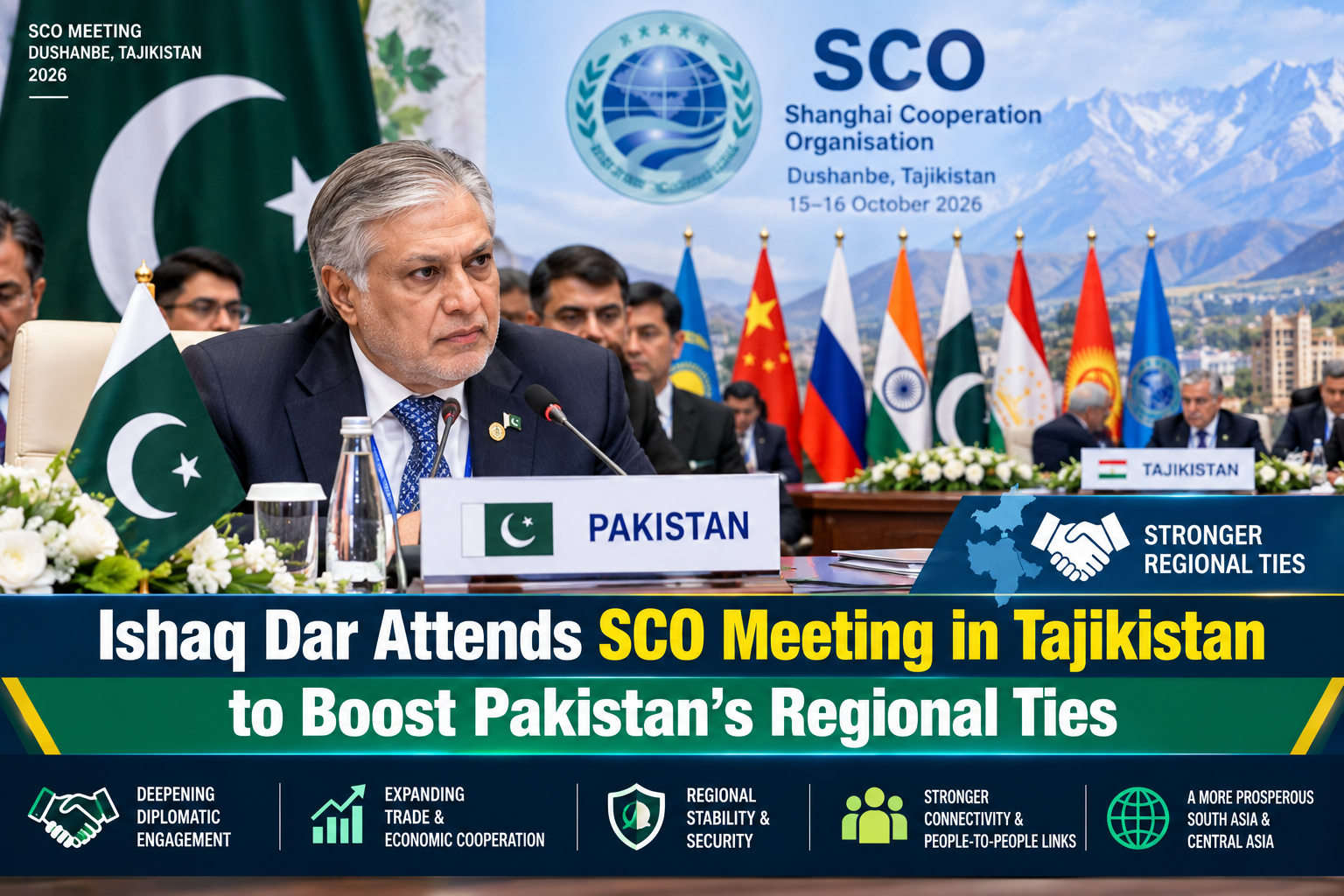
Pakistan’s Deputy Prime Minister and Foreign Minister, Senator Mohammad Ishaq Dar, arrived in Dushanbe, the capital of Tajikistan, on October 19, 2026, to lead Pakistan’s delegation at the Shanghai Cooperation Organisation (SCO) Council of Heads of Government meeting. The two-day meeting, scheduled for October 19–20, brings together senior representatives from member countries to discuss economic cooperation, trade, connectivity, finance, and regional development.The visit represents another opportunity for Pakistan to strengthen its engagement with regional partners and promote cooperation on issues that affect economic growth and regional stability. Dar is also expected to meet Tajikistan’s leadership and hold bilateral discussions with counterparts from other SCO member states.
The gathering comes at a time when regional countries are seeking stronger economic links, improved transport networks, and greater coordination on shared challenges. For Pakistan, participation in the meeting is particularly significant because of its geographical position, its relationships with Central Asian countries, and its interest in expanding trade and investment opportunities.
The SCO provides a platform for member countries to discuss common priorities through regular consultations. Although the organisation does not replace bilateral relations, it offers an additional framework for cooperation on matters that cross national borders.
What Is the Shanghai Cooperation Organisation?
The Shanghai Cooperation Organisation is a regional organisation that promotes cooperation among countries across Asia and neighbouring regions. Its work covers economic development, trade, transport connectivity, security, cultural exchange, and other shared priorities.
The organisation provides a forum where governments can discuss issues that affect more than one country. These may include cross-border trade, transport infrastructure, financial cooperation, energy development, and regional security.
The SCO’s Council of Heads of Government is its second-highest decision-making body. It focuses particularly on economic, financial, trade, connectivity, and socioeconomic cooperation, as well as the organisation’s budgetary matters.
Meetings of the council provide opportunities for participating governments to review existing initiatives and identify areas where further coordination may be useful.
For Pakistan, the forum is important because its regional economic interests extend beyond its immediate neighbours. Better links with Central Asia could help Pakistani businesses access additional markets, while improved transport arrangements could support the movement of goods between South Asia and other regions.
The organisation also provides opportunities for countries with different economic structures and foreign policy priorities to discuss shared concerns.
However, cooperation through a multilateral organisation takes time. Governments need to negotiate agreements, coordinate domestic policies, arrange financing, and implement projects. Announcements made during high-level meetings are therefore only one part of a longer process.
The practical value of the SCO depends on whether its members can turn discussions into workable initiatives that benefit businesses, communities, and their economies.
Why Ishaq Dar’s Visit Matters for Pakistan
Ishaq Dar’s participation in the Dushanbe meeting reflects Pakistan’s continued engagement with regional diplomatic and economic institutions.
Pakistan has an interest in strengthening relations with countries that can support trade diversification, investment, energy cooperation, and improved access to regional markets. Engagement through the SCO gives Islamabad an opportunity to discuss these priorities alongside a broad group of partners.
The visit is also relevant to Pakistan’s relationship with Tajikistan. The two countries have expressed interest in improving economic links, strengthening institutional cooperation, and exploring opportunities in trade, energy, education, and connectivity.
Dar’s scheduled meetings with Tajikistan’s president and prime minister provide an opportunity to discuss bilateral priorities directly. Meetings with other SCO representatives can also help identify shared interests and potential areas for cooperation.
For Pakistan, such diplomatic engagement can support efforts to build relationships beyond traditional commercial partners. Expanding the number of markets available to Pakistani exporters may help businesses reduce their dependence on a limited range of destinations.
Nevertheless, successful economic diplomacy requires follow-up. Businesses need practical information about market access, customs procedures, transport costs, payment arrangements, and applicable regulations before they can benefit from new opportunities.
Government-to-government discussions can help address these issues by establishing channels for communication and identifying barriers that need attention.
The long-term significance of Dar’s visit will therefore depend not only on the meetings themselves but also on the agreements, projects, and institutional contacts that emerge from them.
Pakistan and Tajikistan: A Relationship With Economic Potential
Pakistan and Tajikistan share an interest in strengthening cooperation across several fields, including trade, energy, transport, education, and regional development.
Tajikistan is a landlocked country in Central Asia, while Pakistan has access to the Arabian Sea. Their different geographic positions create potential opportunities for complementary economic relationships.
Tajikistan has significant hydropower resources, while Pakistan has a large population, established commercial sectors, and access to maritime trade routes. Cooperation could create opportunities in energy, agriculture, construction, transport, and other industries.
However, geography alone does not guarantee successful trade. The cost and reliability of transport, customs procedures, border arrangements, and access to financing all influence whether businesses can trade competitively.
For example, an exporter must consider the total cost of moving goods from a factory to the final buyer. If transport takes too long or involves multiple expensive transfers, the product may become less competitive in the destination market.
Improved regional connectivity could help address some of these challenges over time. Better roads, coordinated border procedures, dependable logistics services, and reliable commercial information could make trade more practical.
Diplomatic discussions can help governments identify the most significant obstacles and consider how to address them.
Pakistan and Tajikistan can also benefit from closer cooperation between chambers of commerce, universities, technical institutions, and private-sector organisations. Such connections can help businesses understand market requirements and encourage the exchange of professional knowledge.
While these opportunities are promising, their value will depend on commercially viable projects and effective implementation.
Trade Opportunities Between Pakistan and Central Asia
Central Asia offers potential opportunities for Pakistani businesses seeking to diversify their export markets.
Pakistan has established industries in textiles, clothing, surgical instruments, sports goods, pharmaceuticals, agricultural products, food processing, and other manufacturing activities. Depending on market requirements and applicable regulations, some of these industries may be able to expand their presence in Central Asian markets.
The region also has demand for machinery, consumer products, construction materials, agricultural inputs, and various services. Pakistani exporters may find opportunities where their products are competitive in terms of quality, price, and delivery.
However, businesses need more than diplomatic goodwill to enter a new market. They must understand local consumer preferences, technical standards, import rules, taxation, distribution networks, and payment practices.
Smaller companies may find these requirements especially challenging because they often have limited resources for international market research.
Government agencies and trade organisations can help by providing reliable market information, arranging business delegations, supporting trade fairs, and explaining export procedures.
Digital platforms may also help Pakistani businesses reach international buyers, although exporters still need to manage product quality, shipping, customer service, and payment risks.
Another important consideration is the stability of trade arrangements. Businesses are more likely to invest in a new market when they have confidence that goods can move efficiently and commercial rules will be applied consistently.
Through the SCO and bilateral discussions, Pakistan can seek practical ways to reduce unnecessary barriers and improve commercial connections.
The benefits will be greatest when new trade opportunities translate into additional production, sustainable jobs, and stronger participation by small and medium-sized businesses.
Regional Connectivity and Pakistan’s Geographic Position
Pakistan’s location gives it potential to serve as a connection between South Asia, Central Asia, the Middle East, and maritime trade routes.
Its ports, roads, railways, and border crossings form part of a wider transport network that can support international commerce. However, turning this geographic advantage into a lasting economic benefit requires investment and effective coordination.
For Central Asian countries, reliable access to international markets can help reduce transport constraints associated with being landlocked. For Pakistan, improved regional connectivity could increase demand for logistics services, warehousing, transport, and port-related activities.
Such cooperation could also support businesses that import raw materials or export finished products.
However, transit arrangements must be commercially practical. Traders need clear documentation requirements, predictable fees, efficient customs processing, and dependable schedules.
Delays at border crossings can increase costs and create uncertainty for businesses dealing with perishable agricultural goods or time-sensitive manufacturing orders.
Infrastructure is equally important. Roads and railways must be maintained, logistics facilities need adequate capacity, and transport operators require dependable operating conditions.
Cross-border cooperation can also involve digital customs systems, information sharing, and coordinated procedures. These measures may improve efficiency without requiring every improvement to depend on major construction projects.
Pakistan’s participation in regional forums gives it opportunities to discuss these practical concerns with potential partners.
The objective should be to build transport connections that are economically sustainable and useful to businesses, rather than treating infrastructure announcements as achievements in themselves.
Energy Cooperation and Shared Development Interests
Energy is another area in which Pakistan and Central Asian countries may find opportunities for cooperation.
Pakistan needs reliable energy supplies to support households, agriculture, transport, and industrial production. Energy costs also influence the competitiveness of local businesses and the affordability of essential goods.
Tajikistan has substantial hydropower resources, creating potential for discussions about electricity generation, regional energy connections, and technical cooperation.
Cross-border energy projects can offer benefits when participating countries have complementary supply and demand patterns. They can also support greater coordination in planning and infrastructure development.
However, such projects require careful assessment. Governments and investors must consider construction costs, financing, transmission capacity, seasonal supply conditions, environmental impacts, and the commercial terms under which electricity or other energy resources would be exchanged.
Large infrastructure projects may take years to develop. They often require agreements among several governments, detailed technical assessments, and financing arrangements that can withstand changes in economic conditions.
For Pakistan, energy cooperation should be evaluated in terms of reliability, affordability, and long-term economic value.
Improving domestic energy efficiency is also important. Better transmission systems, reduced technical losses, efficient industrial equipment, and responsible consumption can help make energy supplies more useful to the economy.
Regional cooperation and domestic reform can complement each other. International partnerships may expand supply options, while improvements at home can help ensure that available energy is delivered and used efficiently.
The SCO offers a forum for discussing these shared interests, although any specific project must be assessed on its own merits.
Investment and Business Cooperation
Investment is another important subject for regional economic engagement.
Foreign investment can support the development of factories, transport networks, energy projects, logistics facilities, and other productive activities. It can also introduce technology, professional expertise, and access to new markets.
For Pakistan, attracting sustainable investment requires a business environment in which investors can understand the rules, assess risks, and make decisions based on reliable information.
Policy predictability is important. Businesses are more willing to commit capital when they have confidence in regulatory procedures, taxation arrangements, contract enforcement, and the availability of essential infrastructure.
Investment discussions with Central Asian partners could explore opportunities in agriculture, food processing, transport, energy, information technology, and other sectors.
However, announcements about investment interest should be distinguished from signed agreements, funded projects, and completed investments. Each stage represents a different level of progress.
A proposed project may still require feasibility studies, financing, approvals, land arrangements, and negotiations over commercial terms.
Transparency is also essential. Investment projects should be evaluated for their expected economic benefits, environmental consequences, financial sustainability, and impact on local communities.
For small businesses, cooperation can take less formal forms than large investment projects. Joint ventures, distribution agreements, technical partnerships, and business-to-business contacts may help companies explore new markets at a manageable scale.
Pakistan’s diplomatic engagement can support these relationships by helping businesses connect with relevant institutions and understand commercial requirements.
Ultimately, the success of investment cooperation should be measured by actual economic activity, productive capacity, employment, and the value created for participating communities.
The Importance of Financial and Economic Coordination
The SCO Council of Heads of Government also provides a forum for discussions about financial cooperation and the organisation’s budgetary matters.
Financial coordination is important because trade and investment depend on the availability of reliable payment systems, financing arrangements, and clear commercial rules.
Businesses operating across borders must manage currency movements, payment timelines, transaction costs, and the possibility of delayed payments. These issues can be particularly difficult for smaller companies entering unfamiliar markets.
Greater communication between financial institutions and relevant government agencies may help identify practical barriers and improve understanding of the rules that apply to international transactions.
For Pakistan, expanding trade requires attention to both exports and imports. Exporters need access to customers, while businesses importing equipment or raw materials need predictable supply arrangements and affordable financing.
Economic cooperation can also involve the exchange of information about investment opportunities, business regulations, and potential areas for joint development.
However, financial cooperation must be designed carefully. Any new arrangements need to comply with relevant laws, protect participants, and offer clear economic benefits.
Countries may also have different financial systems and policy priorities. Reaching agreements therefore requires consultation and a realistic understanding of what each participant can implement.
The SCO can provide a setting for these discussions, but the practical results depend on decisions taken by individual governments, financial institutions, and businesses.
Pakistan’s Role in the SCO During 2026–2027
Pakistan is seeking to play an active role in the SCO’s work during the 2026–2027 period. The country has been involved in preparations for upcoming meetings and is scheduled to host the organisation’s Council of Heads of State summit in Islamabad in 2027.
Hosting a major international meeting provides an opportunity for Pakistan to welcome representatives from member countries and facilitate discussions on regional priorities.
It also creates responsibilities. Successful hosting requires logistical planning, security arrangements, diplomatic coordination, and timely communication among participating governments.
More importantly, the value of hosting a summit depends on the quality of the discussions and the follow-up that takes place afterwards.
Pakistan can use its participation to promote practical cooperation in trade, transport, investment, digital development, and other areas where members share common interests.
The country can also encourage discussion about the obstacles that prevent regional agreements from delivering their expected benefits.
For example, improved connectivity may require coordination among transport authorities, customs agencies, border officials, and private logistics companies. A single government cannot resolve every issue independently when a route crosses several countries.
Similarly, business cooperation requires information that is useful to companies, not simply high-level statements about the importance of trade.
Pakistan’s role will therefore be strengthened when diplomatic initiatives are supported by detailed planning and measurable outcomes.
The 2027 summit offers a future opportunity to review progress, but work towards that meeting also provides a chance to develop practical initiatives in advance.
How Regional Cooperation Can Benefit Ordinary Pakistanis
International diplomacy may appear distant from everyday life, but regional economic decisions can influence employment, prices, business opportunities, and access to products.
If regional trade becomes more efficient, Pakistani exporters may find additional customers. Increased demand can encourage companies to expand production, improve their operations, and recruit workers.
Farmers may benefit when food-processing companies and international buyers provide additional outlets for agricultural products. Transport operators, warehouse workers, and logistics businesses may also gain from higher trade volumes.
Improved energy cooperation could potentially support businesses that require reliable electricity, although the benefits would depend on the design and implementation of specific projects.
Students and professionals may also benefit from educational exchanges, technical training, and opportunities to develop skills relevant to international business.
Small businesses could gain access to new markets if they receive practical guidance about export procedures, product standards, and commercial requirements.
Nevertheless, these benefits are not automatic. Increased imports can create competitive pressure for domestic producers, and new infrastructure may have limited effects if businesses cannot afford to use it.
Policymakers therefore need to assess how regional agreements affect different groups within the economy.
Measures that support skills development, access to finance, productive investment, and fair competition can help communities benefit more broadly from international cooperation.
The central objective should be to ensure that diplomatic engagement contributes to tangible improvements in people’s economic opportunities.
Challenges That Could Limit Regional Cooperation
Despite the potential benefits, several challenges could slow progress in regional economic cooperation.
Transport and logistics costs
Long distances, difficult terrain, limited transport options, and border delays can make regional trade expensive. Businesses need dependable routes and predictable delivery times to compete effectively.
Different regulations
Countries may apply different customs procedures, product standards, licensing requirements, and taxation rules. Understanding these differences can be difficult for exporters, especially smaller businesses.
Financing constraints
Infrastructure projects and commercial expansion often require substantial investment. Limited access to affordable financing can delay projects or prevent otherwise viable businesses from entering new markets.
Political and security concerns
Regional tensions can affect transport routes, investor confidence, and diplomatic relations. Governments need to manage disagreements while protecting their national interests and maintaining channels for dialogue.
Implementation difficulties
Even when governments agree on common goals, projects may face delays involving approvals, financing, technical planning, or coordination between agencies.
Addressing these challenges requires practical cooperation rather than broad statements alone. Countries need clear responsibilities, realistic schedules, transparent procedures, and mechanisms for monitoring progress.
Pakistan can benefit from identifying the barriers that have the greatest effect on its exporters and investors, then working with partners to address them systematically.
What to Expect From the Dushanbe Meeting
The SCO Council of Heads of Government meeting is scheduled for October 19–20, 2026, in Dushanbe. According to official information, the meeting is expected to produce a joint communiqué, statements, and decisions relating to the organisation’s work.
The meeting provides an opportunity for member countries to review shared economic priorities and discuss areas where further cooperation may be possible.
For Pakistan, important areas of interest include regional trade, transport connectivity, investment, energy, and stronger links with Central Asian economies.
Dar’s planned bilateral engagements may also help Islamabad discuss issues that require direct cooperation between governments.
However, the exact results will depend on the decisions reached during the meeting and the details published by the participating countries. It would be premature to assume that every proposal discussed will become an implemented agreement.
After the meeting, the value of the outcomes will be clearer when governments explain what was agreed, how implementation will proceed, and which institutions will be responsible for follow-up.
Businesses and investors will also look for information about whether the discussions create new opportunities or remove existing obstacles.
For the public, the most meaningful results will be those that contribute to stronger economic links, better opportunities for workers and businesses, and more reliable regional cooperation.
Conclusion
Deputy Prime Minister and Foreign Minister Ishaq Dar’s arrival in Tajikistan on October 19, 2026, highlights Pakistan’s continued engagement with the Shanghai Cooperation Organisation and its efforts to strengthen regional economic relations.
The two-day Council of Heads of Government meeting brings together representatives of member countries to discuss trade, finance, connectivity, socioeconomic development, and other shared priorities.
For Pakistan, the gathering offers opportunities to strengthen relations with Tajikistan and other regional partners, explore additional markets for Pakistani products, and discuss practical ways to improve transport and investment links.
The country’s participation also comes ahead of its planned hosting of the SCO Council of Heads of State summit in Islamabad in 2027, giving it a further opportunity to contribute to the organisation’s regional agenda.
Nevertheless, the long-term value of these diplomatic efforts will depend on implementation. Better trade arrangements, commercially viable investment, dependable transport networks, and stronger business connections require sustained work after high-level meetings conclude.
If Pakistan and its regional partners can turn shared priorities into practical initiatives, cooperation may support employment, business development, and wider economic progress.
The Dushanbe meeting is therefore an important opportunity to strengthen dialogue and identify areas for future collaboration. Its ultimate success will be judged by the concrete results that follow and the benefits they deliver to participating countries and their people.
Frequently Asked Questions (FAQs)
1. Why is Ishaq Dar visiting Tajikistan?
Ishaq Dar is leading Pakistan’s delegation to the Shanghai Cooperation Organisation Council of Heads of Government meeting in Dushanbe on October 19–20, 2026.
2. What is the main purpose of the SCO meeting?
The meeting focuses on economic cooperation, trade, finance, connectivity, socioeconomic development, and other shared regional priorities.
3. Which countries are represented at the meeting?
Participating countries include Pakistan, China, Russia, India, Tajikistan, Kazakhstan, Kyrgyzstan, Uzbekistan, and Belarus, alongside Iran’s representative.
4. How can Pakistan benefit from stronger ties with Central Asia?
Stronger regional relations could create opportunities for Pakistani exports, investment, energy cooperation, transport connectivity, and business development.
5. What is Pakistan’s upcoming role in the SCO?
Pakistan is scheduled to host the SCO Council of Heads of State summit in Islamabad in 2027, providing another opportunity to promote regional cooperation.