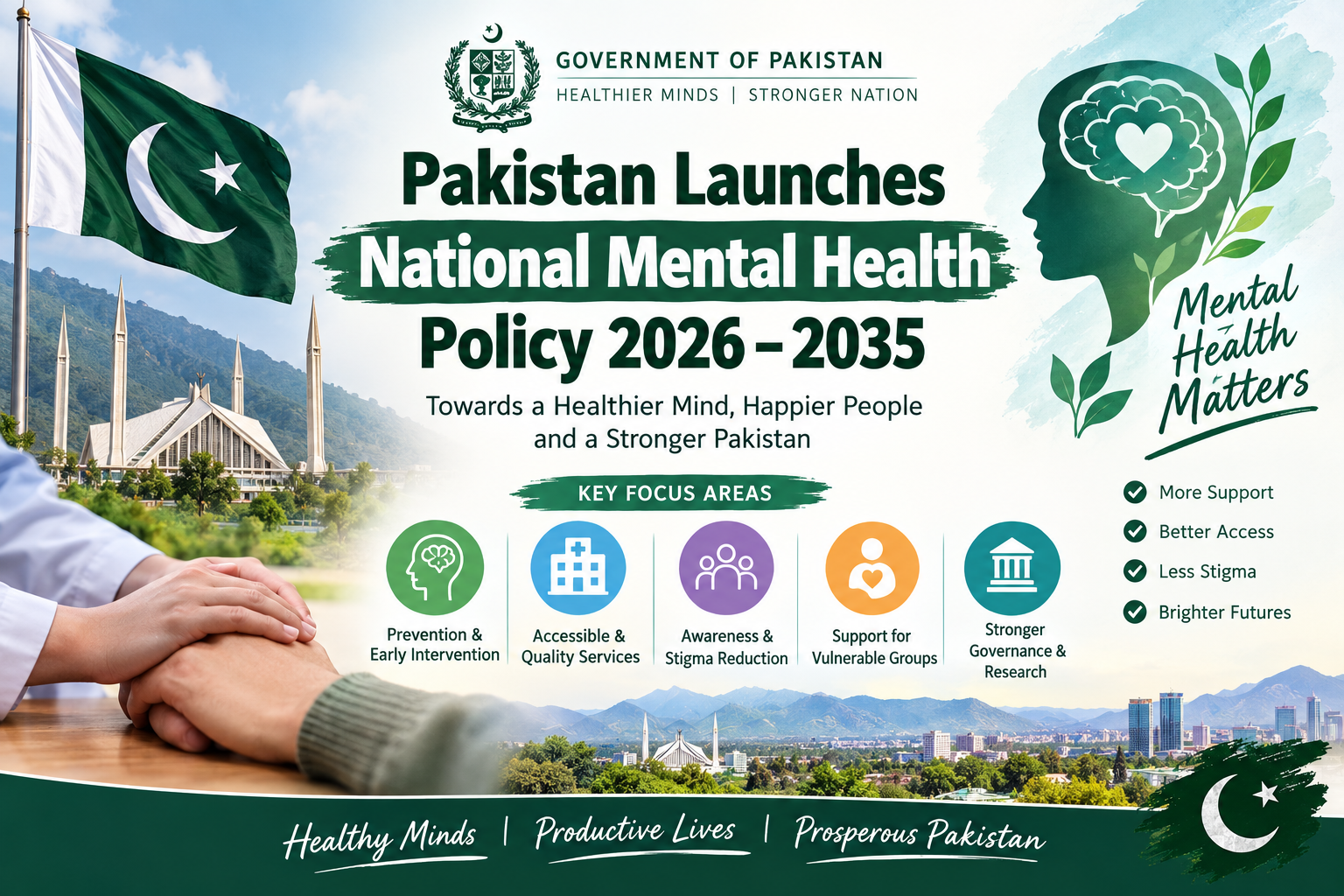
Pakistan has launched its National Mental Health Policy 2026–2035, marking a major step toward developing a more coordinated national approach to mental healthcare. The policy was launched on Thursday, October 1, 2026, during the Pakistan Global Mental Health Summit 2026 in Islamabad.
The two-day summit, being held from October 1 to 2, has brought together health experts, policymakers, mental health professionals, academics and representatives of national and international organisations. The event is focused on strengthening mental health systems in Pakistan and developing approaches that can respond to the needs of children, young people and communities.
The policy has been introduced under the leadership of the Ministry of National Health Services, Regulations and Coordination, with support from international and national partners including the World Health Organization (WHO), UNICEF and the Global Institute of Human Development at Shifa Tameer-e-Millat University.
The government says the policy is designed to provide a shared national direction while allowing provinces and regions to develop measures according to their local needs.
National Mental Health Policy Launched in Islamabad
The National Mental Health Policy was formally launched during the opening session of the Pakistan Global Mental Health Summit 2026.
Federal Health Minister Syed Mustafa Kamal addressed the inaugural session and said the policy had been developed with the objective of bringing mental healthcare closer to families across Pakistan.
The policy is intended to provide a common national framework for mental health while recognising that different parts of Pakistan have different healthcare requirements.
According to the Ministry's approach, provinces, Gilgit-Baltistan and Azad Jammu and Kashmir will be able to respond according to their respective local circumstances.
This approach is intended to connect national policy with practical healthcare delivery at provincial and community levels.
Pakistan Global Mental Health Summit 2026
The policy launch is taking place alongside the Pakistan Global Mental Health Summit 2026 in Islamabad.
The summit is being held on October 1 and 2 under the theme “Building Climate-Resilient and Future-Ready Mental Health Systems for Children, Young People and Communities in Pakistan.”
The event brings together approximately 800 participants, including policymakers, mental health specialists, academics and representatives of development organisations.
The summit is designed to discuss evidence-based approaches, prevention, early identification, treatment, rehabilitation and community-based mental healthcare.
Experts are also discussing the relationship between mental health and climate-related risks, particularly for communities affected by disasters.
Estimated Need for Mental Healthcare
According to figures presented at the launch, a large number of people in Pakistan require mental health support.
The Associated Press of Pakistan reported an estimate of approximately 32.4 million people requiring mental healthcare, while Radio Pakistan reported an estimate of around 24 million people requiring psychiatric assistance.
The different figures reflect different estimates and definitions used in reporting mental health needs. They both indicate a substantial gap between the number of people who may require support and the available services.
APP reported that only around five percent of the population currently has access to mental health services, leaving a treatment gap estimated at approximately 95 percent.
The figures highlight one of the central challenges that the new policy is expected to address: increasing access to appropriate mental health services across the country.
Shortage of Mental Health Professionals
One of the major challenges identified by officials is the shortage of trained mental health professionals.
According to APP, Pakistan has approximately 0.19 psychiatrists per 100,000 people, compared with an average of about seven psychiatrists per 100,000 people in high-income countries.
Radio Pakistan reported that the country has fewer than one psychiatrist for every 500,000 people.
These figures demonstrate the limited availability of specialised psychiatric care, particularly when compared with the size of Pakistan's population.
The shortage also creates challenges for people living outside major urban centres.
Mental health services have traditionally been concentrated in larger cities and tertiary healthcare institutions. This can make access difficult for people living in smaller cities, rural communities and remote areas.
The new policy aims to encourage a broader system in which mental healthcare becomes part of primary healthcare and community services.
Bringing Mental Healthcare Closer to Families
Federal Health Minister Syed Mustafa Kamal said the policy was developed to bring mental health services closer to families.
This approach means that mental healthcare should not be limited to specialised hospitals or large urban centres.
Instead, mental health considerations can be incorporated into primary healthcare facilities, schools and communities.
The government has said that provincial authorities will be involved in translating the national policy into practical measures.
This could include strengthening awareness, prevention, early identification and access to professional support.
The objective is to create a system in which people can receive assistance earlier rather than waiting until problems become more difficult to manage.
Mental Health and Primary Healthcare
One of the important directions of the new policy is the integration of mental health into the wider healthcare system.
According to APP's report on the launch, the government intends to make mental health an integral part of primary healthcare.
This means mental health would be considered alongside other health needs rather than being treated as a completely separate area.
The policy approach includes health promotion, prevention, early diagnosis, treatment, rehabilitation and recovery.
Such a continuum can allow healthcare providers to identify mental health concerns earlier and connect people with appropriate services.
The approach also recognises that mental health is connected with education, employment, family life, social conditions and physical health.
Focus on Children and Young People
Children and young people are a major focus of the 2026–2035 policy agenda.
UNICEF Representative in Pakistan Pernille Ironside emphasised the importance of placing children and adolescents at the centre of mental health efforts.
She highlighted prevention, early identification and access to care as important elements.
The summit's theme also specifically mentions children and young people.
This focus reflects growing attention to the need for mental health support during childhood and adolescence.
Schools and educational institutions can play an important role in identifying students who may need additional support and connecting families with appropriate professionals.
The policy is expected to encourage greater cooperation between healthcare, education and community systems.
Role of Schools
Schools are among the settings where mental health awareness can potentially be strengthened.
The government has said it will work with provincial authorities to translate the national policy into measures involving schools, primary healthcare facilities and communities.
A school-based approach can include age-appropriate awareness, identification of concerns and pathways for professional support.
However, schools cannot replace qualified mental health professionals.
Teachers and school staff can help identify signs that a student may need additional support, while trained professionals can provide assessment and care where necessary.
The national policy's broader approach therefore involves cooperation among families, educational institutions, healthcare providers and government departments.
Importance of Prevention
The new policy places emphasis not only on treatment but also on prevention.
Federal Health Minister Syed Mustafa Kamal said mental health efforts should go beyond treatment and include awareness, prevention and early support.
Prevention can involve public education, reducing stigma, strengthening social support and improving access to services.
Early support is also important because people may be more likely to seek help when services are available within familiar and accessible healthcare settings.
The government has therefore emphasised the need to develop a system that works across different stages of mental healthcare.
Reducing the Treatment Gap
The treatment gap is one of the most significant challenges facing mental healthcare in Pakistan.
A treatment gap means that many people who may need professional support do not receive it.
According to APP, approximately five percent of the population currently has access to mental health services, leaving a very large gap between need and available care.
Several factors can contribute to this gap.
These can include a shortage of professionals, limited services outside major cities, financial barriers, lack of awareness and social stigma.
The new national policy aims to address these challenges through a more coordinated approach.
Expanding services at the community and primary healthcare levels could potentially make professional support more accessible.
Mental Health Services in Rural Areas
Access to healthcare can vary significantly between urban and rural areas.
Large cities such as Islamabad, Lahore, Karachi and other major urban centres have more specialised hospitals and professionals.
Smaller cities and rural communities may have fewer specialised services.
A national policy that supports community-based mental healthcare could help address this geographic imbalance.
The government has stated that provinces and regions will be able to adapt the national direction according to local needs.
This could allow different provinces to develop approaches that reflect their population, healthcare infrastructure and available workforce.
Climate Change and Mental Health
Climate change is another important part of the new mental health discussion.
Pakistan has experienced major floods, heatwaves and other climate-related events.
Natural disasters can affect communities physically, financially and emotionally.
The Global Mental Health Summit is specifically focused on developing climate-resilient mental health systems.
The summit's theme reflects the government's intention to consider mental health when planning for climate-related risks and emergencies.
Earlier information released before the summit noted that the 2022 floods affected an estimated 33 million people.
Government assessments cited in the pre-summit reporting indicated that a significant share of people in flood-affected communities could require mental health support.
Lessons From the 2022 Floods
The 2022 floods demonstrated how a large-scale disaster can create healthcare needs far beyond physical injuries and infectious diseases.
Millions of people lost homes, livelihoods or access to basic services.
Communities affected by disasters can also experience prolonged uncertainty and disruption.
The government has therefore included climate resilience in discussions surrounding the new mental health policy.
Integrating mental health and psychosocial support into disaster preparedness could help authorities respond more comprehensively during future emergencies.
The policy discussion is consequently not limited to hospitals and clinics.
It also considers how communities can receive support during major disasters and climate-related events.
Mental Health and the Economy
Federal Health Minister Syed Mustafa Kamal has also linked mental health with economic development.
He said mental health was not solely a health-sector issue and called for involvement from all government ministries.
A person's health can affect education, employment and productivity.
WHO Director-General Dr Tedros Adhanom Ghebreyesus also highlighted the economic benefits of investing in mental health.
According to APP, he noted that every dollar invested in addressing conditions such as depression and anxiety could generate four dollars in health and productivity benefits.
The statement was used to emphasise that mental health investment can have implications beyond healthcare.
A Cross-Government Approach
The health minister has called for coordinated action involving different government departments.
Mental health can intersect with education, labour, social welfare, youth development, disaster management and other areas.
For example, schools may need awareness and referral systems, while workplaces may require policies supporting employee wellbeing.
Disaster management authorities may need to include psychosocial support in emergency planning.
The policy therefore aims to move mental health from a narrow medical issue toward a broader public health and social policy framework.
Such coordination is one of the main challenges of implementing a nationwide policy.
Role of Provinces
Pakistan's healthcare system involves both federal and provincial responsibilities.
The new national policy provides an overall direction while allowing provinces, Gilgit-Baltistan and Azad Jammu and Kashmir to respond according to their own local needs.
This approach recognises differences in population, healthcare facilities and available professionals.
Provincial governments will have an important role in turning policy objectives into actual programmes.
Implementation may include strengthening existing hospitals, expanding community services, training healthcare workers and improving referral systems.
The success of the policy will therefore depend not only on its written objectives but also on implementation at provincial and local levels.
International Cooperation
International organisations are supporting Pakistan's mental health agenda.
The National Mental Health Policy launch is being supported by the World Health Organization, UNICEF and other partners.
International cooperation can provide technical expertise, research support and opportunities to learn from mental health systems in other countries.
At the same time, Pakistan's policy must be adapted to its own population, healthcare infrastructure and social conditions.
The Global Mental Health Summit provides a platform for Pakistani and international experts to exchange ideas and discuss practical approaches.
Role of Research
Research is another important part of developing effective mental health services.
Dr Syed Usman Hamdani of the Global Institute of Human Development said Pakistan was undergoing significant transformation in its mental health agenda through investment in research, policy development, implementation science and community-based approaches.
Research can help policymakers understand which services are needed in different communities.
It can also help evaluate whether programmes are reaching the people they are intended to serve.
Evidence-based planning is therefore an important element of the policy's implementation.
Community-Based Mental Healthcare
Community-based services can potentially make mental healthcare more accessible.
Instead of relying entirely on specialised psychiatric hospitals, a community-based system can involve primary healthcare facilities and trained professionals working closer to where people live.
Such systems can also improve referral pathways.
A person visiting a primary healthcare centre could potentially receive initial screening and, where necessary, be referred to an appropriate specialist.
The policy's emphasis on community-based approaches reflects the need to expand care beyond major urban hospitals.
Tackling Social Stigma
Social stigma can be another barrier to mental healthcare.
Some people may hesitate to discuss mental health concerns because of fear of judgement or misunderstanding.
Public awareness can help people understand that mental health is part of overall health.
The government has emphasised greater awareness as part of the new policy approach.
Reducing stigma does not mean encouraging people to self-diagnose or replace professional care with informal advice.
Instead, awareness can help individuals and families recognise when professional support may be appropriate.
Digital Mental Health
Digital technology is also part of the wider mental health discussion in Pakistan.
Pre-summit planning for the Global Mental Health Summit included digital mental health and innovation among the topics for discussion.
Digital tools can potentially expand access to information and certain forms of professional support, particularly for people who live far from major healthcare centres.
However, digital healthcare also requires appropriate privacy, quality and professional standards.
The national policy's broader goal of expanding access could therefore involve carefully developed digital services alongside traditional healthcare.
Mental Health Workforce
Expanding the mental health workforce is likely to be an important part of implementation.
Pakistan faces a shortage of psychiatrists and other mental health professionals.
Training more specialists requires time and investment.
At the same time, healthcare systems can strengthen the role of other trained professionals through appropriate task-sharing and referral systems.
The government and international partners have previously discussed approaches involving non-specialist healthcare providers.
Such models need appropriate training, supervision and referral pathways.
What the Policy Means for Pakistan
The National Mental Health Policy 2026–2035 provides Pakistan with a long-term national framework for mental healthcare.
Its importance lies in bringing different areas together: prevention, early identification, treatment, rehabilitation, community services, children and adolescents, climate resilience and workforce development.
The policy also creates a common direction for federal and provincial authorities.
However, the actual impact will depend on implementation.
Policies require funding, trained professionals, healthcare facilities, monitoring and coordination.
The next stage will therefore be translating the national framework into practical programmes.
Challenges Ahead
Pakistan will face several challenges in implementing the policy.
The shortage of mental health professionals is one major issue.
Another is the unequal distribution of healthcare facilities.
Financial resources and coordination between different government departments will also matter.
The treatment gap is large, meaning that expanding services will require long-term investment.
The country will also need systems to measure whether policy programmes are reaching communities and improving access.
Children, adolescents, rural communities and disaster-affected populations may require particular attention.
Government's Expected Direction
The government has stated that mental healthcare should become part of primary healthcare and should be connected to prevention, early diagnosis, treatment, rehabilitation and recovery.
It also intends to work with provincial authorities and communities.
The health ministry's approach suggests that the policy is intended to be implemented over the 2026–2035 period rather than as a short-term programme.
The long timeframe provides an opportunity for gradual expansion of services and evaluation of progress.
Global Mental Health Summit Continues
The Global Mental Health Summit will continue through October 2.
Participants are expected to discuss evidence-based policies, community services, child and adolescent mental health, climate resilience and other areas.
The summit provides an opportunity for Pakistan to present its new policy to international partners and obtain technical input.
It also gives policymakers a platform to discuss how national commitments can be converted into practical healthcare services.
Conclusion
Pakistan's launch of the National Mental Health Policy 2026–2035 on October 1, 2026, represents a new national framework for addressing mental healthcare.
The policy was launched in Islamabad during the Pakistan Global Mental Health Summit 2026, which is bringing together health professionals, policymakers, academics and international organisations.
The government has stated that the policy aims to bring mental healthcare closer to families and make it part of the broader primary healthcare system.
Children and young people are an important focus, while climate-related risks and disaster preparedness have also been included in the national discussion.
Pakistan continues to face major challenges, including a shortage of psychiatrists and limited access to mental health services. Different official estimates indicate that millions of people may require mental healthcare, while only a relatively small proportion currently has access to formal services.
The new policy therefore has a broad agenda. It covers prevention, early identification, treatment, rehabilitation, recovery, community-based services, research and workforce development.
The involvement of provinces, international organisations and local communities will be important during implementation.
Ultimately, the policy's progress will depend on how effectively its objectives are translated into accessible services across Pakistan. The 2026–2035 framework provides a long-term direction, while the next stage will be turning that direction into practical programmes for people and families across the country.
FAQs
1. When was Pakistan's National Mental Health Policy 2026–2035 launched?
It was launched on October 1, 2026, during the Pakistan Global Mental Health Summit in Islamabad.
2. What is the main purpose of the policy?
The policy aims to provide a national direction for improving mental healthcare and bringing services closer to individuals and families.
3. Who is supporting Pakistan's mental health initiative?
The initiative involves Pakistan's Ministry of National Health Services along with organisations including WHO, UNICEF and national academic and development partners.
4. Will children and young people be included?
Yes. Children and young people are among the major focus areas of the policy and the Global Mental Health Summit.
5. What are the major challenges for mental healthcare in Pakistan?
Major challenges include shortages of mental health professionals, limited access to services, geographic inequalities and a large treatment gap.




