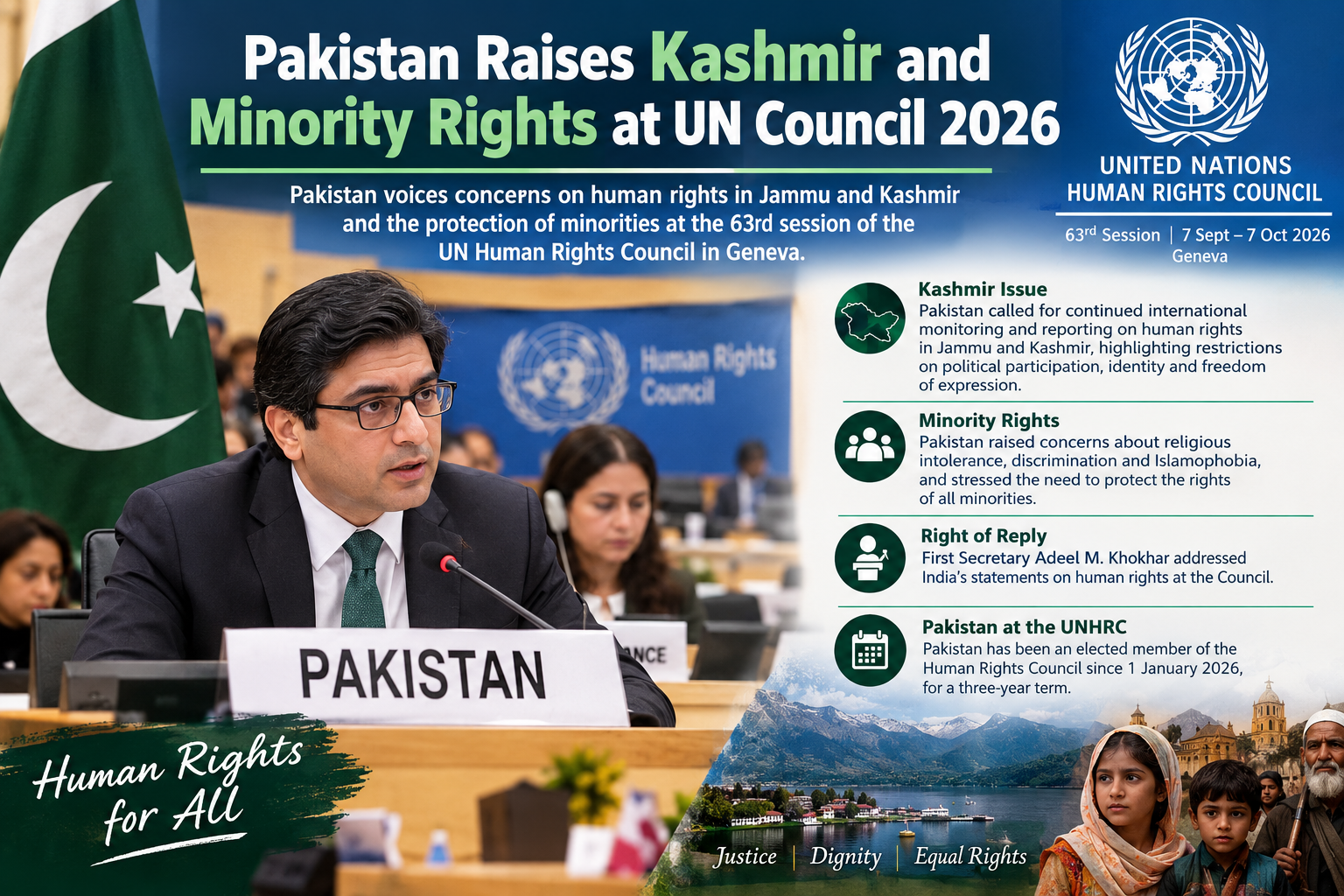
Pakistan raised strong concerns about human rights, Kashmir and minority rights in India during the 63rd session of the United Nations Human Rights Council in Geneva on October 1, 2026. Pakistan exercised its right of reply after India's remarks and criticised what it described as India's response to questions about human rights in Indian-administered Jammu and Kashmir and the treatment of minorities.
Pakistan's representative, First Secretary Adeel M. Khokhar, said that India had avoided addressing the questions raised about human rights and had instead referred to Pakistan. He presented Pakistan's position on the Kashmir dispute and highlighted issues including alleged arbitrary detention, extrajudicial killings, torture, restrictions on political activity and changes to laws affecting the territory.
India has a different position on Jammu and Kashmir and has repeatedly rejected Pakistan's claims concerning the territory. Indian representatives have also raised allegations concerning Pakistan-administered areas of Kashmir and the treatment of minorities in Pakistan. The latest exchange therefore forms part of the continuing diplomatic disagreement between the two countries at international forums.
Pakistan Raises Kashmir at the UN Human Rights Council
The latest Pakistani statement was delivered at the 63rd session of the United Nations Human Rights Council in Geneva.
Speaking on behalf of Pakistan, First Secretary Adeel M. Khokhar addressed India's position and said that New Delhi had followed what Pakistan described as a recurring pattern of changing the subject when confronted with questions about human rights.
Pakistan's representative argued that the Kashmir dispute remains unresolved and referred to United Nations Security Council resolutions concerning Jammu and Kashmir.
Pakistan maintains that the people of Jammu and Kashmir should be allowed to exercise their right to self-determination through a UN-supported process.
The Pakistani position has been repeatedly presented at the United Nations and other international forums.
On September 17, Pakistan's Foreign Office also called upon the international community and the UN Security Council to translate its resolutions on Jammu and Kashmir into meaningful action toward a peaceful settlement.
Pakistan's Position on the Kashmir Dispute
Pakistan's representative told the Human Rights Council that Jammu and Kashmir remains a disputed territory.
According to Pakistan, repeated statements regarding the status of Kashmir cannot change the nature of the dispute.
Pakistan has consistently maintained that the final status of Jammu and Kashmir should be determined in accordance with relevant United Nations Security Council resolutions.
The Pakistani government has also criticised India's August 5, 2019 constitutional and administrative changes concerning Indian-administered Jammu and Kashmir.
Islamabad argues that those measures changed the political and legal environment of the territory without resolving the underlying dispute.
The issue remains one of the central disagreements between Pakistan and India.
India, meanwhile, maintains that Jammu and Kashmir is an integral part of India and rejects Pakistan's characterisation of the territory as one requiring an internationally organised plebiscite.
This difference in position continues to appear in statements made by both countries at international organisations.
Pakistan Refers to Human Rights Concerns
During the UN Human Rights Council session, Pakistan raised several allegations regarding the human rights situation in Indian-administered Jammu and Kashmir.
Adeel M. Khokhar referred to allegations of extrajudicial killings, arbitrary detention and torture.
He also referred to international reports concerning the human rights situation.
Pakistan has previously used reports by the United Nations Office of the High Commissioner for Human Rights in its statements concerning Kashmir.
The Pakistani delegation also raised concerns about laws that it said provide security forces with protection from prosecution.
One law specifically mentioned was the Armed Forces Special Powers Act, which applies in certain parts of India.
Pakistan argued that such legal protections can create difficulties in holding security personnel accountable.
These statements represent Pakistan's diplomatic position and allegations made at the Human Rights Council.
The Indian government has disputed Pakistan's descriptions of the situation and has repeatedly accused Pakistan of supporting terrorism and failing to protect minorities.
The Armed Forces Special Powers Act
One of the issues highlighted by Pakistan was the Armed Forces Special Powers Act, commonly known as AFSPA.
The legislation provides special powers to security forces in areas officially designated as disturbed.
Pakistan's representative argued that the law can make accountability difficult because prosecution of personnel for certain actions requires government approval.
Pakistan used this point to support its argument that security forces should be subject to effective accountability mechanisms.
India has defended security legislation in the context of maintaining security in areas affected by militancy.
The debate surrounding such laws is therefore connected to the wider discussion about security, counterinsurgency and human rights.
Changes After August 5, 2019
Pakistan also raised concerns about measures implemented in Indian-administered Jammu and Kashmir after August 5, 2019.
India's government revoked Jammu and Kashmir's special constitutional status and reorganised the region into two federally administered union territories.
Pakistan strongly opposed those measures.
The Pakistani delegation at the Human Rights Council referred to changes involving domicile certificates, land laws and constituency delimitation.
According to Pakistan, these measures could affect the demographic and political structure of the territory.
Pakistan also claimed that large numbers of domicile certificates had been issued to people who were not originally from Kashmir.
India has rejected Pakistan's characterisation of its constitutional and administrative changes.
New Delhi maintains that the measures are internal constitutional matters and that the region's development and governance should be addressed within India's constitutional framework.
The difference between these positions remains central to the diplomatic dispute.
Pakistan Raises Minority Rights in India
The Pakistani representative also discussed the situation of religious minorities in India.
He referred to concerns involving Muslims and mentioned several developments involving places of worship.
Among the examples mentioned was the Babri Masjid dispute.
Pakistan's representative also referred to other incidents involving Muslim religious sites.
These references were used to argue that minority rights should be discussed when India raises human rights issues concerning Pakistan.
Pakistan also mentioned India's Citizenship Amendment Act of 2019.
The law provides a pathway to Indian citizenship for members of certain religious communities from Afghanistan, Bangladesh and Pakistan who meet specified conditions.
Muslims are not included among the religious groups listed under the law.
Critics of the legislation have argued that its religious criteria are discriminatory, while India's government has defended the law as a humanitarian measure for persecuted minority communities from neighbouring countries.
The issue has therefore remained controversial in international discussions about India's human rights record.
India's Response and Position
India has rejected Pakistan's allegations concerning Kashmir and minority rights.
Indian representatives have also used international forums to raise their own concerns about Pakistan.
During an earlier UN Human Rights Council exchange, India accused Pakistan of illegally occupying parts of Jammu and Kashmir and called for Islamabad to vacate those areas.
Indian representatives have also discussed the displacement of Kashmiri Pandits and attributed their displacement to violence by militants whom India says were supported by Pakistan.
These claims are rejected by Pakistan.
The competing statements demonstrate that the UN Human Rights Council has become another forum where the two countries present their opposing positions on Kashmir, terrorism and human rights.
The Broader Pakistan-India Diplomatic Dispute
The latest Human Rights Council exchange cannot be separated from the broader relationship between Pakistan and India.
The two nuclear-armed neighbours have experienced several conflicts and periods of serious tension since independence in 1947.
The Kashmir dispute has remained one of the most important unresolved issues between them.
Both governments regularly accuse the other of violating international obligations or supporting activities that threaten regional security.
Diplomatic disagreements are frequently discussed at the United Nations General Assembly, Human Rights Council and Security Council.
Pakistan regularly raises Kashmir at these forums.
India responds by focusing on terrorism and Pakistan's alleged support for militant groups.
Pakistan rejects those allegations and has itself accused India of supporting or conducting destabilising activities in Pakistan.
The latest exchange follows the same broader pattern.
Pakistan's Reference to UN Security Council Resolutions
A major part of Pakistan's position is based on United Nations Security Council resolutions concerning Jammu and Kashmir.
Pakistan argues that these resolutions provide an international framework for addressing the dispute.
The Pakistani government has repeatedly called for implementation of relevant resolutions.
Earlier in September 2026, Pakistan's Permanent Representative to the UN, Asim Iftikhar Ahmad, made a similar appeal during a Pakistan-hosted Arria Formula meeting of the Security Council.
He called on the international community and the Security Council to translate existing resolutions into meaningful action toward a peaceful settlement.
Pakistan also highlighted the potential risks of leaving the dispute unresolved between two nuclear-armed states.
OIC Also Discusses Kashmir
The Kashmir issue was also discussed recently by the Organisation of Islamic Cooperation's Contact Group on Jammu and Kashmir.
The group met on the sidelines of the 81st session of the United Nations General Assembly in New York on September 22, 2026.
A joint communiqué reaffirmed support for a peaceful settlement of the Jammu and Kashmir dispute in accordance with relevant UN Security Council resolutions.
The OIC statement also called for improvement in the human rights situation in Indian-administered Jammu and Kashmir and referred to political prisoners, political parties and restrictive laws.
Pakistan has traditionally used the OIC as another diplomatic forum for raising the Kashmir issue.
The OIC's involvement gives Pakistan an additional international platform for presenting its position on Kashmir.
Why the UN Human Rights Council Matters
The United Nations Human Rights Council is an international forum where member states discuss human rights situations around the world.
Countries can use the council to raise concerns about other states.
However, statements made during council sessions do not automatically constitute independent findings.
A government representative may present allegations, evidence or political positions from their country's perspective.
Independent investigations, UN reports and other credible evidence are important for assessing individual allegations.
This distinction is particularly important when Pakistan and India make competing claims about each other.
The October 1 exchange involved strong statements from Pakistan, while India's position differs significantly.
For readers, it is useful to distinguish between what Pakistan alleged, what India has said in response and what has been independently established by international bodies.
The Importance of Human Rights Discussions
Human rights discussions at international organisations are important because they provide governments with a platform to raise concerns about detention, freedom of expression, religious freedom, political participation and other rights.
Kashmir has repeatedly appeared in such discussions because of the long-running territorial dispute and security situation.
Pakistan's latest intervention focused particularly on alleged violations in Indian-administered Jammu and Kashmir and the treatment of minorities in India.
India has similarly raised human rights and security concerns about Pakistan.
The competing arguments show the broader difficulty of discussing human rights issues when they are connected to unresolved territorial disputes.
Kashmir and Regional Stability
The Kashmir dispute has implications beyond the territory itself.
Pakistan and India are both nuclear-armed states, and periods of heightened tension between them have raised international concerns about escalation.
Pakistan has argued that resolving Kashmir peacefully is important for regional stability.
The Pakistani representative at the Human Rights Council connected the unresolved dispute with wider international concerns.
Pakistan's earlier UN statements have also emphasised that continued tension between nuclear-armed states creates risks for South Asian security.
India, on the other hand, has emphasised terrorism and security threats when discussing Pakistan.
Both sides therefore connect Kashmir to broader questions of regional security, although they describe the causes and responsibilities differently.
The 2019 Constitutional Changes
The August 2019 changes remain an important part of Pakistan's criticism of India's Kashmir policy.
In 2019, India's government removed the special constitutional status previously associated with Jammu and Kashmir and reorganised the former state into two union territories.
Pakistan opposed the decision and downgraded diplomatic relations with India.
Islamabad has continued to describe the measures as unilateral.
India has maintained that the constitutional changes were a matter of its domestic governance and that they were intended to improve administration and development.
The disagreement over the 2019 measures continues to appear in diplomatic statements.
Domicile and Land Laws
Another issue raised by Pakistan was the introduction and expansion of domicile rules in Indian-administered Jammu and Kashmir.
Pakistan argues that issuing domicile certificates to people from outside the region could change the demographic composition of the territory.
Pakistan's representative used this argument to say that the Kashmir dispute cannot be resolved through demographic or administrative changes.
India has defended its policies as part of its effort to integrate the region more fully into the country's legal and administrative system.
The disagreement therefore involves both constitutional questions and the future political and demographic character of the territory.
Minority Rights as a Diplomatic Issue
Minority rights have increasingly become part of the wider Pakistan-India diplomatic debate.
Pakistan raises concerns about Muslims and other minorities in India.
India raises concerns about minorities in Pakistan, including Hindus, Christians and other communities.
Both countries use international forums to present their respective positions.
This means that discussions about minority rights can sometimes become connected to broader political disputes.
Independent documentation by human rights organisations and international bodies can therefore be important in evaluating individual claims.
The Human Rights Council provides a forum for such concerns but does not eliminate the underlying disagreement between the two governments.
Pakistan's Message to the International Community
Pakistan's message during the October 1 session was that the international community should continue paying attention to Kashmir and human rights.
The Pakistani representative argued that denial of the dispute does not resolve it.
Pakistan also called attention to what it described as restrictions on political activity and human rights in Indian-administered Jammu and Kashmir.
The government has consistently argued that a lasting solution should involve the people of Kashmir and follow the relevant UN framework.
This position has remained a central part of Pakistan's foreign policy.
India's Broader Counter-Argument
India's broader counter-position is that Pakistan should address concerns related to terrorism and violence before raising human rights issues concerning India.
Indian representatives have repeatedly accused Pakistan of supporting militant organisations.
Pakistan denies sponsoring terrorism and has itself accused India of involvement in terrorism and destabilisation inside Pakistan.
These mutual allegations have been a recurring feature of Pakistan-India diplomacy.
The latest UN exchange should therefore be viewed as part of an ongoing diplomatic contest rather than as an isolated statement.
International Attention on Kashmir
Kashmir continues to attract international attention because of its disputed political status and the history of conflict between India and Pakistan.
Governments in different countries have generally encouraged dialogue and peaceful resolution.
The United Nations remains an important forum for discussing the dispute, although the two sides disagree about how relevant UN resolutions should be applied today.
Pakistan continues to call for international involvement.
India maintains that Kashmir is an internal matter and rejects international mediation.
This fundamental disagreement remains unresolved.
What Happens Next?
The immediate diplomatic significance of the October 1 statement will depend on how Pakistan and India respond in future international forums.
The issue could appear again at the United Nations General Assembly, Human Rights Council or other international meetings.
Pakistan is likely to continue raising Kashmir and minority rights as part of its diplomatic agenda.
India is expected to continue presenting its own position on Kashmir and raising concerns about terrorism and security.
The continuation of these exchanges reflects the absence of a comprehensive political settlement between the two countries.
Importance for Pakistani Readers
For Pakistani readers, the latest development is important because it shows how Pakistan is presenting the Kashmir issue internationally.
The Human Rights Council provides an opportunity for Pakistan to put its concerns on the official record.
It also shows how Pakistan and India use international institutions to challenge each other's narratives.
However, readers should remember that statements made by government representatives are official positions rather than automatically independent determinations of fact.
Understanding this distinction helps readers follow international news more accurately.
Conclusion
Pakistan's October 1, 2026 intervention at the United Nations Human Rights Council brought Kashmir and minority rights in India back into international diplomatic discussion.
Pakistan's representative, First Secretary Adeel M. Khokhar, criticised India for what Pakistan described as avoiding questions about human rights in Indian-administered Jammu and Kashmir and the treatment of minorities.
Pakistan raised allegations involving detention, extrajudicial killings, torture, security laws, political restrictions and demographic changes following India's 2019 constitutional measures.
Pakistan also referred to minority rights in India and raised concerns about the Citizenship Amendment Act and incidents involving Muslim places of worship.
India rejects Pakistan's characterisation of Kashmir and has its own longstanding position on the territory. Indian representatives have also raised allegations concerning Pakistan-administered Kashmir, terrorism and minority rights in Pakistan.
The latest exchange demonstrates that Kashmir remains a major point of disagreement between the two countries. Pakistan continues to refer to relevant UN Security Council resolutions and calls for a peaceful settlement, while India maintains that Jammu and Kashmir is an integral part of India.
Because the dispute involves competing political and historical claims, readers should distinguish clearly between official allegations, opposing government positions and independently verified findings.
The October 1 Human Rights Council session nevertheless demonstrates that Kashmir and human rights remain important subjects in Pakistan's international diplomacy.
ghts India
FAQs
1. What did Pakistan raise at the UN Human Rights Council?
Pakistan raised concerns about human rights in Indian-administered Jammu and Kashmir and the treatment of minorities in India.
2. Who represented Pakistan at the session?
Pakistan was represented by First Secretary Adeel M. Khokhar during the right-of-reply statement.
3. What is Pakistan's position on Kashmir?
Pakistan maintains that Jammu and Kashmir is a disputed territory and calls for a peaceful settlement in accordance with relevant UN Security Council resolutions.
4. What is India's position on Kashmir?
India maintains that Jammu and Kashmir is an integral part of India and rejects Pakistan's position on the territory.
5. Why is the Kashmir issue important?
The dispute has remained a major source of tension between Pakistan and India and has wider implications for regional security and diplomatic relations.