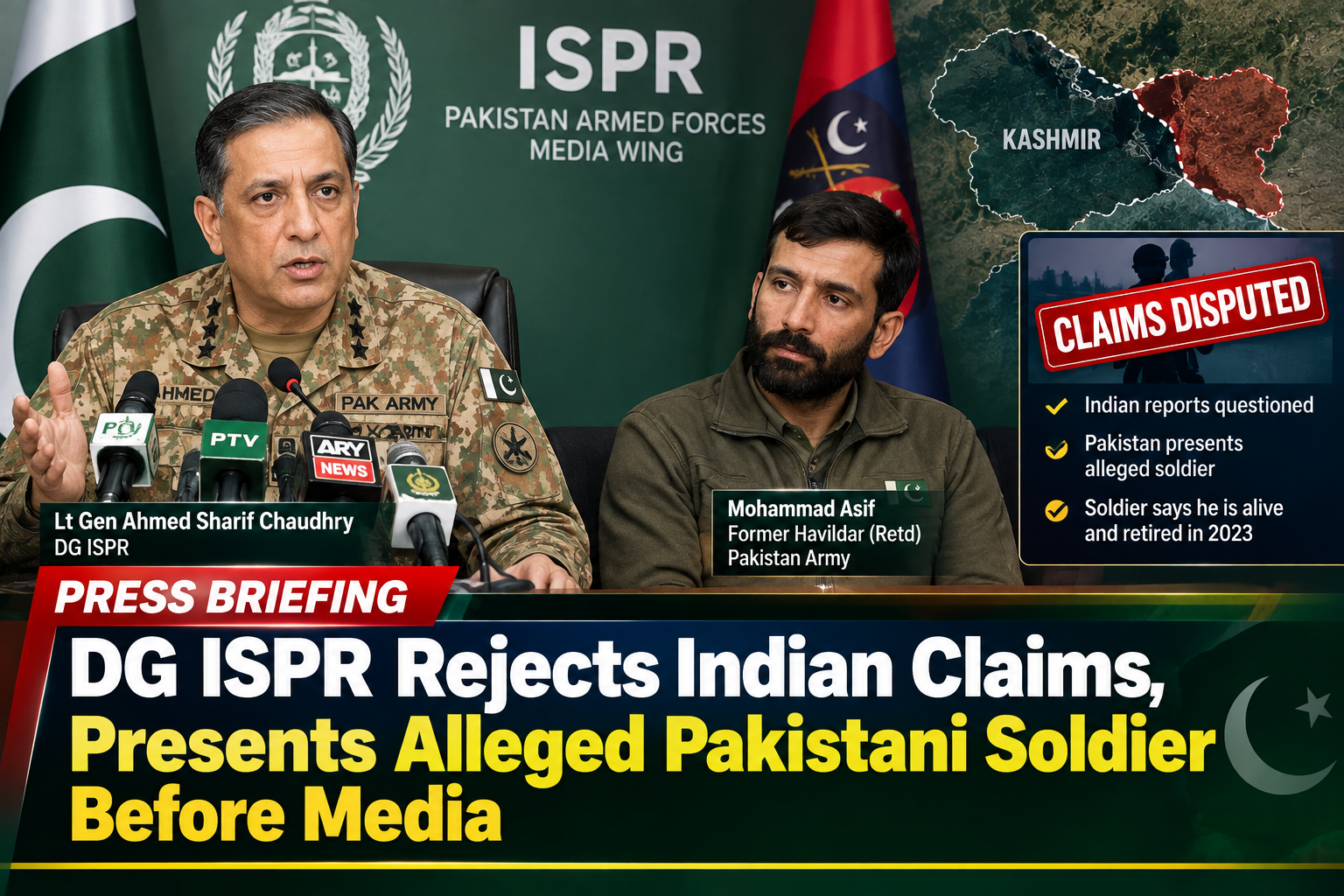
Pakistan’s military spokesperson, Director General Inter-Services Public Relations (ISPR) Lieutenant General Ahmed Sharif Chaudhry, addressed the media on October 1, 2026, regarding an Indian military and media claim about the alleged killing of a Pakistani former army soldier in Indian-administered Jammu and Kashmir. During the press conference, Pakistan presented the individual identified in the Indian reports as Mohammad Asif, who appeared alive before the media in Pakistan.
The development attracted significant attention because Indian media reports had claimed that a man named Mohammad Asif, also referred to as Hashim Moosa, had been killed during an operation in the Korag area of Yousmarg in Indian-administered Jammu and Kashmir. Those reports described him as a former Pakistan Army soldier and alleged that he was associated with the banned militant organisation Lashkar-e-Taiba.
Pakistan rejected these claims. During the briefing, the DG ISPR presented a timeline of the events and questioned the information released by Indian authorities and media outlets. The individual himself also spoke to journalists and said that he was alive and had been at his home when reports about his alleged death began circulating.
Background of the October 1 Development
The issue began with reports emerging from Indian-administered Jammu and Kashmir on September 29 and 30, 2026. According to the timeline presented by the Pakistani military spokesperson, an Indian military corps announced on social media that security forces had launched a joint operation in the Korag area of Yousmarg.
The operation was described as involving Indian Army personnel, Jammu and Kashmir Police and the Central Reserve Police Force. Indian authorities later announced that a suspected Lashkar-e-Taiba militant had been killed.
Indian media subsequently identified the alleged deceased person as Mohammad Asif, also known as Hashim Moosa. Reports attributed various details to unnamed sources and described the individual as a former Pakistan Army soldier.
The reports then circulated widely through Indian media platforms.
Pakistan's military authorities challenged the identification and the claim that the individual had been killed. On October 1, DG ISPR held a press conference in which Mohammad Asif himself appeared before journalists.
The appearance became the central point of Pakistan's response because it directly contradicted the reports that a person with the same identity had been killed during the operation.
Mohammad Asif Appears Before Pakistani Media
During the press conference, Lieutenant General Ahmed Sharif Chaudhry introduced Mohammad Asif to journalists.
Asif told the media that he had learned about reports claiming that he had been killed in Kashmir. He said that friends contacted him after seeing the reports and that he reassured them that he was alive and at home.
According to Asif's account, he also received calls from Indian numbers after the reports appeared. He said that some callers asked about his personal information, identity and whereabouts.
Asif stated that he became aware of the reports through social media and Indian news coverage. He said he was surprised because, according to his account, he was sitting at his home while reports were circulating that he had been killed.
He subsequently contacted his former unit regarding the situation. He said that he was advised to block suspicious calls and that ISPR officials later contacted him.
The appearance of Asif before the Pakistani media therefore became an important element of Pakistan's response to the Indian reports.
His Reported Military Background
During the briefing, Mohammad Asif also discussed his previous service in the Pakistan Army.
According to his statement, he joined the Pakistan Army in 2000. He said that he joined the Special Services Group, commonly known as SSG, in 2005 and served for approximately 18 years.
He said he retired from military service in 2023.
After retirement, Asif stated that he worked for a private security company for around three years. He also said that he had been living with his family in Rawalpindi for the previous few months.
These details were important because Indian reports had also described the alleged deceased person as a former Pakistani soldier. Indian media reports had published a profile containing information about a person named Mohammad Asif and connected him with previous military service.
Pakistan's presentation of Asif before the media was intended to challenge the identification made in those reports.
What Indian Reports Had Claimed
Indian media reports had described Mohammad Asif, also called Hashim Moosa, as an individual allegedly linked to Lashkar-e-Taiba.
Reports also claimed that he had previously served in the Pakistan Army and had been associated with the Special Services Group.
According to reports cited by Pakistani media, Indian sources attributed a number of militant activities to the person they identified as Asif. These included attacks in different parts of Indian-administered Jammu and Kashmir.
Some Indian reports also connected the alleged individual to the April 2025 Pahalgam attack.
These allegations were presented in Indian reporting as information from official or security sources. Pakistan rejected the allegations and disputed the identification.
The Pakistani military's October 1 press conference therefore focused not only on the reported death but also on the broader sequence through which the identity and alleged background of the person were presented.
Pakistan's Timeline of Events
During his briefing, the DG ISPR presented what he described as a five-point timeline.
According to the Pakistani account, the sequence started on September 29, when India's Chinar Corps announced a joint operation in the Korag and Yousmarg area.
The following day, Indian authorities reportedly announced that a suspected Lashkar-e-Taiba militant had been killed.
Indian media then published additional reports identifying the alleged militant as Mohammad Asif.
The reports included detailed information about his supposed military history and alleged involvement in different attacks.
Pakistan subsequently brought Mohammad Asif before the media on October 1.
This timeline was used by the Pakistani military spokesperson to question how the reports had developed and how the individual had been identified.
The central issue raised by Pakistan was that the man being described in the reports as dead was appearing alive before journalists in Pakistan.
DG ISPR's Response
During the press conference, Lieutenant General Ahmed Sharif Chaudhry strongly rejected the Indian account.
He described the incident as what Pakistan considers another false-flag operation. This characterization represents the Pakistani military's position and should be distinguished from independently established facts.
The Pakistani military spokesperson questioned the sequence of official statements and media reports.
He also displayed reports from Indian news organisations during the briefing and discussed how the story had been circulated.
The purpose of the briefing, according to Pakistani officials, was to present Pakistan's response and challenge what they described as false information regarding the identity and alleged death of a former Pakistani soldier.
The Indian side's original allegations and Pakistan's subsequent rejection represent competing claims. The appearance of Mohammad Asif in Pakistan was presented by Islamabad as evidence contradicting the reported identification.
Why the Incident Has Become Significant
The incident is significant because information involving Pakistan, India and Kashmir can have wider political and security implications.
Pakistan and India have a long history of tensions, particularly over Jammu and Kashmir. Security incidents and allegations involving militant groups frequently become part of wider political and diplomatic disputes between the two countries.
In such circumstances, reports about military operations can spread quickly through television, social media and online news platforms.
The October 1 incident demonstrates how questions about identity can become central to a security-related news story.
In this case, Indian reports identified a person as having been killed, while Pakistan subsequently presented a person with the same name and background before journalists.
This development has made verification particularly important.
For readers, the most important distinction is between what was reported, what officials claimed, and what can independently be established.
The Importance of Verification in Breaking News
Breaking news often develops in stages.
An initial report may contain information from security sources. Later reports may add names, photographs or background information. Governments or military institutions may then issue statements challenging those reports.
This process makes independent verification especially important.
The October 1 incident is a useful example of why readers should examine the source of information before accepting a major security-related claim as established fact.
In this case, Indian reports made allegations about Mohammad Asif, while Pakistan's military presented him alive.
The Pakistani side's presentation therefore directly challenged the earlier reports.
For journalists and news readers, the incident highlights the importance of checking official statements, examining multiple sources and distinguishing confirmed information from allegations.
Role of Social Media
Social media played an important role in the development of the story.
According to Mohammad Asif's account, he became aware of the reports through social media. Indian military and media accounts had published information about the alleged operation and the identity of the person they said had been killed.
Once the reports began circulating, they were discussed by users and news organisations.
The speed of social media can be useful during breaking news because information becomes available quickly. However, speed can also create difficulties when information has not yet been independently verified.
A claim about a person's death, arrest or involvement in a security incident can have serious consequences. If incorrect information is published, it can spread to thousands or millions of people before corrections reach the same audience.
The October 1 controversy therefore also highlights the need for responsible social media reporting.
Pakistan's Official Position
Pakistan's official position is that the reports concerning Mohammad Asif were false and that the incident was part of what Pakistani authorities described as an attempt to create a narrative linking Pakistan to militant activity in Kashmir.
The DG ISPR rejected the Indian account during the October 1 briefing.
Mohammad Asif also rejected the allegations and said that he was alive and present before the media.
Pakistan has previously rejected Indian allegations regarding Pakistani involvement in militant incidents in Kashmir and has called for evidence and neutral investigations in disputes surrounding major incidents.
The latest development continues this pattern of disagreement between the two countries over security-related claims.
India's Claims and the Need for Independent Verification
The original Indian reports attributed the identification and allegations to official or security sources.
They described the alleged deceased individual as Mohammad Asif, also known as Hashim Moosa, and connected him with Lashkar-e-Taiba.
Indian reports also alleged that the person had previously served in the Pakistan Army and had been involved in militant activities.
However, Pakistan has rejected these allegations and presented a person identified as Mohammad Asif before the media.
Because the two accounts conflict, readers should distinguish between allegations made by officials or media outlets and facts that can be independently verified.
The appearance of Asif is a significant development because it directly challenges the claim that a person with that identity had been killed.
Further independent verification would be required to establish how the conflicting identities and reports emerged.
Connection With Previous Pakistan-India Tensions
The latest incident comes against a background of continued tensions between Pakistan and India.
The two countries have experienced repeated disputes involving Kashmir, terrorism allegations, border security and military activity.
The Pahalgam attack in April 2025 became one of the major developments in the relationship between the two countries.
India linked the attack to Pakistan, while Pakistan rejected responsibility and called for a neutral investigation.
Tensions later escalated into military confrontation in May 2025 before a ceasefire was reached.
Because of that history, new claims involving alleged militants, Pakistani military personnel or operations in Kashmir can quickly become politically sensitive.
The October 2026 incident should therefore be understood within this broader regional context.
The Importance of Responsible Reporting
Responsible reporting is particularly important when stories involve national security.
A report about an alleged militant can affect not only the individual concerned but also diplomatic relations between countries.
News organisations have a responsibility to distinguish verified facts from claims made by unnamed sources.
Readers also have an important role. Before sharing a dramatic claim, they can check whether multiple credible sources are reporting the same information and whether the relevant authorities have issued statements.
The October 1 development shows how quickly a security story can change.
An individual who was described in some reports as killed subsequently appeared alive before the media in Pakistan.
This does not automatically establish every aspect of either side's narrative, but it does demonstrate why verification is essential.
Possible Diplomatic Impact
The incident could contribute to further disagreement between Pakistan and India because it concerns allegations involving the Pakistani military and militant activity in Kashmir.
Pakistan's military has publicly rejected the Indian claims.
India's earlier reports presented a different account.
Such disputes can influence public discussion and diplomatic messaging between the two countries.
However, the long-term diplomatic consequences will depend on subsequent statements, investigations and developments.
At present, the clearest development is Pakistan's public presentation of Mohammad Asif and its rejection of the reports concerning his alleged death.
Why the Story Matters to Pakistan
For Pakistan, the incident is important because it involves claims about a Pakistani citizen and former military personnel.
The Pakistani military used the press conference to challenge what it described as misleading information.
The appearance of Mohammad Asif before journalists provided Pakistan with an opportunity to present its own account directly rather than responding only through written statements.
The issue also matters because information surrounding Pakistan's military and security environment can influence public understanding of regional events.
When competing narratives emerge, official briefings and independent reporting become important sources for establishing what is known and what remains disputed.
Public Reaction and Media Attention
The story received considerable attention in Pakistani media after the DG ISPR press conference.
The unusual nature of the development — a person being reported as killed and then appearing alive before journalists — naturally generated discussion.
Pakistani news organisations reported on the press conference and the statements made by the DG ISPR and Mohammad Asif.
The incident was also discussed in the context of previous disagreements between Pakistan and India over security-related allegations.
However, social media reactions should not be treated as independently verified evidence.
Public reaction can show how widely a story is being discussed, but it cannot by itself establish the accuracy of the underlying claims.
Lessons for News Readers
There are several lessons that readers can take from the incident.
First, breaking news should be treated carefully until important details are independently confirmed.
Second, information attributed to unnamed sources should be identified as such.
Third, official statements from one side of a dispute should not automatically be treated as independently established facts.
Fourth, when two countries provide conflicting accounts, readers should look for evidence from credible and independent sources.
Finally, readers should avoid sharing unverified information about individuals, particularly when the information concerns alleged terrorism, military activity or death.
Pakistan's Broader Information Environment
Pakistan has increasingly relied on official briefings, digital platforms and traditional media to respond to security-related developments.
The ISPR frequently communicates military positions through press conferences, statements and social media.
Such communications can be important during rapidly developing situations because they provide the Pakistani government's and military's position directly.
At the same time, independent journalism remains important for checking and contextualising official claims.
The October 1 incident illustrates the interaction between official statements, international media reports and social media.
What Happened on October 1?
In simple terms, the sequence can be summarised as follows:
Indian authorities announced a security operation in the Korag area of Yousmarg.
Indian reports said a suspected Lashkar-e-Taiba militant had been killed.
Media reports identified the alleged militant as Mohammad Asif, also known as Hashim Moosa.
Reports described him as a former Pakistani soldier.
Pakistan rejected the claim.
DG ISPR Lieutenant General Ahmed Sharif Chaudhry held a press conference on October 1.
Mohammad Asif appeared before the Pakistani media.
Asif said he was alive and had been at home when reports of his alleged death circulated.
Pakistan described the incident as an alleged false-flag operation.
The conflicting accounts have raised questions about the identification and verification of the original report.
Conclusion
The October 1, 2026 press conference by DG ISPR Lieutenant General Ahmed Sharif Chaudhry has become a major Pakistan-related news development because it directly challenged Indian reports about the alleged killing of a former Pakistani Army soldier.
Indian media reports had identified a person named Mohammad Asif, also known as Hashim Moosa, as an alleged militant killed during an operation in Indian-administered Jammu and Kashmir. Pakistan rejected the reports and presented Mohammad Asif before the media in Pakistan.
Asif stated that he was alive and had learned about the reports through social media and contacts from friends. He also discussed his former military service and his life after retirement.
The incident highlights the importance of verification in breaking security news. Pakistan and India have a long history of disputes involving Kashmir, terrorism allegations and military developments, making accurate reporting particularly important.
For readers, the key point is that competing claims should be clearly separated from independently verified facts. Pakistan has rejected the Indian account, while the appearance of Mohammad Asif has directly challenged the reported claim that a person with that identity had been killed.
Further independent information may clarify how the conflicting reports originated and whether the person identified in the Indian reports was in fact the same individual presented by Pakistan. Until then, the development remains an example of how quickly narratives can change in a sensitive regional security environment.
FAQs
1. Who is Mohammad Asif?
Mohammad Asif is a former Pakistan Army soldier who appeared before Pakistani media during the October 1, 2026 DG ISPR press conference.
2. What did Indian reports claim about Mohammad Asif?
Indian reports claimed that a person identified as Mohammad Asif, also known as Hashim Moosa, had been killed during an operation in Indian-administered Jammu and Kashmir.
3. What was Pakistan's response?
Pakistan rejected the claim and presented Mohammad Asif alive before journalists in Pakistan.
4. What did Mohammad Asif say?
Asif said that he was alive and had been at home when reports about his alleged death began circulating.
5. Why is the incident important?
The incident is significant because it involves conflicting claims about a person's identity and alleged death in the wider context of Pakistan-India security tensions.