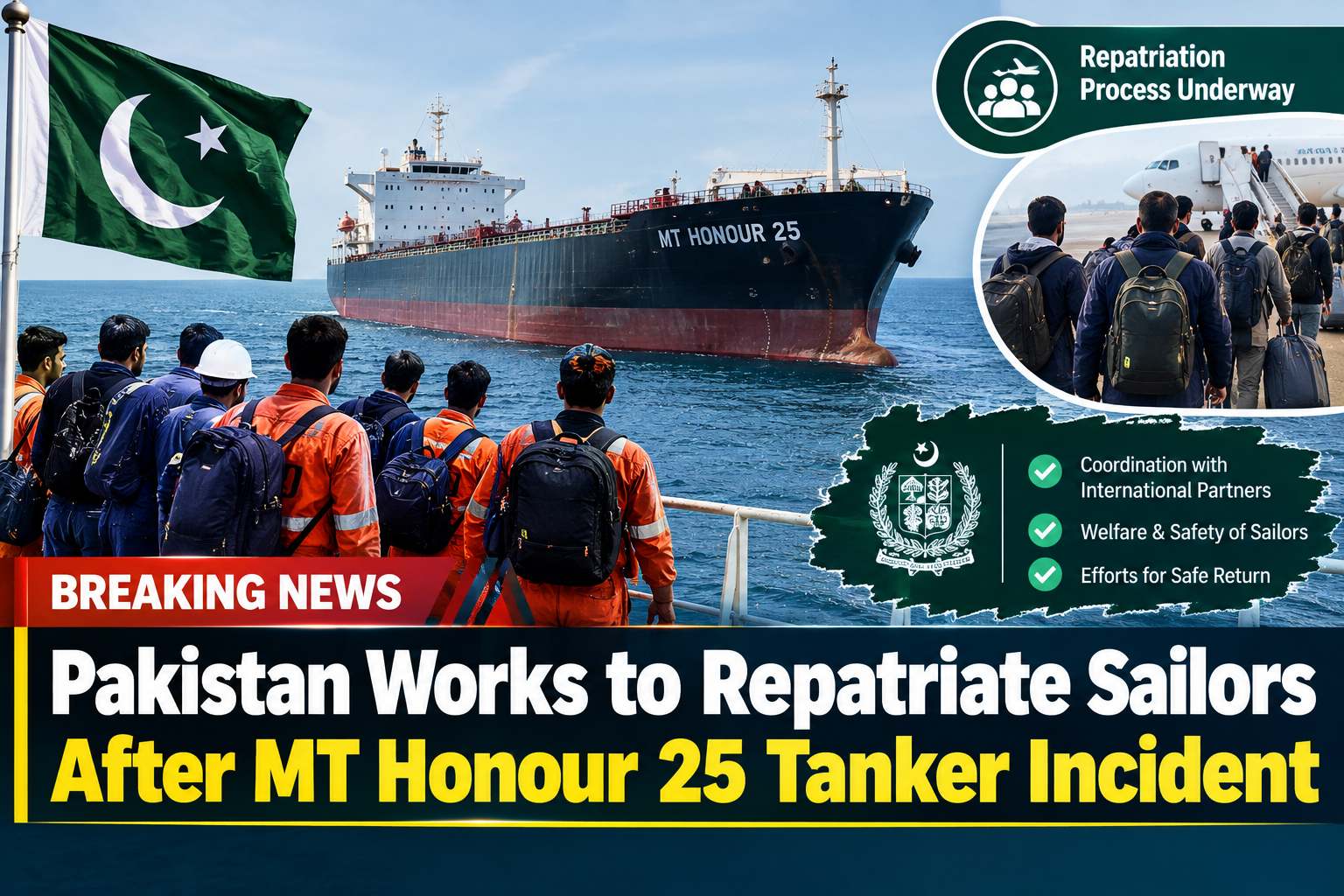
Pakistan is working to bring home the bodies of three Pakistani sailors who were killed during an operation to recover the hijacked oil tanker MT Honour 25 off the coast of Somalia. The Foreign Office has also said that it is facilitating medical treatment and the safe return of surviving Pakistani crew members.
The incident has attracted significant attention in Pakistan because the tanker had been held by pirates for more than five months and had 10 Pakistani nationals among its crew. The vessel was eventually recovered by security forces in Somalia's semi-autonomous Puntland region, but the operation resulted in the deaths of five crew members, including three Pakistanis. Four other crew members were injured.
The Pakistani government has expressed condolences to the families of the deceased and said that every possible effort is being made to facilitate the transportation of the bodies to Pakistan. Pakistani officials are also assisting the surviving crew members and coordinating with Somali authorities and other stakeholders.
The incident has once again highlighted the dangers faced by seafarers working on international commercial vessels and the importance of diplomatic coordination when Pakistani nationals become involved in maritime emergencies abroad.
What Happened to MT Honour 25?
MT Honour 25 is a Palau-flagged oil tanker that was hijacked off the coast of Somalia on April 21, 2026.
The vessel was reportedly carrying 18,500 barrels of oil and had a multinational crew. Ten of the crew members were Pakistani nationals. The tanker was seized approximately 30 nautical miles off the coast of Puntland.
The crew remained in captivity for several months.
During that period, families of the Pakistani sailors repeatedly appealed for their safe release. Pakistani authorities also remained engaged with Somali officials and other stakeholders in efforts to secure the release of the hostages.
The situation eventually changed when Puntland security forces launched an operation to recover the vessel.
Recovery Operation in Puntland
Puntland authorities said their maritime and ground forces conducted an operation near Dharin-Bar in the Bandar Beyla district.
The operation resulted in the recovery of MT Honour 25 and the detention of suspected pirates.
However, according to Puntland authorities and Pakistani officials, five crew members had been killed before the vessel was fully secured.
The deceased included three Pakistani nationals, one Indian national and one Myanmar national. Four other crew members were injured, including three Pakistanis.
The tanker was subsequently brought under the control of Puntland authorities.
The incident ended the months-long captivity of the surviving crew members, but it also created a new challenge for governments and families: arranging medical treatment and bringing the surviving sailors and the bodies of those who died back to their respective countries.
Three Pakistani Sailors Killed
Pakistan's Foreign Office identified the three Pakistani nationals who died as:
Rafi Ullah Khan
Syed Kashif Umer
Mahmood Ahmed Ansari
The Foreign Office expressed condolences to their families and confirmed that Pakistan was working to facilitate the transportation of their mortal remains.
The deaths have deeply affected the families of the sailors, who had spent months hoping that their loved ones would return home safely.
The families are now waiting for the bodies to be brought back to Pakistan so that funeral and burial arrangements can be completed.
Pakistani Survivors Injured
Four crew members were injured during the recovery operation.
Three of the injured are Pakistani nationals.
According to the Foreign Office, the injured crew members were receiving medical treatment after being brought ashore.
The surviving crew members were initially taken to Bandar Beyla, where medical assistance was provided. By October 1, the Foreign Office said the Pakistani survivors had been moved to Garowe, the capital of Puntland, where injured crew members were receiving treatment.
Pakistan's diplomatic representatives are assisting them during this process.
Pakistan's Repatriation Efforts
The Foreign Office has said that Pakistan is making every possible effort to ensure the safe return of the surviving Pakistani sailors and to facilitate transportation of the bodies of those who died.
A team from Pakistan's Embassy in Djibouti was sent toward Bandar Beyla to assist the Pakistani nationals.
The Pakistani government has also remained in contact with Somali authorities and other relevant stakeholders.
These diplomatic contacts are important because the incident occurred outside Pakistan, meaning that arrangements for medical treatment, documentation, transportation and repatriation require coordination between different authorities.
The Foreign Office said it was working through its mission and relevant authorities to address these issues.
Why Repatriation Is Important
Bringing the deceased sailors home is an important concern for their families.
When Pakistani nationals die overseas, repatriating their remains can involve several administrative steps. These can include identification, documentation, coordination with local authorities, transportation arrangements and communication with the family.
In this case, the situation is more complicated because the deaths occurred during a maritime security operation in Puntland.
Pakistan therefore needs to coordinate with Somali authorities and other stakeholders before the bodies can be transported.
The Foreign Office has made the repatriation of the remains one of its stated priorities.
Families Waiting for Their Loved Ones
The families of the sailors have experienced a prolonged period of uncertainty.
The crew had already spent months in captivity after the tanker was hijacked in April.
During that period, families hoped for their relatives' safe release.
The recovery of the tanker brought an end to the captivity, but news of the deaths of three Pakistani sailors created another painful situation for their families.
Reports from Karachi showed relatives mourning the sailors and requesting that the bodies be returned to Pakistan.
The families are also concerned about the injured survivors and want them to receive proper medical care before returning home.
Pakistan's Earlier Diplomatic Efforts
Pakistan had been working diplomatically for months to secure the release of the Pakistani sailors.
In June, Pakistan's Foreign Office said that the government had launched sustained diplomatic and humanitarian efforts after the hijacking.
The Ministry of Foreign Affairs said its Embassy in Djibouti had engaged with Somali authorities and other stakeholders. Pakistan's Deputy Prime Minister and Foreign Minister also communicated with Somalia's foreign minister.
An inter-ministerial meeting was also convened to coordinate the government's response.
According to the Foreign Office, Pakistan had decided to pursue negotiations and humanitarian channels as the primary means of securing the release of the seafarers.
The government also explored assistance from friendly countries and other relevant interlocutors.
These efforts continued while the crew remained in captivity.
Long Period of Captivity
The tanker was hijacked in April and remained under pirate control for more than five months.
Long periods of captivity can create serious physical and psychological challenges for crew members.
The Pakistani sailors reportedly remained aboard the vessel during the period of captivity.
Their families had limited information about their condition, which added to the uncertainty.
The eventual recovery of the vessel provided an opportunity to release the surviving crew members, but the operation also resulted in casualties.
International Crew
MT Honour 25 had a multinational crew.
Along with Pakistani nationals, the crew included sailors from other countries.
The five people killed during the incident included three Pakistanis, one Indian national and one Myanmar national, according to reports from Puntland authorities and international sources.
The multinational nature of the crew means that several countries are dealing with the consequences of the incident.
Each country must arrange assistance and repatriation for its own nationals while cooperating with Somali authorities.
Role of the Pakistani Embassy
Pakistan's diplomatic mission in Djibouti has been involved in assisting the Pakistani sailors.
The Foreign Office said that an embassy team was proceeding to Bandar Beyla to provide assistance.
The diplomatic team can help coordinate communication with Somali authorities, medical facilities and the Pakistani government.
Embassy officials can also assist with documentation and arrangements needed for the eventual return of the sailors.
This illustrates the importance of diplomatic missions when Pakistani nationals face emergencies abroad.
Medical Care for Injured Sailors
The immediate priority for the injured survivors is medical treatment.
The Foreign Office said the injured Pakistani sailors were receiving medical care.
The latest update indicated that the injured survivors had been moved to Garowe, where treatment was continuing.
Before their return to Pakistan, doctors may need to assess their injuries and determine whether they are medically fit to travel.
The government can then coordinate transportation arrangements.
The health and safety of the surviving sailors remain important parts of the repatriation process.
The Maritime Security Challenge
The MT Honour 25 incident also highlights the continuing maritime security challenge around parts of Somalia.
Somali piracy had declined significantly from its peak years, but incidents involving commercial vessels have continued to raise concerns.
The hijacking of an oil tanker carrying an international crew demonstrates that maritime security remains an important issue in the region.
International shipping depends on safe sea routes because vessels transport fuel, food, raw materials and other goods between countries.
When ships are hijacked, the consequences can extend beyond the vessel itself.
Crew members can be held hostage, families can face uncertainty, and shipping companies can suffer financial losses.
Importance of Seafarers
Seafarers play a vital role in international trade.
Large quantities of goods and energy products move around the world by sea.
Pakistan has a significant number of citizens working in the maritime sector, both on national and international vessels.
Pakistani sailors can work as officers, engineers, deck crew and other maritime professionals.
Their work can require long periods away from home and exposure to difficult conditions.
The MT Honour 25 incident demonstrates some of the risks that can arise in international waters.
Safety of Pakistani Mariners
The incident may also renew discussion about the safety of Pakistani sailors working on international vessels.
Maritime workers depend on shipping companies, flag states, coastal states and international organizations for safety and security.
Ships operating in regions with a history of piracy may require additional security planning.
Governments can also maintain communication channels so that emergency assistance can be coordinated quickly when an incident occurs.
Pakistan's earlier engagement with the International Maritime Organization regarding the Pakistani sailors demonstrates the importance of international maritime institutions.
Role of the International Maritime Organization
The International Maritime Organization, commonly known as IMO, is a United Nations agency responsible for matters related to international shipping.
Pakistan previously sought the IMO's intervention regarding the Pakistani seafarers aboard MT Honour 25.
International organizations can help countries coordinate maritime safety and security efforts.
They can also provide frameworks for cooperation between governments, shipping companies and other stakeholders.
Although the specific circumstances of the MT Honour 25 recovery operation involved Somali authorities, the wider issue of maritime security requires international cooperation.
Communication During a Maritime Crisis
The incident has also raised questions about communication between different authorities.
Families of the Pakistani sailors had sought information during the months of captivity.
After the recovery operation, there were reports of difficulties involving communication and coordination.
Dawn reported that rights groups had attributed some difficulties to a communication gap related to Pakistan's position toward Puntland, which Islamabad does not recognize as an independent state.
Such claims are attributed to the groups and should not be treated as an established official finding.
Nevertheless, the incident demonstrates how complicated communication can become when a crisis occurs in a region involving different local, national and international authorities.
Why Puntland Matters
Puntland is a semi-autonomous region in northeastern Somalia.
The MT Honour 25 was recovered by Puntland security forces.
Puntland authorities have their own maritime security structures and operate in the coastal areas where the tanker was recovered.
Pakistan maintains diplomatic relations with Somalia at the federal level, while its embassy in Djibouti has been involved in assistance to the Pakistani nationals.
This creates a complex environment for practical coordination during emergencies.
Return of the Deceased
The return of the bodies of the three Pakistani sailors is one of the key tasks currently facing the Pakistani government.
The Foreign Office has explicitly stated that it is facilitating transportation of the mortal remains.
The process requires coordination with local authorities and arrangements for international transportation.
Once the bodies arrive in Pakistan, they can be handed over to the families for burial.
The families have publicly expressed their desire to receive their loved ones' remains.
Return of Surviving Sailors
The surviving Pakistani crew members also need to be brought home once their medical condition allows.
The Foreign Office has said it is working to ensure their safe return.
Because three Pakistani survivors were injured, medical considerations are important.
Their doctors will determine the appropriate treatment and whether they can travel safely.
Government officials and diplomatic representatives can then coordinate their transportation to Pakistan.
No Fixed Repatriation Date Yet
As of the latest reports on October 1, 2026, no specific public timetable had been announced for the return of the deceased sailors or the surviving crew members.
The government has said that efforts are continuing.
This means families are still waiting for concrete arrangements.
The timing may depend on medical assessments, documentation, local coordination and transportation arrangements.
Impact on Pakistani Families
The incident has had a strong personal impact on the families of the sailors.
The families had already experienced months of uncertainty while their relatives were held captive.
The death of three sailors has now transformed that uncertainty into grief.
For the families of injured sailors, there is also concern about recovery and safe return.
Government assistance with repatriation and medical care can therefore be important in helping families during this difficult period.
Lessons From the Incident
The MT Honour 25 incident provides several broader lessons for maritime safety.
First, international cooperation remains essential in areas where piracy is a risk.
Second, governments need reliable communication channels for emergencies involving their nationals.
Third, shipping companies and vessel operators need to maintain appropriate security measures when operating in high-risk maritime areas.
Fourth, families of seafarers need timely and accurate information during crises.
Finally, when an incident ends, the safe return of surviving crew members and the repatriation of deceased sailors should remain important priorities.
Pakistan's Continued Coordination
The Foreign Office has emphasized that Pakistan remains in contact with Somali authorities and other relevant stakeholders.
This coordination is expected to continue until the injured sailors receive appropriate medical care and the repatriation process is completed.
Pakistan's Embassy in Djibouti is also assisting the nationals.
The government's approach involves diplomatic communication rather than dealing with the incident through a single institution.
The Ministry of Foreign Affairs, diplomatic mission and relevant Pakistani authorities all have roles to play.
Broader Maritime Cooperation
The incident may also encourage further discussion about international maritime cooperation.
Piracy is not limited by national borders.
A vessel may be registered in one country, owned by a company from another country and staffed by workers from several different nations.
When such a vessel is hijacked, several governments can become involved.
Effective cooperation among maritime authorities, governments and international organizations is therefore essential.
Conclusion
Pakistan is working to bring home the bodies of three Pakistani sailors killed during the recovery of the hijacked MT Honour 25 oil tanker off the coast of Somalia.
The three deceased Pakistanis were identified by the Foreign Office as Rafi Ullah Khan, Syed Kashif Umer and Mahmood Ahmed Ansari. Four other crew members were injured, including three Pakistani nationals, while the surviving crew members were brought safely ashore.
The tanker had been hijacked on April 21 and had 10 Pakistani nationals among its crew. It was eventually recovered by Puntland security forces after months of captivity. According to authorities, five crew members were killed during the incident and several others were injured.
Pakistan's Foreign Office has said that every possible effort is being made to provide medical care to the injured, facilitate transportation of the deceased sailors' remains and ensure the safe return of the surviving Pakistani crew members. A Pakistani Embassy team in Djibouti has also been sent to assist the nationals.
The incident highlights the risks faced by seafarers working on international vessels and the importance of diplomatic and maritime cooperation. It also demonstrates how a single maritime security incident can affect families, governments and international shipping networks.
For the families of the deceased sailors, the immediate priority is to bring their loved ones home and complete their burial arrangements. For the injured survivors, receiving proper medical care and returning safely to Pakistan remain the key concerns.
The Pakistani government has said that coordination with Somali authorities and other stakeholders will continue until these arrangements are completed.
FAQs
1. What happened to MT Honour 25?
The oil tanker was hijacked off Somalia in April 2026 and was later recovered by Puntland security forces.
2. How many Pakistani sailors died?
Three Pakistani nationals were among the five crew members killed during the incident.
3. Who were the Pakistani sailors who died?
The Foreign Office identified them as Rafi Ullah Khan, Syed Kashif Umer and Mahmood Ahmed Ansari.
4. How many Pakistani sailors were injured?
Three Pakistani crew members were injured and were receiving medical treatment after being brought ashore.
5. What is Pakistan doing now?
Pakistan is coordinating with Somali authorities to facilitate medical care, repatriate the deceased sailors' remains and safely return the surviving Pakistani crew members.