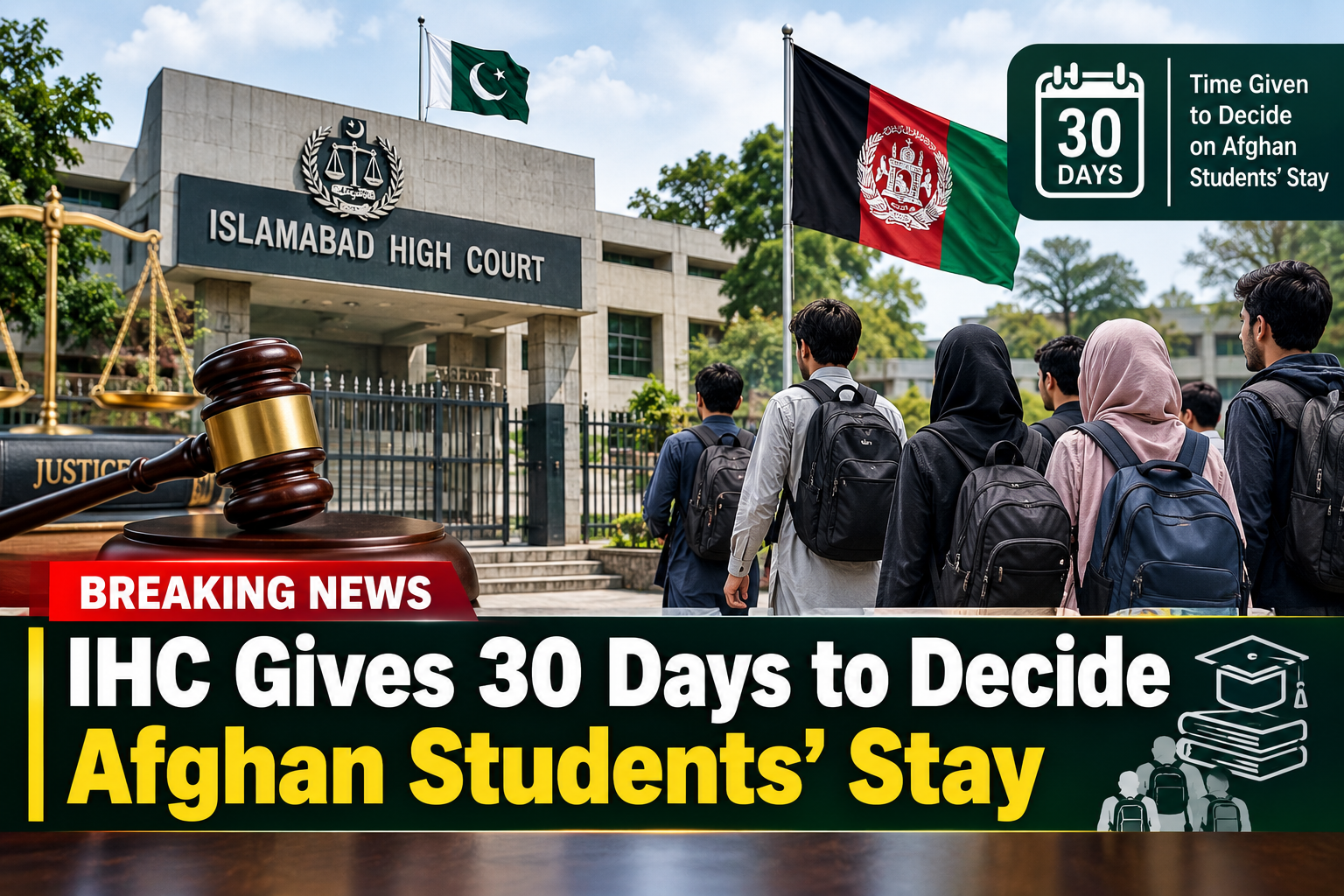
The Islamabad High Court (IHC) has directed Pakistan’s Ministry of Interior to decide within 30 days on the stay-related applications of 87 Afghan students currently studying in Pakistan. The development came after the students approached the court seeking extensions of their study visas and relief from difficulties arising from delays in processing their applications.
The court disposed of the constitutional petition and converted it into a representation to be considered by the Ministry of Interior. The order was issued by Justice Khadim Hussain Soomro on a petition filed by Atta Reda and other Afghan students against the Federation of Pakistan and other respondents.
The students are enrolled in undergraduate and postgraduate programmes at recognised Pakistani educational institutions. They had asked authorities to decide their pending visa-extension applications and sought protection from harassment, arrest or deportation while their applications remained unresolved.
The court did not itself grant the requested visa extensions. Instead, it directed the relevant government ministry to consider the matter and make a decision within the specified 30-day period.
Who Are the Students Involved?
The petition concerns 87 Afghan nationals who are pursuing higher education in Pakistan.
According to the court report, the students are enrolled in undergraduate and postgraduate degree programmes at recognised Pakistani educational institutions. Their studies include programmes at institutions that accept international students.
The students had previously submitted applications seeking extensions of their study visas. However, according to their petition, the applications had remained pending.
The delay created uncertainty for students whose academic programmes were continuing in Pakistan.
For international students, immigration documentation is an important part of their ability to remain legally in the country. A delay in renewing a visa can create difficulties even when a student is already enrolled at a recognised institution.
The petition therefore focused on obtaining a decision from the authorities rather than simply asking the court to issue new visas itself.
What Did the Islamabad High Court Decide?
The IHC did not exercise its writ jurisdiction to directly decide the students' immigration status.
Instead, the court converted the petition into a representation and directed that the case, along with its annexures, be sent to the Ministry of Interior.
The ministry has been directed to decide the matter within 30 days.
This means the next formal decision will come from the relevant government authority.
The court's order provides a specific time frame for consideration, giving the students a defined period within which they expect the ministry to respond.
The case was subsequently disposed of on those terms.
Why Did the Students Approach the Court?
The students approached the IHC because their visa-extension applications had remained pending.
According to their legal petition, the uncertainty had caused several problems.
The students said the situation had affected their academic activities and created difficulties with banking facilities and hostel arrangements. They also sought protection from possible harassment, arrest or deportation because their previous visas had expired while their applications were still awaiting a decision.
For students pursuing multi-year undergraduate or postgraduate degrees, interruptions in legal status can create significant practical complications.
Academic institutions may require valid documentation, while students may also need valid immigration documents for accommodation, banking and other administrative matters.
The petition therefore sought a clear decision from the authorities.
Afghan Embassy Also Raised the Issue
The students' case also referred to communication from the Afghanistan embassy.
According to the court report, the embassy had formally requested Pakistani authorities to expedite processing of the students' visa applications.
Diplomatic communication can play an important role when foreign nationals face immigration or documentation issues in another country.
In this case, the embassy's communication was presented as part of the background to the students' request for timely consideration.
The court ultimately sent the matter to the Ministry of Interior, which is responsible for deciding the students' stay-related applications.
Earlier Court Hearing
The matter had already been considered by the Islamabad High Court on September 15.
At that stage, the court questioned whether the petition was maintainable because the petitioners were Afghan nationals.
The question was related to the scope of the court's constitutional writ jurisdiction.
The students' counsel subsequently offered an alternative approach. Rather than asking the court to directly decide the visa issue, the counsel stated that the students would be satisfied if the petition were converted into a representation and forwarded to the Ministry of Interior for a decision within a specific period.
This approach ultimately became the basis of the court's order.
Government's Position
The government's representative opposed the petition.
Assistant Advocate General Sarfraz Rauf argued that the matter concerned government policy and immigration decisions rather than an issue that should be determined through the court's writ jurisdiction.
The government's position also referred to the current tensions between Pakistan and Afghanistan.
The court did not make a determination on the broader political dispute through this case. Instead, it focused on the procedural question of how the students' pending applications should be handled.
The matter was therefore transferred to the Ministry of Interior for consideration.
What Does the 30-Day Direction Mean?
The 30-day direction is important because it establishes a time frame for the government to decide the students' case.
Without a specified period, administrative applications can sometimes remain pending for extended periods.
The IHC order requires the Ministry of Interior to consider the representation and make a decision within 30 days.
This does not automatically mean that all 87 students have been granted visa extensions.
It also does not mean that the court has ordered the government to approve every application.
Instead, the ministry has been directed to examine the matter and decide the students' stay-related requests.
Visa Extension and Legal Status
A study visa allows a foreign student to remain in a country under the conditions established by the relevant immigration authorities.
Students who wish to continue their education beyond the validity period of their existing visas normally need to follow the applicable extension process.
When an application remains pending, the legal position can become complicated, particularly if the previous visa expires before a final decision is issued.
The Afghan students' petition specifically highlighted this difficulty.
They sought protection while their applications remained in administrative limbo.
The court's decision gives the relevant ministry a defined period in which to resolve the issue.
Impact on Education
The visa issue has a direct connection with education.
Students pursuing undergraduate and postgraduate degrees generally spend several years completing their programmes.
A disruption in immigration status can interfere with attendance, examinations, research, accommodation and other academic activities.
For postgraduate students, the impact can be particularly significant because programmes may involve laboratory work, research projects, clinical training or other activities that cannot easily be transferred to another country.
The students therefore argued that the delay was causing academic disruption.
The ministry's decision will determine how their individual cases proceed.
Banking and Other Practical Problems
The students also told the court that the visa delay had affected access to banking facilities.
International students may need valid identification and immigration documentation for financial services.
If documentation expires or remains unresolved, students can encounter administrative difficulties.
Hostel arrangements were another issue cited by the petitioners.
These practical concerns show that immigration status can affect daily life beyond the classroom.
A student may be academically enrolled but still face difficulties if their legal documentation is not updated.
Pakistan as an Education Destination
Pakistan has historically hosted students from Afghanistan in universities and other educational institutions.
Students from neighbouring countries may choose Pakistan because of geographical proximity, cultural connections and access to educational programmes.
Universities in Pakistan offer undergraduate, postgraduate and professional programmes in areas such as medicine, engineering, computer science, business, social sciences and other fields.
The presence of Afghan students therefore forms part of the broader relationship between the two neighbouring countries.
The current visa issue is taking place against a more difficult security and diplomatic environment, but the court case itself concerns the administrative status of the 87 students.
Broader Context of Afghan Students in Pakistan
The latest case is not the only recent legal development involving Afghan students.
In September 2026, the Islamabad High Court allowed an Afghan doctor to continue postgraduate medical training after temporarily suspending an expulsion order. The case involved a doctor already enrolled in postgraduate training in Pakistan.
The Foreign Office also stated in September that Afghan students who have valid visas and are registered in valid courses would be allowed to continue and complete their education. It noted that there could be individual cases involving students who had completed their studies and were seeking further education or specialisation without completing the required registration.
These developments show that different categories of Afghan students may have different immigration and educational circumstances.
Valid Visa and Registered Students
Pakistan's Foreign Office said in a September 17 briefing that Afghan students who are in Pakistan on valid visas and registered in valid courses would be allowed to continue and complete their education.
The spokesperson also said students on scholarships and those already registered would continue their studies.
This policy statement is relevant to the wider discussion about Afghan students.
However, the 87 students in the IHC case approached the court because their visa-extension applications were reportedly still pending.
The ministry's upcoming decision will therefore be important for determining their individual status.
Difference Between Policy and Individual Cases
A general government policy and an individual immigration application are not always identical.
A government may establish a broad policy for a category of foreign students, while individual applications still require administrative processing.
Each student's circumstances can include different factors such as:
Current visa status
University enrolment
Programme duration
Scholarship status
Previous immigration records
Academic progress
Documentation
Pending applications
The ministry will therefore need to consider the relevant details before making decisions.
Role of the Ministry of Interior
The Ministry of Interior plays an important role in Pakistan's internal security and immigration-related administration.
The ministry will now receive the petition and its annexures as a representation.
The court has instructed the ministry to decide the matter within 30 days.
The ministry's decision could determine whether the students receive extensions, face additional documentation requirements or receive other instructions regarding their stay.
The precise outcome will depend on the applicable rules and the facts of each case.
Importance of Administrative Decisions
The case highlights the importance of timely administrative decisions.
When people submit official applications, particularly applications connected with immigration and education, long periods without a decision can create uncertainty.
For foreign students, this uncertainty can affect academic planning.
They may need to decide whether they can remain in their accommodation, continue attending classes, travel, access banking services or complete examinations.
A defined decision period can therefore provide greater clarity.
Role of the Courts
The IHC's decision also illustrates the relationship between courts and government departments.
The students initially approached the court seeking relief.
The court considered whether the petition could be heard under its constitutional jurisdiction.
Rather than directly deciding the immigration policy question, the court converted the matter into a representation and sent it to the responsible ministry.
This approach leaves the policy decision with the executive authority while still providing a formal mechanism for the students' applications to be considered.
Why the Case Matters for International Students
The case may also be relevant to other foreign students in Pakistan who face delays in visa processing.
International students depend on clear immigration procedures to complete their education.
A predictable system can help universities and students plan academic programmes more effectively.
Universities may also need to coordinate with government authorities when students' documentation is pending.
The 30-day direction therefore provides a specific administrative timeline for the students involved in this particular case.
Academic Continuity
Academic continuity is especially important for students enrolled in longer degree programmes.
A student who has already completed several semesters may face substantial difficulties if an immigration problem interrupts their studies.
Transferring to another university or country is not always straightforward.
Credits may not transfer automatically, scholarships may have restrictions, and students may lose time if they have to restart parts of a programme.
For this reason, the students told the court that the pending visa issue had already affected their academic activities.
Possible Next Steps for the Students
The immediate next step is for the Ministry of Interior to consider the representation.
The ministry has 30 days to make a decision under the IHC order.
During this period, the relevant government authorities can examine the students' applications and supporting documents.
The students may also need to provide any additional information requested by the authorities.
The final decision will determine how each student's immigration status is handled.
Need for Clear Communication
Clear communication between government departments, educational institutions and students can reduce confusion.
Students need to know whether their applications are complete, whether additional documents are required and what happens while an application remains pending.
Universities can also help international students understand administrative requirements.
In cases involving large groups of students, clear communication can be particularly important because individual students may have different circumstances.
Security and Immigration Concerns
The case comes at a time when Pakistan-Afghanistan relations are under significant security pressure.
Pakistan has raised concerns about militant activity originating from or operating from Afghan territory, while Afghanistan has rejected Islamabad's accusations.
These broader tensions have affected many areas of bilateral relations.
However, immigration decisions involving students still require consideration under the applicable legal and administrative framework.
The government's security concerns and individual students' educational circumstances can therefore both form part of the wider context.
Importance of Following the Legal Process
The IHC's decision does not establish that every Afghan student in Pakistan has an automatic right to remain in the country.
Instead, it directs the Ministry of Interior to decide the particular representation involving the 87 petitioners.
The distinction is important.
Immigration status is governed by Pakistan's laws and government policies, and individual cases can depend on documentation and eligibility.
The ministry's forthcoming decision will therefore be significant for the students involved.
Future of the 87 Students
The next 30 days will be important for the 87 Afghan students.
They are waiting for the Ministry of Interior to determine their stay-related applications.
The students' main concern is continuity of their education and resolution of their visa status.
The government, meanwhile, will need to examine the applications within the framework of immigration policy and national security considerations.
The court has now established a clear deadline for that administrative process.
Conclusion
The Islamabad High Court has directed the Ministry of Interior to decide within 30 days on the stay-related matter involving 87 Afghan students studying at recognised Pakistani educational institutions.
The students had approached the court seeking extensions of their study visas and protection from difficulties linked to expired visas while their applications remained pending. They said the delay had affected their education, banking access and hostel arrangements.
The court did not directly grant the students visa extensions. Instead, Justice Khadim Hussain Soomro converted the petition into a representation and directed that it be transmitted to the Ministry of Interior for a decision within 30 days.
The case comes amid broader tensions between Pakistan and Afghanistan, making immigration issues involving Afghan nationals particularly significant. At the same time, Pakistan's Foreign Office has stated that Afghan students with valid visas who are registered in valid courses can continue their education.
The upcoming decision by the Ministry of Interior will provide greater clarity for the 87 students and determine how their individual applications are handled.
For the students, the central issue remains educational continuity and legal certainty. For the government, the matter involves applying immigration rules while considering broader policy and security circumstances.
The IHC's 30-day direction has now placed the responsibility for resolving the matter with the Ministry of Interior.
FAQs
1. How many Afghan students are involved in the IHC case?
The petition involves 87 Afghan students studying in recognised Pakistani educational institutions.
2. What did the students request?
They sought extensions of their study visas and relief from problems caused by delays in processing their applications.
3. What did the Islamabad High Court decide?
The court converted their petition into a representation and sent it to the Ministry of Interior.
4. How long does the Ministry of Interior have to decide the matter?
The ministry has been directed to make a decision within 30 days.
5. Did the IHC directly extend the students’ visas?
No. The court did not directly grant visa extensions; it directed the relevant ministry to consider and decide the matter.