Introduction
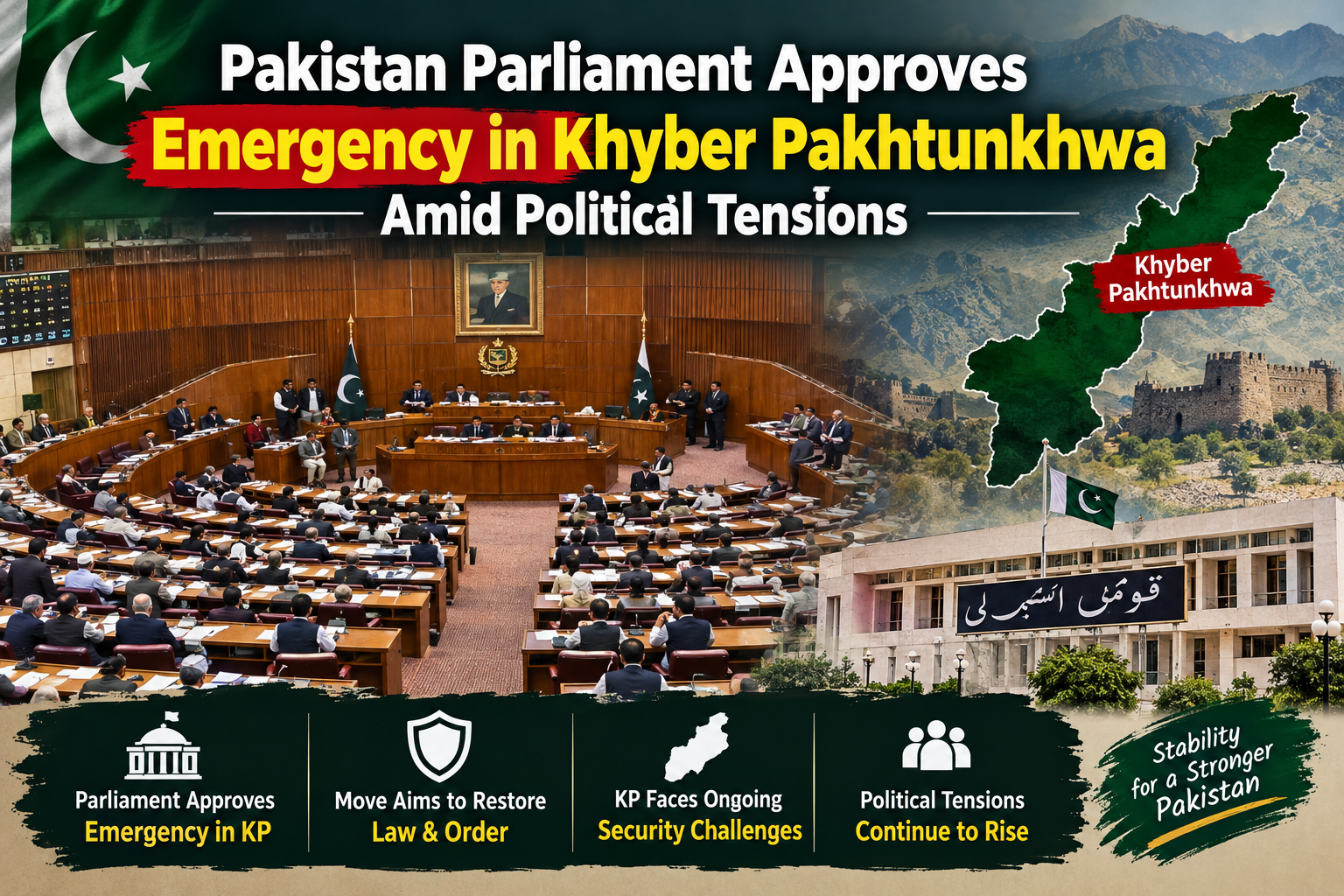
Pakistan's political landscape has entered another significant phase following Parliament's approval of emergency measures and Governor's Rule in Khyber Pakhtunkhwa (KP). On October 15, 2026, a joint sitting of Parliament approved the presidential proclamations concerning the province, intensifying an already difficult political situation between the federal government and the Pakistan Tehreek-e-Insaf (PTI).
The federal government has defended the measures by pointing to security challenges and concerns about counterterrorism efforts in the province. Opposition representatives, meanwhile, have challenged the decision, raising questions about provincial autonomy, constitutional principles and the political consequences of transferring authority away from the elected provincial administration.
The development has attracted considerable attention because Khyber Pakhtunkhwa has an important position in Pakistan's political and security landscape. The province faces complex challenges related to terrorism, border security, public administration and economic development. Decisions affecting its government can therefore have consequences extending beyond provincial politics.
The approval of emergency measures has also renewed discussions about the relationship between the federal government and provincial administrations under Pakistan's constitutional system. Supporters of the decision argue that extraordinary circumstances require stronger coordination, while opponents warn that such powers must be exercised carefully and within constitutional limits.
Understanding this development requires examining the parliamentary proceedings, the government's stated reasons, the opposition's response and the potential implications for ordinary citizens.
What Happened in Parliament on October 15?
On Thursday, October 15, 2026, a joint sitting of Pakistan's Parliament took place at Parliament House in Islamabad. Lawmakers considered presidential proclamations issued on October 11 concerning emergency measures and Governor's Rule in Khyber Pakhtunkhwa.
According to reports published that day, the joint sitting approved the relevant resolutions by majority vote despite opposition objections. The proceedings followed earlier approvals by the National Assembly and Senate on October 14. <Cite refs={["turn272233search1","turn272233search11"]}/>
The resolutions were presented by Minister for Parliamentary Affairs Tariq Fazal Chaudhary. Law Minister Azam Nazeer Tarar addressed the constitutional requirements associated with the proclamations and defended the government's position.
The parliamentary session also included objections from opposition members who carried placards and expressed disagreement with the measures. The debate reflected the wider political divide over how the province should be governed during a period of security concerns and political uncertainty.
The proceedings were significant because parliamentary approval forms part of the constitutional process associated with such extraordinary measures.
The decision does not eliminate the political controversy surrounding the issue. Instead, it moves the debate into another phase in which constitutional interpretation, implementation, public administration and possible legal challenges are likely to remain important topics.
Understanding Emergency Measures in Khyber Pakhtunkhwa
Emergency provisions are extraordinary constitutional arrangements intended for exceptional circumstances. They are different from the routine administrative powers exercised by elected governments.
Pakistan's Constitution contains provisions addressing emergencies and situations in which the ordinary functioning of provincial government may be affected. Articles 232 and 234 concern distinct constitutional mechanisms, and each has its own requirements and implications.
The emergency proclamation concerning Khyber Pakhtunkhwa was issued under Article 232, while the proclamation relating to Governor's Rule was associated with Article 234. The government subsequently sought parliamentary approval for the measures. <Cite refs={["turn272233search2","turn272233search8"]}/>
These distinctions matter because constitutional powers are not interchangeable. The legal basis, approval process, duration and consequences of each measure must be assessed according to the relevant constitutional provisions.
The involvement of Parliament provides an institutional process for considering the government's decision. However, parliamentary approval does not mean that every political or legal question surrounding the decision has disappeared.
Citizens, legal professionals and political representatives may continue examining whether the measures are justified, properly implemented and consistent with constitutional safeguards.
For this reason, the development should be understood not only as a political event but also as an important constitutional issue.
Why Did the Federal Government Take This Step?
The federal government has justified the measures by citing security concerns and what it describes as insufficient commitment by the provincial administration to counterterrorism efforts.
During parliamentary proceedings, government representatives argued that the situation in Khyber Pakhtunkhwa required stronger coordination and a more effective response to militant violence.
Law Minister Azam Nazeer Tarar referred to reported terrorist incidents in the province and argued that security concerns had become serious enough to require extraordinary action. The government has maintained that the measures are intended to improve the response to terrorism and address internal disturbances. <Cite refs={["turn272233search5","turn272233search6"]}/>
Security remains a major issue for Khyber Pakhtunkhwa because of its geography, proximity to Afghanistan and history of militant violence. Residents in affected districts can face serious difficulties when attacks disrupt daily activities, transportation, businesses and public services.
Police officers, security personnel and civilians have also faced risks associated with militant attacks in the region.
The federal government's stated position is that a more coordinated administrative approach is necessary to address these challenges.
However, the justification for extraordinary powers remains a matter of public and political debate. The government must explain its claims through evidence and demonstrate how the measures will improve security while respecting the law.
A successful security strategy requires effective institutions, reliable intelligence, public cooperation and appropriate resources. Administrative changes alone cannot resolve every challenge facing the province.
Opposition Rejects the Decision
Opposition representatives have strongly criticised the imposition of emergency measures and Governor's Rule in Khyber Pakhtunkhwa.
PTI representatives argue that the decision undermines the authority of an elected provincial government and raises concerns about provincial autonomy. Opposition members have also questioned the government's justification and rejected allegations that the provincial administration was deliberately failing to address terrorism.
During parliamentary proceedings, opposition members protested against the measures. Some carried placards expressing their opposition, while reports described objections and disruptions during the debate. <Cite refs={["turn272233search1","turn272233search10"]}/>
From the opposition's perspective, security challenges should be addressed through constitutional cooperation between federal and provincial institutions rather than measures that remove or suspend the authority of elected representatives.
The opposition has also raised concerns about the broader political environment, including the treatment of PTI leaders and the consequences of the government's actions for democratic competition.
These objections form part of a larger disagreement between the federal government and PTI, which has continued amid political tensions and disputes over the future of Imran Khan.
The opposition's claims and the federal government's allegations require careful consideration. Public understanding depends on distinguishing verified developments from political statements and examining the available evidence.
Political disagreement is a normal part of democratic governance. However, it becomes particularly consequential when disputes involve constitutional powers, public security and the authority of elected institutions.
The Political Importance of Khyber Pakhtunkhwa
Khyber Pakhtunkhwa holds a distinctive position in Pakistan's political system. The province has a diverse population, important urban centres, rural communities and districts that face different economic and security challenges.
It also occupies a strategically important geographical position along Pakistan's northwestern border.
The province's political importance has increased during periods of national disagreement because provincial leadership can influence debates about federalism, security policy and the relationship between Islamabad and provincial administrations.
PTI has maintained a substantial political presence in the province, making the suspension of its provincial administration especially significant for the party and its supporters.
For the federal government, the situation presents the challenge of demonstrating that extraordinary measures can improve security and public administration without creating further political instability.
For opposition parties, the development raises questions about whether the province's political leadership and voters' representation are being respected.
The outcome may influence future debates about the balance of authority between Pakistan's federal and provincial governments.
Nevertheless, the immediate concerns of residents should remain central. People in the province need effective public services, safe communities, employment opportunities and confidence that institutions are working in their interests.
Constitutional Questions and Provincial Autonomy
One of the most important issues arising from the decision concerns provincial autonomy.
Pakistan operates under a federal constitutional structure in which powers and responsibilities are distributed between federal and provincial institutions. Provincial governments have important responsibilities in areas such as education, health, local administration and other matters assigned to them by law.
Emergency provisions create mechanisms for exceptional circumstances, but their use raises important questions about constitutional safeguards and institutional accountability.
The central legal questions include whether the applicable constitutional conditions have been met, whether the required approvals were obtained and whether the measures remain within the limits established by the Constitution.
Articles 232 and 234 address different circumstances, so the legal consequences of the proclamations must be considered separately.
The Constitution also establishes procedures concerning the duration and continuation of certain extraordinary measures. These safeguards are important because exceptional powers should not become a substitute for normal democratic governance.
Legal experts and courts may play an important role if constitutional challenges are brought forward.
The broader lesson is that constitutional authority must be exercised through established procedures. Neither political popularity nor the urgency of a government decision removes the need to comply with the law.
What Governor's Rule Means for Provincial Administration
Governor's Rule changes the normal arrangement through which a province's executive authority is exercised.
Under ordinary circumstances, a provincial government led by a chief minister administers the province within the framework of the Constitution. The provincial assembly performs legislative functions, while departments implement policies and deliver services.
When Governor's Rule is imposed under the relevant constitutional provisions, the normal distribution of executive authority can change significantly.
The precise administrative consequences depend on the constitutional proclamation, the applicable legal requirements and the actions taken during implementation.
For residents, the most important question is whether public services continue functioning effectively.
Hospitals must continue treating patients, schools need to maintain educational activities, and government departments must process essential administrative work. Local services should not become secondary to political disputes.
Authorities implementing the measures should provide clear information about administrative responsibilities, departmental instructions and any changes affecting the public.
Transparency is particularly important during extraordinary arrangements because uncertainty can create confusion among government employees, service users and businesses.
A stable administrative transition should preserve essential services and ensure that citizens know where to seek assistance.
Impact on Ordinary Citizens
Political developments in Islamabad can appear distant from the daily lives of ordinary people, but changes in provincial administration can affect public services and confidence in government institutions.
Residents of Khyber Pakhtunkhwa rely on provincial departments for education, healthcare, infrastructure, employment-related services and administrative support.
During a period of political uncertainty, citizens may worry about delays in government decisions, changes in departmental priorities and the future of ongoing development projects.
Public employees may also seek clarification about reporting arrangements and administrative responsibilities.
Businesses depend on predictable rules, reliable transportation and a stable environment in which to operate. Extended uncertainty can affect decisions about investment, recruitment and expansion.
However, the extent of any economic or administrative impact will depend on how the situation develops. It would be premature to assume that every public service or business will necessarily be disrupted.
The government and relevant departments can reduce uncertainty by communicating clearly, maintaining normal service delivery and publishing reliable information about any operational changes.
For residents, the immediate priorities are safety, access to services and confidence that administrative decisions will be made transparently.
Security Challenges and Counterterrorism Coordination
Security is central to the federal government's justification for the emergency measures.
Khyber Pakhtunkhwa has experienced years of militant violence, and some districts face particular challenges because of geography, border conditions and the presence of armed groups.
Effective counterterrorism efforts require coordination among police, security agencies, intelligence institutions and relevant civilian departments.
They also require community cooperation. Residents are often among the first to experience the effects of insecurity, and public confidence can influence how effectively authorities communicate with communities and respond to threats.
The government argues that stronger administrative coordination is necessary to improve the response to terrorism. The opposition, however, disputes the decision to suspend the provincial administration and argues that constitutional and political concerns must also be addressed.
These positions illustrate the difficulty of balancing security requirements with democratic accountability.
A durable approach to security must include professional policing, effective investigations, suitable training, institutional coordination and the protection of civilians.
Authorities should also ensure that counterterrorism policies comply with the law and respect the rights of citizens.
Security is most effective when public institutions work together and residents have confidence that decisions are evidence-based and fairly implemented.
Economic Implications for Khyber Pakhtunkhwa
Political uncertainty can influence economic confidence, particularly when investors and businesses are unsure about future policies or administrative arrangements.
Khyber Pakhtunkhwa has a diverse economy that includes agriculture, trade, services, small businesses, tourism and other activities. Economic conditions vary across districts, and local businesses may face different challenges depending on security, infrastructure and access to markets.
A period of political tension may encourage some businesses to delay major decisions until the situation becomes clearer. Uncertainty can also affect discussions about development priorities and the implementation of public projects.
However, the actual economic consequences cannot be determined from the parliamentary decision alone. They will depend on the duration of the measures, the stability of administration, security conditions and the government's subsequent policies.
Maintaining routine public services and providing clear information can help limit unnecessary disruption.
The province also needs sustained attention to employment, education, transport infrastructure and opportunities for small businesses.
Political institutions should seek to protect these long-term priorities even when disputes over constitutional authority become intense.
Economic development is most sustainable when public administration is predictable, security institutions are effective and businesses can make decisions with reasonable confidence.
Democratic Institutions and Political Dialogue
The disagreement over Governor's Rule highlights the importance of political dialogue in Pakistan.
Parliament provides a forum in which elected representatives can debate national decisions, question government policies and present alternative positions.
Opposition parties also have an important role in scrutinising the use of executive powers and raising concerns about the impact of government decisions.
At the same time, political parties must find ways to address disagreements through lawful and peaceful means.
Dialogue can help clarify competing claims, reduce uncertainty and identify areas where cooperation remains possible. This is particularly important when the subject involves public security and the administration of a large province.
Political negotiations do not require parties to abandon their principles. They provide an opportunity to explain concerns, examine evidence and seek solutions that comply with constitutional requirements.
Pakistan's political institutions benefit when disagreements are handled through established democratic processes rather than prolonged confrontation.
A stable political environment can also help government departments focus on service delivery and long-term development.
What Could Happen Next?
The parliamentary approval of emergency measures and Governor's Rule represents an important development, but the longer-term implications will depend on what happens next.
One important issue will be the implementation of the proclamations and the administrative arrangements established under them.
Authorities will need to clarify responsibilities, maintain essential services and explain how decisions affecting provincial departments will be handled.
Another issue concerns the legal and constitutional debate. Opposition representatives may pursue available legal avenues to challenge the measures, while the government is likely to defend its decision on security and constitutional grounds.
The security situation will also remain an important factor. If the government claims that the measures are necessary to improve counterterrorism efforts, the public will reasonably expect clear evidence of progress and effective institutional coordination.
Political dialogue could help reduce tensions and establish a more predictable environment for governance.
The duration and consequences of the measures will depend on the relevant constitutional requirements, subsequent decisions and any legal proceedings.
It is therefore important to avoid making definite predictions before further developments are confirmed.
Conclusion
Pakistan's Parliament approved emergency measures and Governor's Rule in Khyber Pakhtunkhwa on October 15, 2026, following earlier parliamentary approvals and amid strong political disagreement.
The federal government has defended the decision by citing security concerns and the need for stronger coordination in counterterrorism efforts. Opposition representatives have rejected the measures, arguing that they threaten provincial autonomy and raise serious constitutional questions.
The issue demonstrates the complexity of governing a province facing security challenges while preserving democratic accountability and constitutional safeguards.
The immediate responsibility is to ensure that public services continue operating, security measures remain lawful and residents receive clear information about decisions affecting their lives.
A transparent approach, careful legal scrutiny and constructive political dialogue can help reduce uncertainty and maintain public confidence.
Ultimately, the success of any extraordinary administrative arrangement should be judged by its compliance with the Constitution, its effectiveness in addressing the stated concerns and its impact on the people of Khyber Pakhtunkhwa.
Pakistan's long-term stability depends on institutions that can respond to security challenges while respecting constitutional processes, democratic representation and the rights of citizens.
Frequently Asked Questions (FAQs)
1. What did Pakistan's Parliament approve on October 15, 2026?
A joint sitting of Parliament approved resolutions concerning emergency measures and Governor's Rule in Khyber Pakhtunkhwa.
2. Why did the federal government impose emergency measures in KP?
The federal government cited security concerns, militant violence and what it described as shortcomings in the provincial administration's counterterrorism efforts.
3. Why is PTI opposing Governor's Rule in Khyber Pakhtunkhwa?
PTI representatives argue that the decision undermines provincial autonomy and raises concerns about constitutional governance and the authority of the elected provincial administration.
4. Which constitutional provisions are involved in the decision?
Article 232 concerns the proclamation of an emergency, while Article 234 addresses constitutional arrangements relating to a province where the relevant conditions for such intervention are met.
5. How could Governor's Rule affect residents of Khyber Pakhtunkhwa?
Its practical impact will depend on implementation. Residents will be particularly concerned about the continuity of public services, security, development projects and administrative decision-making.
Remove unsupported citation placeholdersCut repeated constitutional explanations




