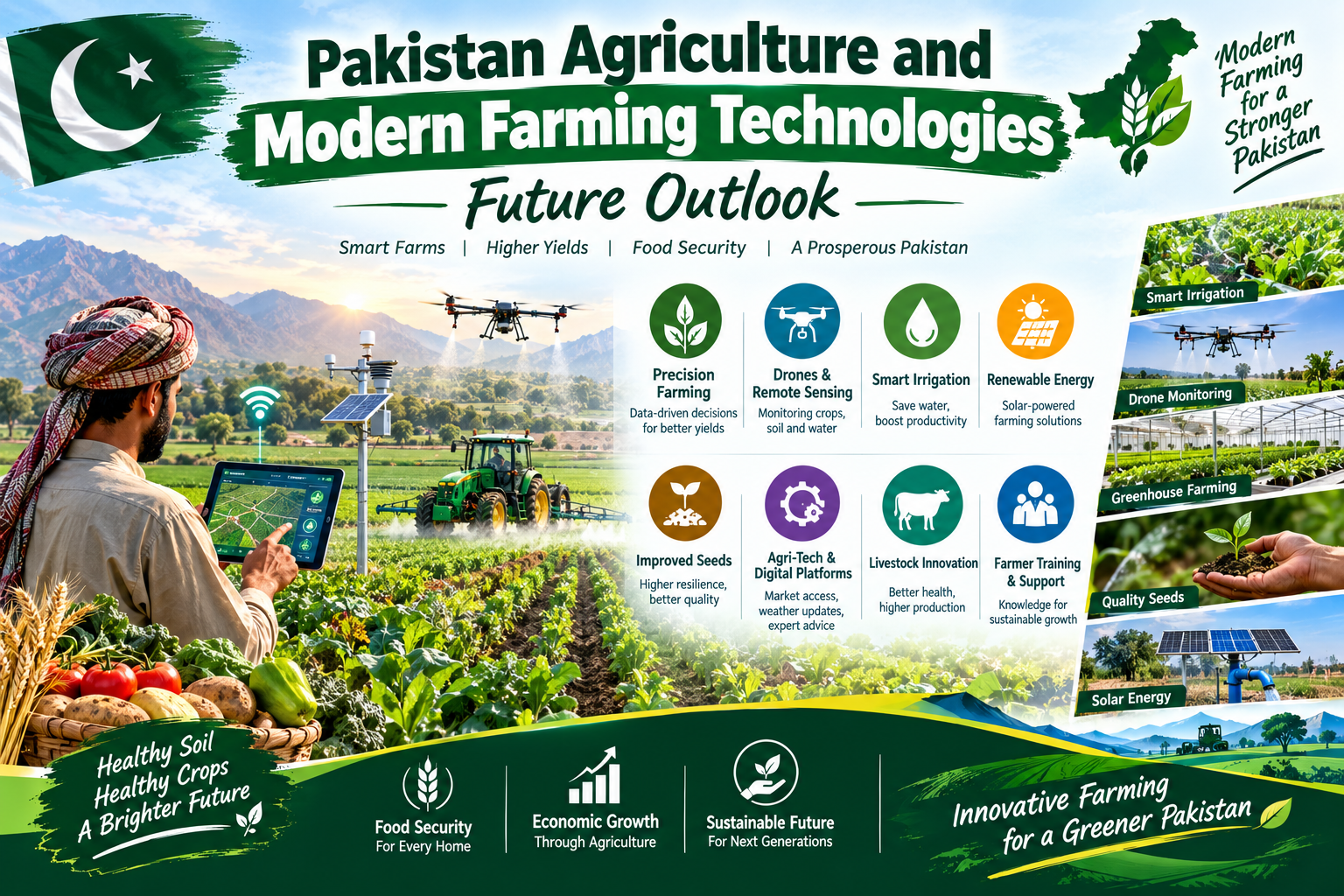
Pakistan's agriculture sector is entering a period of important change as farmers face rising production costs, water shortages, changing weather patterns and growing demand for food. Agriculture remains closely connected to the country's economy because it supports rural livelihoods, supplies raw materials to industries and contributes to domestic food production and exports.
Traditional farming practices have supported generations of Pakistani farmers. However, changing economic and environmental conditions mean that many farmers need better access to modern machinery, improved seeds, efficient irrigation systems, digital information and practical agricultural training.
Modern farming technologies can help farmers use resources more efficiently, monitor crop conditions and make informed decisions. Technologies such as drip irrigation, laser land levelling, soil testing, satellite-based crop monitoring and digital agricultural advisory services offer opportunities to improve productivity when they are suitable for local conditions.
Nevertheless, adopting new technology is not always easy. Small farmers may struggle with equipment costs, limited financing, unreliable electricity, inadequate training and uncertainty about market prices. Modernisation must therefore be supported by practical education, accessible services and policies that consider the needs of farmers across different regions.
The future of Pakistani agriculture will depend on combining local farming knowledge with scientific research, appropriate technology and sustainable management of land and water.
The Importance of Agriculture to Pakistan's Economy
Agriculture is one of the foundations of Pakistan's economic and social structure. It supplies food to households, provides raw materials for manufacturing and supports businesses involved in transportation, storage, processing and distribution.
According to the Pakistan Economic Survey 2025–26, agriculture accounted for approximately 23.44 percent of the country's gross domestic product and recorded growth of 2.89 percent during the financial year. These figures illustrate the sector's economic importance while also highlighting the need to strengthen its productivity and resilience.
Agricultural activity extends beyond the cultivation of major crops. Livestock, poultry, fisheries, horticulture and related services also contribute to food production and rural incomes.
Wheat, rice, cotton, sugarcane and maize are among Pakistan's important crops. Their production influences food availability, textile manufacturing, agricultural trade and the incomes of farming households.
Agriculture also supports businesses that supply fertilisers, seeds, machinery, pesticides and irrigation equipment. Once crops are harvested, workers and companies remain involved in storage, packaging, processing and transportation.
This creates a broad economic network in which farming performance affects several other industries.
When agricultural production is disrupted by drought, flooding, pests or high input costs, the consequences can extend beyond farms. Food prices may become more difficult to manage, processing businesses may face supply problems and rural households may experience lower incomes.
Improving agricultural productivity is therefore not simply a matter of increasing the number of crops produced. It also involves reducing avoidable losses, improving product quality, conserving resources and helping farmers earn more predictable incomes.
Why Modern Farming Technologies Matter
Modern farming technologies are designed to help farmers make better use of available resources and improve the management of agricultural operations.
These technologies can range from relatively simple equipment to advanced digital systems. A farmer may benefit from a soil-testing service, a more efficient irrigation method or improved harvesting equipment without needing expensive automated machinery.
The most appropriate technology depends on the farm's size, crop type, soil conditions, water availability and financial resources.
For example, a farmer growing vegetables on a small area may benefit from a carefully designed drip irrigation system. A farmer cultivating a larger field may find laser land levelling or access to shared machinery more useful.
Digital tools can provide information about weather, crop diseases, market prices and irrigation requirements. However, information must be reliable and understandable to be useful.
Modernisation should not mean replacing every traditional method. Some established practices remain valuable when they suit local conditions. The objective is to identify where scientific knowledge and suitable technology can improve results.
Successful adoption also requires maintenance, training and access to spare parts. Equipment that cannot be repaired locally may become an expensive burden rather than a productive investment.
For Pakistani agriculture, the greatest benefits may come from matching practical technologies with farmers' actual needs rather than promoting the same solution everywhere.
Smart Irrigation and Water Conservation
Water management is one of the most important challenges facing agriculture in Pakistan.
Crops require water at different stages of growth, and the amount needed depends on the crop, soil, weather and farming method. When water is applied inefficiently, a portion may be lost through evaporation, runoff or excessive movement below the root zone.
Traditional flood irrigation remains common in many areas, but its effectiveness varies according to field conditions and irrigation management.
Modern irrigation techniques can help farmers deliver water more carefully.
Drip irrigation
Drip irrigation supplies water through pipes and emitters near plant roots. When correctly designed and maintained, it can reduce unnecessary water application and make irrigation more manageable.
The technique can be particularly useful for vegetables, orchards and other crops where controlled watering is appropriate.
However, installation costs, water quality, filter maintenance and access to replacement parts must be considered. Drip irrigation is not automatically the best choice for every crop or field.
Sprinkler irrigation
Sprinkler systems distribute water through nozzles that produce droplets over a cultivated area.
They can be suitable for certain crops and field conditions, particularly where conventional irrigation is difficult to manage. Their performance depends on equipment design, operating pressure, wind conditions and water availability.
Laser land levelling
Laser land levelling uses specialised equipment to improve the uniformity of a field's surface.
A more evenly levelled field can help distribute irrigation water more consistently and may improve the efficiency of field operations.
Farmers do not necessarily need to purchase the equipment individually. Shared machinery arrangements and commercial land-levelling services can make the technology accessible to smaller farms.
Better irrigation scheduling
Farmers can also improve water management by considering soil moisture, crop growth stages, rainfall forecasts and local irrigation schedules.
Instead of irrigating according to habit alone, they can use available information to determine when watering is necessary.
Water conservation is most effective when irrigation improvements are combined with appropriate crop selection, maintenance of water infrastructure and responsible groundwater management.
Soil Testing and Precision Fertiliser Use
Healthy soil is essential for productive agriculture. It supplies nutrients, stores water, supports plant roots and provides an environment for beneficial organisms.
However, soil conditions differ between fields, even within the same farming area. Applying fertiliser without understanding the soil's needs can result in unnecessary expenditure or nutrient deficiencies.
Soil testing can help farmers identify important characteristics, including nutrient availability, pH and other properties relevant to crop growth.
With this information, farmers can make better-informed decisions about fertiliser selection and application.
Precision agriculture takes this approach further by using field data and mapping tools to identify variations within a farm. Instead of treating every part of a field as identical, farmers may be able to adjust inputs according to local conditions.
For small farmers, laboratory soil testing and advice from agricultural extension workers may be more practical than purchasing advanced precision equipment.
The aim is to apply the right inputs, in appropriate amounts and at suitable times.
Better nutrient management can reduce waste, support crop development and improve the efficiency of farm spending.
Farmers should also understand that fertiliser requirements depend on crop type, soil conditions, previous cropping history and expected production. General recommendations cannot replace appropriate local advice.
Improved Seeds and Climate-Resilient Crops
Seeds play a major role in determining crop establishment, growth and potential yield.
Improved seed varieties may offer advantages such as better disease resistance, more suitable maturity periods or greater tolerance to particular environmental stresses. However, their performance depends on whether they are appropriate for the local climate, soil and farming system.
Climate change makes this issue increasingly important.
Higher temperatures, irregular rainfall, heatwaves and extreme weather can affect planting dates, flowering, grain development and harvest quality.
Farmers may need varieties that can perform more reliably under changing conditions. Researchers can help by evaluating crop varieties across different regions and identifying those suited to local challenges.
Access to certified seed is equally important. Farmers need confidence that the seed they purchase matches its stated variety and quality.
Poor-quality or unsuitable seed can result in weak crop establishment, uneven growth and additional production costs.
Agricultural research institutions, seed companies and extension services can support farmers by providing accurate information about available varieties, planting requirements and expected characteristics.
Crop diversification can also help reduce certain risks. Depending on local conditions, farmers may consider different crops or varieties rather than relying entirely on a single crop.
However, diversification decisions must account for market demand, available water, soil suitability and the farmer's ability to manage the new crop.
Digital Agriculture and Mobile Advisory Services
Mobile phones and digital platforms are creating new ways to share agricultural information with farmers.
A farmer may need to know when rain is expected, how to recognise a crop disease, where to obtain suitable seed or what prices are being offered in nearby markets.
Digital advisory services can help deliver such information more quickly than relying exclusively on occasional visits or printed notices.
Weather forecasts can support decisions about irrigation, spraying and harvesting. Pest alerts may help farmers investigate potential problems before damage becomes widespread.
Digital platforms can also distribute information about agricultural training, government programmes and available services.
However, the usefulness of these systems depends on their accuracy and accessibility.
Some farmers may have limited internet access, older mobile devices or difficulty understanding technical information. Advisory services should therefore use clear language and consider local communication preferences.
Information should also be relevant to the farmer's region and crop. Advice intended for one climate or soil type may not work in another.
Digital tools are most effective when they complement experienced agricultural advisers rather than replacing local knowledge entirely.
A combination of mobile information, demonstrations and direct consultation can help farmers understand how to apply new recommendations in practice.
Satellite Monitoring, Drones and Precision Farming
Advanced technologies are gradually creating additional possibilities for monitoring agricultural land.
Satellite imagery can help identify differences in vegetation, estimate crop development and detect areas that may require further investigation. When combined with suitable ground observations, this information can support decisions about crop management.
Drones equipped with cameras or specialised sensors can collect detailed images of fields. These images may help identify uneven crop growth, irrigation problems or potential areas of stress.
However, an image alone does not always explain the cause of a problem. Poor crop growth may result from pests, nutrient deficiencies, water stress, soil conditions or other factors.
Farmers need appropriate interpretation and follow-up assessment before making expensive decisions.
Drones and advanced sensors may also involve equipment, training, maintenance and regulatory requirements. For many small farms, purchasing this technology individually may not be economically practical.
Shared services, agricultural technology companies and research partnerships may offer more accessible options.
Precision farming should therefore be viewed as a range of approaches rather than a requirement that every farmer buy advanced equipment.
Simple field records, soil testing and careful observation can provide valuable improvements, while more advanced tools may be appropriate where their benefits justify the cost.
Artificial Intelligence in Agriculture
Artificial intelligence is increasingly being explored for agricultural applications.
AI-based systems can analyse images, weather information, field records and other data to help identify patterns that may be difficult to detect manually.
Potential applications include crop disease identification, irrigation recommendations, yield estimation and agricultural supply-chain planning.
For example, a farmer might use an image-based tool to investigate unusual marks on leaves. The tool could suggest possible causes, but a local expert may still need to confirm the diagnosis before treatment is selected.
AI can also help businesses organise agricultural data, forecast demand and improve logistics.
However, these systems have limitations. Their accuracy depends on the quality of the data used, the conditions in which they operate and whether the model has been evaluated for the relevant crop and region.
Incorrect recommendations can lead to wasted money or crop damage.
Farmers should therefore treat AI outputs as decision-support information rather than unquestionable instructions. Important decisions involving chemicals, crop protection or major financial investments should be based on reliable professional guidance and applicable regulations.
Language accessibility is another consideration. Agricultural tools are more useful when farmers can understand the recommendations in a familiar language.
The future value of AI in Pakistan's agriculture sector will depend on affordable access, trustworthy information, local research and appropriate farmer training.
Mechanisation and Access to Modern Equipment
Farm machinery can reduce the time and labour required for certain agricultural operations.
Tractors, planters, harvesters, threshers and specialised equipment can support timely planting, field preparation and harvesting.
Timeliness matters because delays may affect crop establishment, expose produce to adverse weather or reduce the quality of harvested crops.
Mechanisation can also help address labour shortages during particularly busy periods.
However, agricultural machinery can be expensive to purchase and maintain. Small farmers may not have enough land or annual usage to justify owning specialised equipment.
One possible solution is shared access.
Under machinery-rental arrangements, farmers can pay for a particular service without purchasing the equipment themselves. Farmer groups, cooperatives and commercial service providers may help organise access to suitable machinery.
Such arrangements can reduce the initial financial burden, although availability, service quality and scheduling still need to be managed.
Equipment must also be appropriate for the local terrain, farm size and crop system. A machine designed for large fields may not be practical for small or fragmented holdings.
Training is essential because improper operation can damage equipment, waste fuel or create safety risks.
Modern mechanisation should focus on improving efficiency and reliability while keeping costs manageable for the farmers who use the services.
Climate Change and Agricultural Resilience
Climate change is creating additional pressure on Pakistan's agricultural systems.
Farmers depend on weather conditions for planting, crop development, irrigation planning and harvesting. When temperatures and rainfall patterns become less predictable, traditional seasonal expectations may become less reliable.
Extreme heat can affect crop development, while irregular rainfall may increase the risks of drought, waterlogging or flooding in different areas.
These challenges can also affect livestock, agricultural infrastructure and rural household incomes.
Climate-smart agriculture aims to improve productivity while strengthening farmers' ability to respond to environmental changes and using resources more responsibly.
Possible practices include efficient irrigation, improved crop varieties, conservation tillage, crop diversification, soil conservation and better management of agricultural residues.
The most appropriate measures depend on local conditions. A strategy suitable for an irrigated region may not be practical in a rainfed area.
Farmers also need access to timely weather information and advice about suitable planting and harvesting decisions.
Agricultural resilience cannot be achieved through technology alone. It also requires reliable infrastructure, financial support, effective extension services and planning for extreme weather events.
Sustainable Management of Agricultural Land
Land degradation can reduce the long-term productivity of farms.
Soil erosion, salinity, nutrient depletion and poor water management can affect the ability of land to support healthy crops.
Sustainable farming practices aim to maintain soil quality while allowing farmers to produce food and earn income.
Crop rotation can help diversify production and, when planned appropriately, support soil management. Cover crops and residue management may help protect the soil surface, while reduced tillage can lower some forms of disturbance.
The benefits of these practices depend on soil type, climate, crop selection and the equipment available.
Organic matter management is also important. Appropriate use of compost and other suitable materials can contribute to soil structure and nutrient management, although materials must be handled carefully to avoid contamination or nutrient imbalances.
Farmers should receive practical guidance before changing established cultivation methods.
Long-term soil health can support resilience by helping agricultural land retain productive capacity across successive growing seasons.
Sustainable management is therefore an investment in the future of farming, not simply an environmental concern.
Post-Harvest Losses and Food Storage
Agricultural productivity depends not only on what farmers grow but also on how much of the harvest reaches consumers in good condition.
Post-harvest losses can occur during harvesting, drying, transportation, handling, storage and processing.
Perishable products such as fruits and vegetables may deteriorate quickly when they are exposed to unsuitable temperatures or delayed transportation.
Grains can also be damaged by moisture, pests and inadequate storage conditions.
Improved storage facilities can help protect produce and reduce avoidable losses. Appropriate drying, ventilation, pest management and monitoring are important for maintaining grain quality.
For perishable crops, cold storage and refrigerated transportation may help extend the period during which products remain suitable for sale.
However, cold-chain facilities require investment, dependable energy and suitable operating practices. Their design should match the products and volumes being handled.
Better packaging and grading can also help farmers supply markets with more consistent quality.
Reducing post-harvest losses can improve the effective availability of food without requiring a corresponding increase in cultivated land.
It may also help farmers preserve the value of their work and give buyers more confidence in product quality.
Digital Markets and Better Access to Buyers
Farmers' incomes depend on both production and the prices they receive for their crops.
In some situations, farmers have limited information about market prices or depend on intermediaries to arrange transportation and sales. These arrangements can make it difficult to compare offers or plan the timing of a sale.
Digital market information may help farmers understand prices across different locations and identify potential buyers.
Online platforms can also connect producers with wholesalers, retailers, food processors and other customers.
However, a digital listing does not guarantee a profitable sale. Farmers must still consider transportation, storage, quality standards, commissions, payment reliability and the possibility of price changes.
Reliable market information should be current, clearly explained and relevant to the product being sold.
Farmers may also benefit from collective marketing arrangements. By coordinating volumes and quality standards, groups of producers may find it easier to approach larger buyers.
Better access to market information can support decision-making, but it works best when combined with transport infrastructure, fair trading practices and dependable payment arrangements.
The Role of Small Farmers in Agricultural Modernisation
Small farmers are an important part of Pakistan's agricultural landscape, but their financial resources and access to services can be limited.
Purchasing machinery, installing irrigation systems or adopting unfamiliar technologies may involve costs that are difficult to manage when income depends on a single harvest.
Small farmers may also have limited access to formal credit, technical advice and reliable market information.
Agricultural modernisation should account for these circumstances.
Affordable soil testing, machinery rental, group purchasing and shared irrigation services can sometimes provide access to technology without requiring individual ownership.
Training programmes should also be designed around farmers' schedules and practical needs.
Demonstration farms can help farmers observe how a technique performs under local conditions before investing in it themselves.
Financing arrangements should be transparent and appropriate for agricultural income cycles. Farmers need to understand repayment obligations and the risks associated with borrowing.
The objective should be to make productive technology more accessible without exposing households to unnecessary financial pressure.
Small farms can benefit from modern methods when solutions are affordable, locally suitable and supported by dependable services.
Women and Young People in Agriculture
Women and young people contribute to agriculture in many ways, including crop production, livestock care, harvesting, processing and family farm management.
However, they may have unequal access to land ownership, training, finance, technology and agricultural decision-making.
Improving access to these resources can strengthen farming households and expand opportunities in rural communities.
Training programmes should ensure that women can participate meaningfully and receive information about technologies relevant to their work.
Young people can contribute through agricultural science, digital services, equipment maintenance, food processing, marketing and entrepreneurship.
Modern agriculture offers career possibilities beyond working directly in the fields. Businesses need people who can manage irrigation equipment, analyse agricultural data, maintain machinery, develop digital platforms and organise supply chains.
Vocational and technical education can help young people build these abilities.
Agricultural entrepreneurship may also create opportunities in seed supply, packaging, transport, storage and farm services.
To support participation, programmes need clear eligibility criteria, accessible training and transparent selection procedures.
Investing in the capabilities of women and young people can help communities make better use of available knowledge and develop new approaches to agricultural challenges.
Agricultural Finance and the Cost of Technology
Financial constraints can prevent farmers from adopting technologies that may improve productivity over time.
Equipment, improved seed, irrigation systems and storage facilities require investment. Farmers may be reluctant to spend money when crop prices, weather conditions and future income are uncertain.
Agricultural finance can help when it is designed around realistic production costs and repayment capacity.
Banks, cooperatives and other eligible financing providers may offer products for different agricultural needs, subject to their terms and requirements.
Farmers should compare the total cost of financing, repayment schedules, fees and risks before committing to a loan.
Subsidies and support programmes can sometimes help reduce the initial cost of selected technologies. However, eligibility rules, available funding and programme conditions may change, so farmers should verify details through official channels.
Support is most useful when it reaches the intended beneficiaries and encourages sustainable improvements rather than short-term purchases without adequate training.
Financial assistance should ideally be accompanied by technical advice, maintenance arrangements and access to markets.
A technology is only a sound investment when its expected benefits, costs and risks make sense for the farmer's circumstances.
Government, Research and Agricultural Extension Services
Government institutions, universities, research organisations and agricultural extension workers can play important roles in modernising Pakistan's farming sector.
Research institutions can evaluate improved crop varieties, irrigation methods, pest-management techniques and soil-conservation practices.
Extension services can help communicate research findings in practical language and explain how farmers may apply them.
Demonstration plots, farmer meetings and field-based training can help people compare methods under local conditions.
Public institutions can also improve access to weather information, soil testing, agricultural statistics and guidance about available support programmes.
Research priorities should reflect the challenges farmers actually face, including water scarcity, heat stress, crop diseases and high production costs.
Coordination between researchers and farmers is essential. Farmers can identify practical problems, while researchers can help test possible solutions.
Programmes should be assessed using meaningful outcomes, such as improved resource efficiency, better crop quality, reduced losses and more stable farm incomes.
Technology adoption should not be measured only by the number of machines distributed or people enrolled in training. The important question is whether the support produces useful and sustainable results.
Challenges to Adopting Modern Farming Technology
Despite its potential, agricultural modernisation faces several obstacles.
The first is cost. Some technologies require substantial initial investment, while maintenance and replacement parts add continuing expenses.
The second is limited technical knowledge. Farmers may need training to operate equipment, interpret digital information and understand new production methods.
The third is infrastructure. Unreliable electricity, weak connectivity, inadequate roads and insufficient storage can reduce the usefulness of otherwise promising technologies.
The fourth is uncertainty. Farmers may be unwilling to change established practices if they do not know whether the new method will work under their conditions.
Water availability and local environmental conditions also influence which technologies are appropriate.
Finally, fragmented agricultural services can make it difficult for farmers to find reliable advice, financing and equipment in one place.
Addressing these challenges requires practical solutions rather than a single national approach. Different regions need strategies suited to their crops, soils, climate and farming systems.
Affordable services, transparent financing, local training and reliable technical support can make modern technology more accessible.
The Future of Pakistan's Agriculture Sector
Pakistan's agricultural future will depend on its ability to increase productivity while protecting natural resources and responding to climate-related risks.
Modern irrigation, improved seeds, soil testing, digital advisory services and better storage can all contribute to more efficient farming.
However, their success depends on choosing technologies that match local needs and ensuring that farmers can afford to use and maintain them.
Agricultural education will remain important. Farmers need opportunities to learn new methods, evaluate information and adapt practices as conditions change.
Businesses can support progress by providing reliable equipment, transparent pricing and effective after-sales services. Research organisations can test innovations, while public institutions can improve access to information and infrastructure.
Better coordination across the agricultural supply chain may also help reduce losses and connect producers with markets.
Future progress should be measured through a combination of indicators, including productivity, water efficiency, soil health, product quality, farmer incomes and the resilience of rural communities.
No single technology will solve every agricultural problem. A combination of suitable equipment, sound management, practical training and supportive institutions is more likely to produce lasting improvements.
Conclusion
Pakistan's agriculture sector is essential to food security, employment, rural livelihoods and industrial development. Yet farmers face increasing pressure from water scarcity, changing weather, rising input costs and difficulties accessing modern equipment and reliable market information.
Modern farming technologies offer opportunities to address some of these challenges. Efficient irrigation, improved seeds, soil testing, digital advisory services, precision agriculture and better storage can help farmers make informed decisions and manage resources more carefully.
Nevertheless, technology must be affordable, locally suitable and supported by training and maintenance. Small farmers need practical access to services, while women and young people need opportunities to develop their skills and participate in agricultural innovation.
Government institutions, researchers, businesses and farming communities all have a role in this transition.
By combining scientific knowledge with local experience, improving access to agricultural services and prioritising sustainable resource management, Pakistan can strengthen its farming systems and support more resilient rural livelihoods.
The future of agriculture will not depend only on producing more crops. It will also depend on using water and land responsibly, reducing losses, improving market access and helping farmers earn sustainable incomes. These priorities can help build a more productive and resilient agricultural sector for Pakistan.
FAQs
1. Why is agriculture important to Pakistan?
Agriculture supports food production, rural employment, livestock, industrial raw materials and several domestic and export-related businesses.
2. What are modern farming technologies?
They include efficient irrigation systems, improved seeds, soil testing, agricultural machinery, digital advisory services, satellite monitoring and other tools that support farm management.
3. How can technology help Pakistani farmers save water?
Suitable irrigation systems, better scheduling, soil-moisture information and improved field levelling can help farmers manage water more efficiently.
4. What challenges prevent farmers from adopting modern technology?
Common barriers include high initial costs, limited financing, insufficient training, unreliable infrastructure and difficulties accessing maintenance services.
5. How can Pakistan improve its agriculture sector?
Pakistan can support agricultural progress through practical farmer training, climate-resilient crops, better irrigation, improved storage, reliable market information and accessible modern farming services.




