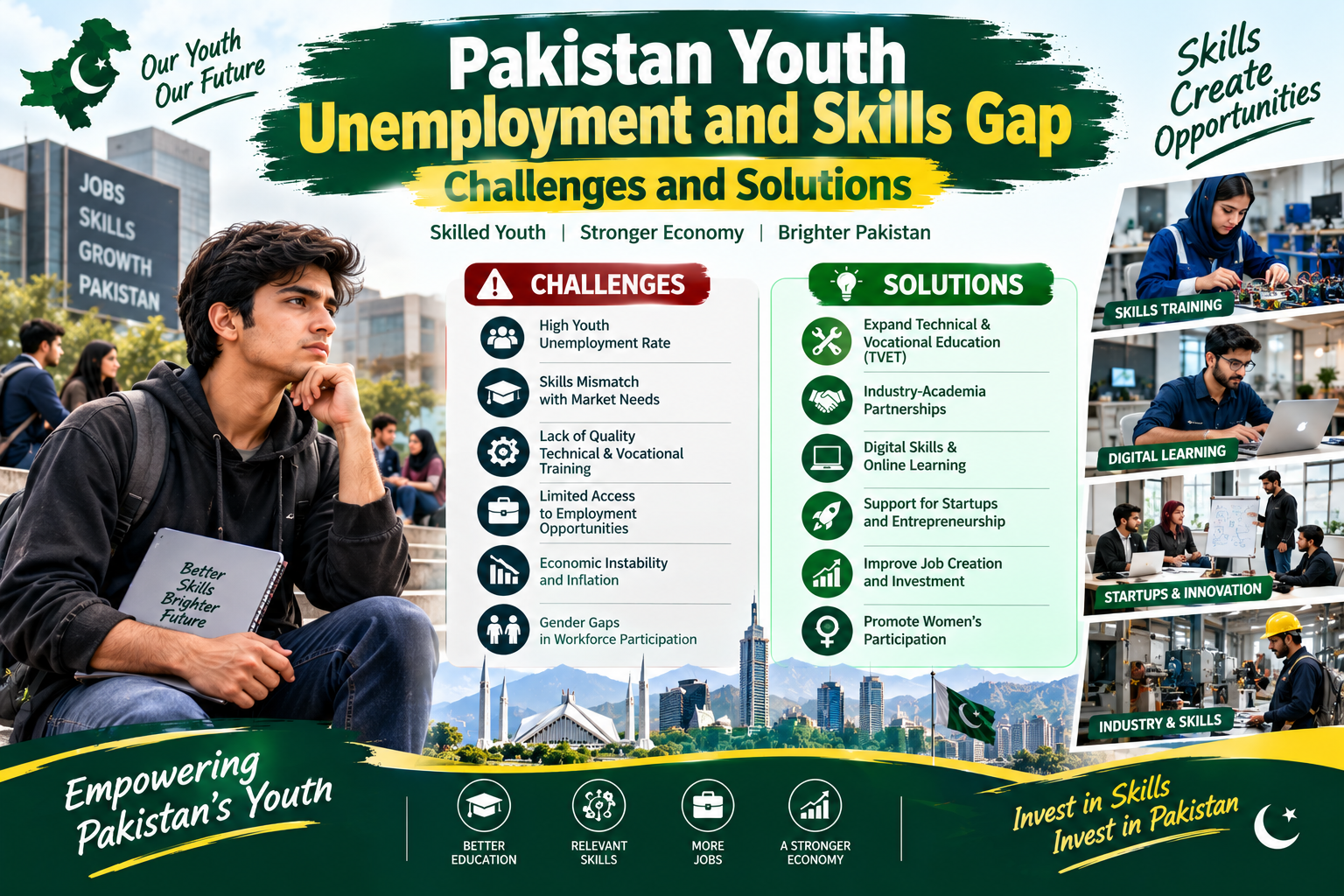
Pakistan's youth population represents one of the country's greatest opportunities for economic growth, innovation and social development. Every year, students complete school, college, university and technical education with hopes of finding employment, supporting their families and building successful careers. However, many young people face difficulties entering the job market because their qualifications do not always match employers' requirements.
Graduate unemployment, limited practical experience, unequal access to professional training and a shortage of suitable entry-level opportunities remain important challenges for Pakistan. At the same time, changing technology and new business models are creating demand for skills that many students have not had the opportunity to develop.
Addressing these challenges requires cooperation between educational institutions, government departments, employers and young people themselves. Improving practical education, expanding technical training, supporting small businesses and strengthening career guidance could help connect young Pakistanis with more employment opportunities.
Understanding Youth Unemployment in Pakistan
Youth unemployment occurs when young people who are available for work and actively seeking employment cannot find suitable jobs. The problem can affect school leavers, college graduates, university graduates and people who have completed technical or vocational training.
In Pakistan, the transition from education to employment can be particularly difficult for students who have spent years studying but have limited knowledge of workplace expectations.
Some graduates struggle to find jobs related to their qualifications. Others accept positions that do not require their level of education or work in fields unrelated to their studies. Many young people also spend months searching for employment while trying to gain the experience that employers frequently demand.
Youth unemployment is not only an individual problem. It can affect household finances, national productivity, consumer spending and confidence in the education system.
When young people cannot find work, families may face continued financial pressure after investing money in school fees, transport, accommodation and educational materials. The wider economy may also lose the benefits of their knowledge and potential contribution.
However, unemployment figures alone do not explain every difficulty faced by young people. Some are working in informal jobs, while others accept irregular employment or positions that provide insufficient hours or income. These circumstances are also important when assessing the quality of employment opportunities available to Pakistan's youth.
Why University Graduates Struggle to Find Jobs
One major challenge is the difference between academic qualifications and the practical abilities required in the workplace.
A student may successfully complete a degree in business, computer science, engineering, commerce or another subject but still lack experience in applying classroom knowledge to real tasks.
Employers may expect new applicants to understand workplace communication, teamwork, problem-solving, digital tools and professional responsibilities. Some positions also require industry-specific software skills, project experience or knowledge of current business practices.
When graduates have not developed these abilities during their studies, employers may prefer applicants who already possess relevant experience.
This creates a difficult cycle. Young people need employment to gain experience, but they may struggle to obtain their first job because they have little experience.
Internships, supervised projects, practical assignments and partnerships between universities and businesses can help address this problem.
Educational institutions can also improve career preparation by introducing workplace simulations, industry-led workshops and opportunities for students to work on realistic projects before graduation.
The goal should not be to reduce the importance of academic knowledge. Instead, education should combine strong theoretical foundations with the practical abilities that help graduates use their knowledge effectively.
The Skills Gap Between Education and Industry
The skills gap refers to a difference between the abilities employers need and the skills available among job applicants.
Pakistan's economy includes agriculture, manufacturing, construction, healthcare, education, retail, information technology, financial services and many other sectors. Each industry requires a different combination of technical and professional abilities.
For example, a business may need employees who understand spreadsheets, customer service, digital marketing, accounting software and data management. A manufacturing company may need technicians who can operate machinery, maintain equipment and follow quality-control procedures.
Healthcare facilities require appropriately trained professionals, while construction businesses need workers with practical technical knowledge and an understanding of safety standards.
If training programmes do not keep pace with these requirements, graduates may find that their qualifications do not directly prepare them for available positions.
Employers can help reduce this gap by communicating their needs to universities, colleges and vocational training providers.
Educational institutions should regularly review course content and consult professionals who understand changing workplace requirements. Students should also receive opportunities to develop transferable skills that remain useful across different industries.
The skills gap cannot be solved through short courses alone. It requires continuous cooperation between education providers, employers and policymakers.
The Importance of Technical and Vocational Education
Technical and vocational education can provide an alternative route into employment for young people who prefer practical learning or want to develop specialised occupational skills.
These programmes may cover electrical work, plumbing, welding, automotive maintenance, refrigeration, information technology support, construction trades, hospitality, tailoring and other professional areas.
Pakistan needs skilled workers in many sectors, and vocational training can help young people prepare for these occupations.
However, the value of a training programme depends on its quality and relevance. Courses should reflect actual industry requirements, include practical instruction and provide access to appropriate equipment.
Training providers can also work with employers to create apprenticeship opportunities. Under supervised arrangements, trainees can develop practical abilities while learning about professional expectations.
Career guidance is essential as well. Students should understand what different occupations involve, which qualifications are required and what opportunities may be available in their regions.
Vocational education should not be treated as an inferior alternative to university education. Both academic and technical pathways can contribute to economic development when they provide useful knowledge and recognised skills.
A stronger vocational system could help employers find qualified workers while giving young people more choices about how to build their careers.
Digital Skills and the Changing Job Market
Technology is changing how businesses operate and how employees complete their work.
Digital communication, online payments, e-commerce, cloud services, data analysis and automation have created new opportunities while changing the requirements of many existing jobs.
Young Pakistanis can benefit from learning digital skills that match their interests and career goals.
Basic digital literacy includes using computers, managing files, working with documents and spreadsheets, communicating professionally online and understanding cybersecurity principles.
More specialised skills may include programming, website development, graphic design, digital marketing, data analysis, user-interface design and technical support.
However, not every student needs to become a software developer. Digital competence can be valuable in many fields, including accounting, education, retail, administration, healthcare and small-business management.
Training programmes should therefore provide different learning pathways instead of assuming that all young people want the same career.
Students also need to understand that digital skills must be supported by problem-solving, communication, reliability and ethical conduct.
For example, someone learning digital marketing should understand customer needs and truthful advertising, not simply how to publish social media posts. A beginner in programming should learn how to solve problems and test code rather than memorising isolated commands.
Practical projects can help students demonstrate what they know. A portfolio containing completed work may provide evidence of ability when a graduate has limited formal employment history.
Artificial Intelligence and New Career Opportunities
Artificial intelligence is becoming increasingly important in workplaces around the world. Businesses are exploring AI tools for research, customer support, document processing, software development, data analysis and other tasks.
This creates both opportunities and challenges for Pakistan's young workforce.
AI tools may help workers complete some tasks more efficiently, but they can also change the skills employers expect from new employees. Repetitive activities may become more automated, while human judgement, creativity, communication and specialised knowledge remain important in many roles.
Young people should learn how to use AI responsibly as a support tool rather than assuming that it can replace all professional learning.
For example, an AI tool may help a student understand a difficult concept, brainstorm ideas or review a draft. However, the student still needs to verify information, understand the subject and take responsibility for the final work.
Training should also explain data privacy, copyright, accuracy and ethical use.
Pakistan can prepare young workers for technological change by introducing relevant digital education, supporting teacher training and encouraging businesses to provide opportunities for continuous learning.
The purpose should be to help people adapt to changing work rather than promising that any single technology will guarantee employment.
English Communication and Professional Confidence
Communication is another important factor in employment.
Many jobs require employees to explain ideas, write messages, understand instructions, communicate with customers and work with colleagues. In some industries, English is particularly useful because companies interact with international clients or use English-language documentation.
However, limited English proficiency should not prevent young people from developing valuable technical abilities or pursuing suitable careers.
Students can improve communication gradually by practising professional writing, learning relevant vocabulary, reading understandable material and participating in conversations.
Employers also value clear communication in Urdu and regional languages, depending on the position and customer base.
Professional confidence develops through practice. Students can prepare for interviews by explaining their skills, describing projects they have completed and learning how to answer common questions honestly.
Career preparation should focus on communication that is relevant to real workplace situations rather than memorising impressive phrases without understanding them.
Schools, colleges and universities can help by providing presentations, group projects, writing exercises and interview preparation sessions.
These activities can make students more comfortable expressing their ideas and asking questions.
Limited Internship and Entry-Level Opportunities
Internships can help students understand how workplaces operate, but access to useful opportunities is not always equal.
Some students have family connections or live near large businesses and professional institutions. Others live in smaller cities and rural areas where internships in specialised industries are limited.
Unpaid opportunities can create additional difficulties for students who need to cover transport, food and other daily expenses.
Employers can help by offering structured internships with clear learning objectives, supervision and transparent selection procedures.
Where possible, internships should provide reasonable support for necessary travel and other participation costs. Paid entry-level positions and apprenticeships can also help young people gain experience without placing excessive financial pressure on their families.
Universities can develop partnerships with local businesses, hospitals, schools, technology firms and manufacturing facilities.
Smaller organisations may not have formal internship programmes, but they can still provide supervised projects or short placements when suitable arrangements are available.
The most valuable experience is not simply time spent in an office. Students should have opportunities to perform meaningful tasks, receive feedback and understand the standards expected in their chosen fields.
Rural and Urban Differences in Employment Access
Employment opportunities are not distributed equally across Pakistan.
Major urban centres generally have a wider concentration of offices, universities, industrial facilities and technology businesses. Young people living in smaller cities or rural communities may have fewer nearby opportunities in specialised fields.
Travel and accommodation costs can make it difficult for them to relocate or attend training programmes in larger cities.
Digital education and remote work can help reduce some geographical barriers, but only when people have reliable internet access, suitable devices and the necessary skills.
Training centres in smaller cities can support local development by offering courses linked to regional economic needs.
For example, areas with strong agricultural activity may benefit from training in agricultural technology, food processing, equipment maintenance and supply-chain management. Communities with manufacturing businesses may need technicians and quality-control workers.
Local employers can help identify which skills are in demand and participate in designing relevant programmes.
Public institutions can also improve access by providing affordable digital facilities and making information about scholarships, apprenticeships and employment services easier to find.
The aim should be to expand opportunities across regions rather than requiring every young person to move to a major city to pursue a career.
Women and Youth Employment
Young women may face additional barriers when entering the workforce.
These can include limited access to transport, concerns about workplace safety, family responsibilities, unequal hiring practices and fewer opportunities to obtain professional experience.
In some communities, social expectations can also influence the occupations women are encouraged to pursue.
Improving employment access requires attention to these practical challenges.
Educational institutions can provide career guidance and information about different professional pathways. Employers can adopt transparent recruitment procedures, clear workplace policies and appropriate mechanisms for reporting harassment or discrimination.
Reliable transport, flexible working arrangements where practical and access to digital training can also help some women participate more fully in employment.
Remote work may create opportunities in fields such as customer support, design, writing, software services and digital administration. However, these positions still require appropriate skills, dependable internet access and protection against fraudulent recruitment offers.
Women should have access to the same quality of professional training and career information as other young people.
Expanding participation can benefit households, businesses and the wider economy by allowing more people to contribute their abilities and knowledge.
Entrepreneurship and Small Businesses
Not every young person will find a suitable salaried position immediately. Entrepreneurship can provide another pathway for people who have a practical business idea, understand a customer need and can access the resources required to begin.
Small businesses operate in areas such as food production, clothing, repair services, education, agriculture, retail, technology and local transportation.
Young entrepreneurs may also explore online services, provided they understand the market and have realistic expectations about income and demand.
However, starting a business involves risks. A promising idea does not automatically become profitable, and young people should be cautious about borrowing money without understanding repayment obligations.
Business education can help students learn how to estimate costs, identify customers, manage cash flow, maintain records and evaluate competition.
Mentorship can also be valuable. Experienced business owners may help new entrepreneurs understand common mistakes and make more informed decisions.
Government agencies, educational institutions and financial organisations can support responsible entrepreneurship through training, transparent financing options and guidance about registration and taxation requirements.
Small businesses can contribute to local employment, but they need a supportive environment in which to operate. Reliable infrastructure, fair competition and predictable rules are important for business development.
Improving Career Guidance in Schools and Colleges
Many students begin thinking seriously about employment only after completing their degrees.
By that stage, they may have limited knowledge of different industries, professional qualifications and the skills employers seek.
Career guidance should begin earlier and continue throughout education.
Schools can introduce students to a range of occupations and explain how subjects connect with different career pathways. Colleges can help students compare university degrees, technical training and vocational qualifications.
Universities should provide information about internships, graduate recruitment, professional certifications and further study.
Career counselling should also consider students' interests, abilities and circumstances rather than pushing everyone towards a small number of popular professions.
For example, a student interested in computers may explore programming, network support, cybersecurity, data analysis or technical assistance. Someone interested in business may consider accounting, sales, logistics, marketing or entrepreneurship.
These pathways require different levels of education and experience, so students need clear information before making decisions.
Career services can also help young people prepare CVs, practise interviews and identify legitimate job opportunities.
Good guidance cannot guarantee employment, but it can help students make informed decisions and avoid investing time in courses that do not fit their goals.
What Government and Educational Institutions Can Do
Reducing youth unemployment requires a coordinated approach.
Government departments can support employment by improving access to relevant training, encouraging business growth and making labour-market information more accessible.
Educational institutions can update curricula, strengthen practical learning and establish partnerships with employers.
Training providers should publish clear information about course content, costs, certification and the kinds of skills students are expected to gain.
Public employment services can help connect applicants with employers and provide guidance about available training opportunities.
It is also important to evaluate programmes based on their results. The number of people enrolled in a course is not enough to show whether it has been effective.
Useful indicators include completion rates, demonstrated skills, employment outcomes, employer feedback and the ability of graduates to continue learning.
Programmes should be adjusted when evidence shows that their content or delivery is not meeting learners' needs.
Public policies should also recognise the diversity of Pakistan's economy. A single training programme is unlikely to suit every region, industry or student.
Local consultation and reliable information can help decision-makers focus resources on areas where they may have the greatest practical impact.
How Employers Can Support Young Graduates
Businesses also have an important role in helping young people enter the workforce.
Employers can make recruitment requirements clearer so applicants understand which qualifications and skills are essential and which can be developed after hiring.
Where practical, businesses can offer entry-level positions that provide training rather than demanding extensive experience for every role.
Structured onboarding helps new employees understand workplace expectations, systems and responsibilities.
Mentorship can also improve the transition from education to employment. An experienced worker can guide a new graduate, explain professional standards and provide feedback on performance.
Companies can work with educational institutions to identify changing skill requirements and offer opportunities for students to gain experience before graduation.
Transparent recruitment processes may help reduce confusion and ensure that applicants understand how selection decisions are made.
Employers benefit when new workers receive appropriate training because employees who understand their responsibilities may become more productive and confident over time.
Supporting young workers is therefore not only a social responsibility. It can also be a practical investment in the future workforce.
Practical Steps Young People Can Take
Young people cannot control every condition in the labour market, but they can take practical steps to improve their preparation.
First, they should research the types of jobs available in their chosen field. Reviewing job descriptions can help identify commonly requested qualifications and skills.
Second, students can build practical experience through academic projects, supervised internships, volunteering or small portfolio projects where appropriate.
Third, they should develop communication and digital skills that complement their main subject.
Fourth, applicants should prepare a clear CV that accurately describes their education, abilities and experience. They should avoid claiming skills they cannot demonstrate.
Fifth, young people should learn to recognise fraudulent job offers. Genuine opportunities should provide understandable information about the employer, job responsibilities and recruitment process. Applicants should be cautious when asked to pay suspicious fees or share sensitive information without a legitimate reason.
Finally, learning should continue after graduation. Technology, business practices and professional requirements change, so workers may need to update their knowledge throughout their careers.
These steps cannot remove structural barriers or guarantee a job, but they can help young people make better-informed decisions and demonstrate their abilities more effectively.
The Importance of Reliable Employment Data
Effective employment policies require accurate information.
Decision-makers need to understand which groups face the greatest difficulties, which industries are hiring and what qualifications are associated with available jobs.
Reliable labour-market data can help identify differences between regions, education levels, age groups and occupations.
It can also reveal whether young people are finding stable employment or relying on temporary and informal work.
Educational institutions can use this information to review course content, while employers can use it to plan recruitment and training.
Public reporting should distinguish between unemployment, underemployment, informal employment and people who are not currently seeking work. These categories describe different situations and require different policy responses.
Without clear definitions and reliable measurements, it becomes difficult to assess whether an employment initiative is producing meaningful results.
Regular monitoring can also help identify emerging industries and changes in skill requirements.
Better information will not solve unemployment by itself, but it can make training and employment policies more targeted and effective.
Conclusion
Pakistan's youth skills gap and graduate unemployment challenge the country's ability to turn its young population into a strong economic advantage.
Many young people complete their education with valuable knowledge but struggle to find employment that matches their qualifications. The gap between classroom learning and workplace requirements, limited access to internships, regional inequalities and changing technological demands can make the transition to employment difficult.
Addressing these problems requires stronger links between education and industry, more effective vocational training, practical digital education and better career guidance.
Employers can contribute by offering structured entry-level opportunities, internships and mentorship. Government institutions can support the process through relevant training programmes, reliable labour-market information and policies that encourage sustainable business growth.
Young people can also improve their preparation by developing practical skills, building evidence of their abilities and continuing to learn throughout their careers.
No single solution will eliminate youth unemployment. Progress will depend on sustained cooperation and careful evaluation of what works.
If Pakistan can connect education more effectively with real employment opportunities, its young people will be better positioned to contribute to businesses, public services, innovation and community development. The long-term goal should be not only to create more jobs but also to build a labour market where young people can find meaningful, productive and sustainable work.
FAQs
1. Why do graduates struggle to find jobs in Pakistan?
Some graduates face limited entry-level opportunities, insufficient practical experience and a mismatch between their qualifications and employers' requirements.
2. What is the skills gap in Pakistan?
The skills gap is the difference between the abilities employers need and the skills available among job applicants.
3. How can vocational education help young people?
Vocational education provides practical training for specific occupations and can help learners prepare for technical jobs and apprenticeships.
4. Which digital skills can help Pakistani youth?
Depending on their career goals, young people can learn digital literacy, spreadsheets, programming, website development, data analysis, graphic design or digital marketing.
5. How can Pakistan reduce youth unemployment?
Possible measures include improving practical education, expanding internships and apprenticeships, strengthening career guidance, supporting businesses and providing training aligned with industry needs.