The proposed expansion highlights the importance of women-friendly public transportation in Pakistan. For many women and students, commuting is not simply about reaching a destination. It also involves managing travel expenses, finding reliable transport, arriving on time and feeling comfortable throughout the journey.
By improving access to free transportation, the initiative could help reduce some of the difficulties faced by female commuters. Its overall success, however, will depend on the implementation of the expansion plan, the availability of buses, suitable routes, reliable schedules and effective passenger safety arrangements.
Islamabad Focuses on Better Transportation for Women
Public transportation plays an important role in the daily lives of people living in large cities. Students use buses to reach colleges and universities, while working women depend on transport to access offices, hospitals, educational institutions, shops and other workplaces.
In Islamabad, commuting needs vary significantly between central urban areas and communities located farther from major commercial and educational centres. People living in rural and peri-urban areas may have fewer convenient transport options, making daily journeys more difficult.
The planned expansion of the Pink Bus Service seeks to address part of this challenge by increasing its reach to additional areas of the capital territory.
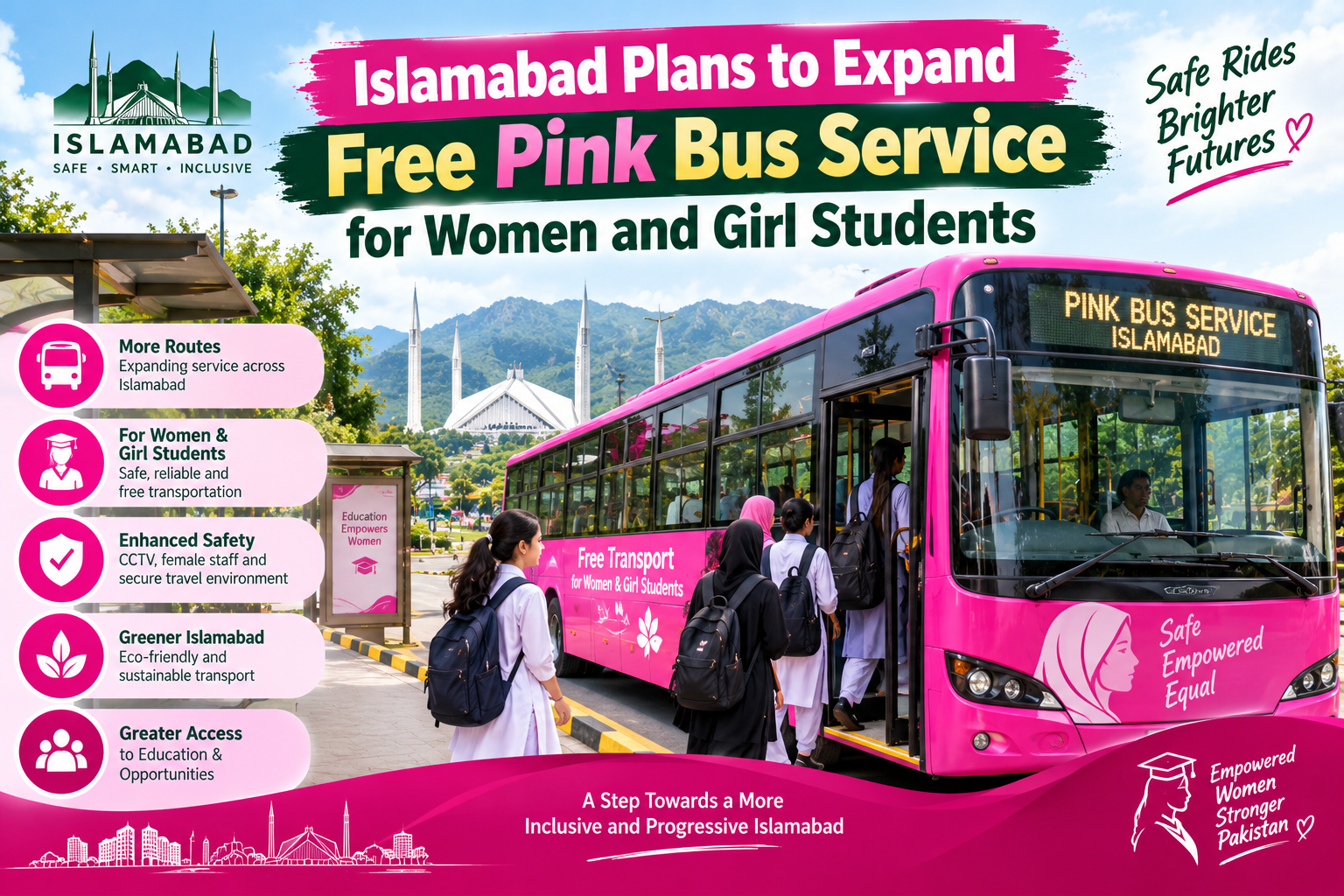
The Ministry of Federal Education and Professional Training is planning to enhance the service, with a focus on wider accessibility, safety and convenience. The plan also includes deploying trained female staff and security personnel to support a safer travel environment.
These measures reflect a broader understanding that transportation services must respond to the needs of different passenger groups. A service designed with women and girl students in mind can consider factors such as route accessibility, passenger comfort, travel timing and the availability of assistance.
The proposed expansion is an important development for female commuters, particularly those who need to travel regularly for education or employment.
What Is the Pink Bus Service?
The Pink Bus Service is a free public transportation facility intended to support working women and girl students in Islamabad.
Its central purpose is to make commuting more accessible for female passengers who might otherwise have to depend on paid transport, family members or less convenient travel arrangements.
For students, transport costs can become a recurring financial burden. Even when tuition fees and educational expenses are manageable, daily commuting can add a significant amount to a family's monthly budget.
Working women face similar challenges. Transport expenses reduce the amount of income available for household needs, savings, education and other responsibilities.
A free bus service can help ease this pressure, especially for people who travel frequently.
However, the usefulness of any public transport service depends on more than its price. Passengers also need routes that connect with their destinations, dependable schedules, sufficient capacity and clear information about where and when buses operate.
The proposed expansion creates an opportunity to strengthen these elements and improve the overall experience for women using public transportation.
Planned Expansion to Rural and Peri-Urban Areas
One of the important features of the proposed plan is its focus on additional rural and peri-urban areas of the Islamabad Capital Territory.
Peri-urban communities are located around the edges of a city, where residential development and urban services may be expanding. Residents of these areas often travel towards central locations for work, education, healthcare and shopping.
When public transportation is limited, daily journeys can require multiple vehicles or expensive private arrangements. Students may have to leave home earlier, while working women may face difficulties coordinating transport with office schedules.
Extending bus services towards underserved areas could help reduce these barriers.
Route planning will be especially important. Transport authorities need to identify areas where demand is high and existing services are insufficient. Educational institutions, employment centres, residential communities and connections with other public transport services can all be considered during planning.
Consultation with passengers could also help officials understand actual commuting patterns. Women and students can provide useful information about the locations they need to reach, the times they travel and the difficulties they experience.
A route that looks convenient on a map may not always meet passengers' daily needs. Real-world travel times, walking distances to bus stops, road conditions and connections with other transport services should also be considered.
If the expansion is planned carefully, the service could become more useful to communities that currently have limited access to convenient public transportation.
How Free Transportation Can Help Girl Students
Education is one of the most important areas in which reliable transportation can make a difference.
Many students travel from residential areas to schools, colleges, universities and vocational training centres. For some families, the cost and complexity of daily travel influence decisions about educational opportunities.
A free bus service can reduce transport expenses and make regular commuting more manageable.
For girl students, the availability of suitable transport may also help families plan educational journeys with greater confidence. Parents and guardians often consider reliability, travel time and safety when deciding how a student will reach an institution.
A dependable service with clearly communicated routes and schedules can make these decisions easier.
Transport can be particularly important for students who live far from their educational institutions. Long journeys involving several vehicles may increase travel time and create additional logistical difficulties.
An expanded service could help connect more students with educational opportunities, although the actual impact will depend on whether bus routes match the locations of schools, colleges and universities.
The initiative should therefore be considered alongside other measures that support education, including affordable learning materials, adequate classroom facilities, digital access and effective student support.
Transportation alone cannot solve every educational challenge, but it can remove one practical barrier that prevents students from accessing opportunities.
Supporting Women's Participation in the Workforce
Access to transportation can influence whether women are able to accept jobs, continue working or pursue career advancement.
A woman may find a suitable employment opportunity but face difficulties reaching the workplace at an affordable cost. Another may need to travel at particular times that do not align with available public transport.
These problems can be more difficult for people who live outside central urban areas.
A free and reliable transport option could help reduce commuting costs and make some employment opportunities more accessible.
The benefits may extend across different professions. Teachers, healthcare workers, office employees, retail workers and other professionals all depend on transport to reach their workplaces.
For women entering the workforce for the first time, predictable commuting arrangements can also help them plan their daily schedules.
However, the relationship between transportation and employment is complex. Access to jobs also depends on qualifications, recruitment practices, workplace conditions, childcare arrangements and the availability of suitable positions.
The Pink Bus Service should therefore be viewed as one practical part of a wider effort to improve women's participation in education and economic activity.
If the service reaches areas where transport is a significant barrier, it could help more women consider opportunities that might otherwise be difficult to access.
The Importance of Passenger Safety
Safety is a central consideration in public transportation, particularly when a service is designed for women and girl students.
The planned deployment of trained female staff and security personnel is intended to support a safer travel environment. Effective implementation will require clear responsibilities, appropriate training and reliable procedures for dealing with passenger concerns.
Staff should understand how to respond respectfully to questions, assist passengers and report safety-related incidents through established channels.
Security arrangements should be designed to protect passengers without creating unnecessary barriers to access.
Passengers also need clear information about how to seek help if they encounter a problem during a journey. Well-defined complaint procedures can make it easier to report concerns and enable authorities to identify recurring issues.
Bus stops and boarding areas matter as well. Poor lighting, unclear signage, difficult pedestrian access and long waiting times can affect the commuting experience.
Authorities can improve the overall service by considering the full journey rather than focusing exclusively on what happens inside a bus.
This includes the walk to the stop, waiting conditions, boarding procedures, travel schedules and the journey from the final stop to the passenger's destination.
A safe transport system is one in which passengers can access understandable information, know where to seek assistance and expect concerns to be taken seriously.
Why Reliable Schedules Matter
Free transportation is most useful when passengers can depend on it.
Students need to arrive at educational institutions on time, while employees may have fixed starting hours. If a bus arrives unpredictably or service information is unclear, passengers may need to arrange alternative transport.
That can reduce the practical value of a free service.
As the Pink Bus Service expands, reliable scheduling should remain a priority. Authorities need to communicate route information, operating hours, boarding locations and any service changes through accessible channels.
Where possible, passengers should be able to obtain updated information without having to visit an office in person.
Clear information is particularly important for people using a route for the first time. Students joining a new institution or women starting a new job may need guidance about the most convenient stops and the time required for their journeys.
A dependable schedule also helps families plan daily routines. Students can coordinate departure times, while working women can better organise their travel around professional and household responsibilities.
If authorities monitor delays and collect passenger feedback, they may be able to identify routes where schedules require adjustment.
Consistency can help build trust in the service and encourage more people to consider public transportation for their regular journeys.
Managing Routes and Passenger Demand
Expanding a bus service requires careful planning to ensure that available resources meet actual passenger demand.
Some routes may experience higher demand during morning and afternoon commuting periods, while other areas may require different schedules. Educational institutions and workplaces may also have varying start and finish times.
Transport planners can assess demand by studying existing commuting patterns, consulting communities and gathering information from passengers.
The aim should be to provide useful coverage without leaving important areas underserved.
Bus capacity is another consideration. If too few buses operate on a busy route, passengers may experience long waits or find it difficult to board. If routes and schedules are poorly coordinated, vehicles may not be used efficiently.
Authorities need to balance coverage, frequency, operating costs and service reliability.
Connections with other transport services can also improve the usefulness of the Pink Bus Service. Passengers may need to transfer to another bus or use a short local journey to reach their final destination.
Where such connections are necessary, clear route information can help make the overall journey easier to understand.
The expansion should also consider accessibility for passengers with different mobility needs. Appropriate boarding arrangements, clear information and convenient stops can make public transport more inclusive.
These practical details may appear small, but they can determine whether a service becomes a dependable part of everyday life.
Financial Benefits for Families
Transport expenses can place continuing pressure on household budgets.
Families may need to pay for school or college travel, commuting to work, healthcare appointments and other regular journeys. When several family members travel daily, these costs can accumulate.
A free bus service can help reduce some of that expenditure for eligible passengers.
For students, the money saved may help families manage books, stationery, meals and other educational expenses. For working women, reduced commuting costs can leave more income available for personal or household priorities.
The financial benefit will vary according to how frequently a person uses the service and whether the available routes match their needs.
It is also important to recognise that a free service still requires funding. Vehicles, fuel or electricity, maintenance, staff salaries, security and operational management all involve costs.
For the programme to remain useful over time, authorities need to plan for these requirements and establish sustainable operating arrangements.
Financial planning should support consistent service rather than short-term availability alone.
A well-managed service can provide public value by helping people reach education and employment while reducing some of the direct costs associated with daily commuting.
Public Transportation and Urban Development
Islamabad continues to face the kinds of transportation challenges associated with growing urban populations.
Residential development, employment opportunities and educational facilities can be spread across different parts of the capital territory. As communities expand, transport networks need to adapt to changing travel patterns.
Public transportation can help connect residential areas with important destinations.
When reliable buses are available, some commuters may have less need to arrange individual vehicle journeys. This can potentially contribute to more efficient use of road space, although the environmental and traffic effects depend on service quality and passenger uptake.
A bus service that is poorly connected or unreliable may struggle to attract regular users. Conversely, routes that serve real commuting needs can become more useful over time.
The Pink Bus Service has a specific focus on women and girl students, but its development also relates to wider questions about public transport planning.
These include how authorities serve growing residential areas, coordinate different transport options and ensure that services remain accessible to people with different incomes and travel requirements.
Effective planning should consider both current demand and future population growth.
The Role of Passenger Feedback
Passenger feedback can help authorities understand whether a transport service is meeting its intended goals.
Women and students who use the buses regularly can identify practical problems that may not be obvious during route planning.
For example, a stop may be too far from a college entrance, a departure time may not match class schedules, or passengers may need clearer information about service changes.
Collecting and reviewing such feedback can help transport managers make informed improvements.
Feedback mechanisms should be easy to understand and accessible to people who may not be comfortable using complex online systems. Different methods of communication can help ensure that more passengers are able to share their experiences.
Authorities should also communicate how complaints and suggestions are reviewed. When passengers can see that concerns are considered, they may be more willing to participate in improving the service.
Regular monitoring can help assess punctuality, passenger numbers, route coverage and reported problems.
These indicators provide a more complete picture of service performance than simply counting the number of buses operating.
Challenges That May Affect the Expansion
Despite its potential benefits, expanding the Pink Bus Service may involve operational challenges.
The first is the availability of sufficient vehicles. Extending coverage to more areas may require additional buses or adjustments to existing routes and schedules.
The second is the need for dependable funding. Vehicles require maintenance, and services need staff, fuel or charging arrangements, insurance where applicable and administrative support.
The third challenge is route suitability. A service may be available in an area but still fail to meet passenger needs if its stops are poorly located or operating hours are inconvenient.
Safety and staff training will also require continuing attention. A policy commitment must be supported by practical procedures and appropriate resources.
Finally, passengers need accurate information. If route details are difficult to find or changes are not communicated clearly, the service may become less convenient for the people it is intended to support.
These challenges do not remove the potential value of the initiative. Instead, they demonstrate why planning, monitoring and public communication are essential to a successful expansion.
What the Expansion Could Mean for Islamabad
The proposed expansion offers an opportunity to improve transport access for women and girl students across a wider part of Islamabad.
If additional routes reach underserved communities and operate reliably, more passengers could gain access to education, employment and other essential destinations.
The free-of-cost arrangement may also help reduce recurring commuting expenses for eligible users.
The intended emphasis on trained female staff and security personnel highlights the importance of passenger confidence and safety.
However, the benefits will depend on implementation. The announcement of an expansion plan does not, by itself, confirm that new routes have already started operating or establish a final timetable.
Passengers should rely on official announcements for confirmed routes, operating hours and eligibility information as the plan develops.
It will also be important to assess whether the service reaches the people who need it most and whether it remains dependable over time.
A successful programme should be judged by its practical outcomes: easier commuting, better access to educational and employment opportunities, clear information and a positive experience for passengers.
Conclusion
Islamabad's plan to expand the free Pink Bus Service represents a significant opportunity to improve transportation access for working women and girl students.
The proposed extension to additional rural and peri-urban areas could help address commuting difficulties faced by people who live far from major educational institutions and employment centres.
The initiative also highlights the connection between public transportation, education, employment and household finances. By reducing some commuting costs and improving access to transport, a well-managed service can support women's participation in everyday economic and social life.
To achieve these benefits, authorities will need to focus on suitable routes, reliable schedules, passenger safety, sufficient operational resources and clear communication.
The planned deployment of trained female staff and security personnel is an important part of the proposal, but continuing monitoring and passenger feedback will also be necessary.
As Islamabad develops its public transport network, the Pink Bus Service can become a useful part of a more accessible and inclusive commuting system. Its long-term value will depend on how effectively the expansion meets the needs of the women and students it is designed to serve.
FAQs
1. What is the Pink Bus Service in Islamabad?
It is a free public transportation facility intended to support working women and girl students in Islamabad.
2. Is Islamabad planning to expand the Pink Bus Service?
Yes. The announced plan aims to extend service coverage to additional rural and peri-urban areas of the Islamabad Capital Territory.
3. Who is the Pink Bus Service designed for?
The service is intended primarily for working women and girl students.
4. What safety measures are included in the expansion plan?
The plan includes deploying trained female staff and security personnel to help support safer travel.
5. Have the new routes and schedules been confirmed?
The expansion has been planned, but passengers should check official announcements for confirmed routes, operating hours and implementation details.