Introduction
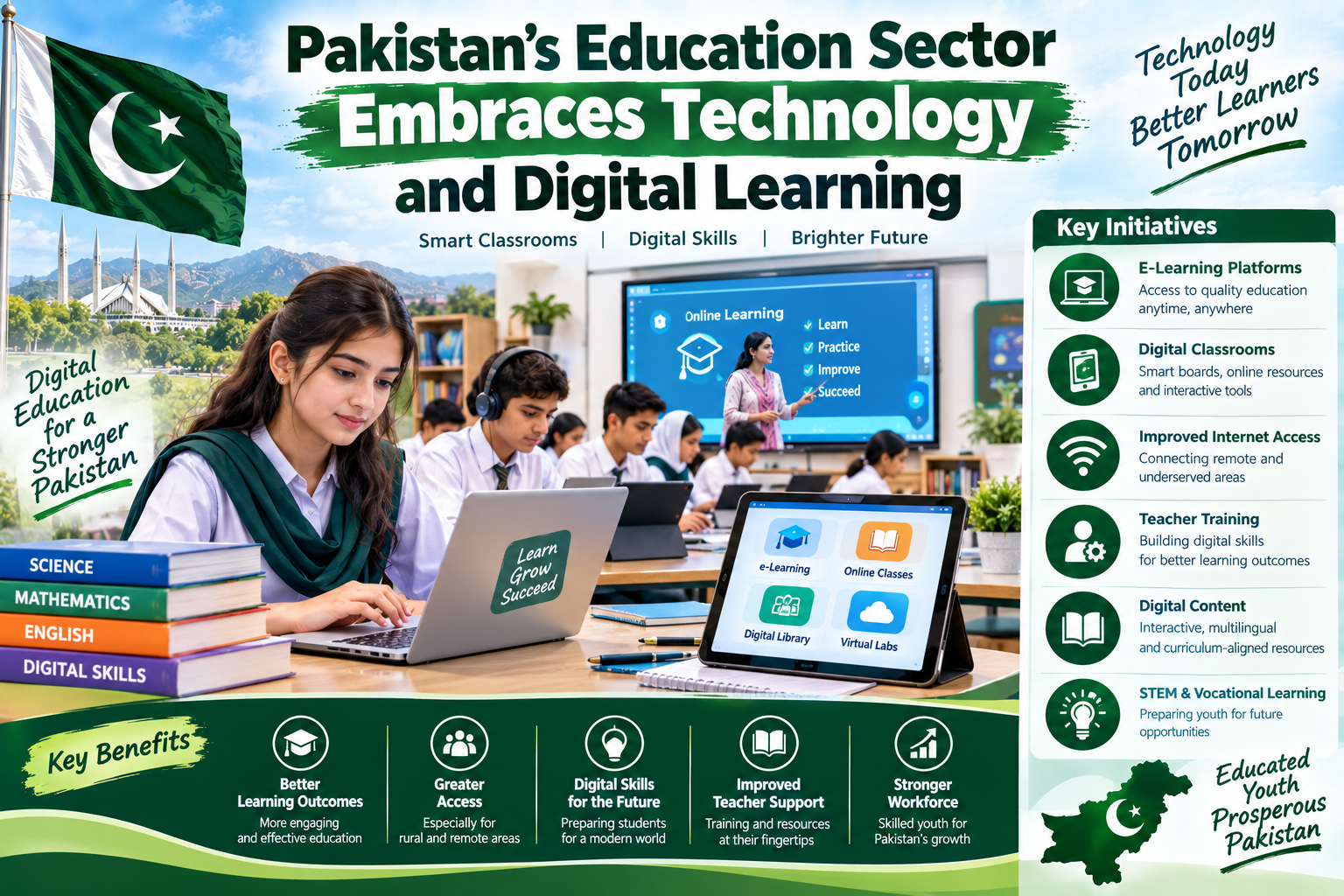
Technology is changing the way education is delivered, accessed, and experienced around the world, and Pakistan is also becoming increasingly connected with digital learning. Schools, colleges, universities, teachers, students, education organizations, and technology companies are exploring digital tools to make learning more accessible, flexible, interactive, and efficient.
For many years, traditional classroom education remained the primary method of learning in Pakistan. Students generally depended on textbooks, classroom lectures, notebooks, physical libraries, and face-to-face interaction with teachers. These methods remain important, but digital technology is creating additional opportunities for education.
Smartphones, computers, tablets, internet services, educational websites, video lessons, digital libraries, learning management systems, online assessments, and educational applications are becoming increasingly relevant to students.
Digital learning can be particularly useful when students need access to educational material outside the classroom. A student can watch a recorded lesson, read an online document, practice questions, research a topic, or communicate with a teacher through digital platforms.
Technology can also support teachers. Digital presentations, online resources, educational videos, assessment tools, and electronic records can help teachers organize lessons and monitor student progress.
However, digital education is not without challenges. Unequal access to devices, internet connectivity, electricity, digital literacy, teacher training, online safety, and the quality of digital content remain important issues.
Pakistan's education system therefore needs a balanced approach. Technology should complement teachers and traditional learning rather than simply replace them.
If digital learning is developed responsibly, it can help expand educational opportunities, support teachers, improve access to information, and prepare students for an increasingly digital economy.
The Growing Importance of Educational Technology
Educational technology refers to the use of digital tools and technologies to support teaching and learning.
It can include computers, smartphones, tablets, projectors, educational applications, online courses, digital libraries, video lectures, virtual classrooms, learning management systems, and interactive learning platforms.
Technology can make information easier to access.
A student studying science, mathematics, computer science, languages, or history can find additional educational material online.
Teachers can also access lesson plans, diagrams, videos, simulations, presentations, and other resources.
This creates an opportunity to make learning more diverse and interactive.
Digital Learning in Schools
Schools across Pakistan are gradually exploring digital learning.
Some institutions use computer laboratories, multimedia classrooms, digital presentations, online assignments, and educational applications.
Digital tools can make certain concepts easier to understand.
For example, a science teacher can use an animation to explain a complex process. A mathematics teacher can use interactive graphs. A geography teacher can use digital maps. A history teacher can show photographs, documentaries, and virtual tours of historical locations.
Technology does not automatically improve education, but when used appropriately, it can support better explanations and greater student engagement.
Online Classes
Online classes have become an important part of modern education.
Students can attend lessons through video-conferencing platforms and other online systems.
Online classes can be useful for students who cannot physically attend an institution for certain reasons.
They can also connect students with teachers and educational resources located in different cities.
However, online education requires reliable internet, suitable devices, quiet learning environments, and digital skills.
Students without these resources can face disadvantages.
Digital Learning After the Expansion of Internet Access
The expansion of internet access has changed the education environment.
Students can now access educational material from many different sources.
Search engines, educational websites, video platforms, digital libraries, and online courses can supplement textbooks.
This means learning is no longer limited to information available in a classroom or physical library.
However, the large amount of information online creates another challenge.
Students need to learn how to identify reliable sources and distinguish educational information from inaccurate or misleading content.
Digital literacy is therefore becoming an important part of modern education.
Smartphones as Learning Tools
Smartphones are among the most widely available digital devices.
A smartphone can provide access to educational videos, dictionaries, calculators, e-books, practice questions, research resources, and communication platforms.
Students can use educational applications to practice different subjects.
However, smartphones can also create distractions.
Social media, games, entertainment, and notifications can interrupt study time.
Students therefore need responsible digital habits.
Teachers and parents can help students understand how to use technology for productive purposes while maintaining a healthy balance.
Digital Libraries
Digital libraries can significantly expand access to educational resources.
A traditional library is limited by its physical collection and opening hours.
A digital library can provide access to books, research papers, reference materials, articles, and other resources through electronic devices.
Students in areas with limited physical library facilities may particularly benefit from online educational resources.
Digital libraries can also help university students and researchers access academic material.
E-Books and Digital Notes
E-books are becoming increasingly common.
Students can store multiple digital books on a computer, tablet, or smartphone.
Digital notes can also be organized and searched more easily than large collections of paper documents.
Some students prefer physical books, while others find digital material more convenient.
Both methods can coexist.
The important goal is ensuring that students can access quality learning material in a format that works for them.
Interactive Learning
Traditional lectures often require students to listen and take notes.
Digital tools can introduce more interactive approaches.
Students can complete quizzes, simulations, educational games, virtual experiments, and interactive exercises.
Interactive learning can help students actively participate in the learning process.
For example, a mathematics application can provide immediate feedback when a student solves a problem.
A language-learning application can provide pronunciation exercises.
A science simulation can allow students to observe concepts that may be difficult to demonstrate in a classroom.
Digital Assessment
Technology can also change how students are assessed.
Online quizzes can automatically calculate results.
Teachers can use digital platforms to assign homework and collect submissions.
Electronic assessment can save time and make record keeping easier.
However, online assessment must be designed carefully.
Schools need to consider academic integrity, technical problems, accessibility, and privacy.
Digital assessment should measure genuine understanding rather than simply students' ability to use technology.
Supporting Teachers Through Technology
Teachers remain central to education.
Technology should support teachers rather than make their role less important.
Digital resources can help teachers prepare lessons, create presentations, organize assignments, communicate with students, and monitor academic progress.
Teachers can also collaborate with colleagues through online platforms.
Professional development courses can help educators learn new teaching methods and digital skills.
Teacher Training
Successful digital education depends heavily on teacher training.
Providing computers or software is not enough.
Teachers need to know how to use technology effectively in the classroom.
Training can cover digital presentations, online assessment, educational applications, virtual classrooms, digital research, cybersecurity, and responsible use of artificial intelligence.
Teachers should also learn how to evaluate online educational resources.
A well-trained teacher can choose technology based on educational objectives rather than using technology simply because it is available.
Artificial Intelligence in Education
Artificial intelligence is becoming increasingly relevant to education.
AI-based tools can assist students with explanations, practice questions, language learning, brainstorming, and other educational activities.
Teachers may also use AI-supported tools for lesson planning, generating practice material, and organizing information.
However, students need clear guidance about responsible AI use.
AI-generated information can sometimes be incorrect or incomplete.
Students should learn to verify information and understand concepts rather than simply copying answers.
The purpose of technology should be to strengthen learning and critical thinking.
Personalized Learning
One potential benefit of digital education is personalized learning.
Traditional classrooms often contain students with different learning speeds and needs.
Digital platforms can sometimes allow students to practice material according to their level.
A student who understands a topic quickly can move forward, while another student can spend additional time practicing.
Personalized learning can help make education more flexible.
However, teachers remain important because learning difficulties often require human understanding and guidance.
Education in Rural Areas
Technology has the potential to support students in rural and remote areas.
Students in communities with limited educational resources may access online lectures, digital books, educational videos, and remote learning programmes.
However, this potential depends on infrastructure.
Poor internet connectivity, limited electricity, lack of devices, and insufficient digital skills can restrict access.
Digital education policies therefore need to address the digital divide.
The Digital Divide
The digital divide refers to differences in access to technology.
Some students may have smartphones, computers, fast internet, and private study spaces.
Others may share a single device with family members or have limited internet access.
This difference can influence educational opportunities.
If digital learning becomes a major part of education, institutions need strategies to ensure that students without advanced technology are not left behind.
Affordable devices, community digital centres, improved connectivity, and offline educational content can help reduce the gap.
Digital Learning and Girls' Education
Technology can create additional learning opportunities for girls.
Online educational resources can allow students to continue learning from home when physical access to educational institutions is difficult.
Digital courses can also provide access to subjects and instructors beyond the student's local area.
However, equal access to devices and internet services remains important.
Digital safety and privacy should also be part of educational programmes.
Language and Digital Education
Pakistan is linguistically diverse.
Students may learn in English, Urdu, and regional languages depending on their educational environment.
Digital educational content can help make learning resources available in multiple languages.
Simple explanations and subtitles can improve accessibility.
Developing high-quality educational material in Urdu and regional languages could help more students benefit from digital learning.
English Learning Through Technology
Technology can also support English language learning.
Students can use digital dictionaries, pronunciation tools, grammar exercises, listening activities, reading resources, and language-learning applications.
This can be particularly useful for students who have limited opportunities to practice English outside the classroom.
Digital language tools can provide repeated practice and immediate feedback.
Mathematics and Digital Tools
Mathematics is another subject where technology can provide useful support.
Students can use digital calculators, graphing tools, geometry applications, interactive exercises, and practice platforms.
Visual representations can make abstract mathematical concepts easier to understand.
However, students should still learn the underlying concepts.
Technology should support mathematical reasoning rather than replace it.
Science Education
Science education can benefit greatly from digital tools.
Animations, simulations, virtual laboratories, diagrams, videos, and interactive models can demonstrate concepts that are difficult to observe directly.
Students can explore topics such as physics, chemistry, biology, astronomy, and environmental science through digital resources.
Virtual simulations can provide additional practice when physical laboratory equipment is limited.
Computer Science Education
The growth of Pakistan's technology sector increases the importance of computer education.
Students can learn programming, web development, databases, artificial intelligence, cybersecurity, data science, and other digital skills.
Early exposure to computing can help students prepare for future academic and career opportunities.
Schools can support this development by providing computer laboratories, qualified teachers, and practical projects.
Digital Skills and Future Employment
The modern job market increasingly requires digital skills.
Employers may expect workers to understand computers, communication platforms, digital documents, data, online collaboration, and specialized software.
Students who develop strong digital skills during their education may have greater opportunities in areas such as information technology, e-commerce, freelancing, digital marketing, design, programming, and data-related fields.
Education and employment are therefore becoming increasingly connected with technology.
Online Courses
Online courses can provide learning opportunities beyond traditional institutions.
Students can study topics that may not be offered at their schools or colleges.
Online courses can cover languages, programming, business, mathematics, science, design, communication, and many other subjects.
They can also support lifelong learning.
However, students should choose credible courses and verify the quality of the information provided.
Digital Homework
Digital homework can make assignment management easier.
Teachers can upload instructions, students can submit work electronically, and teachers can provide feedback through digital platforms.
This can reduce paper usage and make assignments easier to organize.
However, schools should ensure that students without reliable internet access have alternative arrangements.
Communication Between Teachers and Students
Digital platforms can improve communication.
Teachers may share announcements, assignments, schedules, and educational resources electronically.
Students can ask questions or receive clarification through approved communication channels.
Clear boundaries and privacy policies are important to ensure that digital communication remains appropriate and professional.
Parents and Digital Education
Parents can also play a role in digital learning.
They can encourage responsible technology use, help students organize study schedules, and monitor online safety.
Parents do not necessarily need advanced technical knowledge.
Simple support, such as encouraging students to use reliable resources and maintain a balanced routine, can be valuable.
Cybersecurity Education
As students spend more time online, cybersecurity awareness becomes increasingly important.
Students should understand basic concepts such as strong passwords, privacy, suspicious links, phishing, account security, and responsible sharing of information.
Schools can incorporate cybersecurity education into computer studies.
Teaching students how to protect digital accounts is becoming as important as teaching them how to use digital tools.
Online Privacy
Privacy is another important issue.
Students may create accounts on educational platforms that collect personal information.
Schools and technology providers should handle student information responsibly.
Students should also learn not to share unnecessary personal information online.
Privacy education can help young people develop safer digital habits.
Educational Technology and Accessibility
Technology can improve accessibility for some students.
Features such as text-to-speech, captions, adjustable text size, recorded lectures, and digital documents can make learning resources more flexible.
Accessible design can help students with different learning requirements.
Educational technology should therefore be developed with diverse learners in mind.
Challenges of Digital Learning
Digital education offers many benefits, but several challenges remain.
Limited Internet Access
Some students do not have reliable internet connections.
Device Costs
Computers and smartphones can be expensive for some families.
Electricity Problems
Unreliable electricity can interrupt online learning.
Digital Literacy
Students and teachers may need training.
Distractions
Social media and entertainment can reduce concentration.
Content Quality
Not every online resource is accurate.
Privacy
Educational platforms may handle personal information.
Teacher Training
Teachers need support to use technology effectively.
These challenges need practical solutions.
Importance of Offline Learning Resources
Digital education should not depend entirely on continuous internet access.
Offline videos, downloaded lessons, electronic textbooks, educational software, and locally stored resources can help students with limited connectivity.
A mixed approach can make digital learning more resilient.
Public and Private Sector Cooperation
Government institutions, schools, universities, technology companies, and non-profit organizations can work together to expand digital education.
The public sector can focus on infrastructure, policy, teacher training, and access.
Private companies can provide technology, platforms, software, and innovation.
Universities can contribute research and teacher training.
Cooperation can help reduce duplication and improve educational outcomes.
Universities and Digital Transformation
Universities are increasingly using digital systems for admissions, course materials, assignments, communication, examinations, and research.
Learning management systems can help students access lectures and course materials.
Online libraries can support academic research.
Universities can also offer online and blended programmes.
Digital transformation can improve administrative efficiency while expanding access to educational resources.
Blended Learning
Blended learning combines traditional classroom teaching with digital education.
This approach can offer a balance between human interaction and technological convenience.
Students can attend physical classes while using online material for additional practice.
Teachers can explain concepts in class and provide digital exercises for revision.
Blended learning may be particularly suitable for institutions that want to introduce technology without completely replacing classroom education.
Future of Education in Pakistan
The future of Pakistani education is likely to involve greater integration of technology.
Smart classrooms, digital libraries, online learning platforms, AI-supported tools, virtual laboratories, electronic assessments, and digital communication may become more common.
However, technology should remain focused on educational goals.
The objective is not simply to put computers into classrooms.
The objective is to improve learning outcomes, increase access, support teachers, and prepare students for the future.
Preparing Students for a Digital Economy
Pakistan's future economic growth will increasingly depend on knowledge and technology.
Students therefore need more than textbook knowledge.
They need problem-solving skills, communication abilities, digital literacy, creativity, collaboration, and critical thinking.
Educational institutions can prepare students by combining academic learning with practical digital skills.
This can help young people participate in Pakistan's growing technology and services sectors.
Conclusion
Pakistan's education sector is gradually embracing technology and digital learning as part of a broader transformation in the way knowledge is accessed and delivered.
Digital tools can provide students with educational videos, online courses, digital libraries, interactive exercises, electronic books, research resources, and communication platforms.
Teachers can benefit from digital lesson materials, assessment systems, professional training, and improved classroom resources.
Technology can also help extend educational opportunities to students in remote areas, although this depends on solving challenges related to internet connectivity, electricity, device affordability, and digital literacy.
The digital divide remains one of the most important issues. A student with a fast internet connection and personal computer has different opportunities from a student who has limited access to technology. Pakistan's digital education policies must therefore focus on inclusion.
Teacher training is equally important. Technology is only effective when educators know how to use it for meaningful learning.
Cybersecurity, privacy, responsible AI use, and digital literacy should also become important parts of modern education.
The future is likely to involve blended learning rather than a complete replacement of traditional classrooms. Teachers will continue to provide guidance, explanation, motivation, and human interaction, while technology will provide additional resources and flexibility.
Pakistan's young population provides a major opportunity. If students receive strong academic foundations alongside digital skills, they can participate in areas such as software development, artificial intelligence, freelancing, e-commerce, digital marketing, cybersecurity, research, and other technology-driven industries.
Educational technology can therefore contribute not only to better learning but also to Pakistan's broader economic development.
The successful digital transformation of education will require cooperation among government institutions, schools, colleges, universities, teachers, parents, technology companies, and communities.
With better infrastructure, affordable access, quality digital content, trained teachers, strong cybersecurity, and inclusive policies, Pakistan can use technology to create a more accessible and future-ready education system.
Digital learning is not simply about replacing books with screens. It is about giving students more opportunities to learn, explore, practice, create, and prepare for a rapidly changing world.
Frequently Asked Questions (FAQs)
1. How is technology changing education in Pakistan?
Technology is providing students and teachers with online classes, digital libraries, educational applications, interactive resources, electronic assessments, and other learning tools.
2. What are the benefits of digital learning?
Digital learning can provide flexible access to educational material, interactive learning experiences, online courses, research resources, and additional support outside traditional classrooms.
3. What are the main challenges of digital education in Pakistan?
Major challenges include limited internet access, device affordability, electricity problems, digital literacy, teacher training, online distractions, privacy, and cybersecurity.
4. Can technology replace teachers?
Technology is better viewed as a tool that supports teachers rather than completely replacing them. Teachers provide guidance, explanation, motivation, feedback, and human interaction that technology cannot fully reproduce.
5. What is the future of digital education in Pakistan?
The future is likely to include greater use of blended learning, digital libraries, online platforms, smart classrooms, artificial intelligence, virtual resources, and technology-based skills training.




