Introduction
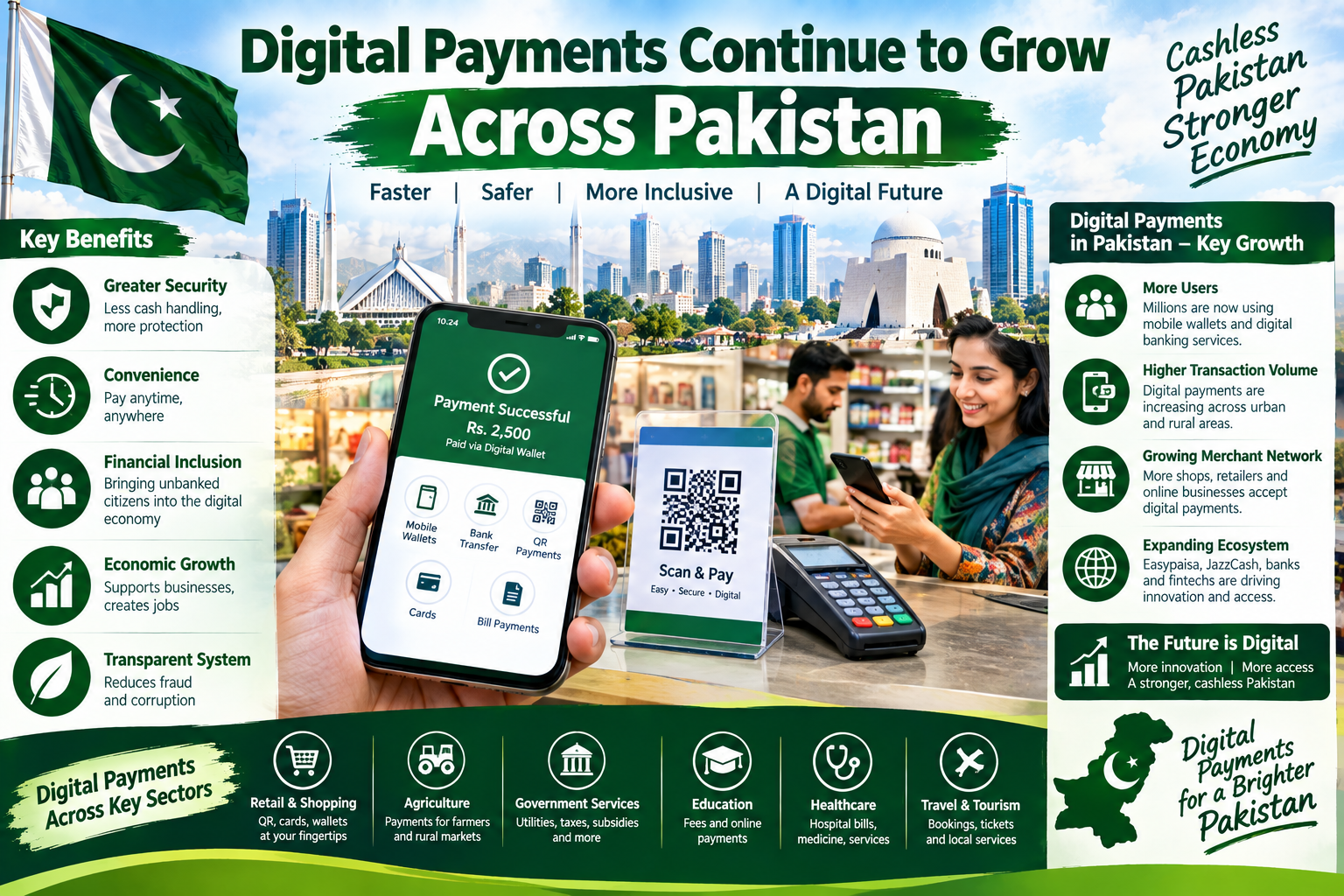
Digital payments are becoming an increasingly important part of Pakistan's modern economy. As smartphones, internet access, mobile banking applications, digital wallets, QR payments, cards, and online shopping become more common, people are gradually changing the way they send, receive, save, and spend money.
For many years, cash remained the dominant method of payment in Pakistan. People commonly relied on physical currency for shopping, utility bills, transportation, school fees, business transactions, and everyday expenses. However, the growth of digital technology is creating new alternatives that can make financial transactions faster and more convenient.
Digital payments allow individuals and businesses to transfer money without physically exchanging cash. Customers can pay through mobile applications, bank accounts, cards, QR codes, and other electronic methods. Small businesses can receive payments directly into digital accounts, while consumers can pay bills and purchase products without visiting a bank or carrying large amounts of cash.
The expansion of digital payments is also connected to broader financial inclusion. People who previously had limited access to traditional banking services can increasingly use mobile-based financial tools. This can help connect more citizens with the formal financial system.
Pakistan's large young population also provides significant potential for digital financial services. Young consumers are generally comfortable using smartphones and online platforms, making them an important part of the country's digital economy.
At the same time, the growth of digital payments brings challenges. Cybersecurity, fraud awareness, internet access, digital literacy, privacy, transaction reliability, and trust remain important concerns.
For digital payments to grow sustainably, users need secure platforms, clear information, reliable infrastructure, strong consumer protection, and confidence in electronic transactions.
What Are Digital Payments?
Digital payments are transactions in which money is transferred electronically rather than through physical cash.
A digital payment can take many forms. A customer may pay a shopkeeper using a QR code, transfer money through a banking application, use a debit or credit card, or send funds through a digital wallet.
Online businesses can receive payments electronically from customers. Utility bills can be paid through mobile applications. Individuals can transfer money to family members without visiting a bank branch.
The main idea is simple: instead of physically exchanging currency, the payment is completed through an electronic financial system.
Growth of Mobile Banking
Mobile banking has become one of the most important drivers of digital payments in Pakistan.
Banking applications allow customers to perform many basic transactions from their phones. Depending on the service, users may be able to transfer money, pay bills, check balances, manage accounts, and make other financial transactions.
This reduces the need to visit a physical bank branch for routine activities.
Mobile banking is particularly useful for people who live far from bank branches or have busy schedules.
As smartphone ownership and internet connectivity increase, mobile banking can become an increasingly important part of everyday financial activity.
Digital Wallets
Digital wallets provide another method for electronic payments.
A digital wallet can allow users to store funds electronically and use them for transfers, bills, shopping, and other transactions supported by the service.
Wallets can be especially useful for people who may not regularly use traditional bank accounts.
They can also provide small businesses with convenient ways to receive payments.
The simplicity of mobile-based wallets makes them an important component of financial inclusion.
QR Code Payments
QR codes are increasingly visible in modern payment systems.
A customer can scan a QR code using a compatible application and complete a payment electronically.
For businesses, QR payments can reduce dependence on cash handling.
Small retailers can potentially accept electronic payments without needing complicated equipment.
QR systems can also be useful for restaurants, stores, service providers, educational institutions, and other organizations.
As awareness increases, QR-based payments could become a more common feature of everyday commerce.
Benefits for Consumers
Digital payments offer several benefits to consumers.
Convenience
People can make payments without carrying large amounts of cash.
Speed
Many electronic transactions can be completed within a short period.
Record Keeping
Digital transactions can create electronic records that help users track spending.
Accessibility
Mobile financial services can make certain financial activities available outside traditional banking hours.
Remote Transactions
People can send money to family members or pay for services without physically visiting a location.
These advantages can make digital payments attractive to consumers who have access to reliable digital services.
Benefits for Small Businesses
Small businesses are an important part of Pakistan's economy.
Retail shops, restaurants, home-based businesses, freelancers, service providers, and online sellers can all benefit from digital payment systems.
Electronic payments can reduce the need to keep large amounts of cash at business locations.
They can also make it easier for online businesses to receive customer payments.
A small business can potentially serve customers beyond its immediate physical area when it combines digital payments with online marketing and delivery services.
Digital Payments and E-Commerce
The growth of e-commerce is closely connected with digital payments.
Online customers need convenient ways to pay for products and services.
Digital payment systems can make online transactions easier by allowing customers to transfer funds electronically or use payment cards and other supported methods.
As more Pakistanis become comfortable with online shopping, the demand for reliable digital payment systems can increase.
E-commerce businesses also benefit from faster payment confirmation and electronic transaction records.
Supporting Freelancers
Pakistan has a growing community of freelancers and digital workers.
Graphic designers, programmers, writers, video editors, virtual assistants, digital marketers, and other professionals can work with clients located in different cities and countries.
Digital financial services can help these workers receive and manage payments.
Reliable payment systems are particularly important for freelancers because their income may come from multiple clients and platforms.
Improving digital financial infrastructure can therefore support Pakistan's broader information technology and services economy.
Digital Payments and the IT Sector
Pakistan's technology sector can benefit from the expansion of digital financial services.
Software developers, cybersecurity professionals, data specialists, financial technology companies, and digital service providers can develop new solutions for consumers and businesses.
Financial technology, often called fintech, combines finance and technology to provide new financial services.
The growth of fintech can encourage innovation and create employment opportunities for technology professionals.
Financial Inclusion
Financial inclusion means increasing access to useful and affordable financial services.
Digital payments can contribute to financial inclusion by providing alternatives to traditional banking.
A person who does not frequently visit a bank branch may still be able to access certain financial services through a mobile phone.
This can be particularly valuable for people in areas where physical banking infrastructure is limited.
However, digital inclusion depends on more than having an application.
People also need smartphones or suitable devices, internet connectivity, digital literacy, identification systems, and confidence in using financial technology.
Rural Areas and Digital Payments
Digital payments have potential benefits for rural communities.
Agricultural workers, farmers, small retailers, transport providers, and local businesses can use electronic transactions when appropriate services are available.
Farmers may eventually benefit from digital systems for receiving payments, purchasing inputs, and accessing financial services.
Rural adoption depends heavily on connectivity and digital literacy.
Improving telecommunications infrastructure can therefore support financial inclusion alongside other aspects of digital development.
Reducing Dependence on Cash
Cash remains important in Pakistan, but digital payments provide an alternative.
Reducing unnecessary dependence on physical cash can make some transactions more convenient.
Businesses may spend less time handling and counting cash.
Consumers may have easier access to transaction histories.
Digital transactions can also make certain payments easier to track.
However, cash will not disappear immediately.
Many people still prefer cash because of familiarity, accessibility, or concerns about digital technology.
A successful digital payment ecosystem should therefore focus on providing reliable alternatives rather than assuming that everyone will immediately stop using cash.
Digital Payments for Utility Bills
Utility bill payments are another area where digital services can provide convenience.
Consumers may be able to pay electricity, gas, water, telephone, and internet bills through banking applications or other supported platforms.
This can save time and reduce the need to stand in long queues.
Digital payment records can also make it easier for customers to confirm that a payment has been completed.
Digital Payments in Education
Educational institutions can also benefit from electronic payment systems.
Parents and students may be able to pay fees through online banking or other digital channels.
Schools, colleges, and universities can reduce manual payment processing by adopting secure electronic systems.
Digital payments can also make record management more efficient.
However, institutions should ensure that students and families who have limited digital access are not unfairly excluded.
Digital Payments in Healthcare
Healthcare providers can use digital payments for consultations, laboratory services, medicines, and other expenses where appropriate.
Electronic payment systems can simplify transactions for hospitals, clinics, pharmacies, and patients.
Digital receipts can also improve record keeping.
Security and privacy are particularly important in healthcare environments because financial transactions may be connected with sensitive personal information.
Digital Payments and Transportation
Transportation is another area where digital payments can become useful.
Electronic payment systems can support online ticketing, ride services, parking, and other transportation-related transactions.
Digital ticketing can make travel planning easier.
As cities become more digitally connected, integrated payment systems may eventually allow people to use electronic methods across multiple transportation services.
Role of Banks
Banks remain important participants in Pakistan's digital payment ecosystem.
They provide accounts, mobile applications, cards, transfers, and other financial services.
Banks also have an important responsibility to maintain security and educate customers about safe digital transactions.
Strong authentication, transaction monitoring, customer support, and fraud detection can help build trust.
Banks can also cooperate with fintech companies to develop innovative financial services.
Role of Fintech Companies
Fintech companies can introduce new approaches to payments.
They may develop digital wallets, payment gateways, merchant solutions, financial applications, and other technology-based services.
Competition can encourage innovation and improve customer experiences.
However, fintech companies need to operate responsibly.
Clear terms and conditions, transparent fees, strong cybersecurity, customer support, and regulatory compliance are important for sustainable growth.
Cybersecurity and Digital Payments
Cybersecurity is one of the most important issues associated with digital finance.
As more people use electronic payments, criminals may attempt to steal account information, passwords, verification codes, or other sensitive details.
Users should therefore understand basic digital safety.
They should avoid sharing passwords or one-time verification codes with other people.
They should be cautious about suspicious messages and links.
Financial institutions should also continuously improve security systems.
Cybersecurity is not only a technical issue. It is also an education issue.
Users who understand common scams are better prepared to protect their accounts.
Importance of Digital Literacy
Digital literacy means knowing how to use digital technology safely and effectively.
People who are new to digital payments may need guidance.
Banks, educational institutions, government organizations, and technology companies can provide awareness programmes.
Simple instructions in local languages can make financial technology more accessible.
Digital literacy programmes can explain topics such as password security, fraud awareness, transaction verification, and privacy.
Building Consumer Trust
Trust is essential for digital payment adoption.
People need to believe that their money will reach the correct destination and that their personal information will be protected.
Payment platforms can build trust through reliable services, transparent fees, strong customer support, clear transaction notifications, and effective dispute-resolution systems.
If users repeatedly experience failed transactions or poor customer service, they may return to cash.
Reliability is therefore as important as innovation.
Digital Payments and Women
Digital financial services can provide convenient ways for women to manage personal or household financial transactions.
Women who operate home-based businesses can also use electronic payments to receive money from customers.
Digital financial services can support entrepreneurship by connecting small businesses with wider markets.
However, digital inclusion requires access to devices, connectivity, knowledge, and secure accounts.
Youth and Digital Finance
Pakistan's young population represents a major opportunity for digital financial services.
Young people are often early adopters of smartphones, social media, e-commerce, and online services.
Students can use digital tools for educational payments, subscriptions, online purchases, and other legitimate transactions.
Young entrepreneurs can also build businesses around digital commerce and technology.
Digital financial education can help young people develop responsible money-management habits.
Digital Payments and Transparency
Electronic transactions can create digital records.
These records can make it easier for individuals and businesses to review financial activity.
For businesses, electronic records may simplify accounting and financial management.
For consumers, transaction histories can help monitor spending.
Greater transparency can contribute to more organized financial activity.
However, digital records also create privacy responsibilities.
Financial information should be protected from unauthorized access.
Challenges Facing Digital Payments
Despite their benefits, digital payments face several challenges in Pakistan.
These include:
Limited digital literacy
Internet connectivity problems
Fear of fraud
Lack of trust
Transaction failures
Limited acceptance by some small businesses
Privacy concerns
Device affordability
Service fees
Lack of awareness
Addressing these issues is necessary for wider adoption.
Internet Connectivity
Reliable internet access is essential for many digital payment services.
Users in areas with weak connectivity may experience difficulties completing transactions.
Expanding high-quality telecommunications infrastructure can therefore support digital payments.
Offline or low-connectivity solutions may also become important for reaching underserved communities.
Merchant Adoption
Digital payments become more useful when businesses accept them.
Large retailers may already offer multiple payment methods, but some small businesses may still rely primarily on cash.
Merchant education can help businesses understand the benefits of digital payments.
Simple onboarding processes and affordable payment solutions can encourage more retailers to participate.
Transaction Costs
Fees can influence whether consumers and businesses choose digital payments.
If electronic transactions become too expensive, users may prefer cash.
Transparent pricing is therefore important.
Payment providers should clearly explain applicable charges so that customers understand the cost before completing transactions.
Government's Role
Government institutions can support digital payment growth by developing appropriate policies, improving digital infrastructure, encouraging financial inclusion, and strengthening consumer protection.
Public institutions can also digitize their own payment systems.
Government services, taxes, fees, and other transactions can potentially become more convenient through digital channels.
At the same time, regulations need to balance innovation with security and consumer protection.
Digital Payments and the Formal Economy
Digital payments can contribute to the development of a more organized financial economy.
Electronic transactions create records and can help businesses maintain clearer financial accounts.
For small enterprises, digital payment histories may eventually support access to financial services when appropriate.
However, digitalization should be accompanied by education and fair policies.
The objective should be to encourage productive economic activity rather than simply increase the number of electronic transactions.
Future of Digital Payments in Pakistan
The future of digital payments is likely to involve greater integration.
Banking applications, digital wallets, e-commerce platforms, QR systems, cards, and business software may become increasingly interconnected.
Artificial intelligence and data analytics may also help financial institutions detect unusual transactions and improve customer services.
Biometric authentication and other security technologies may further strengthen digital financial systems.
The key will be ensuring that innovation remains secure, accessible, affordable, and easy to understand.
Digital Payments and Economic Growth
A strong digital payment ecosystem can support economic activity by making transactions more convenient.
Businesses can receive payments more efficiently.
Consumers can purchase goods and services through electronic channels.
Freelancers can participate in the digital economy.
Entrepreneurs can build online businesses.
Financial institutions can develop new products.
These developments can contribute to a broader digital transformation of Pakistan's economy.
Creating a Digital Payment Culture
Technology alone cannot create a successful digital payment ecosystem.
People need to develop confidence in electronic transactions.
Businesses need to accept digital payments.
Banks and fintech companies need to provide reliable services.
Government institutions need to create supportive policies.
Educational institutions need to promote digital financial literacy.
Together, these efforts can create a stronger culture of responsible digital payments.
Conclusion
Digital payments are becoming an important part of Pakistan's economic and technological transformation. Mobile banking, digital wallets, QR payments, cards, online banking, and e-commerce are providing people with alternatives to traditional cash-based transactions.
The growth of digital payments can benefit consumers by offering convenience, speed, transaction records, and remote access to financial services. Businesses can benefit from easier payment collection, improved record keeping, and opportunities to participate in e-commerce.
Digital payments can also contribute to financial inclusion by bringing certain financial services closer to people who may have limited access to traditional banking infrastructure.
Pakistan's young population, growing technology sector, expanding e-commerce market, and increasing smartphone use provide a strong foundation for continued digital payment adoption.
At the same time, important challenges must be addressed. Cybersecurity, fraud, privacy, transaction reliability, internet connectivity, digital literacy, service costs, and consumer trust can all influence adoption.
Users need education about safe digital financial practices. Banks and fintech companies need strong security systems and responsive customer support. Businesses need simple and affordable ways to accept electronic payments. Government institutions need policies that encourage innovation while protecting consumers.
Digital payments should not simply be viewed as a replacement for cash. They are part of a broader transformation in how people participate in the economy.
As Pakistan continues to expand its digital infrastructure, electronic payments can support entrepreneurs, freelancers, retailers, consumers, students, and businesses across the country.
The future success of digital payments will depend on accessibility, reliability, security, affordability, and trust.
If these factors are strengthened, digital payments can play an important role in Pakistan's journey toward a more connected, inclusive, and digitally enabled economy.
Frequently Asked Questions (FAQs)
1. What are digital payments?
Digital payments are electronic financial transactions made without physically exchanging cash, including mobile transfers, QR payments, cards, online banking, and digital wallets.
2. Why are digital payments growing in Pakistan?
The growth of smartphones, internet access, mobile banking, e-commerce, digital wallets, and financial technology is contributing to increased use of digital payments.
3. How can digital payments help small businesses?
Digital payments can make it easier for small businesses to receive money, maintain transaction records, serve online customers, and reduce dependence on physical cash.
4. Are digital payments secure?
Digital payments can be secure when reliable platforms and appropriate security measures are used. Users should also protect passwords and verification codes and remain alert to suspicious messages or links.
5. What is the future of digital payments in Pakistan?
Digital payments are likely to become more integrated with banking, e-commerce, mobile applications, QR systems, and other digital services as Pakistan's digital infrastructure continues to develop.