Introduction
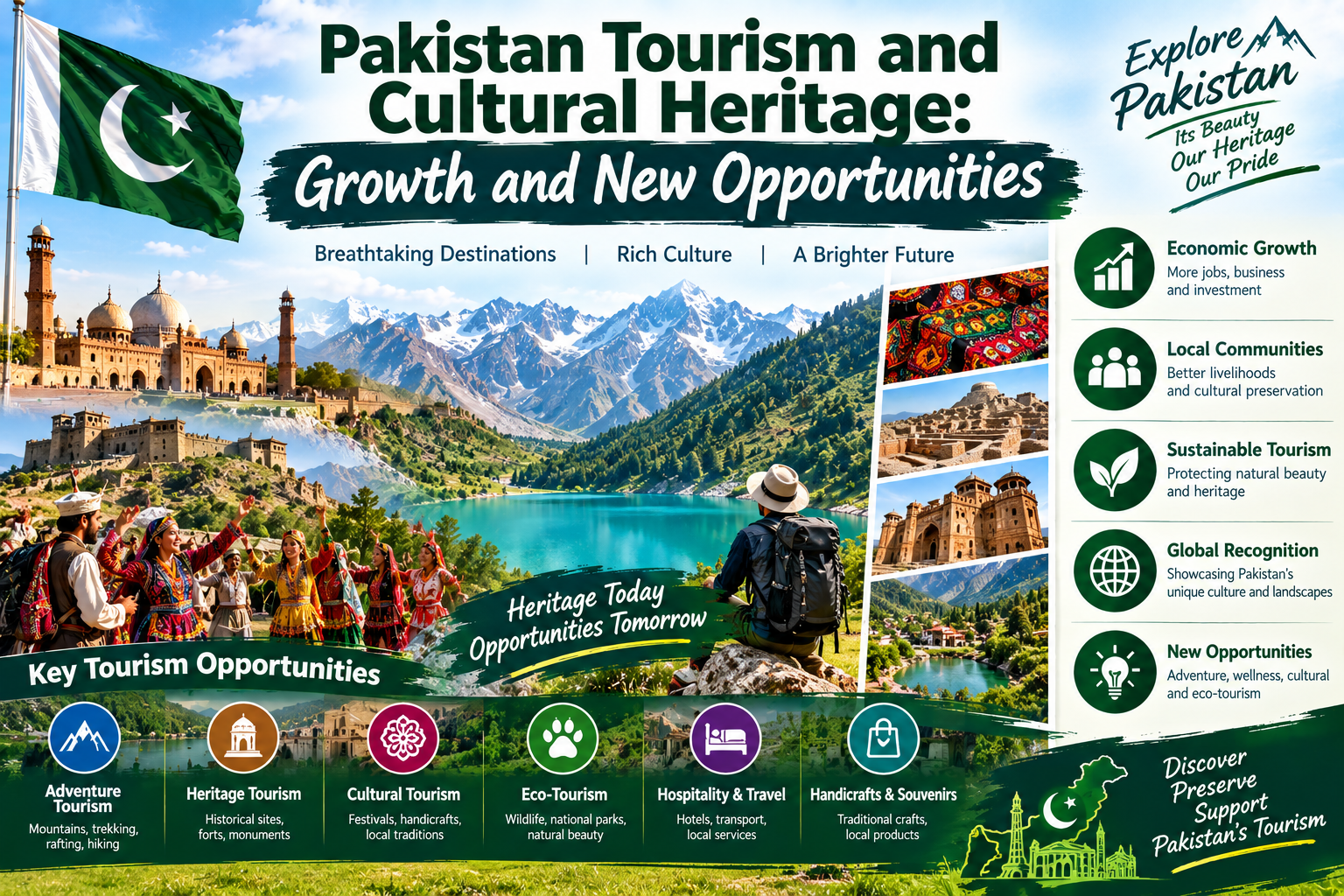
Pakistan is a country with remarkable natural beauty, diverse cultures, ancient civilizations, historic landmarks, and a wide range of landscapes. From the snow-covered mountains of the north to the deserts of Sindh and Balochistan, from the historic streets of Lahore to the coastal areas of Karachi and Gwadar, the country offers a broad variety of tourism opportunities.
Tourism has the potential to contribute significantly to Pakistan's economy. It can create employment, support small businesses, encourage investment, generate income for local communities, and improve international awareness of the country. It can also help preserve historical sites and cultural traditions when tourism is developed responsibly.
Pakistan's tourism sector has received increasing attention as authorities, businesses, local communities, and tourism organizations work to improve destinations, infrastructure, visitor services, digital promotion, and cultural preservation.
The country's cultural heritage is equally important. Pakistan is home to archaeological sites associated with ancient civilizations, historic mosques, forts, shrines, monuments, traditional crafts, music, food, languages, and festivals. Protecting this heritage can strengthen national identity while creating opportunities for cultural tourism.
However, tourism development also faces challenges. Infrastructure, transportation, cleanliness, safety, environmental protection, accommodation, destination management, and international perceptions all influence the visitor experience.
A successful tourism strategy must therefore go beyond promoting beautiful locations. Pakistan needs to make destinations accessible, safe, clean, well-managed, and attractive for both domestic and international visitors.
The future of Pakistani tourism can become particularly promising if natural tourism, cultural tourism, adventure tourism, religious tourism, eco-tourism, and community-based tourism are developed together.
Pakistan's Tourism Potential
Pakistan's geography gives it extraordinary tourism potential.
The northern regions are famous for mountains, valleys, lakes, glaciers, and scenic landscapes. Gilgit-Baltistan, Khyber Pakhtunkhwa, and northern Punjab offer opportunities for trekking, hiking, camping, sightseeing, and adventure tourism.
Punjab has a rich historical and cultural heritage. Lahore contains major monuments, gardens, museums, mosques, and historic areas.
Sindh offers ancient archaeological sites, historic cities, deserts, cultural traditions, and coastal destinations.
Balochistan has dramatic coastlines, mountains, deserts, and distinctive cultural landscapes.
Islamabad and surrounding areas offer a combination of modern urban attractions and natural scenery.
This diversity means Pakistan does not need to depend on one particular type of tourism.
Different destinations can attract different categories of visitors throughout the year.
Tourism and Economic Development
Tourism can contribute to economic development in several ways.
Hotels require employees.
Restaurants purchase food from suppliers.
Tour operators employ guides and drivers.
Transport companies benefit from visitors.
Local shops sell handicrafts, clothing, food, and souvenirs.
Photographers, content creators, travel agencies, and digital businesses can also benefit from tourism.
This creates a multiplier effect.
A visitor spending money in a tourist destination can support several different businesses.
Tourism can therefore be particularly useful for smaller cities and rural communities where employment opportunities may be limited.
Supporting Local Communities
Community participation is essential for sustainable tourism.
Local residents should not simply watch tourists arrive while most of the economic benefits leave the area.
They should have opportunities to operate hotels, restaurants, shops, transport services, tour companies, handicraft businesses, and cultural experiences.
Community-based tourism can help ensure that tourism income remains within local economies.
Training programmes can teach residents hospitality, language, guiding, digital marketing, food safety, and business management skills.
When local people benefit financially from tourism, they may also have stronger incentives to protect natural and cultural resources.
Cultural Heritage of Pakistan
Pakistan's cultural heritage extends across thousands of years.
The country contains archaeological remains from ancient civilizations, including important sites associated with the Indus Valley Civilization.
Historic cities and monuments also reflect centuries of Islamic, Mughal, Sikh, British, and regional history.
The country's cultural diversity is visible in architecture, clothing, languages, food, music, crafts, festivals, and traditional lifestyles.
This heritage creates enormous opportunities for cultural tourism.
Visitors are often interested not only in landscapes but also in stories, traditions, architecture, cuisine, and historical experiences.
Mohenjo-daro and Ancient Heritage
Mohenjo-daro is one of Pakistan's most important archaeological sites.
Located in Sindh, it is associated with the ancient Indus Valley Civilization and provides evidence of sophisticated urban planning, drainage systems, architecture, and organized community life.
The site has enormous historical value.
Protecting archaeological locations such as Mohenjo-daro is essential because environmental conditions, weather, human activity, and inadequate conservation can damage ancient structures.
Tourism can help raise awareness about these sites, but visitor management must be carefully planned.
The goal should be to allow people to experience history while protecting archaeological remains for future generations.
Lahore's Cultural Heritage
Lahore is one of Pakistan's most important cultural tourism destinations.
The city contains historic landmarks including Lahore Fort, Badshahi Mosque, Wazir Khan Mosque, Shalimar Gardens, and other architectural sites.
The Walled City area provides visitors with opportunities to experience historic architecture, traditional markets, food, and urban culture.
Lahore's cultural identity is also connected to literature, music, art, cuisine, and festivals.
Improving pedestrian areas, signage, cleanliness, conservation, public transport, and visitor information can make cultural tourism more accessible.
Historic districts can also benefit from carefully designed restoration programmes.
Taxila and Gandhara Heritage
Taxila is another important heritage destination.
The region contains archaeological remains associated with Gandhara civilization and ancient Buddhist culture.
It has importance not only for Pakistan but also for international visitors interested in archaeology, Buddhism, ancient history, and South Asian civilization.
Better museums, visitor centres, interpretation services, signage, and digital information can help visitors understand the significance of the area.
Cultural tourism can also create opportunities for researchers, historians, students, and educational groups.
Religious Tourism
Pakistan has many sites associated with different religious traditions.
Islamic heritage includes mosques, shrines, historical madrasas, and Sufi sites.
The country also has important Sikh, Hindu, Buddhist, and Christian heritage.
Religious tourism can therefore contribute to cultural understanding and international exchange.
Well-managed religious tourism requires proper facilities, transportation, accommodation, security, cleanliness, and respect for religious practices.
International visitors should be provided with clear information and appropriate assistance.
Adventure Tourism
Pakistan's mountains make it particularly attractive for adventure tourism.
The country is home to some of the world's highest peaks, including K2.
Mountaineering, trekking, hiking, camping, rafting, paragliding, and other activities can attract domestic and international visitors.
Adventure tourism can generate significant economic opportunities for mountain communities.
Local guides, porters, transport providers, hotels, restaurants, equipment suppliers, and tour companies can all benefit.
However, adventure tourism requires strong safety standards.
Weather conditions can change rapidly in mountainous areas.
Visitors need reliable information, trained guides, emergency services, and appropriate infrastructure.
Tourism in Northern Pakistan
The northern areas are among Pakistan's most famous tourist destinations.
Hunza, Skardu, Swat, Naran, Kaghan, Chitral, and other destinations attract visitors because of their mountains, valleys, rivers, lakes, and cultural landscapes.
Tourism has expanded significantly in many northern destinations.
This growth creates economic opportunities but also challenges.
Road congestion, waste management, pressure on water resources, construction, and environmental degradation can increase when visitor numbers rise rapidly.
Sustainable destination planning is therefore essential.
Eco-Tourism
Eco-tourism focuses on experiencing nature while minimizing environmental impact.
Pakistan has many areas where eco-tourism can be developed.
National parks, forests, wetlands, mountains, deserts, and coastal areas can attract nature-loving visitors.
Eco-tourism can support conservation when tourism revenue contributes to protecting natural resources.
Visitors can also learn about wildlife, forests, local ecosystems, and environmental issues.
However, eco-tourism must be carefully managed.
Too many visitors, plastic waste, uncontrolled construction, vehicle traffic, and disturbance of wildlife can damage the very environments that attract tourists.
Environmental Challenges
Tourism can create environmental pressure if it grows without proper planning.
Plastic waste is a major issue in popular destinations.
Water consumption can increase during peak tourist seasons.
Construction can affect landscapes.
Vehicle traffic can contribute to pollution and congestion.
Mountain ecosystems can be particularly fragile.
Pakistan therefore needs strong waste-management systems, environmental regulations, responsible construction standards, and public awareness campaigns.
Tourists also have a role to play by respecting local environments and avoiding littering.
Improving Tourism Infrastructure
Infrastructure is one of the most important factors influencing tourism.
Visitors need reliable roads, public transportation, hotels, restaurants, bathrooms, internet connectivity, medical services, and information centres.
Road improvements can make remote destinations more accessible.
Air connectivity can help international and domestic visitors reach distant areas more quickly.
Railways can support cultural tourism between major cities.
Digital maps and tourism applications can make navigation easier.
Infrastructure development should be planned carefully to avoid environmental damage.
Hotels and Hospitality
The hospitality industry is an important part of tourism.
Visitors need accommodation that matches different budgets and preferences.
Pakistan has hotels, guesthouses, resorts, campsites, and homestays across major tourism regions.
Improving hospitality standards can increase visitor satisfaction.
Staff training is important.
Employees should understand customer service, cleanliness, food safety, communication, emergency procedures, and cultural sensitivity.
Local families can also participate through regulated homestay programmes.
Homestays allow visitors to experience local culture while providing direct income to communities.
Digital Tourism Promotion
Social media has changed the way people discover travel destinations.
Photos, videos, blogs, short-form content, and online reviews can influence tourism decisions.
Pakistan can use digital platforms to promote lesser-known destinations.
Official tourism websites and digital campaigns can provide information about transportation, weather, attractions, accommodation, safety, and local regulations.
High-quality visual storytelling can also help international audiences understand Pakistan beyond common stereotypes.
Digital promotion should be accurate and responsible.
Visitors need realistic information rather than exaggerated claims.
Role of Pakistani Travel Content Creators
Travel bloggers, photographers, vloggers, and social-media creators have become important contributors to tourism promotion.
They can introduce destinations to large audiences at relatively low cost.
Their content can highlight local food, landscapes, historical places, festivals, and cultural experiences.
Responsible content creation is important.
Creators should avoid damaging natural areas, disrespecting cultural sites, or encouraging unsafe behaviour.
They can instead promote responsible tourism and environmental awareness.
Cultural Festivals and Events
Festivals can attract tourists while celebrating local traditions.
Pakistan has a variety of cultural events involving music, food, crafts, sports, literature, and traditional celebrations.
Well-organized cultural festivals can create business opportunities for local vendors, artisans, performers, hotels, and restaurants.
They can also encourage younger generations to learn about traditional culture.
Cultural events can become major tourism attractions when properly promoted and organized.
Traditional Handicrafts
Handicrafts are an important part of Pakistan's cultural identity.
Different regions are known for textiles, embroidery, pottery, woodwork, carpets, jewelry, truck art, and other traditional crafts.
Tourism can provide markets for these products.
Visitors often want souvenirs that represent the culture of the places they visit.
Digital commerce can further expand the market for Pakistani handicrafts.
Artisans can sell products to customers outside their local communities and even internationally.
Pakistani Cuisine as a Tourism Attraction
Food is another major component of cultural tourism.
Pakistan has diverse regional cuisines.
Punjab is known for dishes featuring rich flavours and traditional cooking styles.
Sindh has its own distinctive culinary traditions.
Khyber Pakhtunkhwa and Balochistan also offer unique dishes.
Northern areas have foods shaped by mountain lifestyles and local ingredients.
Food tourism can encourage visitors to explore local restaurants, food streets, markets, farms, and traditional cooking experiences.
Restaurants can also help promote Pakistani cuisine internationally.
Medical and Wellness Tourism
Pakistan has opportunities to develop medical and wellness tourism.
Affordable healthcare services, specialist expertise, traditional wellness practices, and rehabilitation services may attract visitors from selected international markets.
However, this sector requires strong quality standards, accreditation, patient safety, reliable hospitals, and professional marketing.
Wellness tourism can also include nature retreats, cultural experiences, and recreational destinations.
Educational Tourism
Pakistan's historical and archaeological sites can support educational tourism.
Schools and universities can organize educational trips to museums, archaeological sites, historic cities, and cultural centres.
International students and researchers may also visit Pakistan to study archaeology, history, architecture, anthropology, languages, and regional culture.
Better interpretation services and research facilities can strengthen this sector.
Improving Safety for Tourists
Safety is essential for tourism growth.
Visitors need confidence that they can travel safely between destinations and access help when necessary.
Tourist police and dedicated assistance services can improve visitor confidence.
Clear emergency numbers, information centres, road safety measures, and trained personnel can further improve the experience.
Safety information should be easily available through official websites and mobile applications.
Training Tourism Professionals
A strong tourism industry requires skilled workers.
Tour guides need knowledge of history and local culture.
Hotel employees need hospitality skills.
Drivers need road-safety awareness.
Tour operators need business and customer-service skills.
Digital marketers need knowledge of online promotion.
Training institutes can therefore support the growth of the tourism industry.
Foreign-language training can also help international tourism.
English, Arabic, Chinese, Turkish, and other language skills may be valuable depending on target markets.
Youth Employment Through Tourism
Tourism can create employment opportunities for young Pakistanis.
Young people can work as guides, photographers, chefs, hotel staff, travel planners, social-media managers, drivers, tour operators, and entrepreneurs.
Digital technology creates even more opportunities.
A young entrepreneur can promote a local destination through social media, develop travel content, or establish an online travel service.
Tourism can therefore connect traditional local economies with the digital economy.
Women and Tourism
Women can participate in tourism through hospitality, handicrafts, food businesses, photography, cultural education, digital marketing, and entrepreneurship.
Home-based businesses can benefit from tourism because visitors may purchase traditional food, clothing, crafts, and other products.
Training and access to markets can help women participate more actively in tourism-related economic activity.
Inclusive tourism development can strengthen household incomes and local economies.
Tourism and Rural Development
Tourism can diversify rural economies.
A village that depends mainly on agriculture may gain additional income through guesthouses, restaurants, handicrafts, guiding, transportation, and cultural experiences.
This can create opportunities outside traditional farming.
However, tourism should complement local communities rather than replace their traditional livelihoods.
Careful planning is necessary to prevent uncontrolled development.
Protecting Historic Buildings
Historic buildings are valuable cultural resources.
Poor maintenance, pollution, inappropriate construction, and uncontrolled commercial activity can damage heritage sites.
Conservation programmes should preserve original architecture while making sites safe and accessible.
Modern facilities can be introduced without destroying historical character.
Digital documentation, restoration expertise, and public awareness can support heritage protection.
Museums and Visitor Centres
Museums can play a major role in cultural tourism.
They provide context and help visitors understand historical objects, archaeological discoveries, art, and traditions.
Modern museums can use interactive displays, digital screens, audio guides, and multilingual information.
Visitor centres can provide maps, brochures, ticketing, guides, and information about nearby attractions.
Better interpretation can make historical sites more meaningful for visitors.
International Tourism Promotion
Pakistan can increase international tourism by targeting specific markets.
Mountain tourism may attract adventure travellers.
Religious tourism may attract visitors interested in Islamic, Sikh, Hindu, or Buddhist heritage.
Cultural tourism can appeal to historians and heritage enthusiasts.
Food tourism can attract travellers interested in culinary experiences.
Each market requires specialized promotion.
International tourism campaigns should highlight real strengths and provide practical travel information.
Domestic Tourism
Domestic tourism is equally important.
Millions of Pakistanis travel within the country for holidays, family visits, religious purposes, education, and recreation.
Domestic tourists can provide stable demand for hotels and restaurants.
Improving local destinations can therefore support tourism even when international visitor numbers fluctuate.
Affordable travel packages, improved transportation, and better destination management can encourage more domestic tourism.
Responsible Tourism
Responsible tourism means travelling in ways that respect local people, cultures, economies, and environments.
Visitors should avoid littering, damaging historical sites, disturbing wildlife, wasting water, or disrespecting local traditions.
Businesses should employ local people where possible and reduce environmental impact.
Governments should ensure that tourism development benefits communities.
Responsible tourism can help protect destinations for future generations.
Role of Government
Government agencies play an important role in tourism development.
They can improve infrastructure, regulate hotels, protect heritage sites, support local businesses, develop tourism policies, and promote destinations.
Coordination among federal, provincial, and local authorities is particularly important.
Tourism crosses administrative boundaries.
Visitors do not think in terms of government departments; they experience destinations as complete journeys.
Therefore, transportation, accommodation, security, cleanliness, heritage management, and environmental protection should be coordinated.
Role of the Private Sector
The private sector can provide investment and innovation.
Hotels, restaurants, tour companies, airlines, transport providers, technology businesses, and entertainment companies all contribute to tourism.
Private investment can create jobs and improve visitor services.
However, businesses should follow environmental, safety, labour, and heritage regulations.
Good cooperation between government and businesses can create a stronger tourism ecosystem.
Future of Tourism in Pakistan
Pakistan's tourism sector has significant long-term potential.
The country has natural landscapes, historical sites, cultural diversity, religious heritage, traditional cuisine, and adventure opportunities.
The challenge is converting potential into a sustainable tourism industry.
This requires better infrastructure, professional services, digital promotion, environmental protection, heritage conservation, safety, and community participation.
The tourism industry can also benefit from improved connectivity.
Better roads, airports, railways, internet access, and digital booking systems can make travel easier.
At the same time, tourism development should avoid uncontrolled construction and environmental degradation.
Conclusion
Pakistan has enormous potential to develop tourism as an important contributor to economic growth and cultural preservation. The country possesses a unique combination of mountains, valleys, deserts, coastlines, archaeological sites, historic cities, religious landmarks, traditional crafts, diverse cuisines, and cultural traditions.
Renewed attention to tourism can create opportunities for businesses, communities, young people, artisans, hotel workers, guides, transport providers, and entrepreneurs.
However, tourism growth must be managed responsibly.
Infrastructure needs to improve.
Tourist destinations need better cleanliness, transportation, accommodation, safety, digital information, and visitor services.
Historical sites require professional conservation.
Natural areas need protection from waste, pollution, uncontrolled construction, and excessive visitor pressure.
Local communities should be central to tourism development because they understand their regions and should receive a fair share of the economic benefits.
Digital technology provides a powerful opportunity to promote Pakistan to domestic and international audiences. Travel content, online booking systems, digital maps, social media, and tourism applications can make destinations easier to discover and visit.
Cultural tourism can also help Pakistan strengthen its international image by showing the country's history, traditions, hospitality, art, architecture, food, and natural beauty.
Adventure tourism can bring visitors to mountainous areas, while religious tourism can connect Pakistan with international communities interested in its diverse religious heritage.
Eco-tourism can support conservation if it is developed carefully.
Tourism can also help preserve cultural traditions by creating economic value for handicrafts, local foods, music, festivals, and traditional skills.
The future of Pakistan's tourism sector will depend on balancing economic development with environmental protection and cultural preservation.
If Pakistan invests in infrastructure, training, destination management, heritage conservation, responsible tourism, and digital promotion, the country can strengthen its position as an attractive tourism destination.
Tourism is not simply about attracting visitors. It is about creating meaningful experiences while protecting the places, people, and traditions that make those experiences possible.
With effective planning and cooperation among government, private businesses, local communities, and tourists, Pakistan can turn its extraordinary tourism and cultural heritage into a sustainable source of employment, investment, economic growth, and international recognition.
Frequently Asked Questions (FAQs)
1. Why is tourism important for Pakistan?
Tourism can create employment, support local businesses, generate investment, promote cultural heritage, and contribute to economic development.
2. What makes Pakistan attractive for tourists?
Pakistan offers mountains, valleys, deserts, beaches, historical sites, archaeological remains, religious landmarks, diverse cultures, traditional crafts, and a wide variety of cuisines.
3. What is cultural tourism?
Cultural tourism involves travelling to experience a country's history, architecture, traditions, food, festivals, arts, crafts, museums, and cultural heritage.
4. How can Pakistan promote sustainable tourism?
Pakistan can promote sustainable tourism through environmental protection, responsible construction, waste management, community participation, heritage conservation, visitor education, and careful destination planning.
5. How can tourism create jobs in Pakistan?
Tourism can create jobs in hotels, restaurants, transportation, tour companies, guiding, handicrafts, photography, digital marketing, cultural events, food businesses, and other related services.