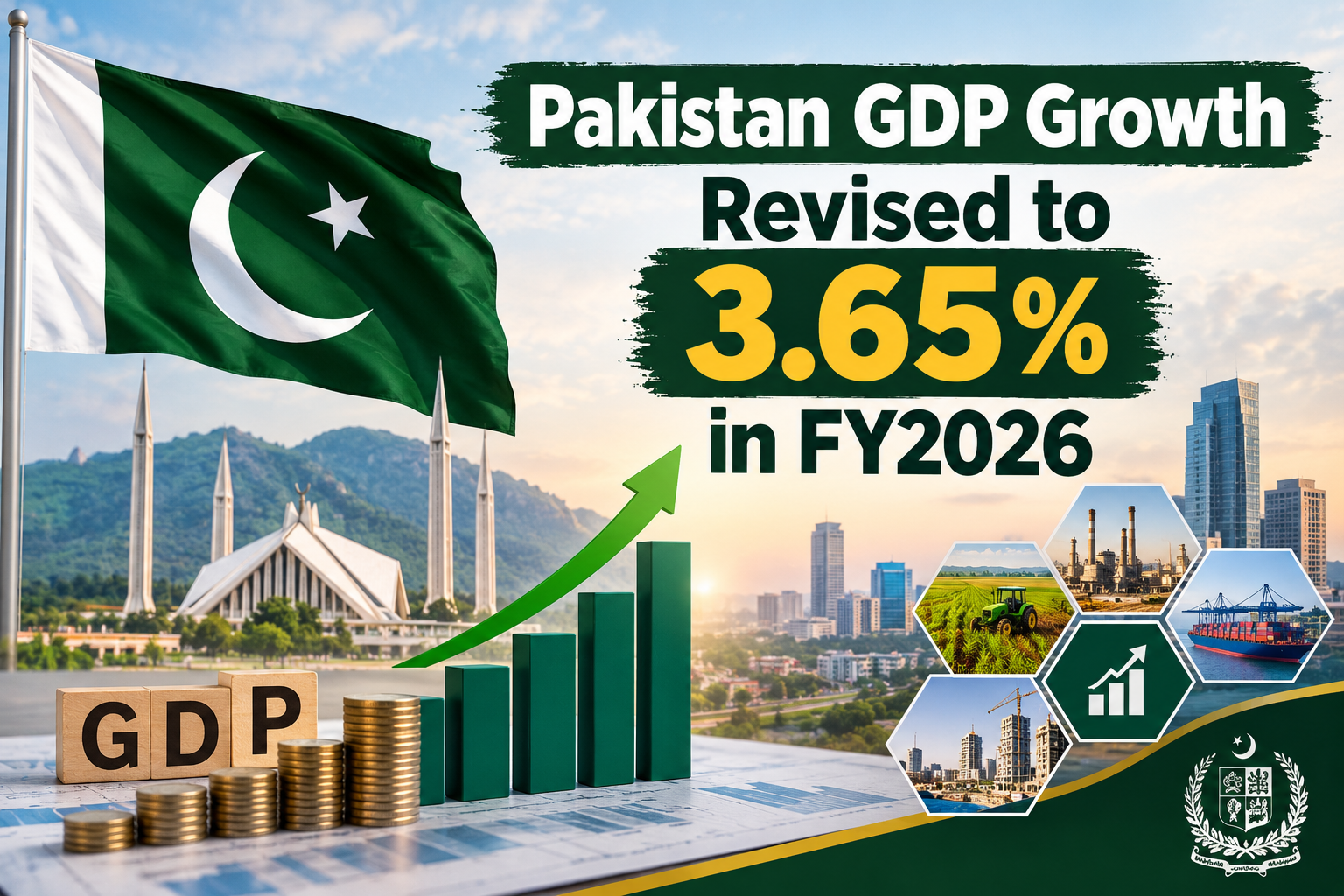
Pakistan’s economy recorded a growth rate of 3.65% during the fiscal year 2025–26, slightly below the previous estimate of 3.70%, according to revised national accounts figures approved by the National Accounts Committee. The updated figures highlight the challenges facing Pakistan as it works to strengthen economic stability, increase industrial production, support businesses and improve living standards.
The revision has renewed attention on the country’s economic performance, particularly the contribution of agriculture, industry and services. Although the overall size of the economy increased, slower growth in important sectors and a sharp slowdown during the final quarter show that a sustained recovery will require continued attention to investment, productivity, employment and household purchasing power.
Pakistan’s economic future depends not only on increasing national output but also on ensuring that economic progress translates into better opportunities for ordinary citizens. Stronger exports, predictable policies, improved energy efficiency, a broader tax base and support for small businesses can all contribute to a more resilient economy.
Understanding Pakistan’s Latest GDP Growth Figures
Gross domestic product, commonly known as GDP, measures the total value of goods and services produced within a country over a particular period. It is one of the main indicators economists use to assess economic performance.
According to the latest figures published by the Pakistan Bureau of Statistics, the country’s GDP growth rate for FY2025–26 was revised from 3.70% to 3.65%. The updated estimate was approved at the 118th meeting of the National Accounts Committee on October 19, 2026.
The difference between the earlier estimate and the revised figure is relatively small. However, the revision matters because economic growth was already below the government’s broader ambitions for a stronger recovery.
The latest figures also provide a more detailed picture of how different sectors performed during the fiscal year. Agriculture recorded growth of 3.50%, industry grew by 3.34%, and services expanded by 3.81%. These revised sectoral estimates show that economic activity continued across the country, although performance differed between sectors.
A growth rate of 3.65% means that the economy expanded in real terms compared with the previous year, based on the official national accounts estimates. It does not mean that every household experienced a corresponding improvement in income. Economic growth can occur alongside financial pressure for families if prices, employment conditions and income distribution do not improve at the same pace.
For this reason, the latest GDP figures should be considered alongside inflation, wages, employment, exports, investment and the cost of essential goods.
Pakistan’s Economy Reaches $450.4 Billion
One of the major developments in the revised national accounts is the increase in the estimated size of Pakistan’s economy.
The economy reached approximately Rs126.4 trillion, equivalent to $450.4 billion, during FY2025–26. In the preceding fiscal year, its estimated size was approximately Rs114.9 trillion, or $408.7 billion.
These figures are measured at current prices, meaning they reflect changes in prices as well as changes in economic activity. Therefore, an increase in the nominal size of the economy should not automatically be interpreted as an equivalent increase in real production or household prosperity.
For policymakers, the expanding nominal economy provides a broader base for evaluating investment, taxation, production and public spending. Yet the central challenge remains turning this expansion into stronger productivity and sustainable improvements in living standards.
Pakistan needs an economy in which businesses can invest confidently, workers can access productive employment, farmers can earn reasonable returns, and consumers can purchase essential goods without facing excessive financial pressure.
The quality of economic growth matters as much as the headline figure. Growth driven by productive investment, technology, exports and efficient manufacturing can create lasting opportunities. By contrast, growth that relies heavily on rising prices or short-term consumption may be less effective at improving long-term economic security.
Per Capita Income and Household Living Standards
The revised national accounts put Pakistan’s per capita income at approximately Rs531,897, equivalent to $1,896, for FY2025–26, compared with $1,824 in the previous fiscal year.
Per capita income is calculated by dividing national income by the population. It is useful for broad comparisons, but it does not show how income is distributed among households or individuals.
For example, an increase in average income does not necessarily mean that every worker receives a pay rise. Some households may benefit from new employment opportunities, while others may continue to struggle with rising food, housing, transport and education costs.
This distinction is particularly important for Pakistan, where household budgets can be affected by changes in essential commodity prices, electricity charges and transport expenses.
A meaningful improvement in living standards requires more than an increase in average national income. It also requires stable employment, opportunities for young people, affordable essential services and greater productivity across the economy.
Public policies that support job creation, improve access to education and training, and help small enterprises expand can make economic growth more inclusive.
Why Economic Growth Was Revised Downward
The latest revision reflects updated economic data and changes in the performance estimates for individual sectors. Industrial and services growth were revised downward compared with the previous estimates, contributing to the lower overall GDP figure.
Economic estimates are periodically adjusted as more complete information becomes available. Initial figures are often based on preliminary indicators, while subsequent estimates incorporate additional information about production, trade, imports and other economic activities.
Consequently, a revision does not necessarily mean that economic activity suddenly declined on the day the figures were announced. Instead, it provides a more updated assessment of what happened during the completed fiscal year.
For businesses and investors, accurate economic data are important because they help inform decisions about production, staffing, expansion and financing. For the government, revised figures can help identify sectors that need additional attention.
Pakistan’s challenge is to ensure that future growth is supported by productive economic activity rather than temporary improvements that are difficult to maintain.
Agriculture Remains Important to Pakistan’s Economy
Agriculture remains a major source of employment, raw materials and economic activity in Pakistan. The sector supports rural communities and supplies inputs for industries such as food processing, textiles and livestock-related businesses.
The revised national accounts estimate agricultural growth at 3.50% for FY2025–26, compared with the earlier estimate of 2.89%.
The upward revision suggests stronger estimated performance than previously recorded. Nevertheless, agricultural productivity continues to depend on factors such as water availability, weather conditions, input costs, access to markets and the adoption of modern farming techniques.
Farmers can face financial pressure when seeds, fertilisers, fuel and electricity become more expensive. In addition, inadequate storage and transportation can reduce the value of harvested crops by increasing losses before products reach consumers.
Improving agricultural performance requires a combination of practical measures. Better irrigation management, modern machinery, quality seeds, agricultural research and timely access to financing can help farmers produce more efficiently.
Storage facilities and improved transport links can also reduce post-harvest losses. When farmers have better access to buyers and market information, they may be able to make more informed production and selling decisions.
The government and private sector can further strengthen agriculture by investing in food processing, packaging and value-added products. Instead of selling only raw commodities, producers can benefit from developing products with greater commercial value.
A more productive agricultural sector can support rural incomes, strengthen food supplies and provide essential materials to domestic industries.
Industrial Sector Faces Persistent Challenges
Industry is a crucial part of Pakistan’s economic development because it creates jobs, supports exports and encourages investment in productive activities. Manufacturing also supplies goods to the domestic market and provides inputs for construction, transportation and other sectors.
The revised national accounts put industrial growth at 3.34% in FY2025–26, down from the earlier estimate of 3.51%. Large-scale manufacturing growth was also revised downward, from 6.11% to 5.0.
These figures indicate that industrial performance remains an important area for policymakers to monitor.
Manufacturers must manage several costs when operating their businesses. Electricity, fuel, transportation, financing and imported raw materials can all influence production expenses. When these costs rise, businesses may find it difficult to maintain competitive prices or expand production.
Smaller manufacturers can be particularly vulnerable because they often have fewer financial resources than large companies. Limited access to credit and modern equipment can also prevent them from improving efficiency.
A stronger industrial strategy would focus on reliable energy supplies, predictable regulations, access to affordable financing and investment in modern technology.
Improving industrial productivity can help Pakistani businesses compete with international producers. It can also create opportunities for skilled workers, technicians, engineers and young people entering the labour market.
The government can encourage this process by simplifying administrative procedures, improving infrastructure and ensuring that industrial policies remain consistent over time.
Manufacturing Industries Show Different Results
Not every manufacturing industry performed in the same way during FY2025–26. The revised figures indicate that automobile manufacturing expanded by 57.77%, while furniture manufacturing increased by 22.69%. Electrical equipment manufacturing grew by 14.25%.
However, some industries faced contraction. Pharmaceutical manufacturing declined by 8.87%, while iron and steel products fell by 7.84%, according to the reported national accounts figures.
These differences demonstrate why the overall manufacturing growth rate does not tell the entire story.
Industries experiencing stronger demand may have opportunities to expand their workforces and invest in additional production capacity. Sectors facing declining output may need to address weak demand, high input costs, supply difficulties or other operational challenges.
The appropriate response will vary by industry. Policymakers and business leaders need to identify the specific reasons behind these different outcomes rather than assume that every sector faces identical problems.
Encouraging competition, improving technical training and supporting innovation can help manufacturers adapt to changing market conditions.
Services Sector Continues to Support Economic Activity
The services sector includes wholesale and retail trade, transport, telecommunications, financial services, education, healthcare and several other activities.
Pakistan’s services sector recorded revised growth of 3.81% during FY2025–26, compared with the earlier estimate of 4.09%.Despite the downward revision, services remained an important contributor to the economy.
Businesses increasingly depend on transportation, digital communication, banking and other services to reach customers and manage operations. Improvements in these areas can benefit companies across agriculture, manufacturing and retail.
The updated estimates also show contrasting performance within the sector. Information and communication grew by 9.53%, while finance and insurance expanded by 4.23%. Wholesale and retail trade growth was revised downward to 2.37%, from 3.71%.
The expansion of information and communication services highlights the importance of digital infrastructure in modern economic development. Reliable internet access, digital skills and technology-based services can create opportunities for businesses serving customers inside and outside Pakistan.
However, digital growth alone cannot resolve every economic challenge. Businesses still need access to finance, trained workers, reliable electricity and clear regulations.
Wholesale and retail trade also deserves attention because it connects producers with consumers. When manufacturing activity and imports weaken, traders may face lower sales or reduced availability of particular products.
Strengthening domestic production, improving logistics and supporting small retailers can help create a healthier commercial environment.
Fourth-Quarter Slowdown Raises Concerns
One of the most important details in the latest economic report is the slowdown recorded during the final quarter of FY2025–26.
Pakistan’s GDP grew by 2% in the fourth quarter, compared with 6.07% in the corresponding quarter of the previous fiscal year. Industrial activity contracted by 4.70% during the quarter.
The figures suggest that economic momentum weakened toward the end of the fiscal year.
Quarterly growth rates can fluctuate because of changes in production, prices, seasonal patterns and comparison with the previous year. The impact of a high base can also influence the percentage change, so the figures should be interpreted alongside the underlying economic conditions.
Nevertheless, the reported industrial contraction deserves close attention because sustained industrial activity is important for employment, investment and exports.
A slowdown can affect businesses through lower demand, reduced capacity utilisation and uncertainty about future sales. If companies become cautious about expansion, the effects can extend to suppliers, transport operators and workers.
The government and private sector therefore need to identify the factors behind the weaker quarter and develop policies that support a more stable recovery.
Improved energy efficiency, stronger export demand, better access to financing and consistent economic planning may help businesses make longer-term decisions.
The goal should not simply be to improve one quarterly figure. Pakistan needs to build an economic structure capable of maintaining growth across successive quarters and fiscal years.
Tax Reforms and Government Revenue
Tax policy remains central to Pakistan’s economic outlook because public revenue helps finance infrastructure, education, healthcare and other essential services.
A broader and more effective tax system can reduce pressure on compliant taxpayers while allowing the government to fund public priorities more sustainably.
However, tax reforms must be designed carefully. Excessively complicated rules can discourage formal business activity, while unpredictable changes can make it difficult for companies to plan investments.
A more effective approach would focus on simplifying procedures, improving transparency, reducing unnecessary exemptions and encouraging businesses to operate within the formal economy.
Digital tax administration can help improve recordkeeping and reduce opportunities for evasion. Clear guidance and accessible support services can also make compliance easier for small enterprises.
At the same time, authorities must consider the effects of taxation on households and productive businesses. Policies that impose disproportionate costs on essential goods or productive investment can weaken demand and discourage expansion.
The objective should be a fairer, broader and more predictable revenue system that supports public finances without unnecessarily restricting economic activity.
Inflation and the Cost of Living
Economic growth figures alone cannot explain the financial situation of ordinary Pakistani households.
Families make daily decisions based on the prices of food, housing, electricity, transport, education and healthcare. Even when the economy expands, households may feel little improvement if their incomes do not keep pace with their expenses.
Inflation reduces purchasing power when prices rise faster than household incomes. It can also affect business performance because higher costs may force companies to increase prices, reduce expenses or delay expansion.
For low-income households, the pressure can be particularly significant because a large proportion of their budgets is spent on essential goods and services.
Sustainable economic improvement therefore requires policies that support productivity while maintaining macroeconomic stability.
Better agricultural supply chains can help reduce avoidable food losses. More efficient transport systems can lower distribution costs, while competition among suppliers can encourage better prices and service.
The government can also improve the effectiveness of social assistance by directing support toward eligible households that need it most.
At the same time, long-term improvements in employment, skills and wages are essential. Temporary assistance can help families manage immediate difficulties, but sustainable income growth provides a stronger foundation for financial security.
Energy Costs and Industrial Competitiveness
Energy availability and affordability are important considerations for Pakistan’s manufacturers, farmers and service providers.
Factories rely on electricity and fuel to operate machinery, maintain production schedules and deliver products to customers. Energy costs also influence the expenses of transport operators, retailers and other businesses.
When energy prices or supply conditions become unpredictable, companies may find it difficult to estimate future costs. This uncertainty can discourage investment and weaken competitiveness.
Pakistan can improve its economic resilience by encouraging energy efficiency, upgrading infrastructure, reducing technical losses and supporting reliable electricity generation.
Businesses can also benefit from adopting more efficient machinery and reviewing production processes to reduce unnecessary energy consumption.
However, investment decisions require careful planning. Improvements must be financially viable and supported by appropriate technical expertise.
Reliable energy infrastructure can contribute to higher industrial productivity, better service delivery and stronger investor confidence.
Small Businesses and Entrepreneurship
Small and medium-sized enterprises are important to Pakistan because they create employment, provide local services and allow people to develop independent sources of income.
These businesses operate in many areas, including retail, food processing, clothing, repair services, transport, information technology and professional services.
Yet small enterprises can face barriers when attempting to expand. Limited financing, complicated registration procedures, inconsistent demand and high operating expenses may restrict their ability to hire workers or invest in equipment.
A supportive business environment can help address these barriers.
Simplified registration, accessible financial services, practical training and transparent regulations can make it easier for entrepreneurs to establish and grow their businesses.
Digital tools can also help small enterprises reach customers, manage payments and maintain records. Businesses that develop reliable products and services may be able to expand beyond their immediate neighbourhoods into larger domestic markets.
For young people, entrepreneurship and digital skills can provide additional career pathways alongside traditional employment. However, successful businesses generally require research, patience, financial planning and a clear understanding of customer needs.
Supporting small businesses can broaden economic participation and help create more diverse sources of employment.
Exports and International Trade
Exports are another important part of Pakistan’s long-term economic outlook.
Selling goods and services internationally can bring foreign exchange into the country, encourage investment and provide businesses with access to larger markets.
Pakistan has established export industries, including textiles, clothing, agricultural products, sports goods and various manufactured items. Expanding into higher-value products and services could create additional opportunities.
Exporters need reliable infrastructure, competitive production costs, efficient customs procedures and predictable trade policies.
Quality standards also matter. Businesses must ensure that their products meet the requirements of international buyers and comply with relevant regulations.
The services economy offers further possibilities, particularly in information technology and other professional services. With appropriate training, infrastructure and business support, Pakistani companies may be able to serve a wider range of international customers.
However, export growth requires more than identifying potential markets. Businesses must build lasting commercial relationships, deliver consistent quality and manage international competition.
A stronger export base can help Pakistan diversify economic activity and reduce excessive dependence on a narrow range of foreign-exchange sources.
Investment, Confidence and Economic Stability
Private investment is essential for expanding productive capacity, introducing new technologies and creating employment.
Businesses are more likely to invest when they can estimate future costs, understand regulatory requirements and anticipate reasonable returns.
Frequent policy changes, uncertainty about taxation and difficulties accessing finance can make long-term planning more complicated.
Pakistan can encourage investment by improving regulatory transparency, strengthening public institutions and ensuring that economic policies are implemented consistently.
Investment in infrastructure, industrial technology, logistics and workforce development can also improve the country’s productive capacity.
Foreign investment may bring additional financing, technical expertise and access to international markets. However, attracting sustainable investment requires a business environment in which investors can assess risks clearly and operate under predictable rules.
Domestic businesses are equally important. Local entrepreneurs understand their markets and can create employment across cities, towns and rural communities.
An effective investment strategy should therefore support both domestic enterprise and responsible foreign participation.
Employment and Opportunities for Young People
Pakistan’s economic performance has important implications for employment, particularly for young people entering the workforce.
A growing economy can create opportunities, but the number and quality of jobs depend on which sectors expand and whether workers have the skills employers need.
Industries that invest in technology, manufacturing and services may require technicians, engineers, accountants, designers, sales professionals and digital specialists.
Education and vocational training can help workers prepare for these opportunities.
Schools, colleges, universities and training institutions can contribute by developing practical skills alongside academic knowledge. Employers can also help by offering internships, apprenticeships and structured workplace training.
For young people, developing communication, problem-solving, computer and professional skills can improve their readiness for different career paths.
However, individual effort must be supported by broader economic conditions. Businesses need opportunities to expand, and workers need access to fair recruitment practices and productive employment.
A successful economic strategy should therefore connect education, training and business development rather than treating them as separate priorities.
What Pakistan Needs to Focus on Next
The revised GDP figures provide an opportunity to evaluate the country’s economic priorities.
First, Pakistan needs to encourage consistent and productive growth. Improving output across agriculture, industry and services can create a broader foundation for recovery.
Second, policymakers should support investment by improving regulatory predictability and reducing unnecessary administrative barriers.
Third, productivity improvements should remain a central priority. Better machinery, modern farming methods, digital systems and workforce training can help businesses produce more efficiently.
Fourth, exports should be developed through higher quality, stronger market access and greater value addition.
Fifth, economic policies should consider their impact on households. Rising national output becomes more meaningful when it contributes to employment, reasonable incomes and access to essential services.
Finally, reliable and transparent economic statistics are essential. Accurate data help policymakers identify problems, businesses evaluate opportunities and citizens understand the country’s economic direction.
These measures will require coordination between federal and provincial governments, businesses, financial institutions, educational organisations and workers.
No single policy can resolve every challenge. Sustainable improvement generally results from consistent reforms, investment and better economic management over time.
Future Outlook for Pakistan’s Economy
Pakistan’s economic outlook will depend on how effectively it addresses the structural challenges highlighted by the latest figures.
The revised growth rate of 3.65% shows that the economy expanded during FY2025–26, but the lower-than-previously-estimated result and the fourth-quarter slowdown indicate that further progress cannot be taken for granted.Agriculture can contribute through higher productivity and better market access. Industry can support recovery through modernisation and competitive production. Services can create opportunities through digital development, transport, finance and professional activities.
The pace of future progress will also depend on investment, inflation, energy conditions, international demand and the consistency of economic policies.
For households, the most meaningful indicators will include employment opportunities, real purchasing power and the affordability of essential goods and services.
For businesses, the priorities will include predictable costs, access to finance, reliable infrastructure and opportunities to reach new customers.
For policymakers, the task is to create conditions in which economic growth becomes more stable, inclusive and productive.
Pakistan has significant human resources, agricultural capacity, industrial experience and entrepreneurial potential. Converting these strengths into lasting progress will require practical reforms, responsible investment and continued attention to productivity.
The latest GDP revision should therefore be understood as both an economic assessment and an opportunity to identify areas where further improvement is needed.
Conclusion
Pakistan’s GDP growth was revised to 3.65% for FY2025–26, while the estimated size of the economy reached $450.4 billion. Per capita income stood at approximately $1,896, and growth slowed to 2% in the final quarter of the fiscal year.
These figures show an economy that continued to expand but still faces challenges involving industrial productivity, household purchasing power and the consistency of growth.
The way forward requires stronger agriculture, competitive manufacturing, modern services, sustainable public finances and a supportive environment for businesses and investors.
Most importantly, economic progress should be measured not only by national statistics but also by whether people gain better employment opportunities, businesses become more productive and households experience improvements in their daily lives.
With consistent policies, effective institutions and long-term investment, Pakistan can work toward a more resilient economy that delivers broader benefits to its population.
Frequently Asked Questions (FAQs)
1. What was Pakistan’s GDP growth rate in FY2025–26?
Pakistan’s GDP growth rate was revised to 3.65%, down from the earlier estimate of 3.70%.
2. What is the estimated size of Pakistan’s economy in FY2026?
The revised national accounts estimate Pakistan’s economy at approximately $450.4 billion, equivalent to Rs126.4 trillion at current prices.
3. What was Pakistan’s per capita income in FY2026?
The reported per capita income was approximately $1,896, or Rs531,897.
4. Which sectors contributed to Pakistan’s economic growth?
Agriculture, industry and services all contributed. Their revised growth rates were 3.50%, 3.34% and 3.81%, respectively.
5. What are Pakistan’s main economic priorities for future growth?
Important priorities include improving productivity, supporting small businesses, increasing exports, attracting investment, strengthening infrastructure and expanding employment opportunities.




