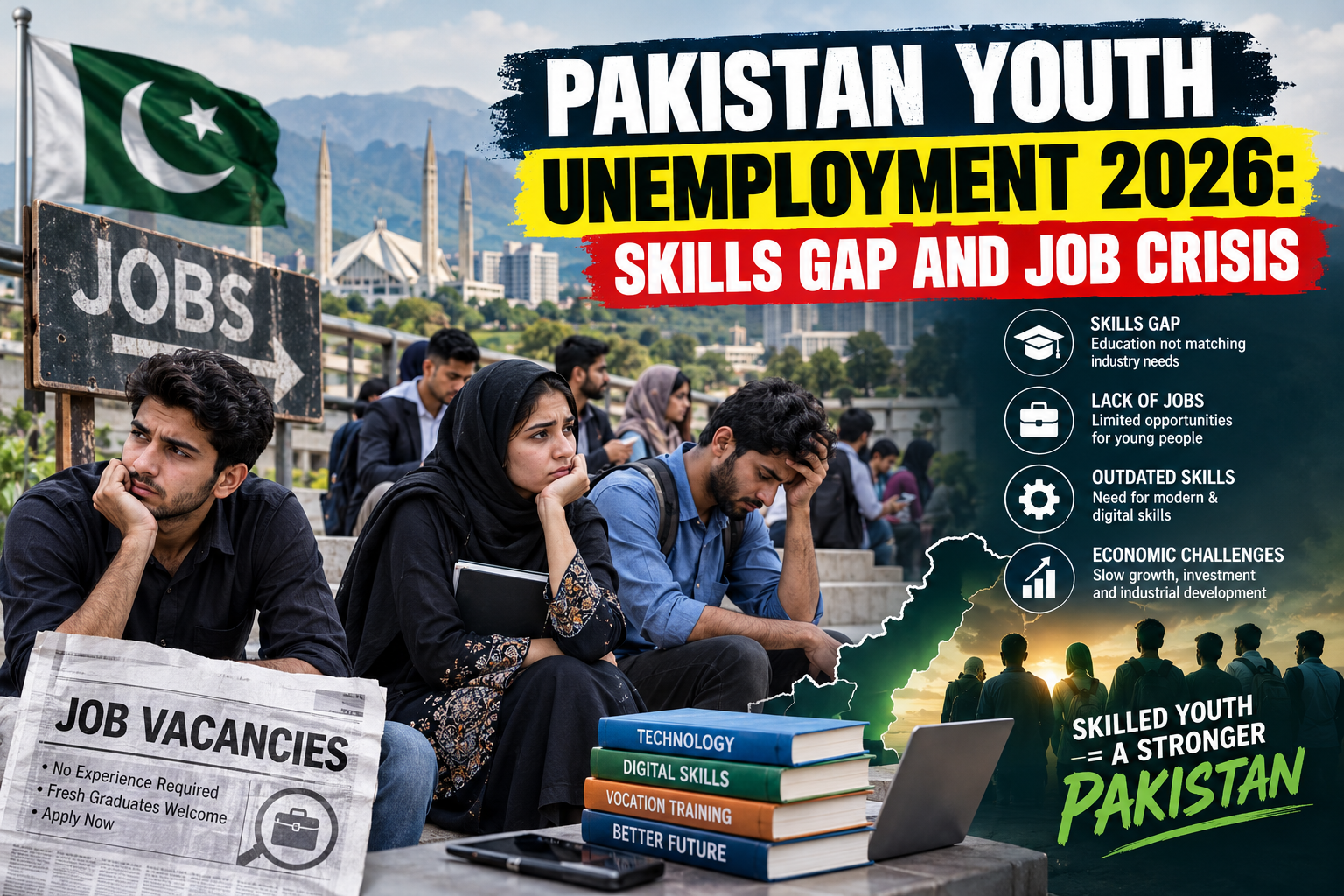
Pakistan's Youth Population: A National Opportunity
Pakistan has a large and growing population of young people. This demographic profile can become a powerful source of economic development if young citizens receive the education, training and employment opportunities they need.
Young people can contribute to agriculture, manufacturing, healthcare, education, information technology, business services and public administration. They can also establish new businesses, introduce innovative ideas and help existing companies improve their productivity.
However, a large youth population does not automatically produce economic prosperity. The benefits depend on whether the economy can create enough productive jobs and whether young people have the skills required to fill them.
When employment opportunities are limited, educated young people may struggle to find work that matches their qualifications. Others may accept jobs that provide insufficient income or little opportunity for professional development.
This situation affects individuals and the wider economy. Families may spend years financing education without seeing the expected improvement in employment prospects. Businesses may struggle to find appropriately trained workers even when many job seekers are available.
The challenge for Pakistan is therefore twofold: create more employment opportunities and improve the connection between education, training and the needs of employers.
If these goals are pursued together, the country's young population could support higher productivity, stronger businesses and more sustainable economic growth.
Youth Unemployment and the Economic Challenge
Youth unemployment is not simply a matter of individuals being unable to find jobs. It can also indicate wider weaknesses in economic growth, investment, skills development and labour-market planning.
When businesses are reluctant to expand, they may limit recruitment. Companies facing high operating costs or uncertain demand may postpone new projects, reducing the number of entry-level positions available to graduates.
At the same time, some employers require practical experience even for relatively junior roles. This creates a difficult situation for young people who have completed their education but have not yet had the opportunity to gain workplace experience.
The problem can be particularly challenging for graduates whose qualifications do not closely match available vacancies.
Unemployment statistics alone may not show the full extent of the issue. Some young people work fewer hours than they would prefer, accept jobs below their skill level or undertake informal work without stable earnings and employment protections.
Others may stop actively searching for jobs because repeated applications have not produced results. These people can be overlooked if policymakers focus only on the number of registered unemployed workers.
A comprehensive employment strategy should therefore consider job quality, wages, working conditions and opportunities for advancement, as well as the total number of people employed.
Pakistan needs an economy that creates opportunities for young people to enter the workforce and build sustainable careers.
The Gap Between Education and Market Requirements
One of the most important challenges facing Pakistan's labour market is the gap between formal education and practical workplace requirements.
Schools, colleges and universities provide essential academic foundations. However, employers may also require communication skills, digital literacy, problem-solving abilities, teamwork and familiarity with professional tools.
When educational programmes do not sufficiently develop these abilities, graduates can find it difficult to compete for available positions.
The problem is not that academic education lacks value. Rather, qualifications are most useful when they are combined with relevant practical skills and opportunities to apply what students have learned.
Educational institutions can help address the gap by reviewing their curricula, introducing practical assignments and building stronger relationships with employers.
For example, business students can benefit from projects involving accounting, customer service and business planning. Computer science students may need opportunities to develop, test and explain software projects. Students studying agriculture can benefit from practical experience with modern farming methods and resource management.
Employers can contribute by explaining the competencies they need and offering suitable workplace learning opportunities.
Regular communication between educational institutions and industry can help identify emerging skill requirements before graduates enter the labour market.
Improving this connection would make education more responsive to economic needs while preserving the broader benefits of academic learning.
Why Practical Skills Matter for Graduates
Practical skills can help young people demonstrate their abilities to potential employers. A qualification provides evidence of education, while relevant projects and experience can show how a person applies knowledge in real situations.
Communication is one important example. Employees may need to write professional emails, explain a problem, prepare reports or communicate with customers. These tasks require clarity, organisation and an understanding of professional expectations.
Digital literacy is another essential area. Many workplaces use spreadsheets, online collaboration tools, digital records and specialised software. Employees who understand these tools may be better prepared to complete routine tasks efficiently.
Problem-solving skills are also valuable. Employers often need people who can identify an issue, assess available information and suggest a practical solution.
Teamwork matters because many projects involve cooperation between people with different responsibilities. Listening carefully, meeting deadlines and sharing information can improve workplace performance.
Financial literacy can help young people understand salaries, budgets, expenses and basic business decisions. These abilities are useful in employment and entrepreneurship alike.
Educational institutions and training programmes should help students develop these skills progressively. Young people also benefit from receiving constructive feedback on their work and having opportunities to improve.
The goal should not be to replace formal education with short courses. It should be to combine academic knowledge with practical competence so that graduates can adapt to different roles and changing industries.
Technology and Digital Skills in Pakistan
Technology is changing how businesses operate and how workers perform many tasks. Digital systems are increasingly used in communication, accounting, marketing, customer service, logistics, education and data management.
These changes create opportunities for young Pakistanis who develop relevant skills. Digital work can support employment in traditional companies as well as in technology-focused businesses.
Skills such as software development, website maintenance, data analysis, digital design and cybersecurity awareness may be useful in particular occupations. The demand for individual skills can change, so students should research the requirements of their chosen field rather than assume every course guarantees employment.
Basic digital competence is also important outside the technology industry. Teachers, office assistants, business owners, healthcare workers and administrative staff may all use digital tools in their daily responsibilities.
Access remains a significant consideration. Not every student has a suitable computer, reliable internet access or a quiet place to study. Differences in access can limit the ability of young people to benefit from digital learning.
Public institutions, educational organisations and community programmes can help by expanding access to devices, internet connectivity and appropriate training.
Digital education should also include responsible technology use, privacy awareness, online safety and the ability to evaluate information critically.
Technology can improve productivity, but its benefits depend on the quality of training and the availability of meaningful work. A sustainable digital employment strategy must connect skills development with real economic opportunities.
Artificial Intelligence and the Future of Work
Artificial intelligence is changing the way many organisations approach routine tasks, information processing and decision-making. For Pakistan's young workforce, this creates both opportunities and a need to adapt.
Some businesses use AI tools to assist with drafting, translation, data analysis, customer support and software development. Other organisations are exploring ways to automate repetitive processes or improve operational efficiency.
These developments may change the skills employers value. Young workers may need to learn how to use new tools responsibly, verify outputs and apply human judgement to complex situations.
However, AI should not be viewed as a guaranteed shortcut to employment. Knowing how to operate a tool does not necessarily mean that a person can deliver reliable work or understand the wider needs of a business.
Employers still need people who can communicate, interpret information, understand customers, protect confidential information and take responsibility for decisions.
Educational institutions can prepare students by combining technical learning with critical thinking, ethics and practical projects.
Students should also understand that AI-generated information can be inaccurate or incomplete. Checking facts, protecting personal data and following relevant rules are important parts of responsible use.
For Pakistan, the opportunity lies in helping young people become adaptable workers who can learn new technologies throughout their careers.
The Role of Vocational and Technical Education
University education is not the only route to a successful career. Vocational and technical education can prepare people for practical occupations in which specialised skills are essential.
Fields such as electrical work, plumbing, automotive maintenance, industrial operations, construction, refrigeration, healthcare support and modern agricultural services require training and practical competence.
When training programmes are well designed, they can help learners develop skills that employers need. They may also provide a more direct route into certain occupations than a purely academic pathway.
The quality of vocational education is crucial. Training should include practical experience, appropriate equipment, safety standards and assessments that demonstrate genuine competence.
Employers can help ensure that courses remain relevant by explaining the technical abilities required in their industries.
Students should also receive clear information about qualification requirements, employment prospects and opportunities for further study.
Vocational education should not be treated as an inferior alternative to university. Different careers require different forms of preparation, and society benefits when a wide range of occupations are respected.
Pakistan can strengthen its workforce by offering multiple pathways into employment and helping young people choose options that fit their interests, abilities and circumstances.
Women and Equal Employment Opportunities
Young women are an important part of Pakistan's potential workforce. Their ability to access education, training and suitable employment can influence household incomes, business productivity and wider economic development.
However, women may face barriers related to transportation, workplace safety, family responsibilities, discrimination or limited access to professional networks.
These challenges can prevent capable individuals from entering or remaining in employment.
Improving access to safe transport, fair recruitment procedures, suitable workplace facilities and professional training can help address some of these barriers.
Employers can also contribute by establishing clear policies against harassment and discrimination and by providing transparent procedures for raising concerns.
Flexible work arrangements may be helpful in some occupations, provided that employees receive fair treatment and that the arrangements suit the requirements of the role.
Digital work can create additional possibilities for some women, but it should not be presented as a universal solution. Access to devices, secure working conditions, reliable payment systems and suitable skills remains important.
Educational institutions can support female students through career guidance, practical training and information about a broad range of professional opportunities.
A stronger and more inclusive labour market would allow more young women to use their skills and contribute to the country's economic activity.
Youth Entrepreneurship and Small Businesses
Entrepreneurship can create an additional route to economic participation for young people who identify a genuine customer need and have the resources to develop a business.
Small businesses operate in many sectors, including food production, retail, education, repair services, agriculture, manufacturing and technology.
A successful business begins with understanding the customer. Entrepreneurs need to identify a problem, assess demand, estimate costs and determine whether the proposed product or service can be delivered reliably.
Business planning is important because enthusiasm alone does not guarantee success. Owners must consider pricing, supplies, operating expenses, competition, customer service and financial risks.
Training in accounting, marketing and business management can help new entrepreneurs make better decisions.
Access to finance is another consideration. Some businesses need equipment or working capital, while others can begin on a smaller scale. Financial commitments should be considered carefully, and young entrepreneurs should avoid taking on obligations they do not understand.
Mentorship can also be valuable. Experienced business owners may help new entrepreneurs understand common mistakes, manage customers and improve their operations.
Public and private organisations can support entrepreneurship through practical training, business advice and transparent information about legitimate support programmes.
However, entrepreneurship should not be treated as a substitute for creating adequate paid employment. Not every young person wants to run a business, and not every business idea becomes financially sustainable.
A balanced employment strategy should support entrepreneurship while also encouraging established businesses to expand and recruit workers.
Rural Youth and Employment Opportunities
Employment challenges are not limited to major cities. Young people in rural areas may face additional barriers because training institutions, employers and professional networks are often concentrated in urban centres.
Agriculture remains an important source of rural employment, but opportunities extend beyond crop production. Food processing, livestock services, agricultural machinery, storage, transportation and rural retail can all provide work.
Improving agricultural productivity can create demand for workers with technical and business skills. For example, modern storage facilities require trained operators, while food-processing businesses need people who understand quality control, packaging and distribution.
Rural internet access can also help young people learn new skills and explore opportunities beyond their immediate communities. However, online access must be accompanied by appropriate training, reliable infrastructure and access to equipment.
Local training programmes can be more effective when they reflect the needs of the surrounding economy. A community with substantial agricultural activity may benefit from training in irrigation management, equipment maintenance, food processing or farm business planning.
Young people should also have access to career information that explains the requirements of different occupations and the training needed to enter them.
Supporting rural employment can help reduce economic pressure on major cities and create more balanced regional development.
The Importance of Career Guidance
Many students make educational decisions without sufficient information about career options, required qualifications or the skills employers expect.
Career guidance can help students understand the relationship between their interests, abilities and employment opportunities. It can also explain that different professions require different combinations of education, training and experience.
Schools and colleges can arrange career discussions, practical demonstrations and opportunities to learn about different industries. Where possible, students can benefit from speaking with professionals who can explain the realities of their work.
Guidance should be realistic rather than based on promises of quick income or guaranteed employment.
Students should learn how to research a profession, compare recognised qualifications and evaluate training programmes. They should also understand that career paths can change as their interests and economic conditions develop.
For graduates, guidance can help with preparing a CV, completing applications, communicating professionally and understanding workplace expectations.
Educational institutions can work with employers to provide clearer information about entry-level roles and the competencies needed to qualify for them.
Better career guidance would help young people make more informed decisions and reduce the gap between their expectations and the opportunities available.
What Employers Can Do to Support Young Workers
Businesses have an important role in preparing young people for employment. Although educational institutions provide foundational knowledge, employers can help learners understand how that knowledge is applied in real workplaces.
Internships, apprenticeships and structured entry-level positions can provide opportunities to gain experience under appropriate supervision.
These programmes are most valuable when they include clear learning objectives, constructive feedback and meaningful tasks. Young people should understand what they are expected to learn and how their performance will be assessed.
Employers can also make recruitment procedures more transparent. Clearly stated job requirements help applicants understand whether they are suitable for a position and what they may need to improve.
Entry-level vacancies should distinguish between essential qualifications and skills that can be learned after recruitment. Requiring extensive experience for every junior role can make it unnecessarily difficult for new graduates to enter the workforce.
Companies can benefit from investing in employee training because workers who understand their responsibilities and develop relevant skills may become more productive over time.
Supporting young employees does not mean lowering professional standards. It means creating fair opportunities for people to demonstrate their abilities and develop competence.
A stronger partnership between employers and educational institutions could help Pakistan prepare a workforce that is better suited to the needs of its economy.
Government Policies Needed to Improve Youth Employment
Government policy can influence youth employment through economic management, education, investment, infrastructure and labour-market regulation.
One priority is creating conditions in which businesses can invest and expand. Predictable regulations, reliable energy supplies, efficient transport and access to appropriate financing can support productive economic activity.
Another priority is improving the quality and relevance of education. Training programmes should be evaluated according to what students learn and whether those skills remain useful beyond the classroom.
Public employment programmes can be helpful when they provide genuine experience, clear training and a realistic pathway into further work. Their success should be measured by meaningful outcomes rather than simply the number of people enrolled.
Governments can also improve access to information about recognised qualifications and legitimate training opportunities. This can help young people make informed decisions and avoid programmes that make unrealistic promises.
Labour-market information is important as well. Reliable data about vacancies, skills shortages, wages and employment patterns can help educational institutions and policymakers identify areas requiring attention.
Support for small businesses may encourage entrepreneurship, but it should be transparent and designed around sustainable business activity.
Finally, employment policies should be assessed regularly. Programmes that do not achieve their intended results should be improved or redesigned.
No single initiative will solve youth unemployment. Progress will require coordination between government departments, employers, educational institutions and communities.
A Practical Way Forward for Pakistan
Pakistan can make progress by connecting economic growth with a clear strategy for developing its workforce.
The first step is identifying sectors with realistic potential to create productive jobs. This requires examining business conditions, investment opportunities, export potential and the skills employers need.
The second step is strengthening education and training. Students should receive foundational knowledge alongside opportunities to practise relevant skills.
The third step is expanding access to workplace experience. Apprenticeships, internships and entry-level jobs can help young people move from education into employment.
The fourth step is improving access to opportunities across regions. Rural communities, smaller cities and groups facing barriers to participation should be considered when training and employment programmes are designed.
The fifth step is supporting businesses that create sustainable jobs. This includes established employers, small enterprises and responsible entrepreneurs.
The sixth step is measuring results. Policymakers should examine whether programmes lead to employment, better wages, improved skills and continued participation in the workforce.
These measures should be accompanied by realistic expectations. Economic changes take time, and results will vary across industries and regions.
Nevertheless, a coordinated approach can improve the connection between young people's abilities and the opportunities available to them.
Conclusion
Pakistan's youth employment challenge is closely connected to education, economic growth, investment and the changing requirements of the labour market.
The country's large young population can become a major economic advantage, but only if young people have access to relevant skills, meaningful employment and opportunities for professional development.
Improving education quality, expanding vocational training, supporting digital literacy and encouraging responsible entrepreneurship can all contribute to progress. Employers also need to provide fair recruitment procedures and realistic pathways for inexperienced workers to gain practical knowledge.
Government policies should focus on creating conditions for businesses to expand while ensuring that training programmes respond to genuine economic needs.
Equal access to opportunities is equally important. Young women, rural communities and students with limited access to technology should not be overlooked when employment strategies are developed.
Ultimately, youth employment is not only a question of finding work for individuals. It is also about strengthening families, improving productivity, supporting businesses and building a more resilient economy.
Pakistan's long-term progress will depend partly on how effectively it turns the potential of its young population into skills, innovation and productive work. With consistent policies and cooperation across society, the country can create better opportunities for its next generation.
FAQs
1. Why is youth unemployment a major issue in Pakistan?
Limited job opportunities, gaps between education and workplace requirements, slow business expansion and a shortage of practical experience can make it difficult for young people to find suitable employment.
2. How can Pakistan reduce graduate unemployment?
Pakistan can improve career guidance, strengthen vocational education, expand internships and apprenticeships, support businesses and connect educational programmes more closely with employer requirements.
3. Which skills can help young people prepare for employment?
Communication, digital literacy, problem-solving, teamwork, financial literacy and occupation-specific technical skills can help young people prepare for different career paths.
4. Can digital skills create more opportunities for Pakistani youth?
Yes. Relevant digital skills can help young people pursue opportunities in technology, business services and other industries. However, employment depends on competence, market demand and access to suitable opportunities.
5. What role can the government play in creating jobs for young people?
The government can support economic growth, improve education and training, encourage investment, provide reliable labour-market information and create policies that help businesses generate sustainable employment.




