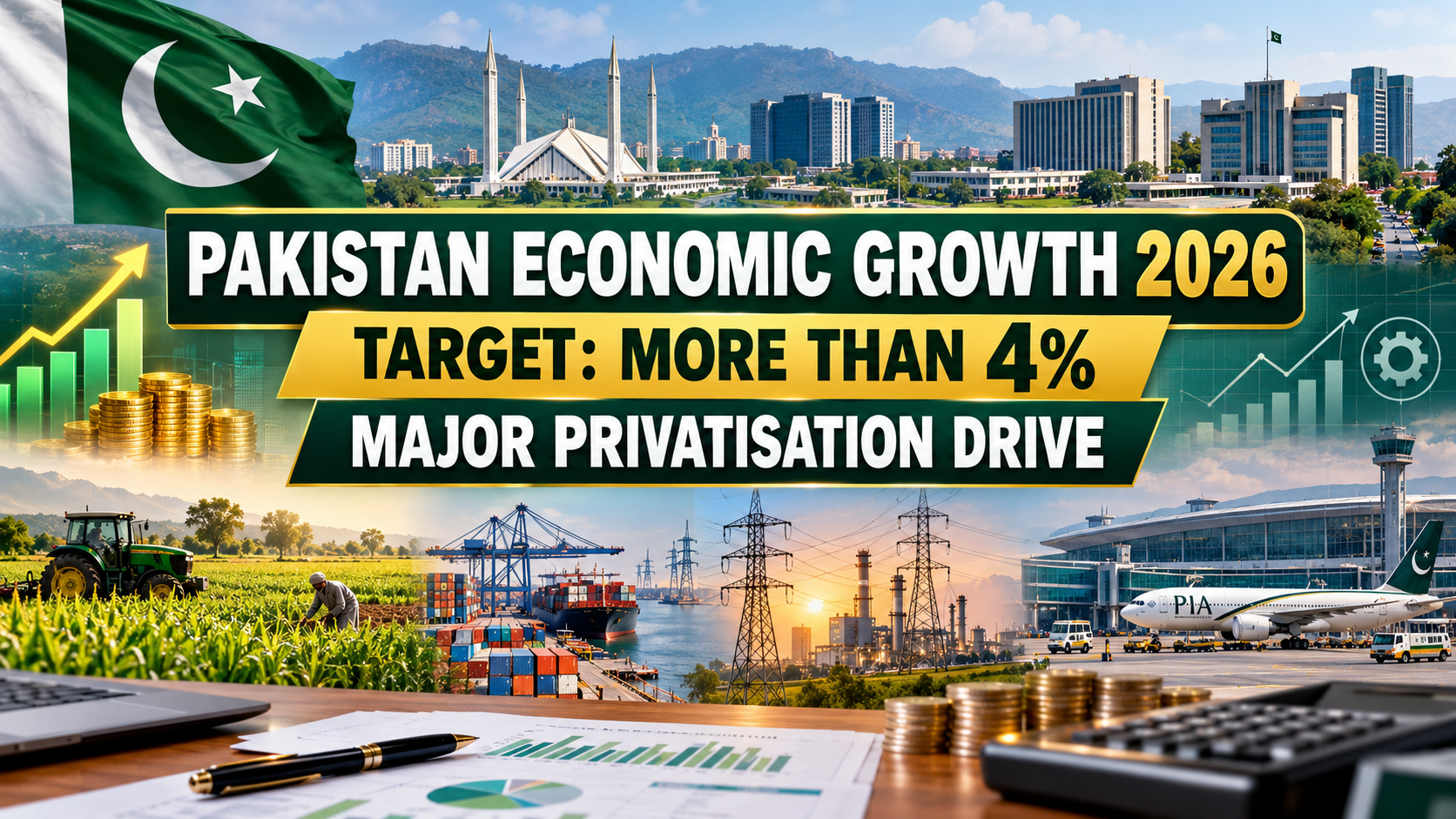
Pakistan’s economic outlook for 2026 has become an important national issue as the government seeks stronger economic growth, increased private investment and improved financial stability. Finance Minister Muhammad Aurangzeb has expressed confidence that the country can achieve economic growth of more than 4% during the current fiscal year. At the same time, the government plans to privatise several state-owned entities in an effort to raise more than $1 billion and reduce pressure on public finances.
Pakistan’s economy has faced significant challenges in recent years, including high inflation, expensive energy, pressure on foreign exchange reserves, public debt and the need for external financing. Although economic conditions have shown signs of improvement, maintaining that progress will require consistent policies, productive investment and greater opportunities for businesses and workers.
The government’s latest economic plans reflect an effort to move beyond short-term financial stabilisation and create conditions for sustainable growth. However, the final outcome will depend on domestic economic performance, global market conditions, energy prices, investment levels and the implementation of reforms.
Introduction: Pakistan’s Economic Outlook in October 2026
Pakistan enters the final months of 2026 with important economic questions facing policymakers, businesses and households. The government wants to increase economic activity, attract investment and improve public finances while managing inflationary pressures and international financial obligations.
Finance Minister Muhammad Aurangzeb has stated that Pakistan could record economic growth above 4% during the current fiscal year. His assessment reflects confidence in the performance of important sectors, including agriculture, as well as the government's efforts to maintain adequate fuel supplies and improve economic management.
However, a growth target is not the same as a confirmed economic result. Actual growth will depend on how production, consumption, investment, exports and government policies perform throughout the fiscal year. Different economic institutions may also publish different projections because they use different assumptions and assessment methods.
The government is also pursuing a privatisation programme involving five or six state-owned entities during the current fiscal year. The programme could generate more than $1 billion if the planned transactions are completed on suitable terms.
These two developments are connected. Stronger economic growth could increase business activity and government revenues, while successful privatisation could help reduce the financial burden of state-owned enterprises and encourage private-sector participation.
Nevertheless, neither outcome is guaranteed. Policymakers will need to balance financial objectives with public interests, employment concerns, service quality and long-term economic development.
What Does More Than 4% Economic Growth Mean?
Economic growth measures the increase in the value of goods and services produced within a country over a specific period, after adjusting for changes in prices. When a country's real economy expands, it generally means that production and economic activity have increased.
For Pakistan, growth above 4% would represent progress if it were supported by productive investment, higher output, stronger exports and improvements in employment opportunities.
Economic growth can influence many parts of daily life. Businesses may expand production when demand increases. Farmers may benefit from better crop yields and improved access to markets. Manufacturers may hire additional workers when orders rise, while service-sector companies may invest in new technology and facilities.
However, the benefits of growth are not automatically shared equally across society. A growing economy can still leave many households struggling if wages fail to keep pace with living costs or if employment opportunities remain concentrated in a limited number of sectors.
This is why economic performance should be assessed through several indicators rather than a single growth percentage. Inflation, employment, household purchasing power, exports, investment, productivity and poverty levels all help provide a broader picture.
For Pakistan, the quality of growth is particularly important. Economic expansion driven by higher productivity and competitive businesses can be more sustainable than growth that depends heavily on temporary spending or additional borrowing.
A long-term strategy must therefore focus not only on achieving a particular annual growth rate but also on improving the country's capacity to produce goods and services efficiently.
Agriculture Remains Important to Pakistan's Economy
Agriculture continues to play an important role in Pakistan's economy. It supports rural livelihoods, supplies raw materials to several industries and contributes to the country's food supply.
The sector also has a significant influence on economic activity beyond farms. Crop production supports transportation, storage, wholesale markets, food processing and retail businesses. When agricultural output performs well, these connected activities can benefit as well.
The finance minister has identified agriculture as one of the sectors helping support Pakistan's economic outlook.
Agricultural performance, however, depends on several factors. Water availability, weather conditions, input costs, access to credit, quality seeds, fertilisers, machinery and market prices can influence farmers' production decisions.
Farmers also face risks associated with floods, droughts, extreme heat and changing weather patterns. Improving resilience to these challenges is important for protecting rural incomes and maintaining stable food supplies.
Investment in water management, agricultural research, storage facilities and modern farming practices could help increase productivity. Better storage and transportation can also reduce post-harvest losses, allowing more produce to reach consumers and markets.
Another important issue is the relationship between farm productivity and food prices. Strong production can support food availability, but prices also depend on transportation expenses, market competition, supply chains and the cost of agricultural inputs.
Policies that help farmers become more productive while ensuring fair competition in markets can support both rural livelihoods and consumers.
For Pakistan to achieve sustainable economic growth, agriculture needs to become more productive, efficient and resilient. Improvements in this sector could contribute to broader economic stability and create opportunities for businesses connected to food production.
The Role of Industry and Manufacturing
Manufacturing is another important part of Pakistan's economic development. Industrial activity creates employment, supports exports and provides products used by households and businesses.
Pakistan has manufacturing businesses in textiles, food processing, cement, pharmaceuticals, engineering and other industries. Their performance depends partly on domestic demand, access to finance, energy costs, imported raw materials and international competition.
When production costs rise sharply, manufacturers may struggle to maintain prices and profitability. Expensive electricity, gas, transportation and borrowing can make it harder for businesses to expand their operations.
A stronger industrial sector requires predictable policies and an environment in which companies can invest with greater confidence. Businesses need access to reliable energy, skilled workers, modern machinery and efficient transportation networks.
Access to financing is particularly important for small and medium-sized enterprises. These businesses often need loans to purchase equipment, expand production, manage inventory or enter new markets.
If financing remains too expensive or difficult to obtain, potentially productive companies may postpone investment. Improving access to appropriate financing could therefore support employment and economic activity.
Pakistan can also benefit from producing higher-value goods rather than relying primarily on products with limited processing. Greater investment in technology, research, quality standards and worker training can help manufacturers compete in international markets.
Industrial development should also consider environmental sustainability. Energy efficiency, cleaner production processes and responsible resource management can reduce costs and improve competitiveness over time.
The government's growth ambitions will be easier to achieve if industrial production becomes more efficient and businesses are able to compete on the basis of quality, reliability and productivity.
Services Sector and Digital Economic Opportunities
The services sector includes a wide range of activities, such as banking, telecommunications, transportation, education, healthcare, retail, tourism and information technology.
This sector can support economic growth by creating jobs, improving business services and helping companies reach new customers. Digital services are especially important because they can sometimes serve international markets without requiring the same physical infrastructure as traditional industries.
Pakistan's technology businesses and freelance workforce have opportunities to provide software development, digital design, business support, marketing and other services to clients in different countries.
However, the long-term development of these activities depends on reliable internet access, digital skills, secure payment systems, professional standards and the ability to compete internationally.
Education and training can help young people develop skills relevant to emerging industries. Businesses also need workers who can communicate effectively, solve problems and adapt to changing technologies.
Digital entrepreneurship can create opportunities for smaller businesses that cannot afford extensive physical operations. Online services may allow entrepreneurs to reach customers beyond their immediate cities or local markets.
Nevertheless, technology alone cannot solve every economic challenge. Reliable infrastructure, financial access, business confidence and a supportive regulatory environment remain important.
If Pakistan strengthens its services sector while developing agriculture and manufacturing, it can create a more diversified economy. Diversification can help reduce dependence on a small number of industries and provide additional sources of employment and foreign earnings.
Rising Global Oil Prices and Economic Pressure
Global energy prices remain an important consideration for Pakistan because the country depends on imported energy supplies. When international oil prices increase, the cost of importing fuel can rise, creating pressure on the country's foreign exchange requirements.
Higher energy prices can also affect domestic businesses and households. Transportation becomes more expensive when fuel costs rise, while companies may face higher production and distribution expenses.
These costs can spread through the economy. Businesses may pass some of the additional expense on to consumers, contributing to inflationary pressure. Alternatively, companies may absorb part of the increase, reducing their profit margins and limiting their ability to invest.
Pakistan is also exposed to developments in international energy markets and geopolitical tensions that can disrupt supply or increase uncertainty.
The government has indicated that adequate fuel procurement has helped Pakistan avoid shortages. Maintaining reliable supplies is important for transport, agriculture, manufacturing and electricity generation.
However, securing supplies is only one part of the challenge. Policymakers must also consider affordability, import costs and the wider impact of energy prices on the economy.
Improving energy efficiency can help reduce vulnerability to international price movements. Businesses can invest in more efficient equipment, while households and public institutions can reduce unnecessary consumption.
Over the longer term, a more diversified energy mix and better energy infrastructure may help improve resilience. Such changes require careful planning, investment and reliable implementation.
The relationship between energy costs and economic growth illustrates why Pakistan's outlook depends partly on international developments beyond the government's direct control.
Pakistan's Privatisation Plan: A Major Economic Policy
One of the government's major economic initiatives is its plan to privatise five or six state-owned entities during the current fiscal year.
The finance minister has indicated that the transactions could generate more than $1 billion. The plan follows the government's wider effort to reduce the financial burden associated with state-owned businesses and encourage a greater role for private investment.
Privatisation generally involves transferring ownership or control of a government-owned enterprise to private investors. Depending on the structure of a transaction, the government may sell a controlling stake, transfer operational responsibilities or use another arrangement permitted by law.
The potential advantages depend on the condition of the business, the quality of the transaction and the effectiveness of subsequent management.
A well-structured privatisation can introduce new capital, improve operational discipline and reduce the need for government financial support. Private investors may also bring technical expertise, improved management systems and stronger incentives to control costs.
However, privatisation is not automatically successful. Its results depend on whether the process is transparent, competition is protected and the new owners have the capacity to operate the business effectively.
The government must also consider the interests of employees, consumers and taxpayers. The sale price is important, but it should not be the only measure of success.
Long-term performance, service quality, financial sustainability and accountability are also relevant.
Pakistan's privatisation programme will therefore need careful preparation, credible valuations and a clear explanation of how each transaction is expected to benefit the economy.
Why the Government Wants to Raise More Than $1 Billion
Raising more than $1 billion through planned privatisation transactions could provide additional financial resources for the government. The actual impact would depend on the final proceeds, transaction costs and how the money is used.
Governments face several competing financial responsibilities, including debt servicing, public services, infrastructure investment, development programmes and support for essential institutions.
When state-owned businesses require repeated financial assistance, they can place additional pressure on public finances. Selling an enterprise or transferring its operations may reduce some future financial obligations, depending on the terms of the transaction.
However, proceeds from selling assets are generally one-time receipts rather than recurring tax revenue. They should not be treated as a permanent replacement for a sustainable public revenue system.
The government therefore needs to evaluate privatisation within a broader fiscal strategy. Improving tax administration, controlling wasteful expenditure and strengthening the performance of public institutions may also be necessary.
The financial outcome of a transaction depends on the enterprise's existing debts, future investment needs, contractual obligations and the terms agreed with investors.
If a sale is conducted at an appropriate valuation and the proceeds are used responsibly, it may contribute to fiscal stability. If the process lacks transparency or fails to account for long-term obligations, the expected benefits may be reduced.
For this reason, the quality of implementation matters as much as the headline value of the programme.
Potential Impact of Privatisation on Employment
Employment is one of the most important considerations in any privatisation programme. State-owned enterprises may employ large numbers of workers, and changes in ownership can affect staffing structures, working conditions and future recruitment.
Private investors may reorganise a business to improve productivity, introduce new technology or remove operational inefficiencies. These changes can strengthen a company's financial performance, but they may also create uncertainty for existing employees.
The government should therefore explain how worker-related issues will be handled in each transaction. Clear employment provisions, lawful procedures and appropriate communication can help reduce uncertainty.
Workers also need opportunities to develop skills that remain useful as industries change. Training programmes can help employees adapt to new technologies, management systems and changing business requirements.
It is equally important to distinguish between businesses that need restructuring and workers who can contribute to future growth. A successful reform programme should seek efficiency without overlooking the value of experience and technical knowledge.
Employment effects will differ from one enterprise to another. Some businesses may expand after receiving new investment, while others may need substantial restructuring before they become financially sustainable.
A balanced assessment should consider the immediate effects on workers as well as the long-term possibility of creating more productive businesses and additional employment.
The Role of Private Investment in Economic Development
Private investment can contribute to economic development by expanding productive capacity, introducing technology and creating employment.
When businesses invest in factories, logistics, digital services or infrastructure, they may increase production and improve the availability of goods and services. Investment can also generate demand for local suppliers and professional services.
However, investors generally assess several factors before committing substantial resources. These may include political stability, taxation, energy availability, regulations, access to finance, currency risks and the expected level of consumer demand.
A predictable policy environment can help reduce uncertainty. Businesses are more likely to make long-term plans when regulations are understandable and major policy changes are communicated clearly.
For Pakistan, attracting investment requires both domestic reform and international engagement. Local entrepreneurs need opportunities to expand, while overseas investors need confidence that their investments will be treated according to clear and consistent rules.
Privatisation may create opportunities for private investors, but it is only one component of a wider investment strategy. Improving infrastructure, workforce skills, contract enforcement and market competition can also influence investment decisions.
The government should aim to build an environment where investment is encouraged because businesses can operate productively and compete fairly, rather than relying solely on temporary incentives.
Over time, stronger investment could help Pakistan improve productivity, increase exports and create a broader base of economic activity.
Inflation and the Cost of Living
Economic growth does not necessarily mean that every household will immediately experience lower living costs. Inflation and household purchasing power remain important measures of economic well-being.
Inflation refers to a sustained increase in the general price level of goods and services. When prices rise faster than incomes, households may find it harder to afford food, transport, housing, electricity, education and healthcare.
Pakistan's experience with high inflation in recent years has made price stability an important concern for households and businesses.
Energy costs can influence inflation through transportation, manufacturing and distribution expenses. Food prices may also change because of agricultural conditions, supply disruptions, market costs and seasonal factors.
A stronger economy could support employment and income growth, but the effect on living standards will depend on how widely those benefits are shared.
Policymakers need to balance efforts to support economic activity with measures designed to maintain price stability. Monetary policy, fiscal management, competition in markets and improvements to supply chains can all influence inflationary conditions.
The government must also avoid assuming that a stronger headline growth figure automatically solves the cost-of-living challenge.
For families, the practical questions are whether employment opportunities improve, incomes become more dependable and essential goods and services remain affordable.
Sustainable economic development should aim to improve both national production and the ability of ordinary households to benefit from that production.
Pakistan's Fiscal Position and External Financing
Pakistan's economic outlook is also linked to its fiscal position and need for external financing. Governments must meet domestic spending commitments while managing debt payments and maintaining confidence in the country's ability to fulfil its financial obligations.
External financing can provide support during periods when a country needs additional foreign currency or must manage significant repayment requirements. However, relying heavily on repeated borrowing can create risks if economic growth and government revenue fail to keep pace with obligations.
Pakistan's reform programme has included efforts to improve public finances and meet the requirements associated with international financial support.
Such programmes can help establish financial targets and encourage policy changes, but they may also require difficult decisions involving taxes, spending and the prices of certain goods or services.
The long-term objective should be to strengthen the economy's ability to generate sufficient revenue and foreign earnings without depending excessively on emergency financing.
Higher exports, productive investment, competitive industries and a stronger tax system can contribute to this objective.
Privatisation may assist by reducing some financial pressures associated with state-owned businesses. Nevertheless, its contribution must be assessed alongside broader fiscal reforms.
A sustainable financial position requires recurring revenue, responsible expenditure, effective public institutions and an economy capable of producing goods and services that domestic and international markets demand.
Exports and the Importance of Foreign Exchange
Exports are important because they generate foreign currency and connect domestic businesses with international markets.
Pakistan exports products and services that include textiles, agricultural goods, food products, manufactured items and information technology services. Expanding these activities could help diversify the country's sources of foreign earnings.
However, export growth depends on competitiveness. Businesses need reliable energy, efficient transport, access to imported inputs, suitable financing and the ability to meet international quality standards.
Companies also need to understand the requirements of their target markets. Product quality, delivery times, certification and dependable customer service can influence whether overseas buyers continue working with Pakistani suppliers.
Moving towards higher-value production may provide additional opportunities. Instead of competing exclusively on price, businesses can invest in design, processing, technology and specialised products.
Small and medium-sized enterprises can also benefit from better access to export information, digital marketplaces and trade-support services.
The services sector offers another opportunity. Skilled workers can provide technology, design, professional and business services to overseas customers.
Stronger exports could help Pakistan improve its external financial position and reduce some of the pressure associated with importing energy and other essential goods.
Achieving this goal will require sustained improvements in productivity, infrastructure, skills and the overall business environment.
Small Businesses and Entrepreneurs
Small businesses are an important source of employment and local economic activity. Retail shops, workshops, manufacturers, service providers and technology startups contribute to household incomes and support wider supply chains.
These businesses often operate with limited financial resources. Rising costs, expensive credit and unpredictable demand can make it difficult for them to expand.
Policies that support entrepreneurship can help create opportunities for people who want to establish new businesses or develop existing ones.
Access to suitable financing is one important requirement. Entrepreneurs may need funds for equipment, inventory, training, technology or additional staff. Financing arrangements should be appropriate to the size and circumstances of the business.
Training and business guidance can also help owners improve accounting, customer service, marketing and operational management.
Digital tools may allow small businesses to reach more customers, maintain records and communicate with suppliers. However, their benefits depend on access to reliable internet, appropriate training and secure payment systems.
The government can support entrepreneurship by simplifying unnecessary administrative procedures and ensuring that regulations are applied fairly.
A growing economy needs businesses of different sizes. Large companies can provide substantial investment and employment, while smaller enterprises contribute flexibility, local knowledge and innovation.
Helping these businesses become more productive can support economic growth from the ground up.
Education, Skills and Employment Opportunities
A country's economic performance depends partly on the knowledge and skills of its workforce. Businesses need employees who can use technology, communicate effectively, solve problems and adapt to changing requirements.
Education and vocational training can help people prepare for employment in manufacturing, agriculture, healthcare, construction, logistics, finance and digital services.
However, education must also be connected to the needs of the labour market. Students benefit when training programmes provide practical knowledge, opportunities to develop relevant skills and a realistic understanding of different careers.
Employers can contribute by offering internships, apprenticeships and workplace training where appropriate.
For young people entering the labour market, access to reliable information about careers and professional development can help them make informed decisions.
Pakistan can also benefit from supporting women and other groups who face barriers to participation in the workforce. Safe working environments, accessible training and fair recruitment practices can help more people contribute to economic activity.
Improving skills will not solve every employment challenge, particularly when the economy is not creating enough jobs. Education policy must therefore be combined with investment and business development.
A stronger connection between education, skills and productive employment can help ensure that economic growth creates opportunities for a wider range of people.
Risks That Could Affect Pakistan's Growth Target
Although the government has expressed confidence in growth above 4%, several risks could affect the final outcome.
Global energy prices: Higher oil prices can increase import costs, raise business expenses and place additional pressure on household budgets.
Inflation: If prices rise faster than incomes, household purchasing power may weaken and consumer demand may come under pressure.
Investment uncertainty: Businesses may delay expansion if they face unpredictable regulations, expensive financing or concerns about future economic conditions.
Agricultural disruption: Adverse weather, water shortages or crop losses could affect agricultural output, food availability and rural incomes.
External financing needs: Debt repayments and foreign currency requirements may continue to place pressure on financial management.
Implementation delays: Privatisation and other economic reforms may take longer than expected if legal, financial or operational challenges arise.
Weak productivity: Growth may be difficult to sustain if businesses do not improve efficiency or develop more competitive products and services.
These risks do not mean that the growth target cannot be achieved. They demonstrate why economic forecasts must be treated as estimates rather than guaranteed outcomes.
Monitoring economic indicators and responding to emerging problems can help policymakers adjust their approach as conditions change.
What Pakistan Needs for Sustainable Economic Growth
Achieving stronger growth over the long term requires a coordinated approach involving public institutions, businesses, workers and investors.
First, the government needs predictable economic policies that allow households and businesses to make informed decisions. Sudden or unclear policy changes can increase uncertainty and discourage investment.
Second, public finances must become more sustainable. Better revenue collection, careful spending decisions and improved oversight of public institutions can help reduce financial pressures.
Third, productive investment needs to increase. Businesses require infrastructure, reliable energy, appropriate financing and access to skilled workers.
Fourth, education and training should help people develop skills that match changing economic opportunities.
Fifth, exports need to become more diversified and competitive. Businesses should be encouraged to improve quality, adopt modern technology and explore additional markets.
Sixth, agricultural productivity should improve through better water management, research, storage and access to markets.
Seventh, reforms to state-owned enterprises should be transparent and evaluated according to their long-term results, not simply the amount of money raised in a transaction.
Finally, economic policy should consider the effects on ordinary households. Growth is more meaningful when it supports employment, stable incomes and access to essential services.
These priorities require consistent implementation. No single announcement or transaction can resolve every challenge facing Pakistan's economy.
Conclusion
Pakistan's economic outlook in October 2026 is shaped by the government's ambition to achieve growth above 4% and its plan to privatise five or six state-owned entities, potentially raising more than $1 billion.
The finance minister's growth projection reflects confidence in agriculture, fuel availability and broader economic management. However, the final outcome will depend on developments throughout the fiscal year, including inflation, energy prices, investment and external financial conditions.
The privatisation programme could help reduce certain financial pressures and encourage private investment, but its success will depend on transparent transactions, appropriate valuations and effective oversight.
Pakistan also needs broader improvements in exports, manufacturing, digital services, workforce skills and agricultural productivity. These areas can help create a stronger foundation for economic expansion.
For households, the most important measure of progress will be whether growth leads to better employment opportunities, more dependable incomes and improved living standards.
Pakistan's economic future will therefore depend not only on reaching a particular growth target but also on creating an economy that is productive, competitive and resilient.
Sustained progress will require sound policies, responsible financial management, private-sector participation and continued attention to the needs of citizens. If these elements work together, the country can improve its prospects for more stable and inclusive economic development.
FAQs
1. What economic growth rate is Pakistan targeting in 2026?
Finance Minister Muhammad Aurangzeb has expressed confidence that Pakistan can achieve economic growth above 4% during the current fiscal year. This is a projection, not a confirmed final result.
2. How much does Pakistan expect to raise through privatisation?
The government expects planned privatisation transactions involving five or six state-owned entities to potentially raise more than $1 billion during the current fiscal year.
3. Why is Pakistan pursuing privatisation?
The government aims to encourage private-sector participation, improve the performance of selected enterprises and reduce some financial pressures associated with state-owned businesses.
4. What challenges could affect Pakistan's economic growth?
Key challenges include high energy costs, inflation, external financing needs, investment uncertainty, agricultural risks and delays in implementing economic reforms.
5. How can economic growth benefit ordinary Pakistanis?
Sustainable growth can create employment opportunities, support business expansion, increase incomes and improve access to goods and services. The benefits depend on how widely economic gains are shared.