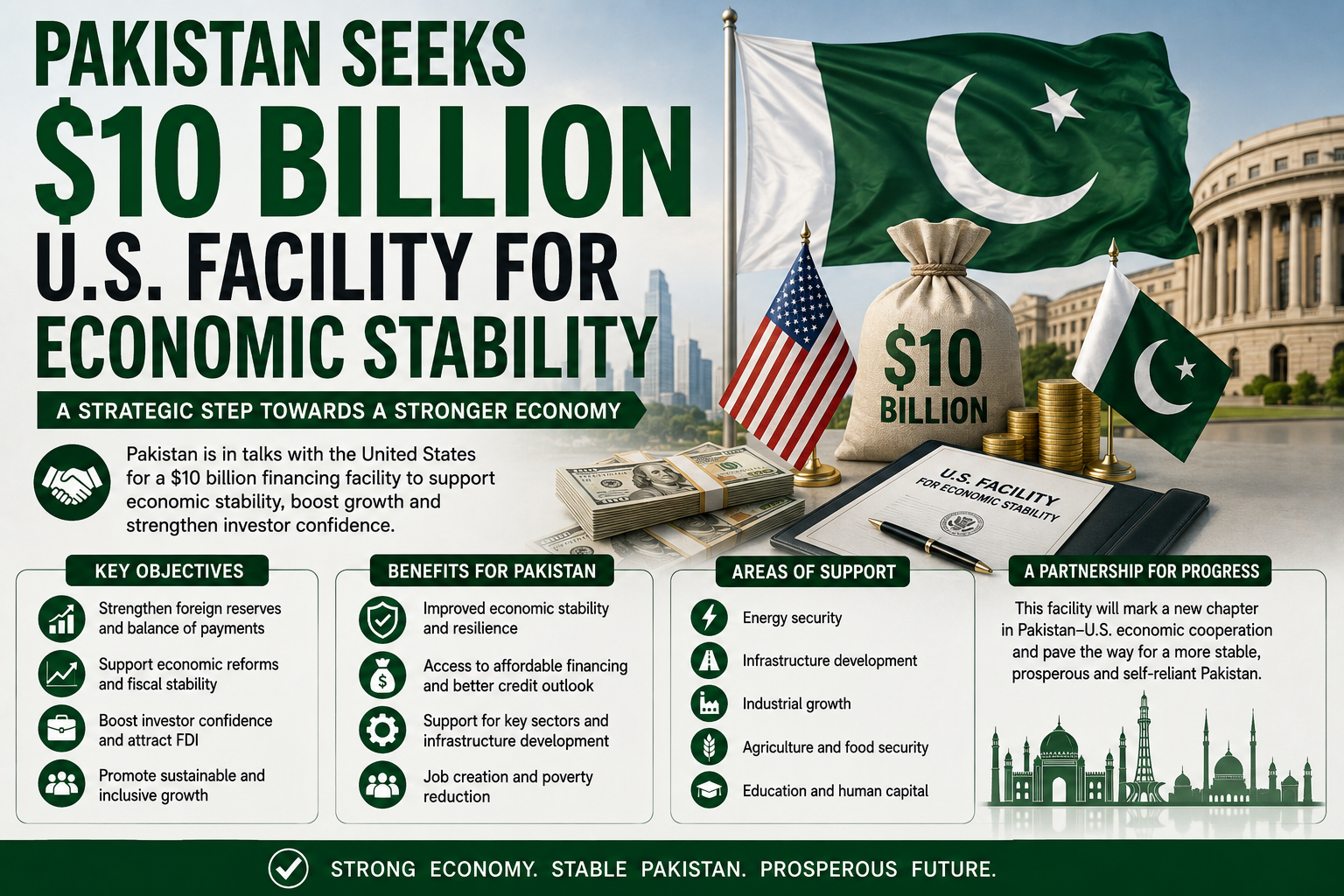
Pakistan is taking steps to strengthen its economy and improve its position in international financial markets. One of the latest developments is Pakistan’s request for a $10 billion financial stabilization facility from the United States. The proposal is aimed at supporting foreign-exchange stability, strengthening investor confidence and reducing pressure on Pakistan’s financial position.
The development has attracted attention because it comes at a time when Pakistan is trying to move from repeated financial emergencies toward a more stable and investment-focused economy. Pakistan is also working under a $7 billion IMF programme, while the government is seeking stronger trade and investment relationships with international partners.
It is important to understand that the $10 billion facility is a request, not an approved payment. Recent reports say Pakistan is waiting for a response from the United States regarding the proposed arrangement.
What Is the $10 Billion Facility?
Pakistan has requested what has been described as a Bilateral Exchange Stabilization Support Facility. Such a facility is different from an ordinary development loan.
The basic purpose would be to provide financial support that could help Pakistan manage pressure on its foreign-exchange reserves and currency.
If approved, the facility could provide greater confidence to international investors and financial markets.
The request is part of Pakistan’s broader effort to strengthen its economic position and improve access to international capital markets.
According to recent reporting, the proposed facility could have a maturity period of up to five years.
Why Does Pakistan Need Financial Stability?
Pakistan's economy has faced repeated pressure from external payments, foreign-exchange shortages and high financing needs.
When a country has limited foreign-exchange reserves, it can become more vulnerable to rising import costs and external shocks.
Foreign exchange is important because Pakistan needs international currencies to pay for imports such as energy, machinery and other essential goods.
A stronger reserve position can provide a better cushion during difficult economic periods.
Pakistan’s central bank has projected that foreign-exchange reserves could reach around $20 billion by the end of 2026, although economic conditions can change.
The Role of the U.S. in Pakistan’s Economic Strategy
Pakistan and the United States have a long history of economic and diplomatic relations.
Recently, Pakistan has been trying to expand economic cooperation with the United States beyond traditional areas.
The proposed financial facility is part of a broader effort to improve economic ties.
Pakistan is also seeking opportunities for American investment in areas such as infrastructure, mining and other sectors.
Recent reporting has highlighted U.S. interest in projects including Pakistan’s Reko Diq mining project, while the U.S. Export-Import Bank has announced financing support related to the project.
How Could the Facility Help Pakistan?
If the proposed facility is approved, it could provide several possible benefits.
1. Stronger Foreign-Exchange Reserves
One of the most important potential benefits would be stronger foreign-exchange reserves.
Higher reserves can help a country manage external payment pressures and unexpected economic shocks.
2. Greater Confidence in the Rupee
Financial stability can also help reduce pressure on the national currency.
A stable currency can make it easier for businesses to plan their costs and investments.
However, currency stability depends on many factors, so a financial facility alone cannot solve every economic problem.
3. Investor Confidence
International investors usually look for financial stability and predictable economic policies.
A credible financial backstop could send a positive signal to investors.
This could support Pakistan’s efforts to attract foreign investment.
4. Better Access to Global Markets
Pakistan is also trying to return more strongly to international capital markets.
Recent reports indicate plans involving instruments such as Eurobonds and other forms of market financing.
Improved confidence could make international financing more accessible over time.
Pakistan’s IMF Programme
Pakistan is currently implementing reforms under a $7 billion IMF programme.
The programme requires Pakistan to maintain fiscal discipline and implement economic reforms.
These reforms have included measures related to taxation, government spending and economic management.
The proposed U.S. facility should therefore be understood as part of a wider financial strategy rather than a replacement for economic reforms.
Long-term stability requires Pakistan to improve its own economic foundations.
Why Economic Reforms Are Important
Financial support can provide temporary stability, but sustainable economic growth requires deeper improvements.
Pakistan needs to increase productivity, improve exports, strengthen tax collection and encourage investment.
The country also needs policies that support businesses and create employment opportunities.
Economic reforms can be difficult because some changes may create short-term pressure, but they can help build a stronger economy over time.
Exports and Economic Growth
Exports are extremely important for Pakistan.
When a country exports more goods and services, it earns foreign currency.
Pakistan has opportunities to increase exports in areas such as:
Textiles
Agriculture
Information technology
Sports goods
Surgical instruments
Food products
Professional services
Technology and digital services could become particularly important for future export growth.
The Importance of IT and Digital Services
Pakistan has a large young population and a growing number of people interested in digital careers.
Information technology can help Pakistan earn foreign exchange without depending entirely on physical exports.
Software development, freelancing, digital marketing, online services and other technology-related fields can contribute to the economy.
Better digital infrastructure and skills development can help Pakistan compete in international markets.
Investment and Economic Development
Foreign investment can bring capital, technology, expertise and employment opportunities.
Pakistan has significant investment potential in areas such as:
Mining
Agriculture
Energy
Technology
Tourism
Infrastructure
Manufacturing
However, investors usually need clear policies, reliable infrastructure and confidence in the business environment.
This is why economic stability and institutional reforms are important.
Pakistan’s Mining Potential
Mining is another important area of economic opportunity.
Pakistan has valuable mineral resources, and projects such as Reko Diq have attracted international attention.
Responsible development of mineral resources could generate investment, employment and government revenue.
At the same time, mining projects need careful planning, environmental responsibility and transparent management.
The Role of the Private Sector
The private sector is essential for economic growth.
Businesses create jobs, produce goods, provide services and contribute to exports.
The government can support the private sector by creating a predictable business environment.
Small and medium-sized businesses are particularly important because they can create employment across different cities and communities.
Small Businesses and Entrepreneurship
Entrepreneurship can help Pakistan create new economic opportunities.
Young entrepreneurs can develop businesses in technology, agriculture, tourism, education and many other fields.
Entrepreneurship also encourages innovation.
However, entrepreneurs need access to training, markets, technology and suitable financing.
A strong economy should create opportunities for both large companies and small businesses.
Agriculture and Pakistan’s Economy
Agriculture remains an important part of Pakistan’s economy.
Millions of people depend directly or indirectly on agriculture for their income.
Improving agricultural productivity can increase food security and support exports.
Modern farming techniques, better water management, improved seeds and access to technology can help farmers.
Agricultural reforms can therefore contribute to broader economic stability.
Energy and Economic Growth
Energy is another major factor in Pakistan’s economy.
Businesses need reliable and affordable energy to operate.
Energy shortages or high costs can increase production expenses and make Pakistani products less competitive.
Long-term energy planning and investment can help improve economic productivity.
Renewable energy can also become an important part of Pakistan’s future energy strategy.
Employment Opportunities
Economic growth is meaningful when it creates opportunities for people.
Pakistan has a large young population entering the workforce.
The economy therefore needs to create jobs in both traditional and modern sectors.
Technology, manufacturing, agriculture, tourism, construction and services can all contribute to employment.
Education and skills training should also match the changing needs of the job market.
Youth and Pakistan’s Economic Future
Young people can play a major role in Pakistan’s economic development.
They can contribute through entrepreneurship, technology, research and professional careers.
The government, universities and private companies can help by providing skills training and practical opportunities.
A skilled young workforce can become one of Pakistan’s greatest economic strengths.
Tourism as an Economic Opportunity
Pakistan has considerable tourism potential.
The country's mountains, valleys, historical sites and cultural diversity can attract domestic and international visitors.
Tourism can create jobs for local communities and support hotels, restaurants, transportation and small businesses.
Better infrastructure and responsible tourism policies can help the sector grow.
The Importance of Infrastructure
Economic development requires good infrastructure.
Roads, railways, ports, airports, electricity networks and digital connectivity all support economic activity.
Infrastructure investment can reduce transportation costs and make it easier for businesses to access markets.
Pakistan’s geographical location also gives it opportunities to strengthen regional trade and transportation links.
Pakistan and International Trade
International trade is important for economic growth.
Pakistan can benefit from stronger trade relationships with countries in Asia, the Middle East, Europe and North America.
Increasing exports and reducing unnecessary dependence on imports can improve the country’s external balance.
Trade agreements and stronger business relationships can create new markets for Pakistani products.
Moving From Borrowing to Investment
One of the biggest long-term goals for Pakistan should be to move toward an economy that depends more on investment, exports and productivity and less on emergency financing.
External financial support can provide breathing room, but sustainable development requires domestic economic strength.
This means producing more, exporting more and creating competitive businesses.
Why Investor Confidence Matters
Investor confidence can have a major effect on economic growth.
Investors want to know that:
Policies are predictable
Contracts are respected
Businesses can operate efficiently
Infrastructure is available
Financial conditions are manageable
Regulations are understandable
Improving these conditions can help Pakistan attract both local and international investment.
Challenges That Remain
Despite recent economic stabilization efforts, Pakistan still faces important challenges.
These include:
High financing needs
External debt
Energy costs
Limited exports
Policy uncertainty
Inflationary pressures
Unemployment
Low investment
Fiscal pressures
These challenges cannot be solved overnight.
They require consistent policies and long-term planning.
The Importance of Long-Term Planning
Economic development requires patience.
A country cannot become economically strong through one financial agreement or one government programme.
Pakistan needs long-term planning that continues across political and economic cycles.
Policies related to education, exports, energy, technology and investment should be designed with the future in mind.
Can the $10 Billion Facility Solve Pakistan’s Economic Problems?
No single financial facility can solve all of Pakistan’s economic challenges.
If approved, the proposed facility could provide additional financial stability and confidence.
But Pakistan would still need to improve productivity, exports, investment and fiscal management.
The real goal should be to build an economy strong enough to manage future challenges without repeatedly depending on emergency support.
A New Direction for Pakistan’s Economy
Pakistan’s recent efforts suggest a growing focus on investment and market-based financing.
Finance Minister Muhammad Aurangzeb has emphasized improving Pakistan’s access to international capital markets and attracting private investment. Recent reporting also says Pakistan is preparing to return to international debt markets.
This could represent a gradual shift from dependence on emergency assistance toward greater participation in international financial markets.
However, this transition will require careful economic management.
What Pakistan Needs for Sustainable Growth
Pakistan can strengthen its economy by focusing on several key areas.
Increase Exports
More competitive exports can generate foreign exchange and support economic growth.
Improve Education
Quality education can create a skilled workforce.
Develop Technology
Digital industries can create new sources of income and employment.
Support Businesses
A healthy private sector can create jobs and investment.
Improve Governance
Transparent and efficient institutions can increase confidence.
Develop Infrastructure
Better infrastructure can reduce business costs.
Encourage Innovation
New ideas and technologies can improve productivity.
The Future of Pakistan’s Economy
Pakistan has both challenges and opportunities.
The proposed $10 billion U.S. financial facility is one part of a larger economic story.
If approved, it could strengthen Pakistan’s financial position and provide additional confidence to international markets.
But the more important question is what Pakistan does with that stability.
The country needs to use periods of financial stability to make structural improvements.
This means investing in people, businesses, infrastructure and productive industries.
Conclusion
Pakistan’s request for a proposed $10 billion U.S. exchange-stabilization facility is an important recent development in the country’s economic strategy. The proposal is intended to strengthen foreign-exchange stability, support investor confidence and improve Pakistan’s ability to access international financial markets.
However, it is important to remember that the facility has not been confirmed as an approved $10 billion loan. Pakistan is still waiting for the U.S. response.
The development also highlights a bigger issue: Pakistan needs long-term economic stability rather than repeated emergency financial support.
A stronger future will depend on increasing exports, attracting investment, developing technology, improving education, supporting entrepreneurship and strengthening institutions.
Pakistan has a large population, a young workforce, natural resources and opportunities in many sectors. With effective economic policies and responsible management, these strengths can support sustainable development.
The proposed U.S. facility may provide additional financial breathing room if approved, but the real goal should be to build an economy that can stand stronger on its own.
Pakistan’s long-term economic success will depend not only on how much financial support it receives, but on how effectively it uses that support to create investment, productivity, jobs and sustainable growth.
5 FAQs
1. What is Pakistan’s $10 billion U.S. facility?
It is a proposed exchange-stabilization facility requested by Pakistan to strengthen foreign-exchange stability and investor confidence.
2. Has the United States approved the $10 billion facility?
No. Recent reports say Pakistan is still awaiting a response from the United States.
3. Why does Pakistan need financial stabilization support?
It could help strengthen foreign-exchange reserves and provide additional protection against external financial pressures.
4. How can Pakistan achieve long-term economic growth?
Pakistan needs stronger exports, investment, productivity, technology, education and business development.
5. What sectors can help Pakistan’s economy grow?
Technology, agriculture, mining, manufacturing, tourism, energy and exports all have significant potential.




