Inflation remains one of the most important economic issues facing Pakistan in 2026. Changes in the prices of food, electricity, fuel, transportation, housing and everyday necessities directly affect households, businesses and the wider economy. Although Pakistan has moved away from the exceptionally high inflation levels experienced during the previous economic crisis, price stability remains an important priority for policymakers.
The inflation situation in 2026 is being influenced by several factors, including domestic demand, energy prices, food supplies, exchange-rate movements, government policies and developments in international commodity markets. The International Monetary Fund (IMF) expects inflation to remain higher than the unusually low levels recorded during parts of the previous year, while emphasizing that external shocks could create additional pressure.
Understanding Pakistan’s inflation outlook is important because inflation is not simply a statistic. It affects how much families can purchase with their incomes, how businesses calculate costs, how investors make decisions and how the government manages economic policy.
What Is Inflation?
Inflation refers to a sustained increase in the general level of prices of goods and services over time.
When inflation rises, the purchasing power of money falls. In simple terms, the same amount of money buys fewer goods and services than it did previously.
For example, if the price of everyday necessities increases while a household’s income remains unchanged, that household may have to reduce spending on other items.
Inflation can therefore affect household budgets even when people continue earning the same amount of money.
Moderate inflation can occur in a growing economy, but very high or unpredictable inflation can create serious economic difficulties.
Pakistan’s Inflation Situation in 2026
Pakistan experienced extremely high inflation during the earlier period of economic instability. Price pressures were particularly difficult for households because food, energy and transportation costs increased sharply.
By 2026, inflation had become considerably more contained compared with those earlier levels. However, price pressures remained an important concern.
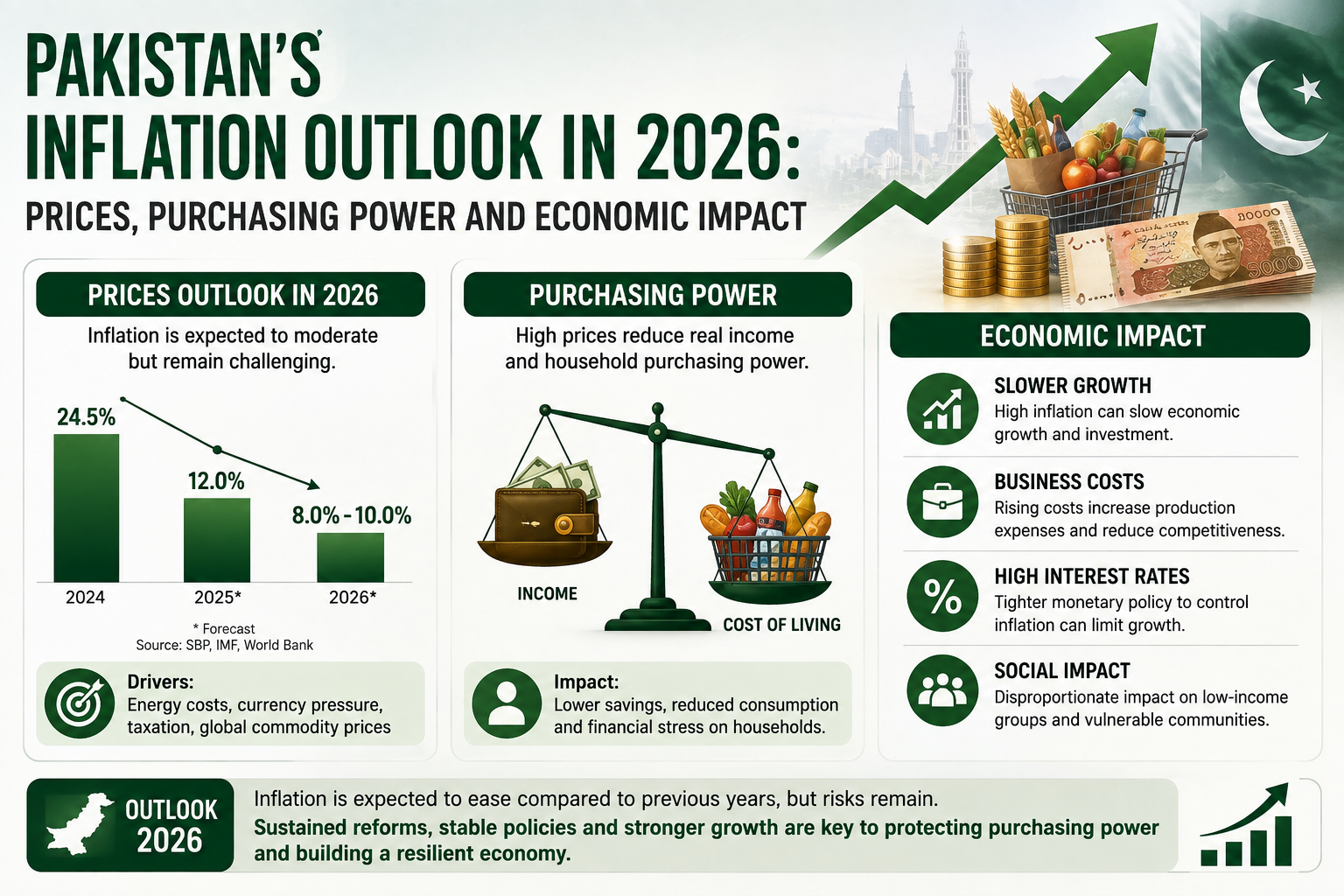
According to the IMF’s 2026 Pakistan assessment, headline inflation reached 7.3% year-on-year in March 2026, partly reflecting increases in energy prices and the impact of higher global commodity prices.
The IMF’s broader outlook projected average consumer-price inflation of around 7.2% for 2026.
These figures show that inflation has stabilized considerably compared with the crisis period, but price increases have not disappeared.
Why Inflation Matters to Ordinary Families
Inflation directly affects household purchasing power.
Families generally have fixed or slowly changing incomes, while the prices of necessities can change more quickly.
When food, transportation, electricity and other essential expenses increase, households may have to adjust their budgets.
Some families may spend a larger share of their income on necessities and reduce spending on non-essential products.
This can also affect businesses because changes in consumer spending influence demand.
Inflation is therefore connected to everyday economic decisions, from grocery shopping to education expenses and transportation.
Food Inflation
Food prices are particularly important in Pakistan because food represents a significant part of household expenditure.
Prices of wheat, flour, rice, vegetables, fruits, cooking oil, milk and other products can be influenced by agricultural production, transportation costs, energy prices and supply conditions.
Weather events can also affect food availability.
Floods, excessive heat, irregular rainfall and other climate-related events can damage crops and disrupt supply chains.
When supplies decline while demand remains stable, prices can increase.
Improving agricultural productivity and storage infrastructure can help reduce some of these pressures.
Energy Prices and Inflation
Energy prices have a strong relationship with inflation.
Electricity and fuel costs influence household budgets directly, but they also affect almost every business.
A factory uses electricity to operate machinery. A farmer may use fuel for agricultural equipment. A transport company needs fuel to move goods.
When energy costs rise, businesses may face higher production and transportation expenses.
These costs can eventually be passed on to consumers through higher prices.
The IMF has warned that higher international energy and commodity prices can create inflationary pressure in Pakistan.
This makes energy security an important part of inflation management.
Global Commodity Prices
Pakistan’s inflation outlook is also affected by global commodity markets.
The country imports energy and various raw materials. Changes in international prices can therefore affect domestic costs.
For example, a significant increase in international oil prices can raise the cost of importing fuel.
This can influence transportation, electricity generation and production costs.
Global food prices can also affect Pakistan, particularly when domestic supplies are insufficient.
Because Pakistan cannot completely control international prices, maintaining adequate foreign-exchange reserves and improving domestic production can help reduce vulnerability.
Exchange Rate and Inflation
The exchange rate is another factor that can influence inflation.
When the Pakistani rupee loses value against major international currencies, imported goods can become more expensive.
This can affect fuel, machinery, industrial inputs, medicines and other imported products.
A more stable exchange rate can reduce some uncertainty for businesses.
However, maintaining exchange-rate stability requires careful economic management because excessive intervention can place pressure on foreign-exchange reserves.
Monetary Policy and Inflation
The State Bank of Pakistan plays a major role in controlling inflation through monetary policy.
Interest rates influence borrowing, investment and consumer spending.
When inflationary pressures are high, tighter monetary policy can help reduce excessive demand and stabilize prices.
When inflation becomes more controlled, monetary policy can potentially provide greater support for economic activity.
The IMF reported that Pakistan’s central bank reduced its policy rate by 50 basis points in December 2025 and maintained it at 10.5% during January and March 2026.
The challenge for policymakers is to maintain a balance between controlling inflation and supporting economic growth.
Inflation and Interest Rates
High interest rates can make borrowing more expensive.
Businesses may postpone expansion because loans cost more.
Consumers may also reduce borrowing and spending.
However, high interest rates can help reduce inflationary pressure by slowing excessive demand.
As inflation becomes more stable, policymakers can consider whether monetary conditions can gradually become more supportive of investment.
The timing of such decisions is important because reducing interest rates too quickly could potentially create renewed inflationary pressure.
Government Policies and Prices
Government policies can also influence inflation.
Changes in taxes, energy tariffs, subsidies, import duties and administered prices can affect the cost of goods and services.
Fiscal discipline is important because excessive government borrowing can contribute to broader economic pressures.
At the same time, governments need to protect vulnerable households when essential prices rise.
Targeted social protection can help households manage temporary price shocks without creating broad fiscal problems.
Inflation and Businesses
Inflation affects businesses in several ways.
Companies may face higher costs for raw materials, electricity, transportation, wages and financing.
If businesses increase their prices to cover higher costs, consumers may face additional inflation.
However, companies cannot always pass all higher costs to customers because competition limits how much prices can increase.
As a result, inflation can reduce profit margins and discourage investment.
Businesses therefore benefit from a stable economic environment where prices and costs are relatively predictable.
Impact on Small Businesses
Small businesses can be particularly vulnerable to inflation.
A large company may have stronger financial reserves or greater negotiating power with suppliers.
A small shop, restaurant, workshop or manufacturer may have less ability to absorb higher costs.
Higher electricity bills, rent, transportation expenses and raw-material prices can put pressure on small businesses.
Improving access to finance and encouraging digital tools can help SMEs become more efficient.
Inflation and Employment
Inflation can also affect employment.
If businesses experience rising costs and weak demand, they may reduce hiring or delay expansion.
On the other hand, stronger economic activity can create jobs and increase household incomes.
The relationship between inflation and employment is therefore complex.
Policymakers need to balance price stability with economic growth and job creation.
Purchasing Power and Household Budgets
Purchasing power refers to the amount of goods and services that people can buy with their income.
When prices rise faster than incomes, purchasing power declines.
This is why inflation can feel particularly difficult for households even when the official inflation rate is much lower than it was during a previous crisis.
For example, if a family’s income increases but food, electricity and transportation costs rise at the same time, the family may not feel significantly better financially.
Maintaining stable prices is therefore essential for improving living standards.
Inflation and Savings
Inflation can also affect savings.
If money is kept in cash while prices rise, its real purchasing power can decline.
This encourages households and businesses to think carefully about how they manage savings.
A stable financial system can provide people with different options for saving and investing.
However, financial decisions should always be based on individual circumstances and appropriate professional advice.
Inflation Expectations
What people expect to happen to prices can influence actual economic behavior.
If consumers believe prices will rise sharply, they may purchase goods earlier than planned.
Businesses may also increase prices in anticipation of higher costs.
These behaviors can contribute to further inflation.
Maintaining confidence in monetary and fiscal policy can therefore help keep inflation expectations stable.
The Role of Food Supply Chains
Improving food supply chains can help Pakistan manage inflation.
Farmers need efficient access to markets.
Storage facilities can reduce post-harvest losses.
Better roads and transportation can reduce delays.
Modern wholesale markets can improve distribution.
Cold-storage facilities are particularly important for fruits, vegetables and other perishable products.
Investment in these areas can improve food availability and reduce unnecessary price increases.
Agriculture and Climate Risks
Climate change creates additional uncertainty for food prices.
Pakistan is vulnerable to floods, heatwaves, drought conditions and irregular rainfall.
These events can reduce agricultural output.
A poor harvest can lead to higher prices, especially when supplies are already limited.
Climate-resilient agriculture can therefore play a role in inflation management.
Modern irrigation, water conservation, improved seeds and better agricultural planning can help farmers cope with changing conditions.
Import Dependence
Pakistan’s dependence on certain imported products also affects inflation.
Fuel, machinery, industrial inputs and some food items may be imported.
When global prices rise or the exchange rate changes, domestic prices can be affected.
Increasing domestic production where economically feasible can reduce some of this exposure.
However, imports remain important because modern industries also need foreign machinery, technology and raw materials.
The goal should therefore be balanced trade rather than eliminating imports.
Inflation and Public Finances
Inflation can create challenges for government finances.
When prices increase, government spending on infrastructure, public services and development projects can also rise.
At the same time, higher prices can increase tax revenues in nominal terms.
However, if inflation is persistent, the government may face higher costs across many areas.
Fiscal discipline is therefore important for maintaining economic stability.
The World Bank has emphasized the importance of stronger fiscal management and revenue mobilization for Pakistan’s long-term economic development.
Social Protection
During periods of price pressure, vulnerable households may need additional support.
Social protection programmes can help families manage temporary increases in essential costs.
The challenge is to make such support targeted and financially sustainable.
Broad subsidies can become expensive and may benefit higher-income households as well.
Targeted assistance can provide support to those who need it most while reducing pressure on government finances.
Inflation and Poverty
High inflation can increase economic hardship, especially for low-income households.
Families with limited incomes generally spend a larger share of their budgets on necessities.
If food and energy prices rise, they may have less money available for education, healthcare, transportation and other needs.
Reducing inflation is therefore not only a macroeconomic objective but also an important social objective.
Pakistan’s Inflation Outlook for the Rest of 2026
The inflation outlook for the remainder of 2026 will depend on several factors.
Domestic food supplies, energy prices, exchange-rate stability, monetary policy and global commodity markets will all play a role.
If international energy prices remain elevated, Pakistan could face additional pressure.
On the other hand, stable food supplies, disciplined monetary policy and improved economic conditions could help keep inflation manageable.
The IMF’s projections indicate that inflation is expected to remain significantly below the extreme levels experienced during Pakistan’s earlier economic crisis, but risks remain.
Why Inflation Could Rise Again
Several factors could cause inflation to increase.
1. Higher Global Oil Prices
Pakistan’s energy import requirements make the economy sensitive to international oil prices.
2. Food Supply Problems
Poor agricultural production can increase food prices.
3. Exchange-Rate Pressure
A weaker currency can increase the cost of imports.
4. Energy Tariff Changes
Changes in electricity or fuel prices can influence overall inflation.
5. Global Geopolitical Conflicts
International conflicts can disrupt energy supplies and increase commodity prices.
The IMF has specifically highlighted global and regional developments as downside risks to Pakistan’s economic outlook.
Why Inflation Could Become More Stable
There are also factors that could support price stability.
Improved foreign-exchange reserves can provide a stronger external buffer.
Better agricultural production can help stabilize food prices.
A stable exchange rate can reduce imported inflation.
Responsible monetary policy can help manage demand.
Improved energy-sector efficiency can reduce cost pressures over time.
Together, these factors could support a more stable inflation environment.
The Importance of Foreign-Exchange Reserves
Foreign-exchange reserves can help Pakistan manage external economic shocks.
Higher reserves can improve confidence and provide greater capacity to finance essential imports.
The IMF reported that Pakistan’s official reserves had increased significantly during the stabilization period.
A stronger reserve position does not directly eliminate inflation, but it can help the country manage exchange-rate and import pressures.
Digitalization and Price Monitoring
Technology can also help manage inflation.
Digital price-monitoring systems can provide authorities with more timely information about market prices.
E-commerce platforms can increase price transparency by allowing consumers to compare products.
Digital payments can also improve documentation of economic activity.
Better data can help policymakers identify supply disruptions and unusual price movements more quickly.
The Role of Competition
Competition can help keep prices under control.
When several businesses compete to sell similar products, consumers have more choices.
Strong competition can encourage businesses to improve efficiency and avoid unnecessary price increases.
Improving competition policy can therefore contribute to a healthier economy.
Long-Term Solutions to Inflation
Short-term measures can help manage inflation, but long-term solutions are more important.
Pakistan needs to increase domestic productivity, improve agricultural supply chains, strengthen energy infrastructure and encourage investment.
A more productive economy can produce goods and services at lower costs.
Higher productivity can reduce pressure on prices while also supporting economic growth.
Productivity and Economic Growth
Productivity means producing more output with the same or fewer resources.
Improving productivity can help businesses reduce costs.
For Pakistan, productivity improvements can come from better technology, worker training, modern machinery, improved infrastructure and stronger management.
Higher productivity can also make Pakistani products more competitive internationally.
Education and Skills
Human capital plays an important role in productivity.
Workers with modern technical and digital skills can contribute more effectively to businesses.
Education and vocational training can therefore support both economic growth and price stability over the long term.
A skilled workforce can help Pakistan move toward higher-value industries that generate better incomes and stronger exports.
Renewable Energy and Price Stability
Renewable energy can potentially help reduce Pakistan’s exposure to international fossil-fuel prices.
Solar, wind and other renewable technologies can diversify the country’s energy mix.
Pakistan has significant solar potential, and greater investment in clean energy could support long-term energy security.
However, renewable-energy development requires careful planning, grid investment and financing.
Export Growth and Inflation
Stronger exports can help Pakistan earn foreign exchange.
Higher foreign-exchange earnings can strengthen the external position and reduce some pressure on the currency.
Export-oriented industries can also create jobs and investment.
However, export growth needs to be accompanied by productivity improvements.
If production costs remain high, Pakistani exporters may struggle to compete internationally.
Investment and Price Stability
Investment can increase productive capacity.
When businesses invest in factories, machinery, technology and logistics, the economy can produce more goods and services.
Greater supply can help reduce price pressures over the long term.
This is why economic policies should encourage productive investment rather than simply focusing on short-term demand management.
What Households Can Learn From the Inflation Outlook
For households, understanding inflation can help with financial planning.
People can track major household expenses, compare prices and distinguish between temporary and long-term price increases.
Families can also focus on budgeting and prioritizing essential expenses.
However, broader inflation management remains primarily a responsibility of economic policymakers and institutions.
What Businesses Can Do
Businesses can prepare for inflation by improving efficiency, managing inventories carefully and monitoring input costs.
Companies can also explore digital tools that reduce administrative and operating costs.
Export-oriented businesses can seek new markets to diversify their revenue.
Small businesses can benefit from financial planning and professional advice when making major investment decisions.
The Broader Economic Impact
Inflation affects almost every part of the economy.
It influences consumption, savings, investment, wages, government spending, imports and exports.
Moderate and predictable inflation can be manageable.
Rapid or unpredictable inflation can create uncertainty and reduce confidence.
Pakistan’s economic recovery therefore depends partly on keeping inflation under control while maintaining enough economic activity to support growth and employment.
Balancing Inflation and Growth
One of the most difficult tasks for economic policymakers is balancing inflation control with economic growth.
If policy becomes too restrictive, economic activity may weaken.
If policy becomes too loose while inflation is already high, price pressures may increase.
The ideal approach is to create conditions where inflation remains manageable while productive investment and employment continue to grow.
Pakistan’s Long-Term Inflation Challenge
Pakistan’s inflation challenge cannot be solved through one policy or one institution.
The central bank can manage monetary policy, but food prices also depend on agriculture.
Energy prices depend partly on the energy sector and global markets.
Imported inflation is affected by the exchange rate and international commodity prices.
Government finances influence fiscal stability.
This means inflation management requires coordination across the economy.
Conclusion
Pakistan’s inflation outlook for 2026 is more stable than during the country’s previous period of severe economic turbulence, but inflation remains an important challenge. The IMF has projected average consumer-price inflation of around 7.2% for 2026, while noting that higher energy and commodity prices could create additional pressure.
The impact of inflation extends far beyond the headline number. It affects household purchasing power, business costs, investment decisions, government finances and overall economic confidence.
Pakistan can strengthen price stability by improving agricultural productivity, strengthening food supply chains, improving energy efficiency, maintaining responsible monetary and fiscal policies, supporting competition and encouraging productive investment.
Foreign-exchange reserves, export growth and a more diversified economy can also help the country become more resilient to external shocks.
At the same time, vulnerable households need effective and targeted social protection when essential prices rise.
The long-term solution is to build a more productive and resilient economy. Higher productivity, modern infrastructure, better education, stronger businesses and improved energy systems can help Pakistan produce more efficiently and reduce some of the structural pressures that contribute to inflation.
Ultimately, Pakistan’s objective should not simply be to reduce the inflation rate for a short period. The country needs stable prices, sustainable economic growth, rising productivity and stronger household purchasing power.
If policymakers can maintain macroeconomic stability while implementing long-term reforms, Pakistan can create a stronger foundation for economic development and gradually reduce the impact of inflation on households and businesses.
FAQs
1. What is Pakistan’s expected inflation rate in 2026?
The IMF has projected average consumer-price inflation of around 7.2% for 2026.
2. What are the main causes of inflation in Pakistan?
Major factors include food prices, energy costs, exchange-rate movements, supply disruptions and international commodity prices.
3. How does inflation affect Pakistani households?
Higher prices reduce purchasing power and can force families to spend more of their income on essential goods and services.
4. Can higher energy prices increase inflation?
Yes. Higher energy costs can increase household expenses as well as the production and transportation costs faced by businesses.
5. How can Pakistan control inflation in the long term?
Improving productivity, agriculture, energy infrastructure, supply chains, fiscal management and economic competitiveness can help reduce long-term inflationary pressures.