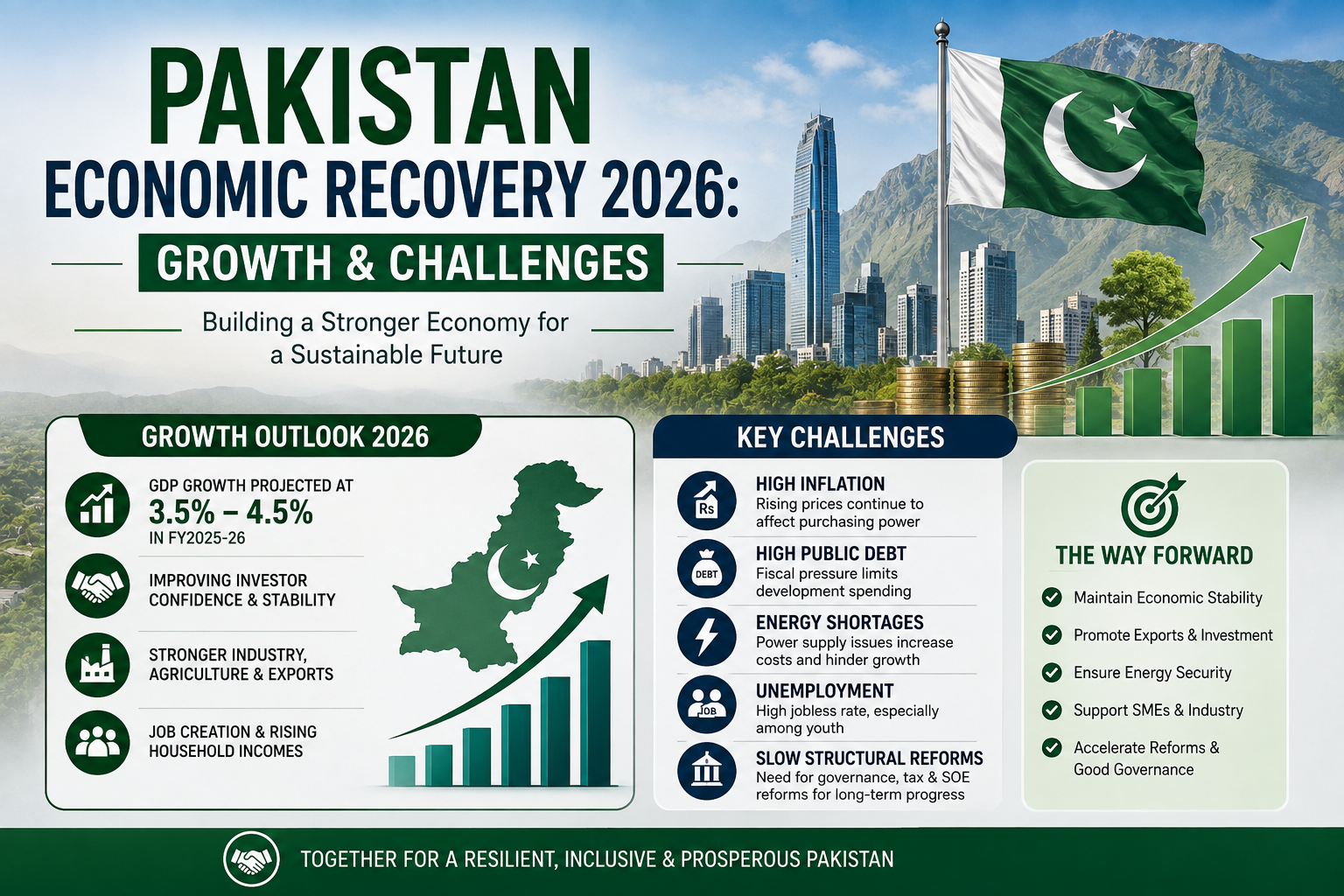
Pakistan’s economy is showing signs of stabilization in 2026 after several years of serious economic pressure. Inflation has been brought down significantly from the extremely high levels seen during the earlier crisis period, foreign-exchange reserves have improved, the current account has remained broadly balanced, and economic activity has started gaining momentum. At the same time, the recovery remains fragile because Pakistan continues to face high debt-related pressures, energy costs, limited fiscal space, weak productivity and risks from global economic developments.
The International Monetary Fund (IMF) reported in its 2026 review that Pakistan’s economic recovery had gained momentum, with GDP growth accelerating during the first half of fiscal year 2026. The IMF also noted that inflation had remained relatively contained, the current account was broadly balanced and reserve rebuilding had exceeded earlier expectations.
However, the economic outlook has become more uncertain because of global and regional developments. Higher commodity and energy prices can increase inflation and put pressure on imports, while weaker global demand can affect Pakistan’s exports. The IMF has therefore stressed that maintaining strong economic policies and continuing structural reforms will be important for protecting the gains made so far.
Understanding Pakistan’s Economic Recovery
Economic recovery means that economic activity begins to improve after a period of weakness or instability. For Pakistan, recovery involves more than simply increasing GDP. It also includes stabilizing prices, strengthening foreign-exchange reserves, improving public finances, supporting businesses and creating conditions for sustainable investment.
Pakistan entered the current reform period after facing substantial pressure on its external finances, inflation and foreign-exchange reserves. The IMF-supported programme, approved in September 2024, has focused on macroeconomic stability, rebuilding reserve buffers, broadening the tax base, improving competition and productivity, reforming state-owned enterprises and restoring the viability of the energy sector.
By 2026, several of these efforts were beginning to show measurable results. However, stabilization is only the first stage. The next challenge is turning stabilization into faster and more inclusive economic growth.
GDP Growth Shows Signs of Improvement
One of the clearest indicators of recovery is economic growth.
According to the IMF’s 2026 staff report, Pakistan’s GDP growth accelerated during the first half of fiscal year 2026. Economic activity grew by around 3.8% year-on-year during the first half, supported by industries including automobiles, construction and garments.
The IMF’s updated baseline projected real GDP growth in the range of roughly 3.5% to 4% for FY2026. Medium-term growth could gradually improve if Pakistan maintains macroeconomic stability, strengthens external competitiveness and improves the environment for private-sector investment.
This is encouraging because stronger industrial activity can generate employment, increase demand for services and encourage private investment.
However, growth around 3.5% to 4% is still relatively moderate for a country with a large and growing population. Pakistan needs stronger productivity and investment if it wants economic growth to translate into significant improvements in household incomes and living standards.
Inflation Has Improved but Remains Important
Inflation has been one of the most difficult economic problems for Pakistani households.
When food, electricity, fuel, transportation and other necessities become more expensive, families have to spend more money simply to maintain their normal standard of living. High inflation also makes it harder for businesses to plan investments and manage production costs.
The economic situation improved considerably compared with the peak inflation period. However, the IMF reported that inflation had begun increasing again during 2026 as higher global commodity prices passed through to domestic energy prices. Headline inflation reached 7.3% year-on-year in March 2026, according to the IMF report.
This demonstrates that inflation remains sensitive to international energy and commodity prices.
Pakistan therefore needs to maintain policies that prevent temporary price shocks from becoming persistent inflation.
Foreign-Exchange Reserves Are Strengthening
Foreign-exchange reserves are another important indicator of economic stability.
Reserves provide a country with a financial buffer that can be used to meet external payment requirements and support confidence in the economy.
According to the IMF, Pakistan’s gross official reserves reached around $16 billion at the end of December 2025, compared with $14.5 billion at the end of June 2025. Reserve rebuilding was stronger than earlier projections.
The improvement in reserves is important because Pakistan has historically faced periods of significant foreign-exchange pressure.
Higher reserves can make it easier for the country to finance imports and manage external shocks.
Nevertheless, reserves must continue to increase over the medium term. A sustainable reserve position depends on stronger exports, stable remittance inflows, responsible external borrowing and improved investment.
The Current Account Position
The current account measures the flow of goods, services, income and transfers between Pakistan and the rest of the world.
A broadly balanced current account can be a positive sign because it means the country is not experiencing an excessively large external deficit.
The IMF reported that Pakistan’s current account remained broadly balanced during the first nine months of FY2026. Strong remittance inflows helped offset a wider trade deficit caused partly by stronger import demand and slower export growth.
This balance is important because Pakistan’s previous economic difficulties have often been associated with large external financing requirements.
However, increasing imports as economic activity recovers can again create pressure if exports do not grow at the same time.
Remittances Continue to Support the Economy
Remittances from overseas Pakistanis are a major source of foreign exchange.
Millions of Pakistanis work abroad and send money to their families. These inflows support household consumption and contribute to the country’s external financial position.
Strong remittance flows were one of the factors supporting Pakistan’s external balance during the recent recovery period.
In the long term, Pakistan can increase the economic impact of remittances by encouraging formal financial channels and creating opportunities for overseas Pakistanis to invest in productive businesses.
Remittances can support economic stability, but they should complement rather than replace export growth and domestic investment.
The Role of the IMF Programme
The IMF-supported economic reform programme has played an important role in Pakistan’s stabilization efforts.
In May 2026, the IMF Executive Board completed the third review of Pakistan’s Extended Fund Facility and the second review of its Resilience and Sustainability Facility. This allowed Pakistan to access around $1.1 billion under the EFF and around $220 million under the RSF. Total disbursements under the two arrangements reached approximately $4.8 billion.
The programme focuses on maintaining macroeconomic stability while implementing reforms.
Important areas include public finances, taxation, competition, productivity, state-owned enterprises, energy-sector viability, social protection and human capital.
The IMF has emphasized that maintaining these reforms is essential if Pakistan wants to achieve sustainable long-term growth rather than temporary stabilization.
Fiscal Discipline and Government Finances
Government finances remain one of Pakistan’s biggest economic challenges.
The government needs revenue to fund education, healthcare, infrastructure, social protection and development projects. At the same time, debt servicing and other mandatory expenditures consume a significant share of public resources.
Fiscal discipline is therefore necessary.
The IMF reported that Pakistan’s fiscal performance remained strong under the programme, with a primary surplus expected for FY2026.
A primary surplus means that government revenues exceed expenditures before interest payments are included.
Maintaining fiscal discipline can strengthen investor confidence and reduce financial risks. However, the government also needs to ensure that fiscal adjustments do not undermine essential public investment and social protection.
Tax Reform Remains Essential
Pakistan’s economic recovery cannot be sustained without improving tax collection.
A broader and more efficient tax system can provide the government with resources for development while reducing excessive dependence on borrowing.
Tax reform should focus on improving compliance, expanding the documented economy and making tax administration more efficient.
Digital systems can help improve transparency and reduce unnecessary administrative costs.
A stronger revenue system would also give Pakistan more flexibility to invest in infrastructure, education, healthcare and climate resilience.
Energy Sector Challenges
Energy remains a major issue for Pakistan’s economy.
Industries need reliable electricity to operate, while households depend on affordable energy for everyday activities.
High energy costs can reduce industrial competitiveness and contribute to inflation.
The IMF has identified restoring energy-sector viability as an important part of Pakistan’s reform programme.
Pakistan also needs to reduce inefficiencies and improve the financial health of the energy sector.
At the same time, renewable energy can provide an important long-term opportunity. Greater use of solar, wind and other clean-energy sources could help diversify the energy mix and improve resilience.
Private Investment Is Critical
Economic recovery becomes more sustainable when private businesses begin investing.
Private investment creates factories, technology, services and employment.
Pakistan therefore needs an environment where businesses can plan confidently and access finance.
The IMF has identified improving competition, productivity and competitiveness as important priorities for Pakistan’s long-term growth.
Simplifying regulations, improving access to finance and reducing unnecessary barriers can encourage businesses to expand.
Small and medium-sized enterprises can be especially important because they create employment across different sectors and regions.
Industrial Activity Is Recovering
Industrial activity is showing signs of improvement.
The IMF reported that automobiles, construction and garment industries were among the sectors supporting GDP growth during the first half of FY2026.
Industrial recovery can have wider economic effects.
When factories increase production, demand rises for transportation, electricity, raw materials, financial services and skilled workers.
However, long-term industrial growth requires more than temporary increases in production. Pakistan needs investment in technology, productivity and export competitiveness.
Exports Need to Grow
Exports are essential for Pakistan’s long-term economic stability.
A stronger export sector can generate foreign exchange without increasing external debt.
Pakistan has established export industries in textiles, agriculture, rice, sports goods, surgical instruments and other products.
The country also has growing potential in information technology and digital services.
The challenge is to increase value-added exports and diversify markets.
If imports grow faster than exports, external pressure can return even when domestic economic activity is improving.
Digital Economy and IT Exports
The digital economy offers Pakistan a major opportunity.
Information technology services can generate foreign exchange while creating employment for skilled young people.
Software development, freelancing, digital marketing, cybersecurity, business-process services and other technology fields can connect Pakistan with global markets.
The State Bank of Pakistan has also taken measures to facilitate IT companies and freelancers in handling export receipts and foreign-exchange transactions, supporting the development of the digital export sector.
A strong digital economy requires reliable internet infrastructure, technical education, digital payment systems and access to international clients.
Agriculture and Economic Recovery
Agriculture remains central to Pakistan’s economy.
The sector affects food prices, rural incomes, employment and industrial activity.
Improving agricultural productivity can support economic growth while helping control food inflation.
Modern irrigation, improved seeds, better storage, agricultural technology and efficient supply chains can increase productivity.
Climate resilience is becoming increasingly important because floods, heatwaves and irregular rainfall can damage agricultural production.
Climate Risks
Climate change is an important economic risk for Pakistan.
Natural disasters can destroy infrastructure, reduce agricultural output and create additional government spending requirements.
The IMF’s Resilience and Sustainability Facility is intended to support reforms that strengthen Pakistan’s resilience to climate-related risks.
Economic recovery therefore needs to include investment in climate-resilient infrastructure, water management and disaster preparedness.
Impact of Global Energy Prices
Pakistan is sensitive to international energy prices because the country imports significant amounts of fuel.
When global oil and energy prices rise, import costs increase. This can affect the trade balance, inflation and household expenses.
The IMF has warned that the 2026 Middle East conflict has increased uncertainty for Pakistan and could put upward pressure on inflation while weighing on growth and the balance of payments.
This shows why energy diversification is important.
Greater use of domestic renewable energy could reduce some of the economy’s exposure to international fuel-price shocks.
The Importance of Monetary Policy
The State Bank of Pakistan plays an important role in controlling inflation and supporting economic stability.
During the stabilization process, monetary policy was kept relatively tight to control inflationary pressures.
The IMF reported that the State Bank reduced its policy rate by 50 basis points in December 2025 and maintained it at 10.5% in January and March 2026. The central bank also reduced the cash reserve requirement for banks from 6% to 5%, helping support private-sector lending.
As inflation becomes more stable, monetary policy can gradually create greater space for private investment and economic activity.
Credit to the Private Sector
Access to credit is important for businesses.
Companies need financing to purchase machinery, expand production, hire workers and develop new products.
The IMF reported that private-sector lending had started recovering during 2026, although it was still coming from a low base.
A stronger banking system and improved access to finance can therefore support economic recovery.
Small businesses, in particular, need suitable financing options because they may not have the same access to capital as large corporations.
Employment and the Cost of Recovery
Economic growth is meaningful when it creates jobs.
Pakistan has a large young population entering the workforce, making employment generation particularly important.
Industries such as technology, manufacturing, agriculture, construction and tourism can provide employment opportunities.
However, economic reforms can sometimes create short-term pressure on households and businesses.
The government therefore needs to balance stabilization with targeted social protection.
The IMF has identified strengthening social protection and human capital as important parts of Pakistan’s reform programme.
Human Capital and Education
Long-term economic recovery depends on skilled workers.
Education and vocational training can improve productivity and help workers move into higher-value industries.
Pakistan can benefit from expanding technical training in areas such as information technology, engineering, healthcare, agriculture and manufacturing.
Digital skills are particularly important because international markets are increasingly connected through technology.
Investing in people can therefore produce economic benefits for many years.
Small Businesses and SMEs
Small and medium-sized enterprises are another important part of Pakistan’s recovery.
SMEs operate in retail, manufacturing, agriculture, services, technology and many other sectors.
They can create jobs quickly and support local economies.
However, many small businesses face challenges such as limited access to finance, complicated regulations and weak digital capabilities.
Supporting SMEs through financing, training and simpler business procedures could make the recovery more inclusive.
Consumer Confidence
Economic recovery also depends on consumer confidence.
When people feel financially secure, they are more likely to spend on goods and services.
When households are worried about inflation, employment or future income, they may reduce spending.
Stable prices and employment opportunities can therefore support domestic demand.
A stronger domestic market can help businesses increase sales and production.
Pakistan’s Long-Term Economic Potential
Pakistan has several structural advantages.
The country has a large population, a young workforce, agricultural resources, established manufacturing industries, a growing digital sector and a strategic geographic location.
These strengths provide a foundation for future growth.
However, the country needs to convert these advantages into productivity and investment.
Long-term growth requires consistent economic policies, stronger institutions and continued improvements in infrastructure and human capital.
What Needs to Happen Next?
The next stage of Pakistan’s economic recovery should focus on moving from stabilization toward sustainable growth.
Several priorities are especially important:
Maintain macroeconomic stability.
Continue rebuilding foreign-exchange reserves.
Expand and diversify exports.
Improve tax collection.
Strengthen the energy sector.
Encourage private investment.
Support SMEs.
Improve education and technical skills.
Increase agricultural productivity.
Develop the digital economy.
Strengthen climate resilience.
Improve public-sector efficiency.
These reforms can help ensure that economic stabilization becomes a foundation for long-term development.
Opportunities for 2026 and Beyond
Pakistan’s recovery creates opportunities for businesses and investors in several areas.
Technology and IT services can expand internationally.
Agriculture can become more productive through modern technology.
Manufacturing can become more competitive through automation and improved energy efficiency.
Tourism can create opportunities for local communities.
Renewable energy can support energy security.
Export-oriented industries can generate foreign exchange.
If these opportunities are supported by stable policies and investment, Pakistan’s growth rate could gradually improve over the medium term.
Challenges That Could Slow Recovery
Despite positive developments, Pakistan’s recovery remains vulnerable.
A major increase in global energy prices could raise inflation.
A slowdown in international demand could reduce exports.
Climate disasters could damage agriculture and infrastructure.
Higher financing costs could increase pressure on public finances.
Weak productivity could prevent rapid economic growth.
Political and policy uncertainty could also affect investor confidence.
The IMF has warned that downside risks remain high, particularly because of global and regional developments.
This means Pakistan cannot afford to become complacent about the progress achieved so far.
Turning Stabilization Into Sustainable Growth
The most important economic challenge for Pakistan is now to convert stabilization into sustainable growth.
Stabilization creates a foundation. Sustainable growth requires investment, productivity and innovation.
The country needs businesses that can compete internationally, workers with modern skills, reliable infrastructure and institutions capable of implementing long-term reforms.
If these elements come together, Pakistan can gradually move toward stronger and more inclusive economic development.
Conclusion
Pakistan’s economic recovery in 2026 shows several encouraging signs. GDP growth accelerated during the first half of FY2026, inflation remained significantly more contained than during the earlier crisis period, foreign-exchange reserves improved and the current account remained broadly balanced.
The IMF’s May 2026 review also confirmed that strong policy implementation had helped support recovery, strengthen confidence and improve resilience.
However, Pakistan’s economic recovery is not yet complete. Debt-related pressures, energy costs, limited fiscal space, climate risks and global economic uncertainty remain important challenges.
The country’s future economic performance will depend on whether policymakers can maintain stability while implementing reforms that improve productivity and competitiveness.
Pakistan has significant opportunities in exports, information technology, agriculture, manufacturing, renewable energy, tourism and private investment. A young population can also become a major economic asset if it receives the right education and skills.
Ultimately, the success of Pakistan’s recovery should not be measured only by GDP growth. A stronger economy should also provide stable prices, productive employment, greater investment, stronger businesses and improved living standards.
Pakistan’s economic recovery in 2026 is therefore an important step, but the real goal is to turn today’s stabilization into sustainable, inclusive and resilient economic growth for the future.
Short Summary
Pakistan’s economy is showing signs of recovery in 2026, with improving growth, reserves and external stability.
However, inflation, debt, energy costs and global risks remain major challenges for sustainable economic growth.
5 FAQs
1. Is Pakistan’s economy recovering in 2026?
Yes. Recent IMF assessments indicate stronger economic activity, improved reserves and greater macroeconomic stability, although significant challenges remain.
2. What are the main challenges to Pakistan’s economic recovery?
Major challenges include inflation, debt pressures, energy costs, limited fiscal space, climate risks and global economic uncertainty.
3. What is helping Pakistan’s economy recover?
Improved policy implementation, stronger reserves, better fiscal performance, recovering private-sector activity and the IMF-supported reform programme are contributing to stabilization.
4. Which sectors can support Pakistan’s future growth?
IT, exports, agriculture, manufacturing, renewable energy, tourism and private investment can all contribute to stronger growth.
5. What does Pakistan need for sustainable economic growth?
Pakistan needs continued macroeconomic stability, structural reforms, higher productivity, stronger exports, investment in human capital and a more competitive business environment.