Introduction
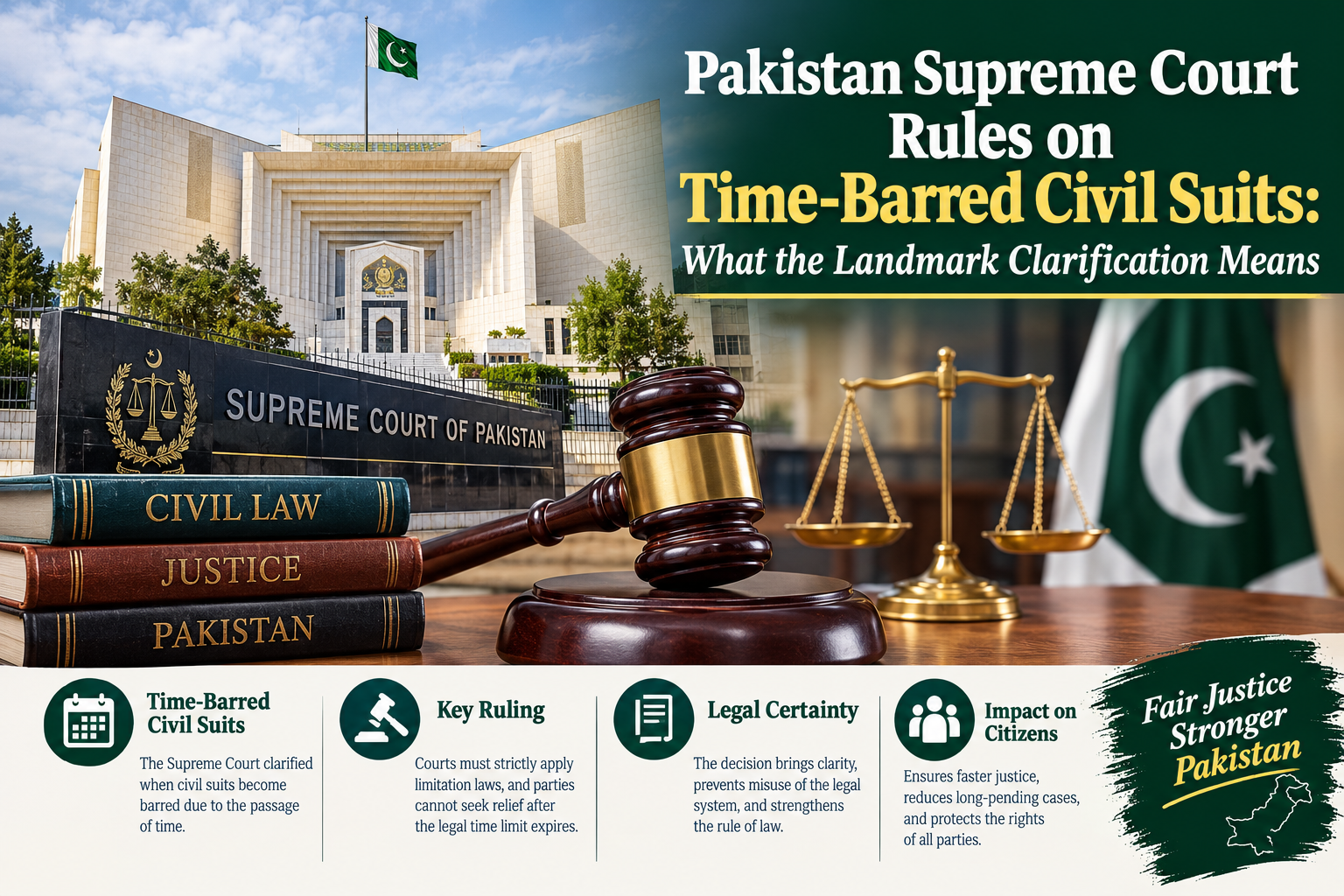
Pakistan’s Supreme Court has issued an important clarification about how civil courts should deal with lawsuits that may have been filed after the legally prescribed time limit. The ruling highlights the responsibility of trial courts to examine whether a case is legally maintainable and to prevent proceedings that are clearly barred by law from unnecessarily consuming judicial resources.
According to a report published by Dawn on October 10, 2026, the Supreme Court held that a trial court may reject a clearly time-barred or legally barred lawsuit on its own initiative, without waiting for the defendant to submit a formal application.
The judgment discussed Section 3 of the Limitation Act, 1908, and Order VII, Rule 11 of the Code of Civil Procedure, 1908. These provisions are relevant to limitation and the rejection of plaints in civil proceedings.
The ruling also emphasised an important safeguard: courts must give parties an adequate opportunity to be heard. A case should not be dismissed simply because a judge has doubts about its merits. The court must examine the pleadings, the applicable legal provisions and whether the claimed legal bar is established.
The decision is significant because limitation rules play an important role in property disputes, contractual disagreements, recovery claims and other civil matters. It also provides an opportunity to explain how Pakistan’s civil justice system balances procedural efficiency with the right to a fair hearing.
1. What Did the Supreme Court Decide?
The Supreme Court clarified that trial courts are not prevented from examining limitation issues on their own initiative.
In straightforward terms, a defendant does not always have to file a separate application asking the court to reject a lawsuit that is clearly barred by law. Where the legal bar is apparent and the relevant procedural requirements are satisfied, the court can consider the issue itself.
The judgment was authored by Justice Muhammad Ali Mazhar, who headed a three-member Supreme Court bench in the matter reported on October 10, 2026.
The principle behind the decision is that courts should identify fundamental legal obstacles at an early stage whenever the law permits. If a lawsuit cannot legally proceed, allowing it to continue unnecessarily can consume time, increase litigation expenses and place additional pressure on an already busy judicial system.
However, the ruling does not mean that courts can dismiss any case simply because it appears weak or difficult to prove.
There is a significant difference between a claim that is legally barred and a claim that requires evidence to determine whether it is valid. When important facts remain disputed, the court may need to proceed through the ordinary stages of civil litigation.
The Supreme Court therefore emphasised both efficiency and fairness. Courts should prevent legally untenable proceedings from continuing unnecessarily, but they must also ensure that genuine disputes receive proper consideration.
2. Understanding the Meaning of a Time-Barred Lawsuit
A time-barred lawsuit is a legal claim brought after the period prescribed by the relevant limitation law has expired, where no applicable legal provision or exception permits the claim to proceed.
Limitation periods are established to ensure that legal disputes are raised within an appropriate period. They help provide certainty and encourage people to pursue their legal rights without unreasonable delay.
The applicable period is not necessarily the same for every type of claim. Different laws and legal provisions may prescribe different time limits depending on the nature of the dispute.
For example, a claim involving a contract may be subject to a different limitation rule from a claim concerning possession, a declaration of rights or another civil matter. The relevant dates and circumstances can also affect how the limitation period is calculated.
It is therefore inaccurate to assume that every civil lawsuit must be filed within one universal period.
Courts must examine the applicable law and the facts relevant to the particular claim. In some circumstances, legal provisions concerning the exclusion of time, acknowledgements, continuing causes of action or other recognised exceptions may affect the limitation analysis.
Whether an exception applies depends on the governing law and the evidence available.
The Supreme Court’s clarification is important because it reinforces the need to examine limitation as a legal issue rather than treating it as a minor procedural detail.
3. What Is Section 3 of the Limitation Act, 1908?
Section 3 of the Limitation Act, 1908, establishes the general principle that proceedings instituted after the prescribed limitation period should be dismissed, subject to the provisions and exceptions recognised by the law.
One important feature of this provision is that the limitation issue is not exclusively dependent on a defendant raising an objection. The court has a statutory responsibility to consider whether the proceeding is within time.
This principle helps explain the Supreme Court’s clarification that a trial court may examine an apparent limitation bar on its own initiative.
The provision supports consistency in the application of limitation rules. A case should not automatically continue merely because a defendant has failed to identify a legal objection that the court is required to consider.
Nevertheless, applying Section 3 requires careful legal analysis. The court must identify the relevant limitation period, determine the legally significant dates and consider whether the law permits any relevant period to be excluded or otherwise affects the calculation.
A simple comparison of the filing date and the date of the disputed event may not always resolve the issue.
For that reason, limitation disputes can require examination of the pleadings, documents, statutory provisions and relevant judicial precedents.
The provision should not be understood as giving courts unlimited discretion to dismiss claims without a legal basis. It operates within the framework of the Limitation Act and other applicable procedural laws.
4. What Is Order VII, Rule 11 of the Code of Civil Procedure?
Order VII, Rule 11 of the Code of Civil Procedure, 1908, identifies circumstances in which a civil court may reject a plaint.
A plaint is the formal document through which a plaintiff presents a civil claim before the court. It sets out the essential facts and the relief being requested.
The rule addresses specified legal defects, including circumstances in which the suit appears from the statements in the plaint to be barred by law.
This procedure can allow a court to address certain fundamental problems without requiring every case to proceed through a complete trial.
However, the rule has limits. Courts must consider the legal requirements applicable to the particular ground of rejection and cannot use it as a substitute for resolving every factual disagreement.
If a question depends on disputed evidence or facts that cannot properly be determined from the plaint and the applicable legal framework, further proceedings may be necessary.
The Supreme Court’s clarification reinforces the distinction between a legal bar that can properly be identified at the preliminary stage and a dispute that requires a fuller examination.
It also underlines that procedural rules should be applied in a manner that protects justice rather than merely accelerating case disposal.
5. Why the Court Emphasised Early Disposal of Legally Barred Cases
Pakistan’s courts handle a large volume of civil, criminal, constitutional and other legal matters. Delays in litigation can affect individuals, businesses, families and public institutions.
When a lawsuit is clearly barred by law, allowing it to continue without first addressing that obstacle may use resources that could otherwise be directed towards disputes requiring judicial determination.
Early examination of maintainability can help courts identify such problems before the case moves further into the litigation process.
This may reduce unnecessary hearings and avoid some of the costs associated with proceedings that cannot legally continue.
The approach can also benefit defendants who might otherwise have to spend considerable time and money responding to a claim that is legally untenable.
However, early disposal must not become an excuse for hurried decisions. A court must understand the nature of the claim, apply the correct legal test and give the parties the hearing required by law.
The objective is not simply to close more cases. It is to ensure that court time is used effectively while preserving access to justice for people with genuine legal claims.
6. The Importance of the Right to Be Heard
One of the most important aspects of the Supreme Court’s clarification is its emphasis on providing both parties with an adequate opportunity to be heard.
A court decision can have serious consequences for the parties involved. Rejecting a plaint at an early stage may prevent the case from proceeding in its existing form, making it essential that the legal basis for doing so is properly examined.
The plaintiff should have a fair opportunity to address the relevant issue within the applicable procedural framework. The defendant must also be able to present the relevant objections and legal arguments.
The requirement of a hearing helps prevent mistakes caused by incomplete information or an incorrect understanding of the dispute.
It also reinforces the principle that procedural efficiency and fairness are complementary goals. A court can act promptly without disregarding the legal rights of the people before it.
Where limitation depends on disputed facts, the court may need to follow a different procedure rather than immediately rejecting the claim.
The correct approach depends on the nature of the legal issue, the applicable procedural rules and the material available to the court.
7. The Background of the Property Dispute
The ruling arose from an appeal connected to a bungalow dispute in Karachi’s Askari IV area.
The litigation involved a question about whether a civil suit could proceed and how the issue of maintainability should be determined.
A previous order of the Sindh High Court had addressed the matter differently from the approach ultimately directed by the Supreme Court.
The Supreme Court set aside the relevant part of the High Court’s February 6, 2025 order and directed the trial court to determine maintainability in accordance with the law after giving both parties an adequate opportunity to be heard.
This procedural direction is important to understand correctly.
The Supreme Court did not simply announce that every claim in the underlying dispute was finally decided or that every similar property claim must be rejected. Instead, it clarified the trial court’s authority to examine the legal question and directed that the matter be handled according to the applicable law.
The trial court must assess the case in light of the pleadings and the parties’ opportunity to present their positions.
This distinction matters because a judicial ruling about how a legal issue should be examined is not always the same as a final determination of every underlying factual or property dispute.
8. Can a Court Reject Part of a Plaint?
The judgment also addressed the limits on rejecting a plaint.
As explained in the reported decision, a plaint cannot simply be rejected in parts under Order VII, Rule 11. If even one prayer for relief is legally maintainable, the entire plaint cannot automatically be rejected on the basis of that rule.
This principle prevents courts from treating a mixed claim as entirely invalid merely because one part raises a legal problem.
A plaint may contain more than one request for relief. Each request may have a different legal basis, and the applicable procedural rules determine how the court should address those requests.
The existence of one potentially maintainable claim may therefore affect whether the plaint as a whole can be rejected under the relevant provision.
This does not mean that every claim within a plaint will necessarily succeed. It means that the court must apply the correct legal procedure when deciding whether the document can be rejected at the preliminary stage.
Where legal and factual questions are intertwined, the case may need to proceed to the stage at which issues can be framed and the necessary evidence considered.
This approach helps prevent procedural shortcuts from unfairly removing claims that require judicial examination.
9. What Happens When Questions of Law and Fact Are Intertwined?
Civil disputes often involve a combination of legal questions and factual disagreements.
For example, the parties may disagree about the date of an agreement, the circumstances in which a right arose, the effect of a document or whether a particular legal exception applies.
Some issues can be determined from the plaint and the relevant law. Others may require documents, testimony or additional evidence.
The Supreme Court’s clarification recognises the importance of distinguishing between these situations.
If the alleged legal bar is clear from the pleadings and the applicable law, the court may be able to address it at the preliminary stage.
If the issue depends on facts that remain genuinely disputed, the court may need to proceed through the appropriate stages of civil litigation. This can include framing issues and deciding them on the basis of the evidence and applicable legal principles.
The objective is to prevent unnecessary proceedings without denying parties a proper opportunity to establish their positions.
A court must therefore examine the nature of the dispute rather than assuming that every limitation objection can be resolved in exactly the same way.
10. What the Ruling Means for Property Disputes
Property disputes can involve ownership, possession, inheritance, agreements, transfers, contractual obligations and other legal rights.
Because such disputes may continue for years, questions about limitation can become particularly important.
A person considering a civil claim needs to understand that the passage of time may affect the available legal remedies. However, the relevant consequences depend on the specific claim and the law governing it.
The Supreme Court’s clarification reinforces the importance of addressing limitation questions at the appropriate stage.
It may also encourage parties to take legal deadlines seriously and avoid assuming that a claim can always be brought regardless of when the underlying events occurred.
At the same time, the ruling does not mean that every older property dispute is automatically time-barred. Some claims may involve different limitation periods, relevant exceptions or circumstances that require detailed legal analysis.
A dispute should not be assessed solely by the age of the property or the length of time that has passed since an event.
The applicable legal provisions and the facts of the case remain essential.
11. What the Ruling Means for Plaintiffs and Defendants
The judgment has implications for both sides in civil litigation.
For plaintiffs, it highlights the importance of identifying the legal basis of a claim and understanding the relevant limitation period before instituting proceedings.
A plaintiff should not assume that the court will ignore a limitation problem merely because the defendant has not raised it.
For defendants, the ruling reinforces the importance of properly identifying legal objections and presenting them through the appropriate procedure. It also clarifies that the absence of a formal application does not necessarily prevent a court from examining a clear legal bar.
For both parties, the judgment emphasises that the court must follow the applicable procedural requirements and provide an adequate opportunity to be heard.
The decision is therefore not simply about making litigation faster. It concerns the proper balance between legal deadlines, procedural efficiency and fair treatment.
Because limitation rules can be technical, anyone involved in an actual civil dispute should obtain advice from a qualified Pakistani lawyer who can examine the relevant documents and facts.
12. How the Decision Could Support Judicial Efficiency
The Supreme Court’s approach may help trial courts identify cases that are legally unsuitable for further proceedings at an early stage.
When used correctly, this can reduce unnecessary hearings and allow judges to devote more attention to disputes that require evidence and detailed adjudication.
It may also encourage more careful preparation of civil claims. Parties and their legal representatives have an incentive to examine the relevant law and limitation periods before initiating proceedings.
However, judicial efficiency depends on more than preliminary rejection of cases. Courts also need sufficient resources, effective case management, timely hearings, reliable records and consistent application of legal rules.
The proper use of preliminary procedures is one part of a wider effort to improve the delivery of justice.
It is equally important to ensure that genuine claims are not dismissed through an overly broad interpretation of procedural requirements.
A legal system is more effective when it can resolve disputes efficiently while maintaining public confidence in the fairness and consistency of its decisions.
13. Why the Ruling Matters to Ordinary Citizens
For ordinary citizens, court procedures can seem complicated, especially when a dispute involves property, contracts or financial rights.
The Supreme Court’s clarification offers a useful reminder that legal deadlines matter and that the court may examine them even when the opposing party has not formally requested it.
People should not assume that waiting too long to seek legal remedies has no consequences. Nor should they assume that every claim involving an old event is automatically barred.
The correct limitation period and the possibility of any exception depend on the relevant law and circumstances.
Understanding these distinctions can help citizens ask better questions when seeking legal assistance.
It can also encourage people to preserve important documents, keep accurate records and seek professional guidance when a dispute arises.
Public understanding of civil procedure can reduce unrealistic expectations about litigation and help people make better-informed decisions.
14. The Broader Importance of Consistent Legal Procedure
The ruling highlights a wider principle of civil justice: courts must apply procedural laws consistently while ensuring that their decisions remain fair.
Limitation rules provide structure and certainty. Preliminary procedures allow courts to address certain legal defects without conducting unnecessary trials. The right to be heard ensures that people affected by judicial decisions have a meaningful opportunity to present their positions.
These principles must operate together.
If procedural rules are ignored, litigation can become unnecessarily prolonged and expensive. If they are applied too aggressively, genuine claims may be prevented from receiving proper consideration.
The Supreme Court’s clarification seeks to maintain the distinction between a claim that is clearly barred by law and one that requires further examination.
The practical effect will depend on how trial courts apply the judgment to individual cases and how consistently the relevant legal standards are followed.
Conclusion
Pakistan’s Supreme Court has clarified that trial courts may examine whether a civil lawsuit is time-barred on their own initiative and, where the legal requirements are satisfied, reject a plaint without waiting for a formal application from the defendant.
The ruling draws attention to Section 3 of the Limitation Act, 1908, and Order VII, Rule 11 of the Code of Civil Procedure, 1908. It emphasises the importance of preventing legally barred proceedings from unnecessarily consuming judicial resources.
At the same time, the judgment stresses that parties must receive an adequate opportunity to be heard. Courts must distinguish between claims that are clearly barred by law and disputes that require evidence or further legal examination. A plaint cannot simply be rejected in parts under Order VII, Rule 11, and maintainable claims must be treated in accordance with the applicable procedure.
For citizens, the decision reinforces the importance of understanding legal deadlines and seeking timely professional advice. For courts, it highlights the need to balance efficiency with fairness.
Ultimately, a strong civil justice system requires more than quick decisions. It requires accurate application of the law, meaningful hearings, consistent procedures and respect for the rights of everyone involved.
FAQs
1. What did Pakistan’s Supreme Court rule about time-barred civil suits?
The Court clarified that trial courts may examine and reject a clearly time-barred suit on their own initiative when the applicable legal requirements are satisfied.
2. What is a time-barred civil suit?
It is a civil claim filed after the applicable legal limitation period has expired, where no relevant provision or exception permits it to proceed.
3. Which laws were discussed in the ruling?
The reported judgment discussed Section 3 of the Limitation Act, 1908, and Order VII, Rule 11 of the Code of Civil Procedure, 1908.
4. Can a court reject a suit without hearing the parties?
The judgment emphasises that both parties must receive an adequate opportunity to be heard. The court must follow the applicable law and procedure.
5. Does the ruling mean every old property dispute is time-barred?
No. The applicable limitation period, nature of the claim, relevant facts and any legally recognised exceptions must be examined in each case.




