Introduction
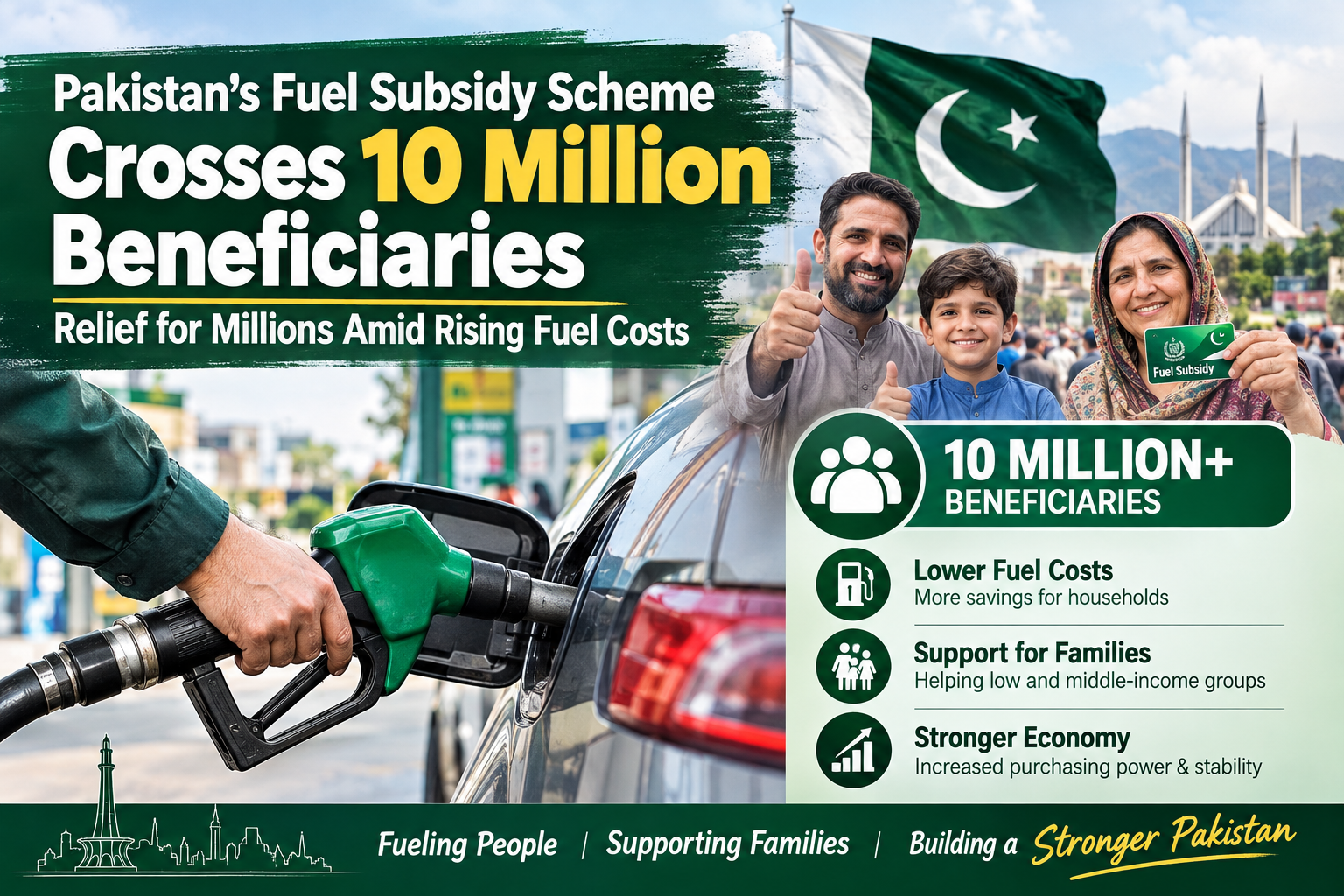
Pakistan’s fuel subsidy scheme has reached a significant milestone, with the government reporting that more than 10 million people have benefited directly from the programme. Announced as a measure to help citizens manage rising petrol expenses, the initiative aims to provide targeted financial relief to motorcyclists, rickshaw operators and owners of eligible small cars.
The programme has attracted national attention because fuel prices affect almost every part of Pakistan’s economy. From daily commuting and small businesses to the transportation of food and essential goods, petrol and diesel costs influence household budgets and the prices consumers pay for everyday necessities.
Prime Minister Shehbaz Sharif has praised the federal and provincial governments and the departments involved in implementing the scheme. The government has allocated Rs75 billion for the initiative and says it intends to continue providing assistance to eligible citizens.
The programme also highlights the growing role of digital systems in delivering public services. Registration, token issuance and verification procedures are designed to make the distribution of assistance more organised and transparent.
However, reaching millions of people is only one measure of success. The programme’s long-term effectiveness will also depend on whether the relief reaches the households that need it most, whether public funds are used efficiently and how the government balances financial assistance with its wider economic commitments.
1. Fuel Subsidy Scheme Crosses the 10 Million Beneficiary Milestone
The government’s fuel relief initiative has become an important part of Pakistan’s response to rising transportation expenses. According to reports published on October 10, 2026, the number of direct beneficiaries has crossed 10 million.
This figure represents a substantial number of citizens who have received assistance through the programme. For people who depend on motorcycles and rickshaws for commuting or earning a living, even a limited reduction in fuel expenses can help manage regular household costs.
The government has credited coordination between federal and provincial authorities, relevant ministries and supporting institutions for the programme’s implementation. Prime Minister Shehbaz Sharif also acknowledged the work of officials involved in developing and operating the initiative.
Information Technology Minister Shaza Fatima Khawaja was specifically recognised for her role in the programme’s digital implementation. The prime minister announced that she would receive a national honour, while other officials and teams would also be recognised for their contributions.
Nevertheless, the reported beneficiary figure should be understood carefully. The number of people registered, the number of tokens issued and the number of tokens redeemed are different measurements. A person may receive more than one token, so token totals do not necessarily represent the number of unique individuals receiving support.
Accurate reporting of these figures is important for evaluating the scheme’s actual reach and its effect on people’s financial circumstances.
2. Why Pakistan Introduced the Fuel Relief Programme
Fuel expenses are a major concern for Pakistani households, particularly when petrol prices rise faster than incomes. Many citizens use motorcycles because they are comparatively affordable to purchase and operate. Rickshaws also provide transport services and employment opportunities in cities, towns and smaller communities.
For workers who travel every day, changes in petrol prices can affect the money available for food, education, electricity bills and other household necessities.
Small business owners face similar challenges. Delivery workers, shopkeepers, mobile technicians, sales representatives and other workers may need personal or commercial transport to perform their jobs. When fuel becomes more expensive, their operating costs increase.
The effects can extend beyond individual motorists. Transport companies and distributors may face higher expenses when moving goods between farms, factories, warehouses, markets and retail shops. Depending on market conditions, some of these additional costs may eventually be reflected in consumer prices.
The government introduced targeted fuel assistance to reduce part of this pressure for selected groups. Instead of applying an identical discount to every vehicle, the programme focuses on specified categories of motorists.
This approach allows the government to direct assistance towards particular groups while attempting to manage the overall cost of the initiative.
However, fuel assistance is not a complete solution to the cost-of-living problem. Food prices, housing expenses, electricity bills, education costs and employment opportunities also influence household financial security. Long-term improvement requires progress across several areas of the economy.
3. How Much Money Has the Government Allocated?
The government has allocated Rs75 billion for the fuel relief programme. This substantial allocation reflects the financial commitment involved in providing assistance to millions of people.
Public spending on subsidies requires careful planning because government funds are limited and must support multiple national priorities. These include healthcare, education, infrastructure, social protection, public administration and debt-related obligations.
For the fuel subsidy scheme, authorities need to monitor the number of eligible recipients, the value of benefits distributed and the amount of money spent over time.
Transparent financial reporting can help citizens understand how public resources are being used. It can also help policymakers determine whether the programme is delivering sufficient benefits relative to its cost.
A well-managed subsidy should have clear eligibility rules, reliable verification procedures and mechanisms for identifying errors or misuse. Regular reviews can help authorities adjust the programme when economic conditions change.
The Rs75 billion allocation should not automatically be interpreted as the amount already spent. An approved allocation represents the budget available or committed for the initiative, while actual expenditure depends on the assistance distributed and the programme’s implementation.
Publishing updated expenditure figures would allow the public to compare the budget with the number of people assisted and the amount of relief delivered.
4. Who Can Benefit from the Fuel Subsidy Scheme?
The programme is designed to provide relief to selected categories of motorists. Government announcements and published reports identify the following groups as its main beneficiaries.
Motorcyclists
Motorcycles are widely used in Pakistan for commuting, education, household errands and employment. They are particularly important for people who cannot afford a car or who need an economical way to travel through crowded urban areas.
Under the reported scheme, eligible motorcyclists can receive fuel assistance worth Rs500 per week, subject to the programme’s applicable limits and requirements.
For a worker who travels regularly, this support can reduce some of the pressure caused by petrol expenses. The benefit may be especially relevant to people whose earnings depend on travelling to different locations throughout the day.
Rickshaw and Qingqi Operators
Rickshaws and Qingqi vehicles provide transport services in many Pakistani cities and towns. Their operators often depend on daily earnings to cover fuel, maintenance and household expenses.
Higher petrol costs can reduce the amount of money left after operating expenses. Fuel assistance may help eligible operators maintain their services without passing every additional cost on to passengers.
The scheme’s reported weekly assistance for two- and three-wheelers can therefore provide some support to workers who rely on these vehicles for income.
Owners of Eligible Small Cars
The programme also includes owners of cars with engine capacities of up to 800cc, subject to eligibility rules.
Published reports describe a discount of Rs100 per litre on a limited quantity of petrol for eligible small-car owners. The applicable limits determine how much assistance an individual can receive over a specified period.
This category extends the programme beyond motorcycles and rickshaws, although it does not cover every vehicle owner.
Eligibility can depend on the programme’s current rules and verification process. Citizens should consult official government announcements for the latest requirements rather than relying solely on social media posts or unofficial messages.
5. Understanding the Digital Token System
One of the programme’s important features is its use of digital tools to administer fuel assistance.
Digital systems can help governments manage large programmes by recording registrations, checking information and issuing tokens. They may also reduce the need for extensive paper-based procedures.
Under the reported arrangement, eligible users receive digital tokens that can be verified at participating petrol stations. The token system is intended to connect the beneficiary’s eligibility with the fuel discount being provided.
This structure can make it easier for authorities to monitor how many tokens are issued and redeemed. It may also help identify unusual transactions or administrative problems that require investigation.
However, a digital system is effective only when citizens can use it reliably. People may face difficulties because of incorrect registration information, mobile network problems, unfamiliarity with digital procedures or errors in vehicle records.
A successful programme should therefore combine digital administration with accessible public guidance and responsive complaint-handling services.
Clear instructions in Urdu and regional languages could help people understand the process. Assistance centres or reliable helplines may also be useful for citizens who struggle with registration or token verification.
Protecting personal information is equally important. Any digital public service that processes identity or vehicle information should use appropriate safeguards and restrict access to authorised personnel.
6. How the Scheme May Help Household Budgets
The direct benefit of a fuel subsidy is a reduction in the amount an eligible recipient must pay for a specified quantity of petrol.
For households with limited incomes, this saving can help preserve money for other necessities. A motorcyclist may use the money saved on fuel for groceries, school expenses, medicines, utility bills or other essential purchases.
The impact can be especially meaningful when a household has several regular transportation needs. Parents may travel to work, students may commute to educational institutions and other family members may use a vehicle for shopping or employment.
For small transport operators, the assistance may help cover a portion of their operating expenses. If fuel costs consume a large share of daily earnings, even a limited discount can provide some financial breathing room.
Nevertheless, the size of the benefit matters. A subsidy with a strict quantity limit cannot protect a household from every increase in fuel prices. People who travel long distances or use vehicles intensively may still face substantial expenses.
Similarly, a household that does not own an eligible vehicle may receive no direct benefit from the programme, even if higher transport costs affect the prices it pays for food and other goods.
For these reasons, the fuel subsidy should be assessed as one part of a broader social protection strategy rather than as a complete answer to rising living costs.
7. The Importance of Fair and Transparent Distribution
A public assistance programme must do more than reach a large number of people. It should also distribute benefits fairly and follow clearly communicated rules.
Transparency begins with accurate information about eligibility. Citizens should know which vehicles qualify, what assistance is available, how frequently tokens can be used and which documents or details are required.
Authorities should also explain how they handle duplicate registrations, inaccurate records and disputed applications. These procedures can help reduce confusion and strengthen public confidence.
Independent monitoring and periodic audits can provide additional assurance that funds are reaching eligible recipients. Publishing meaningful performance data would also help researchers, journalists and citizens assess the programme.
Useful indicators include the number of unique beneficiaries, total expenditure, average assistance received, geographical distribution and the percentage of applications successfully processed.
It is also important to distinguish between people who register and people who actually receive the benefit. Registration indicates that someone has entered the system; a redeemed token provides stronger evidence that the person has used the assistance.
The government’s reported figures suggest substantial participation, but a full evaluation requires consistent definitions and updated records.
8. Challenges Facing the Fuel Subsidy Programme
Despite its reported reach, the scheme faces several challenges that could affect its effectiveness.
Limited Coverage
The programme targets specific vehicle categories. People who rely on public transport, bicycles or walking may not receive direct fuel assistance, even though rising fuel costs can indirectly affect their expenses.
Workers who use diesel-powered vehicles or cars outside the eligible engine-capacity limit may also fall outside the programme.
This creates an important policy question: how can assistance reach households experiencing financial pressure but lacking an eligible vehicle?
Other forms of targeted support may be needed to address the needs of these groups.
Rising Programme Costs
A subsidy covering millions of people can become expensive, particularly when fuel prices remain high for an extended period.
The government must balance immediate relief with other spending priorities and its overall fiscal position. If the programme continues for longer than expected, policymakers may need to reassess its cost and design.
A clear budget framework and regular public reporting can help make these decisions more transparent.
Administrative Difficulties
Large-scale digital programmes can experience registration errors, delays, technical interruptions and disputes over eligibility.
Such problems can prevent eligible citizens from receiving assistance when they need it. Authorities need an effective process for correcting errors and resolving complaints.
Changing Economic Conditions
Fuel prices are affected by international oil markets, currency movements, taxes, transportation costs and government policy. These factors can change quickly.
A subsidy designed for one set of conditions may become less effective or more expensive when circumstances change. Regular reviews are therefore important.
9. The IMF and Pakistan’s Wider Economic Commitments
Pakistan is managing its fuel relief initiative alongside broader economic commitments, including its programme with the International Monetary Fund.
Recent reporting has highlighted concerns about the cost and targeting of fuel subsidies. The IMF has called for fuel support to be phased out promptly, arguing that it should be limited, time-bound and carefully targeted within the government’s budget framework.
This creates a policy challenge for Pakistan. The government wants to provide relief to citizens facing higher transportation expenses, but it must also manage public finances and meet its wider economic commitments.
Both objectives matter. Abruptly withdrawing assistance could place additional pressure on eligible households, while maintaining an expensive programme indefinitely could create budgetary difficulties.
A balanced approach would involve reviewing the scheme’s performance, improving eligibility checks and establishing transparent criteria for its continuation or adjustment.
The government could also assess whether existing social protection systems are better placed to help the most financially vulnerable households during future price shocks.
Any changes should be communicated clearly and in advance wherever possible, allowing citizens and businesses to plan for adjustments.
10. Why Fuel Prices Matter Beyond Transportation
Fuel costs affect more than the price displayed at petrol stations. They can influence the wider economy through transportation, production and distribution.
Farmers may face higher expenses when operating machinery or transporting agricultural products. Manufacturers may pay more to move raw materials and finished goods. Retailers may experience higher delivery costs, while service providers may spend more on travelling to customers.
These pressures can affect businesses differently depending on their location, size and operating model.
For consumers, the consequences may appear through changes in food prices, delivery charges and the cost of various services. However, fuel is only one factor influencing these prices. Weather, supply conditions, exchange rates, taxes and market competition also play important roles.
A targeted fuel subsidy can reduce some direct costs for eligible users, but it cannot automatically prevent every increase in the prices of goods and services.
Long-term resilience requires broader improvements, including efficient public transport, reliable energy supplies, productive employment and better transportation infrastructure.
11. What the Government Should Focus on Next
Crossing the 10 million beneficiary milestone provides an opportunity to examine what has worked and what still needs improvement.
First, the government should publish regular updates that clearly distinguish registrations, unique beneficiaries, tokens issued, tokens redeemed and actual expenditure. This would make the programme easier to evaluate.
Second, authorities should continue improving the registration and verification process. Eligible citizens should be able to understand the rules and resolve errors without unnecessary delays.
Third, the government should examine whether assistance is reaching the households most affected by higher fuel costs. The number of recipients is important, but the distribution of benefits is equally significant.
Fourth, the programme should have a clear financial review process. Policymakers need to understand the cost of extending the subsidy and how that spending compares with other available forms of assistance.
Finally, public communication should remain consistent. Citizens need reliable information about eligibility, token limits, deadlines and any changes to the scheme.
These steps would help make the initiative more accountable and support better decisions about future fuel relief.
12. The Role of Digital Government Services in Pakistan
The fuel subsidy scheme also demonstrates how digital systems can support the delivery of public assistance.
When properly designed, digital platforms can make it easier to register applicants, verify records and monitor transactions. They may help reduce paperwork and provide policymakers with more timely information about programme performance.
However, digital access is not equal for everyone. Some citizens have limited internet access, use basic mobile phones or are unfamiliar with electronic registration systems.
A public programme should therefore avoid assuming that every applicant has the same level of digital access or technical knowledge.
Simple instructions, accessible support and reliable alternatives for resolving problems can help prevent technology from becoming a barrier.
Data security must remain a priority. Public institutions should explain how personal information is handled and ensure that only authorised personnel can access it for legitimate purposes.
The wider lesson is that technology can improve public service delivery, but it must be supported by clear rules, effective administration and accountability.
13. What Citizens Should Understand About the Scheme
Citizens should remember that the fuel subsidy is a targeted programme, not a universal discount available to every vehicle owner.
Eligibility rules and benefit limits determine who can receive assistance and how much support is available. The government may update procedures as implementation progresses, so current official announcements are important.
People should also distinguish between registration and successful receipt of a benefit. Completing a registration process does not necessarily mean that a subsidy token has been issued or redeemed.
Applicants should protect their personal information and be cautious about unofficial messages that promise guaranteed approval or request unnecessary sensitive details.
If a registration or token problem occurs, the safest approach is to use the programme’s officially announced support channels and follow the published instructions.
Understanding these details can reduce confusion and help eligible citizens make informed decisions.
Conclusion
Pakistan’s fuel subsidy scheme crossing 10 million direct beneficiaries is a significant development in the government’s effort to provide targeted relief amid rising fuel expenses. With a reported allocation of Rs75 billion, the programme is intended to support eligible motorcyclists, rickshaw operators and owners of qualifying small cars.
The initiative demonstrates how financial assistance and digital administration can be combined to deliver support at a large scale. For eligible citizens, the savings may help manage commuting costs and preserve part of their household budgets.
However, the programme’s success cannot be measured by beneficiary numbers alone. Fair distribution, accurate records, clear eligibility rules, responsible spending and effective complaint handling are all essential.
The government must also consider the people who do not qualify for direct assistance but remain affected by higher transportation and living costs. At the same time, it needs to balance immediate public relief with Pakistan’s wider economic and fiscal commitments.
Ultimately, the fuel subsidy scheme can provide useful short-term support, but sustainable economic improvement requires broader measures that strengthen household incomes, improve transportation systems and support stable economic growth. Continued transparency and careful evaluation will be crucial in determining how effectively the programme serves Pakistan’s citizens.
FAQs
1. How many people have benefited from Pakistan’s fuel subsidy scheme?
Government reports published on October 10, 2026, said that more than 10 million people had benefited directly from the programme.
2. How much money has the government allocated for the scheme?
The government has announced an allocation of Rs75 billion for the fuel relief programme.
3. Who is eligible for the fuel subsidy?
The reported programme covers eligible motorcyclists, rickshaw and Qingqi operators, and owners of cars with engine capacities of up to 800cc, subject to the applicable rules.
4. How does the digital token system work?
Eligible users receive digital fuel subsidy tokens that can be verified at participating petrol stations before the applicable discount is provided.
5. Will the fuel subsidy scheme continue?
The government has stated that it intends to continue the programme. Its future duration and arrangements may depend on official decisions, programme costs and Pakistan’s wider economic commitments.
Bulnext ke liye recommended category