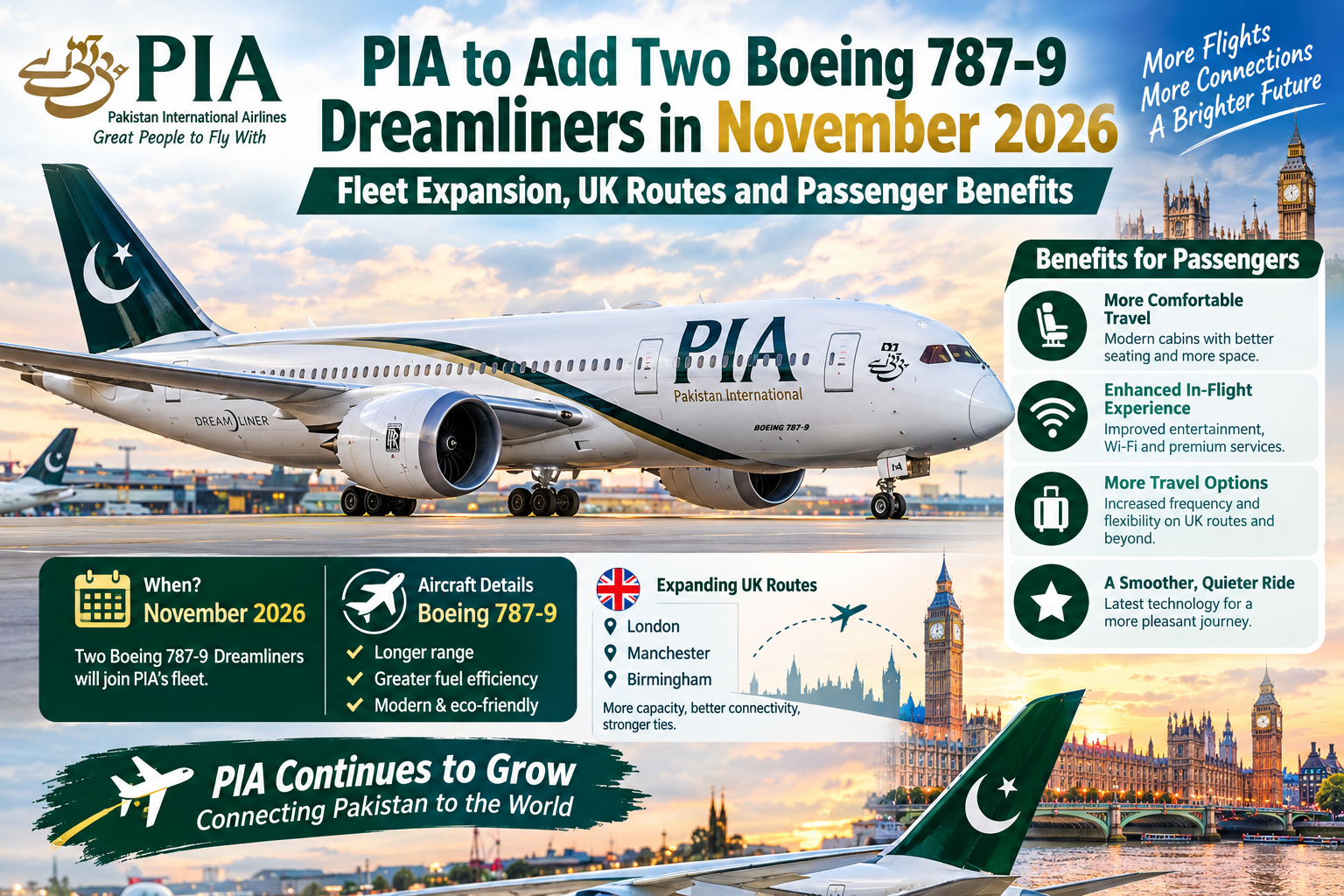
Pakistan International Airlines (PIA) is preparing to introduce two Boeing 787-9 Dreamliner aircraft into its operations under a new agreement with Norwegian airline Norse Atlantic Airways. Announced on October 9 and reported on October 10, 2026, the agreement represents an important development in PIA's efforts to expand its international flight capacity and improve connectivity between Pakistan and the United Kingdom.
The two aircraft are expected to join PIA's operations in November 2026. Under the agreement, Norse Atlantic will provide the aircraft, crew, maintenance, and insurance through an arrangement known as an ACMI lease. This model allows an airline to use aircraft and operational services supplied by another carrier rather than purchasing and operating the aircraft independently.
The agreement comes as PIA seeks to strengthen its international network, respond to passenger demand, and modernize its services. The United Kingdom is an important market for the airline because of travel demand between the two countries, including journeys made by Pakistani families, business travellers, students, and overseas Pakistanis.
The Boeing 787-9 Dreamliner is a modern, long-haul aircraft designed for international journeys. Its introduction into PIA's operations could provide additional capacity on selected routes and offer the airline greater flexibility while it works on its broader fleet-development plans.
However, the agreement should be understood as a leased-aircraft arrangement rather than a direct purchase of two new aircraft by PIA. Its long-term benefits will depend on operating costs, route demand, scheduling, passenger experience, and the airline's ability to maintain reliable services.
What Is the Latest News About PIA's Boeing 787 Dreamliners?
The latest development is an agreement between Pakistan International Airlines and Norse Atlantic Airways for the use of two Boeing 787-9 Dreamliners.
According to reports published on October 10, 2026, the aircraft are expected to begin supporting PIA operations in November. The arrangement is intended to strengthen long-haul connectivity between Pakistan and the United Kingdom.
PIA Chief Executive Officer Amir Hayat described the UK as an important market for the airline. Additional aircraft capacity could help PIA respond to demand and offer travellers more options on routes connecting the two countries.
Norse Atlantic CEO Eivind Roald also described the agreement as an opportunity to expand the airline's aircraft-leasing activities and establish a strategic relationship with PIA.
The arrangement is significant for both companies, although their objectives differ. PIA needs additional capacity for international operations, while Norse Atlantic is seeking opportunities to deploy its aircraft and crews through leasing agreements with other airlines.
For PIA, the immediate objective is to make more capacity available without waiting for a long-term aircraft purchasing and delivery programme to provide all the aircraft it needs.
For Norse Atlantic, providing aircraft and operational services to another airline creates an alternative to operating every aircraft exclusively on its own scheduled passenger routes.
The agreement therefore reflects a practical approach to airline fleet management, in which one carrier can supply aircraft and services while another uses that capacity to support its route network.
What Is Pakistan International Airlines?
Pakistan International Airlines, commonly known as PIA, is Pakistan's national flag carrier and one of the country's best-known aviation brands.
Established in its modern form in 1955 following the merger of Orient Airways with the national airline operation, PIA developed an extensive network of domestic and international destinations.
Over the decades, the airline has connected Pakistani cities with destinations in the Middle East, Europe, Asia, and other regions. Its international operations have been particularly important for passengers travelling for employment, education, family visits, religious journeys, and business.
PIA has also played a role in connecting overseas Pakistani communities with their families at home. Routes between Pakistan and the United Kingdom have particular importance because of the longstanding social, educational, and economic links between the two countries.
Like many airlines, PIA has faced financial pressures, operational challenges, fleet-management difficulties, and competition from other carriers. These issues have made improving reliability, service quality, and financial performance important priorities.
Fleet modernization is one part of that process. Airlines need suitable aircraft for different routes, and long-haul services require aircraft capable of carrying passengers across substantial distances with appropriate operational and maintenance support.
The Boeing 787-9 arrangement is therefore relevant to PIA's wider efforts to increase international capacity while managing the practical demands of running an airline.
What Is the Boeing 787-9 Dreamliner?
The Boeing 787-9 Dreamliner is a wide-body commercial passenger aircraft developed by American aircraft manufacturer Boeing.
It belongs to the Boeing 787 family, which was designed for long-distance airline operations. The aircraft family uses modern aerodynamic features, advanced systems, and lightweight composite materials to support operational efficiency.
The 787-9 is a longer version of the original Boeing 787-8. Its design provides additional passenger and cargo capacity, making it suitable for airlines that operate international routes with substantial travel demand.
The aircraft can be configured differently depending on the airline's seating plan, cabin layout, and service requirements. Consequently, the number of passengers it can carry varies between operators.
The Dreamliner family is designed to serve long-haul routes without requiring the same type of large aircraft used for some of the world's highest-capacity routes.
For PIA, the 787-9 could be useful on routes where additional capacity and long-distance performance are important. The suitability of an aircraft for a particular route depends on factors such as passenger demand, available airport facilities, operating costs, and the airline's schedule.
The introduction of this aircraft type into Pakistani airline operations would also be noteworthy from an aviation-industry perspective.
However, the benefits for passengers will depend on the actual cabin configuration, onboard facilities, service standards, and operational performance of the aircraft used by PIA.
A modern aircraft does not automatically guarantee that every aspect of a journey will improve. Airlines must also maintain punctuality, baggage handling, customer support, and consistent service delivery.
Why Is PIA Leasing Two Boeing Dreamliners?
Airlines have several ways to increase their available aircraft capacity. They can purchase aircraft, lease them without crews, or enter into arrangements under which another airline supplies both the aircraft and operational services.
The agreement between PIA and Norse Atlantic uses the third approach.
This arrangement can be useful when an airline needs additional aircraft for a particular period or wants to expand its network before making longer-term fleet decisions.
Buying a new aircraft can involve substantial financial commitments, financing arrangements, delivery schedules, training requirements, and maintenance planning. A leased-aircraft agreement can provide a more immediate route to additional operating capacity, depending on the availability of suitable aircraft and the regulatory approvals required.
For PIA, the agreement offers an opportunity to add capacity to its international operations while its wider fleet-modernization plans continue.
The arrangement may also help the airline respond to seasonal changes in demand. Travel between Pakistan and the UK can vary according to school holidays, family visits, business activity, and other factors.
Nevertheless, leasing aircraft also involves costs. The airline must assess the commercial terms of the agreement, expected passenger revenue, route profitability, and the cost of operating the services.
A successful arrangement therefore depends on using the additional capacity efficiently rather than simply increasing the number of available aircraft.
Understanding the ACMI Lease Agreement
ACMI stands for Aircraft, Crew, Maintenance, and Insurance.
Under an ACMI agreement, the company supplying the aircraft generally also provides the crew, maintenance arrangements, and insurance specified in the contract. The receiving airline uses that capacity to operate flights within the terms of the agreement and applicable aviation regulations.
This model is sometimes described as a wet lease.
In a conventional dry lease, an airline typically leases the aircraft without receiving the complete package of crew and operational services from the aircraft owner. The airline using the aircraft must arrange the necessary operating resources itself.
The ACMI model differs because several important components are supplied together.
For PIA, the Norse Atlantic agreement means that the arrangement includes more than access to two aircraft. It also covers the associated crew, maintenance, and insurance elements described in the agreement.
This can reduce the need for PIA to arrange every part of the aircraft operation independently, although the airline must still coordinate schedules, routes, passenger services, regulatory requirements, and other responsibilities under the contract.
ACMI agreements are used in the international aviation industry when airlines need additional capacity or want flexibility in managing operations.
They can help airlines respond to aircraft shortages, temporary increases in demand, maintenance disruptions, or route-expansion plans.
However, these arrangements are not automatically less expensive than every alternative. The financial outcome depends on the contract's terms, fuel arrangements, airport charges, utilisation, and the revenue generated by the flights.
For PIA, the key question will be whether the additional capacity can support reliable services and commercially sustainable routes.
How the New Aircraft Could Improve Pakistan–UK Connectivity
One of the main purposes of the agreement is to support long-haul flights between Pakistan and the United Kingdom.
The UK is an important international market for PIA because many people travel between the two countries for family visits, education, work, business, and tourism.
Direct flights can make international journeys more convenient by reducing the need for connecting flights through another country. For travellers with children, older relatives, or substantial baggage, avoiding an additional connection can be particularly useful.
Additional aircraft capacity could also provide the airline with more flexibility in planning schedules and accommodating passengers.
The precise benefits will depend on which destinations receive the additional flights, how frequently services operate, and whether the airline can maintain reliable departure and arrival times.
The agreement does not, by itself, establish that every UK destination will receive a new direct service. Specific routes, frequencies, and schedules depend on PIA's operating plans and any necessary regulatory approvals.
Passengers should therefore check official booking information before making travel arrangements.
If the additional aircraft are deployed effectively, the agreement could help PIA serve existing routes more efficiently and potentially support future network development.
Improved connectivity can also benefit businesses that depend on regular travel between Pakistan and the UK.
Entrepreneurs, exporters, professionals, and organisations with operations in both countries may value convenient air links because they help people travel for meetings, events, and commercial activities.
For overseas Pakistanis, dependable air connections also make it easier to maintain personal and family relationships across borders.
What Could the Dreamliners Mean for Passenger Comfort?
The Boeing 787 family was designed with features intended to support long-distance passenger travel.
Depending on the cabin configuration, passengers may experience features such as larger windows, modern cabin lighting, and cabin-pressure and humidity systems designed to improve the onboard environment.
The actual passenger experience depends on the aircraft's configuration and the airline's service standards.
Seating arrangements, seat pitch, entertainment systems, food options, cabin cleanliness, and crew service can vary between airlines even when they operate the same aircraft model.
This distinction is important when evaluating the potential effect of PIA's new arrangement.
The introduction of the Dreamliners could provide an opportunity to offer passengers a modern long-haul aircraft experience. However, it would be premature to promise specific seating features, premium services, or identical cabin arrangements without confirmed details from PIA.
Passengers will ultimately judge the service through their actual travel experience.
Punctual departures, clear communication during disruptions, efficient baggage handling, comfortable seating, and helpful customer support all contribute to passenger satisfaction.
The aircraft itself is only one part of the complete journey.
For PIA, combining modern aircraft with consistent service standards will be important if the airline wants to improve passenger confidence and encourage repeat travel.
How the Agreement Could Support PIA's International Expansion
Adding two Dreamliners may provide PIA with more flexibility as it works to strengthen its international operations.
Airline expansion involves more than introducing new aircraft. It requires route planning, demand forecasting, scheduling, staffing, maintenance coordination, airport arrangements, and effective management of operating costs.
A route must generate sufficient demand to justify its costs over time. Even a modern and efficient aircraft may perform poorly commercially if it is assigned to a route without enough passengers or if operational costs are too high.
The ACMI agreement offers PIA an additional source of capacity without requiring the airline to purchase these two aircraft directly under this arrangement.
This can be useful when an airline needs to respond to demand while longer-term decisions about aircraft purchases, financing, and fleet composition continue.
The arrangement may also provide operational experience with the aircraft type, although the extent of any future fleet decisions will depend on PIA's broader strategy.
The airline has previously explored options for acquiring or financing additional aircraft as part of its fleet-modernization efforts. A separate leased-aircraft arrangement should not be confused with a confirmed order for permanent ownership.
A balanced fleet strategy may combine different aircraft types and leasing arrangements, depending on the needs of individual routes.
The objective is to ensure that the airline has appropriate capacity while maintaining control over costs and operational reliability.
Why the UK Market Matters to PIA
The United Kingdom has longstanding social and economic links with Pakistan.
Many British residents have family connections in Pakistan, while Pakistani students, professionals, entrepreneurs, and visitors travel between the two countries for different reasons.
This creates demand for air services throughout the year, although passenger numbers can vary by season and route.
Direct services can be particularly attractive to people who prefer not to transfer at an intermediate airport.
For PIA, serving this market involves competing with other airlines that offer different combinations of prices, departure times, connecting routes, and onboard services.
The presence of competition means that aircraft capacity alone will not determine success.
Passengers may compare total journey time, ticket prices, baggage allowances, schedule reliability, customer service, and the convenience of departure and arrival airports.
PIA will therefore need to consider the complete travel experience when deploying the two Dreamliners.
If the aircraft help the airline provide suitable schedules and sufficient capacity, they could contribute to strengthening its position in the Pakistan–UK market.
The arrangement could also be relevant to travellers who need more options during periods of high demand.
Nevertheless, its overall effect will become clearer only after the aircraft enter service and the airline's operating performance can be assessed.
What Does the Deal Mean for Norse Atlantic Airways?
The agreement is also important for Norse Atlantic Airways, a Norwegian airline known for operating long-haul Boeing 787 services.
The airline has been expanding its use of ACMI agreements as it seeks opportunities to deploy aircraft and crews for other carriers.
In an ACMI arrangement, an airline can provide aircraft capacity to a customer without relying exclusively on selling individual passenger tickets on its own scheduled services.
This creates a different commercial model in which the airline supplies operational resources under a contractual agreement.
For Norse Atlantic, the PIA arrangement offers an opportunity to use two Dreamliners in support of another airline's long-haul operations.
The deal also reflects broader changes in the aviation industry, where airlines sometimes adjust their business models in response to fuel costs, demand fluctuations, aircraft availability, and competitive pressures.
Norse Atlantic has been seeking additional ACMI opportunities as it adjusts its operations. The PIA agreement provides one such opportunity.
For both companies, the arrangement will need to work commercially and operationally to deliver its intended benefits.
PIA needs the capacity to support its routes, while Norse Atlantic needs to supply the agreed aircraft and services according to the contract.
The performance of the partnership will depend on effective coordination between the two airlines and compliance with applicable aviation requirements.
PIA's Fleet Modernisation Plans
The Dreamliner agreement forms part of a wider discussion about PIA's future fleet and international network.
Airlines periodically review their aircraft because fleet decisions influence costs, maintenance requirements, passenger capacity, route flexibility, and long-term investment.
Different aircraft types are suited to different operating conditions. Smaller aircraft can be appropriate for shorter routes or markets with lower demand, while wide-body aircraft are commonly used on long-haul routes that require greater passenger and cargo capacity.
A modern fleet can offer operational advantages, but managing several aircraft types may also introduce additional training, maintenance, and logistics requirements.
PIA must therefore consider how each aircraft fits into its wider operating strategy.
The company has been exploring aircraft acquisition and financing options as it seeks to modernize its operations. Government discussions have also addressed potential cooperation involving international aircraft manufacturers and financing institutions.
The two Boeing 787-9 Dreamliners supplied through Norse Atlantic should be viewed as a specific leasing arrangement within this wider process.
They do not, on their own, establish the final size or composition of PIA's future fleet.
Long-term fleet development will depend on financial resources, aircraft availability, regulatory approvals, operational needs, and management decisions.
A carefully planned modernization programme could help the airline match aircraft capacity to passenger demand while improving the consistency of its services.
Challenges PIA Must Address
Although the agreement creates an opportunity for expansion, several challenges will determine whether the new aircraft deliver lasting benefits.
Operating Costs
Long-haul flights involve substantial costs, including fuel, airport charges, handling, crew arrangements, and other contractual expenses.
PIA will need to ensure that the revenue generated by the additional capacity justifies the cost of the services.
Passenger Demand
Aircraft capacity must match demand on individual routes. Too little capacity can limit ticket availability, while too much capacity can make flights difficult to operate profitably.
Accurate demand forecasting will therefore be important.
Operational Reliability
Passengers expect flights to operate according to published schedules. Aircraft availability, maintenance coordination, airport operations, and crew planning all influence reliability.
PIA and Norse Atlantic will need to coordinate their responsibilities effectively under the agreement.
Customer Service
Modern aircraft cannot compensate for poor communication or inconsistent service. Passengers also evaluate booking systems, baggage handling, assistance during delays, and the overall travel experience.
Competition
PIA competes with other airlines serving international markets. Its long-term success will depend on offering a combination of convenient schedules, appropriate fares, reliable operations, and satisfactory service.
Addressing these challenges will be essential if the leased Dreamliners are to contribute meaningfully to the airline's performance.
What Should Passengers Expect Next?
The next major step is the planned entry of the two aircraft into PIA's operations in November 2026.
Passengers will need to watch for official announcements about schedules, route deployment, booking availability, and the commencement of services.
The agreement identifies Pakistan–UK long-haul operations as its intended focus, but the precise timetable and destination arrangements should be confirmed through PIA's official travel information.
Travellers with existing bookings should not assume that their flights will automatically change or that a new aircraft will operate a particular departure.
Aircraft assignments can change because of operational requirements, and airlines publish the applicable details through their booking and flight-information systems.
Passengers should check their booking confirmations and official updates before travelling.
The introduction of the aircraft will also provide an opportunity to assess how effectively the arrangement works in practice.
Important indicators will include whether the aircraft enter service on schedule, whether the intended routes receive additional capacity, and whether passengers experience reliable and convenient journeys.
These results will provide a clearer picture of the agreement's practical value than the announcement alone.
Conclusion: A New Opportunity for PIA's International Operations
Pakistan International Airlines' agreement with Norse Atlantic Airways for two Boeing 787-9 Dreamliners represents a significant development in the airline's efforts to strengthen its international operations.
The aircraft are expected to enter service in November 2026, with the arrangement intended to support long-haul connectivity between Pakistan and the United Kingdom.
Through the ACMI model, PIA will receive the aircraft along with crew, maintenance, and insurance services specified under the agreement. This offers the airline a way to add capacity without purchasing the two aircraft directly under this particular arrangement.
The Dreamliners could provide additional flexibility, support passenger demand, and contribute to PIA's broader fleet-modernization efforts.
However, the agreement's long-term value will depend on the commercial terms, operating costs, route demand, service quality, and reliability of the flights.
For passengers, the most important outcome will be whether the new capacity leads to convenient schedules, dependable operations, and a better overall travel experience.
For Pakistan's aviation industry, the arrangement highlights the role that international partnerships and flexible leasing models can play in meeting airlines' operational needs.
The planned introduction of the two Dreamliners will be an important development to follow as PIA continues working to strengthen its international network and improve its position in the competitive airline industry.
FAQs
1. When will PIA receive the two Boeing 787 Dreamliners?
The two Boeing 787-9 Dreamliners are expected to join PIA's operations in November 2026, according to reports published on October 10, 2026.
2. Which airline is providing the Dreamliners to PIA?
Norwegian airline Norse Atlantic Airways will provide the two aircraft under an ACMI lease agreement.
3. What does ACMI mean in aviation?
ACMI stands for Aircraft, Crew, Maintenance, and Insurance. Under this arrangement, an airline receives an aircraft along with specified crew, maintenance, and insurance services from the supplying company.
4. Which routes will the new PIA Dreamliners serve?
The agreement is intended to support long-haul flights between Pakistan and the United Kingdom. Specific routes and schedules should be confirmed through official PIA announcements.
5. Is PIA purchasing the two Boeing 787 Dreamliners?
The reported agreement is a lease arrangement rather than a direct purchase of these two aircraft. Norse Atlantic is providing the aircraft and associated services under the ACMI agreement.