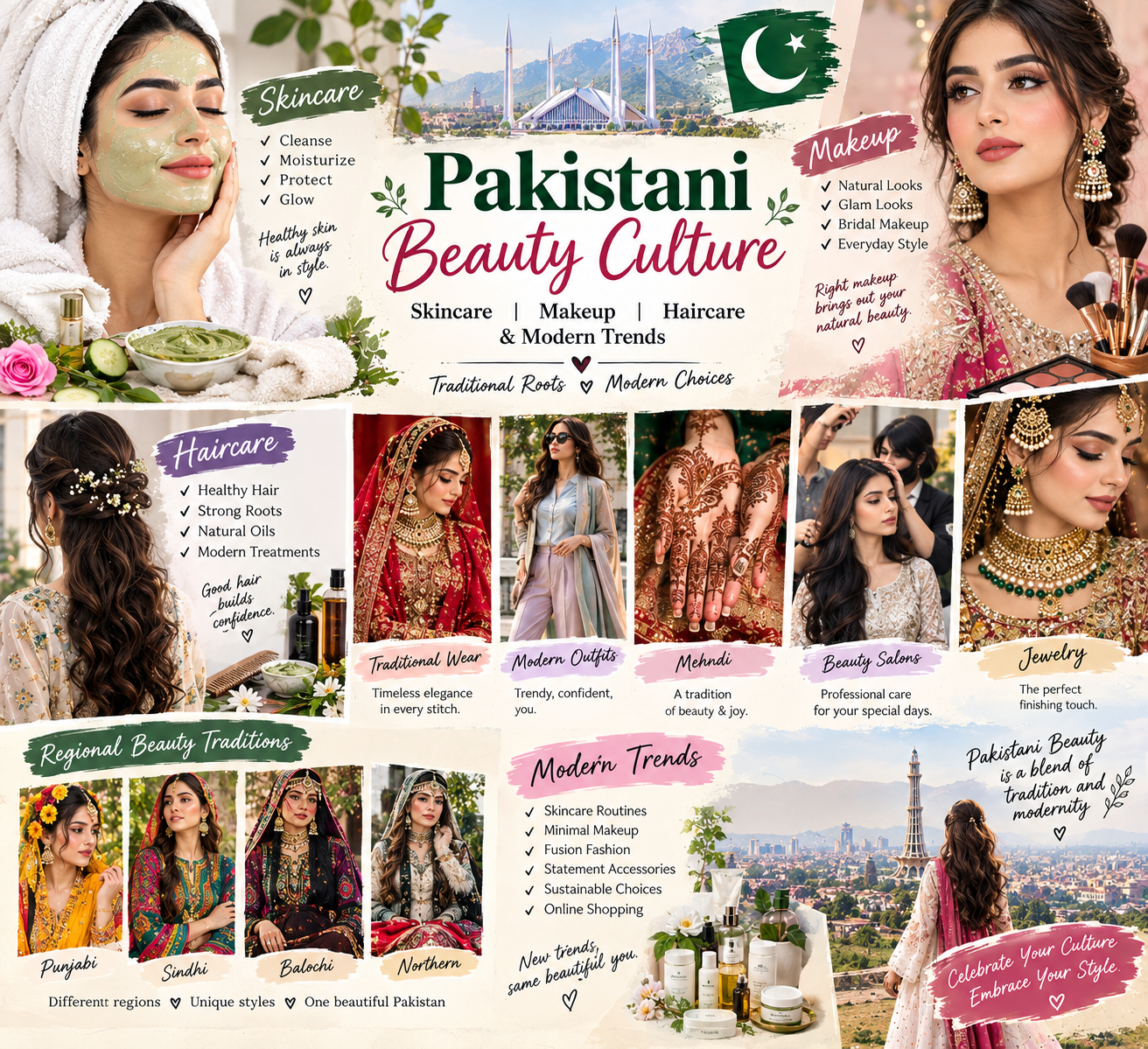
Pakistan has a rich and diverse beauty culture influenced by traditional customs, regional traditions, family celebrations, fashion, and modern lifestyle trends. Beauty in Pakistan is not limited to makeup or clothing. It includes skincare, haircare, personal grooming, traditional beauty practices, jewelry, fragrances, and the way people present themselves on special occasions.
Over time, Pakistani beauty culture has changed significantly. Traditional remedies and beauty practices continue to remain popular, while modern skincare products, professional salons, makeup techniques, and social media trends have introduced new ideas. Pakistani women and young people increasingly explore different styles while also maintaining connections with cultural traditions.
From weddings and Eid celebrations to everyday university and workplace routines, beauty and grooming have an important place in Pakistani society. Different regions of Pakistan also have their own traditions, fabrics, jewelry, hairstyles, and beauty practices, making Pakistani beauty culture highly diverse.
Traditional Beauty Culture in Pakistan
Traditional beauty practices have been part of Pakistani households for generations. Before modern beauty products became widely available, families often relied on commonly available ingredients and simple grooming techniques.
Natural ingredients such as rose water, oils, gram flour, and henna have traditionally been associated with beauty routines. These practices were often passed from mothers and grandmothers to younger generations.
Traditional beauty was generally connected with simplicity. Clean skin, neatly styled hair, traditional clothing, and modest jewelry could create an elegant appearance without requiring complicated makeup.
Even today, many traditional practices continue to appear in modern beauty routines. Some people combine traditional ingredients with commercially available skincare products, creating a routine that reflects both old and new approaches.
Skincare in Pakistani Beauty Culture
Skincare has become one of the most important parts of modern beauty culture in Pakistan. People are increasingly interested in understanding their skin and choosing products according to their individual needs.
A basic skincare routine may include cleansing, moisturizing, and sun protection. Some people also use products such as serums, face masks, or gentle exfoliating products.
Pakistan has different climates, from hot and humid coastal areas to dry regions and colder northern areas. Because of these differences, skincare preferences can vary from one region to another.
During hot weather, people often prefer lightweight skincare products. In colder months, moisturizing becomes more important because dry weather can affect the skin.
Awareness about sun protection has also increased. Sunscreen is increasingly considered part of everyday skincare rather than something used only during outdoor activities.
Natural Beauty Practices
Natural beauty practices remain popular in Pakistan. Ingredients such as rose water and henna have strong cultural associations with beauty and celebrations.
Henna, commonly known as mehndi, is especially important during weddings and festivals. Intricate mehndi designs are often used on hands and feet during celebrations.
Traditional face masks made with household ingredients are also part of Pakistani beauty culture. However, natural does not automatically mean suitable for everyone. Skin can react differently to different ingredients, so people should be careful when trying unfamiliar substances.
Modern beauty culture increasingly combines traditional practices with knowledge about skincare. Instead of following every traditional remedy blindly, many people now look for information about how products and ingredients actually affect the skin.
Makeup Trends in Pakistan
Makeup is a major part of Pakistani beauty culture, particularly during weddings, Eid, parties, and other celebrations.
Traditional Pakistani makeup often emphasizes the eyes. Eyeliner, kajal, mascara, and eyeshadow are commonly used to create defined eye looks.
Lip colors vary according to personal preference and occasion. Soft nude shades may be chosen for everyday looks, while stronger colors can be used for formal events.
Modern Pakistani makeup has become more diverse. Some people prefer light, natural-looking makeup, while others enjoy glamorous styles for weddings and special events.
Makeup trends are also influenced by international beauty trends. Techniques such as soft glam, natural brows, glowing makeup, and minimal makeup have become increasingly visible through social media.
Bridal Beauty in Pakistan
Bridal beauty is one of the most recognizable parts of Pakistani beauty culture. Pakistani weddings can include several events, and each event may have a different fashion and beauty style.
A bride may wear traditional jewelry, detailed embroidery, elaborate clothing, and carefully planned makeup. The beauty look is usually coordinated with the bridal outfit.
Mehndi ceremonies often feature colorful clothing, floral decorations, and traditional mehndi designs. The makeup for such events may be colorful and festive.
For the wedding ceremony, brides may choose heavily embroidered dresses with jewelry and a more formal makeup look.
The reception or walima often features a different style. Some brides prefer elegant dresses and comparatively softer makeup for the event.
Bridal beauty is not one fixed style. Pakistani brides increasingly choose different colors, silhouettes, hairstyles, and makeup looks according to their personality and preferences.
Haircare in Pakistan
Haircare is another important part of Pakistani beauty culture. Healthy-looking and well-groomed hair is valued across different age groups.
Traditional haircare has often included oils and simple hair treatments. Hair oiling remains common in many Pakistani households.
Modern haircare now includes shampoos, conditioners, hair masks, serums, leave-in products, and styling products.
Different hair types require different approaches. Straight, wavy, curly, and textured hair can all require different methods of care.
Professional salons have also expanded the range of hair services available in Pakistan. Haircuts, blow-drying, styling, coloring, and other services are increasingly common, particularly in larger cities.
Pakistani Hairstyles
Pakistani hairstyles range from simple everyday styles to elaborate formal hairstyles.
For everyday life, many people choose practical hairstyles that are easy to maintain. Braids, ponytails, buns, and simple open hairstyles remain popular.
For weddings and formal events, hairstyles may become more elaborate. Hair accessories, curls, buns, braids, and decorative elements can be combined with traditional clothing and jewelry.
The hairstyle often depends on the outfit. A heavily embroidered dress may be paired with a more structured hairstyle, while a simpler outfit may work well with a relaxed hairstyle.
The Importance of Mehndi
Mehndi is one of the most important traditional beauty practices in Pakistan.
It is particularly associated with weddings, Eid, and other celebrations. Mehndi designs can range from simple patterns to highly detailed traditional artwork.
Different regions have their own preferences for mehndi designs. Some people prefer traditional floral patterns, while others choose geometric, Arabic-inspired, or contemporary designs.
Modern mehndi artists have also introduced creative combinations of traditional and modern patterns.
Mehndi is more than decoration. It is connected with celebrations, family gatherings, weddings, and cultural identity.
Pakistani Beauty Salons
Beauty salons have become an important part of modern Pakistani beauty culture.
Salons provide services related to haircare, makeup, skincare, manicures, pedicures, waxing, hairstyling, and bridal preparation.
Large cities such as Lahore, Karachi, Islamabad, Rawalpindi, and Faisalabad have a wide variety of salons. Smaller cities and towns have also seen growth in local beauty businesses.
For many people, salons are particularly important before weddings and major celebrations. Bridal packages may include several services planned over a period of time.
The beauty industry has also created opportunities for women entrepreneurs. Many women operate home-based salons or provide makeup and beauty services independently.
Home-Based Beauty Businesses
Social media and digital platforms have made it easier for individuals to start beauty businesses from home.
A person with professional makeup, hairstyling, or skincare knowledge can promote services through social media pages and communicate with customers online.
Home-based makeup artists are especially popular during wedding seasons. Customers may choose independent artists based on their portfolio, location, availability, and style.
This development has created new opportunities for women who want to build businesses while working from home.
Beauty and Social Media
Social media has dramatically changed Pakistani beauty culture.
Platforms such as Instagram, TikTok, YouTube, and Facebook allow people to discover new makeup techniques, hairstyles, skincare routines, and fashion trends.
Pakistani beauty creators share tutorials and product reviews, while makeup artists showcase bridal and party looks.
Social media has also made international beauty trends easier to access. A beauty trend that begins in another country can quickly become popular among Pakistani audiences.
At the same time, social media encourages people to think more carefully about beauty information. Not every viral beauty tip is scientifically supported, so checking reliable information is important.
Beauty Influencers and Content Creators
Beauty influencers have become an important part of the Pakistani beauty industry.
They create tutorials, product reviews, skincare discussions, makeup transformations, and fashion content. Some influencers focus on affordable products, while others concentrate on professional makeup or luxury beauty.
Their content can help consumers learn how to use different products. It can also introduce audiences to local Pakistani beauty brands.
However, sponsored content can sometimes influence product recommendations. Consumers should therefore consider product ingredients, suitability, and independent information instead of relying only on online popularity.
Pakistani Beauty Brands
Pakistan has a growing beauty and personal-care industry. Local companies produce skincare, makeup, haircare, fragrances, and personal-care products.
The growth of local brands has given consumers more choices. Some Pakistani brands focus on traditional ingredients, while others develop products based on modern cosmetic trends.
Local brands also understand Pakistani climate and consumer preferences. This can help them develop products designed for local markets.
Online shopping has made these products easier to discover and purchase.
Fragrances in Pakistani Culture
Fragrance has a special place in Pakistani grooming culture.
Perfumes, attars, body sprays, and scented products are commonly used for personal grooming. Fragrance preferences can range from floral and fruity scents to woody, spicy, and traditional aromas.
Attar has a particularly long association with South Asian and Islamic cultural traditions.
People may choose different fragrances for everyday use, formal occasions, weddings, or religious gatherings.
The fragrance industry in Pakistan includes both local and international products, giving consumers a broad range of choices.
Jewelry and Beauty
Jewelry plays an important role in Pakistani beauty and fashion.
Traditional jewelry may include earrings, bangles, necklaces, rings, and other decorative pieces.
Gold jewelry is traditionally associated with weddings and major family celebrations. However, modern fashion jewelry has also become popular because it can offer a wide variety of designs at different price points.
Jewelry is often coordinated with clothing. For example, traditional embroidered dresses may be paired with statement earrings or bangles.
Minimal jewelry is also becoming popular for everyday fashion.
Beauty During Eid
Eid is one of the most important occasions for Pakistani beauty and fashion.
Before Eid, many people prepare clothing, accessories, hairstyles, and skincare routines. Women may visit salons for hair and beauty services, while others prefer to prepare at home.
Eid makeup can range from simple and natural to more festive looks.
Traditional clothing such as shalwar kameez remains popular, while modern cuts and fusion styles are also common.
Jewelry, footwear, handbags, and fragrances complete the overall appearance.
Regional Beauty Traditions
Pakistan's diverse regions have their own beauty and cultural traditions.
Punjabi Beauty Traditions
Punjab is known for colorful clothing, traditional jewelry, embroidered outfits, and festive celebrations. Beauty styles associated with Punjabi culture often feature vibrant colors and traditional accessories.
Sindhi Beauty Traditions
Sindhi culture has distinctive embroidery, mirror work, colorful clothing, and traditional jewelry. These elements contribute to a unique regional style.
Balochi Beauty Traditions
Balochi clothing is known for detailed embroidery and distinctive designs. Traditional outfits often represent cultural identity and craftsmanship.
Pashtun Beauty Traditions
Pashtun cultural clothing and jewelry have distinctive characteristics. Traditional dress, embroidery, and accessories remain important parts of cultural celebrations.
Northern Pakistani Traditions
Northern regions have diverse cultural traditions influenced by local communities and environments. Traditional clothing, jewelry, and handmade crafts contribute to the region's unique visual identity.
Beauty for University and Work
Beauty culture is not limited to weddings and festivals. Everyday grooming has become an important part of university and professional life.
Many students prefer simple skincare, light makeup, comfortable hairstyles, and practical clothing.
Working women may choose polished but practical looks suitable for professional environments.
The focus is often on neatness and personal comfort rather than elaborate styling.
This reflects a broader change in Pakistani beauty culture, where beauty routines are becoming more flexible and personalized.
Affordable Beauty Trends
Beauty does not always require expensive products.
Many Pakistani consumers look for affordable skincare, makeup, haircare, and grooming options.
Local brands, drugstore products, and simple routines can provide accessible choices.
Social media has also increased awareness of affordable alternatives. Consumers can compare products, read reviews, and learn techniques without spending large amounts of money.
A simple routine that suits an individual's needs can be more practical than using a large number of unnecessary products.
Clean and Minimal Beauty
Minimal beauty has become increasingly visible in Pakistan.
Instead of heavy makeup, some people now prefer a fresh and natural appearance. This can include light base makeup, simple eye makeup, natural-looking brows, lip balm or subtle lip color, and a healthy skincare routine.
The trend is particularly popular among young people and those who prefer quick everyday routines.
Minimal beauty does not mean there is one correct appearance. It simply represents another style option within the wider beauty culture.
Modern Beauty Technology
Technology is also changing the beauty industry in Pakistan.
Online consultations, digital shopping, product reviews, beauty tutorials, and appointment-booking systems make beauty services easier to access.
Some beauty businesses use social media messaging to communicate with customers and schedule appointments.
Digital tools have also helped small beauty businesses market their services beyond their immediate neighborhoods.
Online Beauty Shopping
Online shopping has changed how Pakistani consumers purchase beauty products.
Instead of visiting a physical store, customers can explore products, compare prices, read descriptions, and order from home.
Online platforms provide access to a large variety of skincare, makeup, haircare, fragrances, and accessories.
However, customers should be careful about counterfeit products and unreliable sellers. Buying from trusted retailers and checking product information can help reduce risks.
Beauty and Cultural Identity
Pakistani beauty culture reflects the country's cultural diversity.
Clothing, jewelry, hairstyles, mehndi, makeup, and fragrances all contribute to personal expression.
Many people combine traditional elements with modern fashion. A person may wear a traditional shalwar kameez with contemporary jewelry or combine a modern outfit with traditional mehndi.
This combination shows how Pakistani culture continues to evolve without completely abandoning traditional influences.
Changing Beauty Standards
Beauty standards in Pakistan have changed over time.
Earlier beauty discussions often focused heavily on particular appearances. Today, there is greater awareness that people have different features, styles, skin types, hair types, and personal preferences.
Modern beauty culture increasingly emphasizes grooming, confidence, personal expression, and individuality.
Social media has contributed to this change by exposing people to many different beauty styles.
It is important to remember that photographs and online beauty content may involve professional lighting, makeup, editing, or filters. Real-life appearance is naturally more diverse.
Sustainable Beauty Choices
Environmental awareness is gradually becoming part of the beauty industry.
Some consumers are interested in products with recyclable packaging, reusable beauty tools, and responsible purchasing.
Rather than buying large quantities of products that may not be used, consumers can focus on products that genuinely fit their routines.
Local products can also support Pakistani businesses and reduce the need to rely entirely on imported options.
Sustainable beauty is still developing in Pakistan, but consumer awareness is increasing.
Women Entrepreneurs in the Pakistani Beauty Industry
The beauty industry provides many opportunities for women entrepreneurs.
Women can work as makeup artists, hairstylists, salon owners, skincare business owners, beauty educators, influencers, or online retailers.
Some begin with small home-based services and gradually build larger businesses.
Social media marketing has made it possible for small businesses to display their work and reach customers without requiring a large physical store.
The industry therefore contributes not only to beauty culture but also to entrepreneurship and employment.
The Future of Pakistani Beauty Culture
The future of Pakistani beauty culture is likely to include both tradition and innovation.
Traditional practices such as mehndi, jewelry, cultural clothing, and family beauty rituals will continue to have an important role.
At the same time, modern skincare, professional makeup, digital shopping, beauty technology, and international trends will continue to influence consumers.
Local beauty brands may expand their product ranges, while independent makeup artists and beauty entrepreneurs may continue using digital platforms to grow their businesses.
Personalization will also become increasingly important. Instead of following one universal beauty trend, consumers can choose routines and styles that suit their individual preferences and lifestyles.
Conclusion
Pakistani beauty culture is a combination of tradition, personal grooming, regional identity, fashion, modern technology, and changing lifestyle preferences. From traditional mehndi and hair oiling to modern skincare routines and professional makeup, beauty practices in Pakistan continue to evolve.
Weddings, Eid, cultural celebrations, university life, workplaces, and everyday routines all influence beauty choices. Regional traditions add further diversity, while social media and online shopping continue to introduce new ideas.
The modern Pakistani beauty industry also creates opportunities for entrepreneurs, makeup artists, salon owners, content creators, and local beauty brands.
Ultimately, Pakistani beauty culture is not based on one single style. It is a broad and changing part of everyday life that combines cultural heritage with modern creativity and individual expression.
1. What is Pakistani beauty culture?
Pakistani beauty culture includes skincare, makeup, haircare, mehndi, jewelry, fragrances, personal grooming, and traditional beauty practices.
2. Is traditional beauty still popular in Pakistan?
Yes. Practices such as mehndi, traditional haircare, jewelry, and cultural grooming remain popular, especially during weddings and festivals.
3. What makeup styles are popular in Pakistan?
Both natural and glamorous makeup styles are popular. The choice usually depends on personal preference, occasion, outfit, and cultural setting.
4. Why is mehndi important in Pakistani beauty culture?
Mehndi is strongly connected with weddings, Eid, celebrations, and cultural traditions, making it an important form of traditional body decoration.
5. How has social media changed Pakistani beauty trends?
Social media has made beauty tutorials, product reviews, makeup techniques, hairstyles, and international trends more accessible to Pakistani audiences.




